
Electromagnetic Flow Meters: An Industrial Buyer's Guide
Electromagnetic Flow Meters: An Industrial Buyer's Guide
An electromagnetic flow meter — also written as magnetic flow meter, magnetic type flow meter, or MAG meter — is a volumetric flow instrument that measures the velocity of a conductive liquid moving through a closed pipe. The global electromagnetic flowmeter market was valued at approximately USD 15.96 billion in 2025, according to Market Research Future, which places the technology among the largest single flow-measurement segments serving water, wastewater, and industrial process duty.
For buyers working at the awareness and research stage, the useful question is rarely whether the category works. It is whether a specific configuration will hold its accuracy in a specific pipeline. This guide sets out how electromagnetic flow meters operate, which constraints actually decide a purchase, where the technology stops being the right answer, and how the SMF platform from Shengda Water Meter Co., Ltd. (SDWM) is built across its variants.
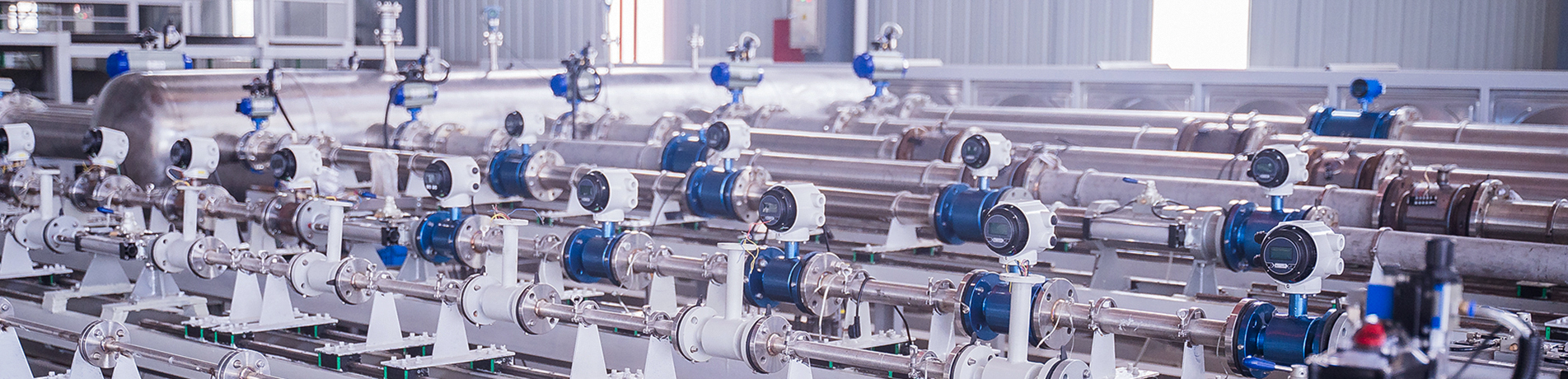
A magnetic flow meter test bench used for calibration and verification. Electromagnetic meters are verified against a reference before dispatch, because the measuring principle depends on stable electrode and coil performance rather than on any mechanical element.
What an Electromagnetic Flow Meter Measures — and Where the Physics Stops
An electromagnetic flow meter generates a magnetic field across a non-magnetic, electrically insulated measuring tube and reads the small voltage induced in the flowing liquid by two electrodes mounted in the tube wall. Because the induced voltage is proportional to flow velocity, the instrument produces a signal that is linear across its velocity range and contains no obstruction and no moving part in the flow stream.
The single most important screening specification is medium conductivity. The SMF MAG meter is suitable for measuring conductive liquids with a minimum conductivity of 5 μS/cm. Liquids below that threshold — including certain hydrocarbon products, gases, and some very low-conductivity water streams — sit outside the measurement principle itself rather than at the edge of it, and no liner or electrode selection changes that.
ISO 20456:2017 provides the international standard guidance for the use of electromagnetic flowmeters for conductive liquids in closed conduits. It is the reference document a buyer can use to frame acceptance criteria, factory verification, and installation requirements with a supplier in a common language.
Market Signals That Shape the Buying Decision
Category-level data matters to buyers because it shows where suppliers are investing, which installed bases are expanding, and which reporting obligations are creating new demand for measured flow data.
| Signal | Figure | Source |
|---|---|---|
| Global electromagnetic flowmeter market, 2025 | Approx. USD 15.96 billion | Market Research Future |
| Projected market value, 2035 | USD 28.20 billion at a CAGR of 5.85% | Market Research Future |
| Asia-Pacific revenue share, 2025 | Approx. 38–39% | Mordor Intelligence / Dataintelo |
| North America share of the global flow meter market, 2025 | Approx. 34–36% | Fortune Business Insights / Straits Research |
| Magnetic technology share of global flow meter revenue, 2024 | 27.2% | Grand View Research |
| Fastest-growing power segment, 2025–2030 | Battery-powered | Grand View Research |
| Fastest-growing pipe size segment, 2025–2030 | 2-inch | Grand View Research |
| Clamp-on share of the ultrasonic product segment by 2026 | 54% | Fact.MR |
| Water and wastewater share of ultrasonic applications | 59% | Fact.MR |
| Reported maintenance cost reduction from IoT-integrated meter systems | Up to 25% | SNS Insider |
Buyers should read these numbers as directional rather than as a procurement input, because published estimates of the same segment diverge substantially. Market Research Future sizes the electromagnetic segment near USD 15.96 billion for 2025, Dataintelo places it near USD 3.57 billion, and Grand View Research sizes the entire flow meter market at USD 10.64 billion in 2024. What the figures agree on is direction: measurement demand is rising, battery-powered instruments are the fastest-growing power class, and water and wastewater remain the dominant application area.
A regulatory signal reinforces that direction. The EU Urban Wastewater Treatment Directive 2024/3019 requires quarterly flow reporting, which increases the number of sites that need documented, verifiable flow data rather than periodic manual checks.
The Procurement Problem: Configuration Decides Performance, Not Brand
Most electromagnetic flow meter problems in the field are configuration problems, not instrument failures. A meter that meets its accuracy class on a calibration bench can still read incorrectly when the liner is incompatible with the medium, the electrode material corrodes, the protection class is too low for a flooded chamber, or the power supply and output protocol do not match the control system that has to read the signal.
- Medium conductivity and chemistry → liner and electrode material selection
- Buried, wash-down, or humid installation → IP65, IP67, or IP68 protection
- Availability of mains power → 24VDC, 220VAC, or battery powered
- Control architecture → 4-20mA, pulse, frequency, RS485, Modbus, or HART output
- Pipe diameter and site access → flanged, wafer, threaded, or insertion installation
- Hygiene requirements → sanitary connection and wetted-material choice
Framed this way, the buying decision becomes a short list of physical constraints rather than a comparison of claims. It also explains why, at the research stage, a supplier's breadth of configuration options is a more useful screening signal than any single headline specification.
How Shengda Water Meter Configures the Category
Shengda Water Meter Co., Ltd. (SDWM) is a Chinese manufacturer of flow meters and water meters, established in 1995, operating a 66,000 square meter manufacturing facility with approximately 100–200 staff, an R&D team of 12 engineers, and an annual production capacity of 3 million units. Products are exported to more than 140 countries, with export business accounting for 50% of total sales and major markets in the USA, South America, Africa, and Southeast Asia. The company is certified to ISO9001, ISO14001, and ISO45001, and its products carry CE, ISO4064, and MID certification. The company manufactures large-size flow meters with nominal diameters up to DN3000.
Its SMF family is the electromagnetic flow meter platform: an inline, full-bore magnetic flow meter for water supply, wastewater treatment, and industrial process service, and the base design from which the sanitary, stainless steel, battery-powered, and insertion variants are configured.
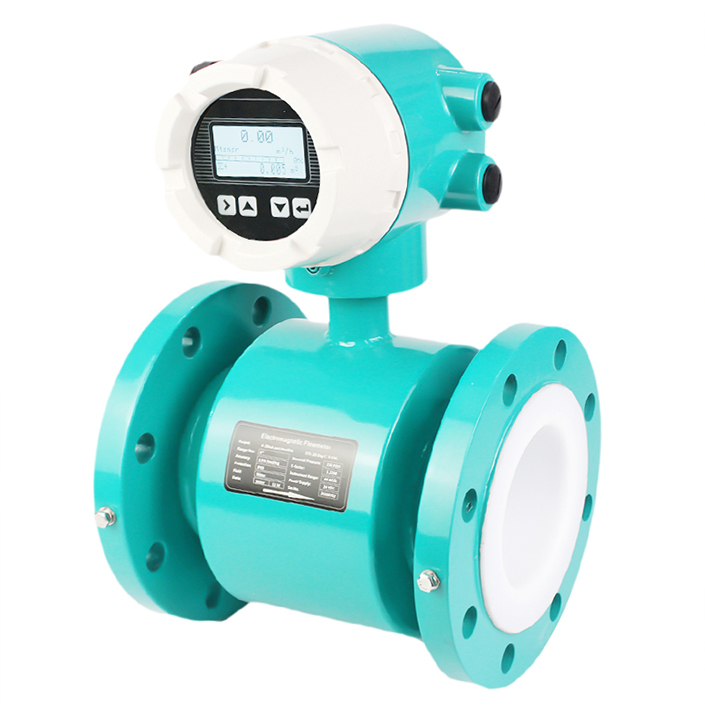
SMF electromagnetic flow meter configured for water metering. The platform is offered in integrated or remote structure, with replaceable-electrode and multiple liner options available.
| Parameter | SMF electromagnetic flow meter |
|---|---|
| Nominal diameter | DN10–DN3000 |
| Accuracy | ±0.5% / ±0.2% (optional) |
| Liner material | PTFE / Rubber / PFA / FEP (optional) |
| Electrode material | Stainless steel / Hastelloy C / Titanium / Tantalum (optional) |
| Electrode type | Standard / replaceable electrode (optional) |
| Flow velocity range | 0.1–15 m/s |
| Medium conductivity | ≥5 μS/cm |
| Working pressure | PN10 / PN16 / PN25 / PN40 (optional) |
| Working temperature | −20°C to +180°C (depending on liner) |
| Protection class | IP65 / IP67 / IP68 (optional) |
| Display | LCD digital display |
| Output signal | 4-20mA / pulse / frequency / RS485 / Modbus / HART (optional) |
| Power supply | 24VDC / 220VAC / battery powered (optional) |
| Installation | Flanged / wafer / threaded / insertion type (optional) |
| Structure | Integrated / remote type |
| Body material | Carbon steel / stainless steel (optional) |
| Certification | CE / ISO |
The variants matter because each one answers a different installation reality, and buyers comparing quotations often discover too late that two offers describe different instruments.
| Variant | Diameter range | Distinguishing configuration |
|---|---|---|
| Sanitary Electromagnetic Flow Meter (SMF) | DN10–DN300 | SS304 / SS316L body, PTFE or food-grade PFA liner options, tri-clamp / thread / flange connection, −20°C to +150°C |
| Stainless Steel Magnetic Flow Meter (SMF) | DN10–DN300 | SS304 / SS316L body for corrosive, hygienic, and demanding environments |
| Battery Power Magnetic Flow Meter (SMF) | DN10–DN2000 | Lithium battery with 5–10 year life depending on configuration, LoRaWAN / NB-IoT / RS485 / GPRS / 4G, IP68 optional, −20°C to +80°C |
| Plug-in Magnetic Flow Meter (SMF) | DN300–DN3000 | Insertion probe, hot-tap / non-stop installation option, remote structure, ±1.0% (±0.5% optional) |
| Electromagnetic flow meter for water meters (SMF) | DN10–DN3000 | Configured for municipal networks, district metering areas, water treatment plants, and irrigation systems |
Technical Explanation: Three Choices That Decide Accuracy
Once conductivity is confirmed, three selections determine whether an electromagnetic flow meter performs as specified: liner, electrode, and protection class.
Liner
The liner isolates the conductive liquid from the metal body and must tolerate the medium's chemistry and temperature. PTFE, rubber, PFA, and FEP are the standard options on the SMF platform, and the working temperature ceiling of the instrument depends on which is chosen, ranging from −20°C to +180°C across the family.
Electrode
The electrodes are the only wetted metal components and are selected against corrosivity rather than against conductivity. Stainless steel covers ordinary water and wastewater duty, while Hastelloy C, titanium, and tantalum extend service life in chemically aggressive streams. Replaceable-electrode versions allow the wetted parts to be serviced without replacing the whole meter body.
Protection class and structure
IP65, IP67, and IP68 options let the same platform be specified for dry indoor cabinets, wash-down areas, or permanent underground installation. The integrated or remote structure choice then decides whether the transmitter sits on the sensor or at a distance reachable for reading and configuration.
Two further technical points explain why the category is preferred in water and wastewater. First, industrial electromagnetic flowmeters typically use either alternating current (AC) or pulsed direct current (DC) circuits for the field coils, and a pulsed DC design helps stabilise the zero point in applications where the medium is noisy. Second, because the measuring tube is unobstructed, there is no pressure loss and no wear surface, which keeps maintenance demand low over a long service life.
Installation practice remains a real constraint. Manufacturers typically specify minimum straight-pipe runs upstream and downstream of the sensor so that the flow profile entering the tube is stable, and the meter body must be properly grounded to the pipeline. A well-configured meter installed in a disturbed flow profile can underperform a simpler instrument installed correctly.
Applications and Use Cases
The SMF platform is specified for water supply, wastewater treatment, chemical, pharmaceutical, food and beverage, irrigation, mining, power plant, HVAC, and oil and gas applications handling conductive fluids. In practice, buyers tend to select a variant by site condition rather than by industry label.
- Municipal water supply and district metering areas: full-bore SMF meters from DN10 to DN3000 in water treatment plants, pump stations, and distribution mains, with RS485, Modbus, 4-20mA, or pulse output feeding SCADA and PLC systems.
- Large transmission mains (DN300–DN3000): the Plug-in Magnetic Flow Meter installs through an insertion probe and offers a hot-tap option that avoids shutting the pipeline down, using less material than a full-bore meter of the same diameter.
- Remote and unmetered sites: the Battery Power Magnetic Flow Meter operates without an external supply, transmits over LoRaWAN, NB-IoT, RS485, GPRS, or 4G, and is offered up to DN2000 for remote water supply lines, irrigation systems, DMA points, and wastewater monitoring.
- Hygienic clean service: the Sanitary Electromagnetic Flow Meter is designed for cosmetics production, brewing, beverage filling lines, dairy processing, and pure water or RO water systems, using SS316L wetted parts and tri-clamp connections that can be cleaned and replaced quickly.
- Corrosive and wash-down environments: stainless steel bodies in SS304 or SS316L suit clean chemical fluids and humid or wash-down areas, with IP68 protection available.
- Industrial process water, HVAC, and cooling loops: full-bore electromagnetic measurement with low pressure loss and no moving parts, integrated into energy management and consumption reporting.
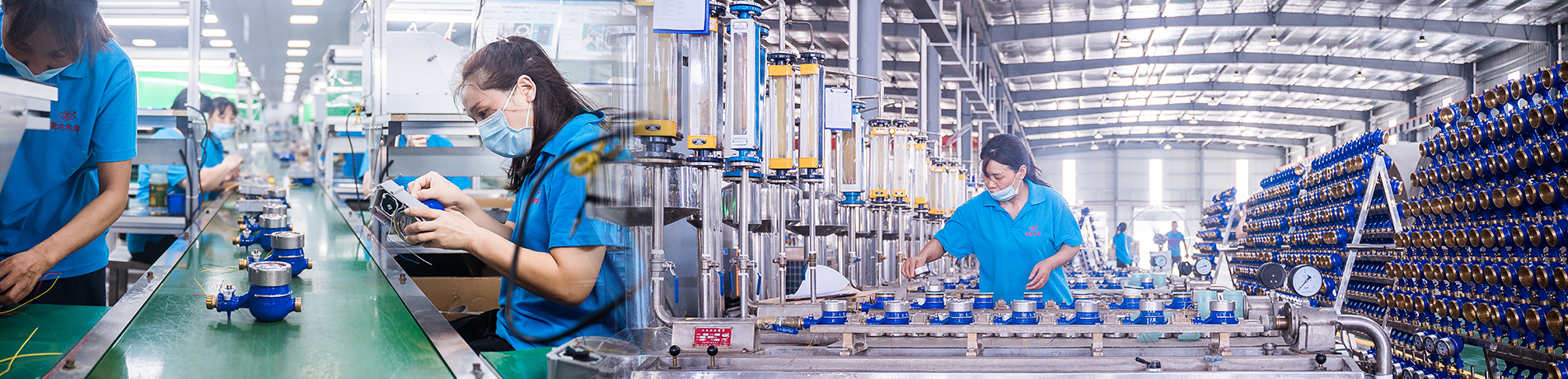
Flow meter production at the Shengda Water Meter facility. Configuration range — liner, electrode, protection, power, and output — is the practical limit on how closely a meter can be matched to a site.
Where Electromagnetic Flow Meters Are Not the Right Fit
Electromagnetic meters are the default choice for conductive water and process fluids, but they carry real boundaries that buyers should test before committing a specification.
| Consideration | Full-bore electromagnetic (SMF) | Clamp-on ultrasonic (TUF) | Mechanical / turbine types |
|---|---|---|---|
| Medium requirement | Conductive liquid, ≥5 μS/cm | Water, wastewater, and industrial liquids; not conductivity-dependent | Clean water; moving element in the flow stream |
| Pipe intervention | Inline installation requires cutting into the pipeline | Clamp-on sensors mount outside the pipe; no cutting, no shutdown | Inline installation requires cutting into the pipeline |
| Pressure loss | None (no obstruction in the tube) | None (sensors external to the pipe) | Present, and increases as parts wear |
| Typical accuracy | ±0.5% or ±0.2% optional | ±1.0% or ±0.5% optional | Quoted against a narrower operating window |
| Diameter range | DN10–DN3000 | DN15–DN6000 | Lower diameters only |
| Best fit | New builds and permanent high-accuracy measurement points | Retrofit, verification, audits, and existing pipelines | Simple, low-cost, non-critical metering |
The clearest limitation is physics, not cost: a liquid below the conductivity threshold cannot be measured by an electromagnetic meter at all. A second boundary is installation. Because full-bore electromagnetic meters sit inline, an existing pipeline must be cut and taken out of service, which is why a clamp-on ultrasonic flow meter is often the pragmatic choice for retrofits, temporary testing, or verification of an installed meter.
Within the electromagnetic category, the trade-offs are also explicit. The battery-powered variant is offered to DN2000 and works from −20°C to +80°C, which is narrower than the −20°C to +180°C range of the mains-powered full-bore version. The Plug-in Magnetic Flow Meter trades some accuracy — ±1.0% standard, ±0.5% optional, against ±0.5% or ±0.2% for the full-bore SMF — in exchange for a much lower installation cost on DN300 to DN3000 mains. Buyers with very low flow velocities, unstable flow profiles, or non-conductive fluids should expect to evaluate an alternative principle rather than push a configuration further.
A Procurement Checklist for Electromagnetic Flow Meters
- Confirm conductivity. Verify that the medium stays at or above 5 μS/cm across its full operating window, including start-up and cleaning cycles.
- Fix the diameter and velocity. Size the meter so normal flow falls inside the 0.1–15 m/s velocity range, with accuracy verified against the stated ±0.5% or ±0.2% class.
- Match liner to chemistry and temperature across the −20°C to +180°C family range, remembering that the ceiling depends on the liner selected.
- Match electrode material to corrosivity, and decide whether replaceable electrodes are worth specifying for serviceability.
- Confirm pressure rating against PN10, PN16, PN25, or PN40, and the flange standard used on site.
- Set the protection class — IP65, IP67, or IP68 — against burial, flooding, or wash-down risk.
- Decide power and communication: 24VDC, 220VAC, or battery, and 4-20mA, pulse, frequency, RS485, Modbus, or HART to match the control system.
- Choose the installation type and structure: flanged, wafer, threaded, or insertion; integrated or remote transmitter.
- Match the variant to the application: sanitary, stainless steel, battery-powered, or insertion, rather than forcing a standard model into an unsuitable site.
- Request the certification set — CE, ISO, and, where relevant to water metering, ISO4064 and MID — and confirm factory calibration documentation.
Future Outlook
Three trends are likely to shape electromagnetic flow meter procurement over the next several years.
First, power architecture is shifting. Battery-powered flow meters are projected as the fastest-growing power segment for 2025–2030, and the option to run a magnetic meter up to DN2000 for 5–10 years on a lithium battery removes the single biggest obstacle to metering remote water networks. Second, data integration is becoming a specification line item rather than an afterthought: IoT-integrated meter systems have been reported to reduce industrial maintenance costs by up to 25%, and reporting obligations such as the quarterly flow reporting under EU Directive 2024/3019 push utilities toward continuously logged, remotely readable data. Third, the 2-inch pipe size segment is expected to grow fastest between 2025 and 2030 on the back of HVAC and precision irrigation demand, while clamp-on ultrasonic instruments are expected to take 54% of the ultrasonic product segment by 2026 — meaning many sites will end up running electromagnetic and clamp-on ultrasonic meters side by side rather than choosing one principle for the whole network.
For buyers, the practical implication is that the meter is increasingly the entry point to a data system. Configuration decisions made at the specification stage — output protocol, power source, protection class — determine whether that system can be built later without replacing hardware.
Frequently Asked Questions
What is an electromagnetic flow meter used for?
An electromagnetic flow meter measures the volumetric flow of conductive liquids in closed pipes. Typical uses include municipal water supply networks, wastewater treatment plants, industrial process water, chemical and pharmaceutical production, food and beverage lines, irrigation systems, mining, power plants, HVAC and cooling water systems, and oil and gas applications handling conductive fluids. The SMF operates in continuous mode and reports instantaneous flow, total flow, and flow velocity.
What conductivity does a magnetic flow meter require?
The SMF MAG meter is suitable for measuring conductive liquids with a minimum conductivity of 5 μS/cm. This threshold follows from the measurement principle: the instrument reads the voltage induced in the liquid by a magnetic field, so a liquid that does not conduct electricity produces no usable signal. Non-conductive fluids such as hydrocarbons and gases require a different measurement technology.
How does an electromagnetic flow meter compare with a clamp-on ultrasonic flow meter?
A clamp-on ultrasonic flow meter such as the TUF mounts its transducers outside the pipe, requires no pipeline cutting, and creates no pressure loss, with a diameter range of DN15–DN6000 and accuracy of ±1.0% or ±0.5% optional. A full-bore electromagnetic meter such as the SMF sits inline, requires the pipeline to be cut for installation, and offers accuracy of ±0.5% or ±0.2% optional. Clamp-on ultrasonic instruments are commonly used for retrofit work, temporary testing, and verification of existing pipelines, while inline electromagnetic meters are used where permanent, higher-accuracy measurement is required.
When should a sanitary electromagnetic flow meter be specified?
A sanitary electromagnetic flow meter is specified where hygiene and cleanability govern the design, including dairy processing, food and beverage production, brewing, beverage filling lines, cosmetics production, pure water and RO water systems, and clean-fluid chemical processing. The SMF sanitary version uses SS304 or SS316L body construction, PTFE or food-grade PFA liner options, tri-clamp, thread, or flange connections, a working range of −20°C to +150°C, and is offered from DN10 to DN300 with no moving parts.
What is a plug-in magnetic flow meter, and when is it used?
A plug-in magnetic flow meter is an insertion type instrument in which a probe measures flow inside a large pipeline rather than a full-bore tube. The SMF Plug-in version covers DN300–DN3000, offers an optional hot-tap or non-stop installation so the pipeline does not need to be shut down, uses a remote structure, and provides ±1.0% accuracy with ±0.5% optional. It is used mainly in municipal water supply pipelines and large-diameter transmission mains, where a full-bore meter of the same size would carry a significantly higher material and installation cost.
How long does a battery-powered magnetic flow meter last?
The SMF battery-powered version uses a lithium battery with a service life of 5–10 years depending on configuration. It requires no external power supply, which suits remote water supply lines, irrigation systems, district metering areas, pump stations, and wastewater monitoring points. Communication options include LoRaWAN, NB-IoT, RS485, GPRS, and 4G, IP68 protection is optional, diameters run from DN10 to DN2000, and the working temperature range is −20°C to +80°C.
What accuracy, output, and communication options are available?
Full-bore SMF meters are offered at ±0.5% or ±0.2% optional accuracy, while the plug-in version is rated ±1.0% with ±0.5% optional. Output signals include 4-20mA, pulse, frequency, RS485, Modbus, and HART, and water flow meter configurations support M-Bus and LoRaWAN in addition. Power supply options are 24VDC, 220VAC, or battery. Independent industry references describe high-accuracy electromagnetic flowmeters as reaching ±0.2% to ±0.5% of flow rate, so accuracy class should always be read together with the installation conditions it assumes.
Manufacturer reference: the Shengda Water Meter company and product profile is available as a PDF at https://cdn.socialarks.com/sbsp/20719/common/2026/0721/Profile.pdf.