
Electronics Injection Molding: A Supplier Decision Framework
An electronic device housing is the one part in a bill of materials where appearance, fit and mechanical function are inspected at the same moment. That makes supplier selection for injection molding a comparison of process evidence rather than of marketing language. The framework below converts a supplier's claims into seven criteria a buyer can verify before tooling is cut: DFM review, tooling and T1 validation, first article inspection, material customization, production consistency, commercial structure, and documentation scope.
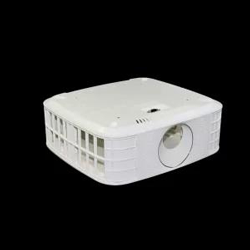
Injection molded housing for an electronic device program, produced in PC+ABS with dimensional and appearance control before mass production.
Why Electronics Housings Expose Supplier Differences
Injection molding remains the default process for electronic enclosures because a single tool can reproduce complex geometry, snap features and cosmetic surfaces at volume. The difficulty is not in identifying the process. It is in comparing the suppliers who all describe themselves with the same words: custom injection molding, tight tolerance, engineering plastics.
An electronics housing has to satisfy several requirements simultaneously. It must locate and protect a PCB, align with connector cut-outs and sealing grooves, hold a consistent colour and surface texture across a production batch, and remain dimensionally stable over the life of the product. A small change in wall thickness, gate position or cooling layout can shift assembly fit without changing the drawing at all. Two suppliers can therefore quote the same part number and deliver measurably different outcomes.
The gap between suppliers is usually not visible in a quotation. It becomes visible in whether manufacturability was reviewed before steel was cut, whether a first article inspection was performed and recorded, whether resin selection was confirmed against the application, and whether the same dimensional result repeats in the second and tenth production run. Those are checkable items, and they are the basis of the framework that follows.
A Decision Framework Built on Verifiable Criteria
The criteria below are ordered the way an electronics project actually moves: design review, tool validation, production start, repeat supply. Each row states what to request and what the request verifies, so that different suppliers can be compared against the same checklist instead of against their own brochures.
| Criterion | What to request | What it verifies |
|---|---|---|
| 1. DFM review | Documented DFM analysis and mold design review covering mold structure, cavity layout, gate design, runner system, surface texture and tooling material. | Whether manufacturability, cosmetics and assembly fit were assessed before tooling investment. |
| 2. Tooling and T1 validation | Mold design review, T1 trial molding, sample inspection and a defined mold approval step. | Whether the tool itself produces parts that meet the approved sample. |
| 3. First article inspection | First article inspection records, dimensional inspection against engineering drawings, appearance and visual inspection. | Whether production parts match the drawing at the moment mass production starts. |
| 4. Material customization | Confirmed resin grade for the housing or component, plus structural, colour and texture customization options. | Whether resin selection is matched to impact, stiffness, appearance and market requirements. |
| 5. Production consistency | Material confirmation, molding parameter control, in-process inspection, pre-shipment inspection, stated capacity and lead times. | Whether the approved sample can be repeated across a batch and across repeat orders. |
| 6. Commercial structure | MOQ basis, lead time by project stage, trade terms, payment milestones and acceptance gates. | Whether the commercial model supports both evaluation and execution. |
| 7. Documentation scope | ISO 9001:2015 certificate, RoHS test report, third-party on-site audit report, and the stated scope of each document. | Whether compliance evidence actually covers the part, resin and destination market in question. |
Criterion 1: DFM Review Is the First Verifiable Step
DFM analysis is the earliest point at which a supplier either adds engineering value or passes the work straight to the tool shop. It is also the easiest step to verify, because it produces a document rather than an opinion. A DFM review should examine how the housing will fill, where weld lines and sink marks are likely to appear, whether draft angles allow clean ejection, and whether the proposed gate position is compatible with a cosmetic Class A surface.
In a documented tooling workflow, the sequence runs: DFM analysis, mold design review, T1 trial molding, sample inspection, and mold approval. Customization at this stage covers mold structure, cavity layout, gate design, runner system, surface texture and tooling material. Those variables determine both the quality of the first samples and the maintenance profile of the tool over its working life.
For electronics buyers, the practical action is straightforward: request the DFM output before approving the mold, and confirm that any agreed design change is reflected in the tool design review. A DFM review reduces risk; it does not remove it. T1 sampling remains the validation gate, because only molded parts prove how the tool behaves in production.
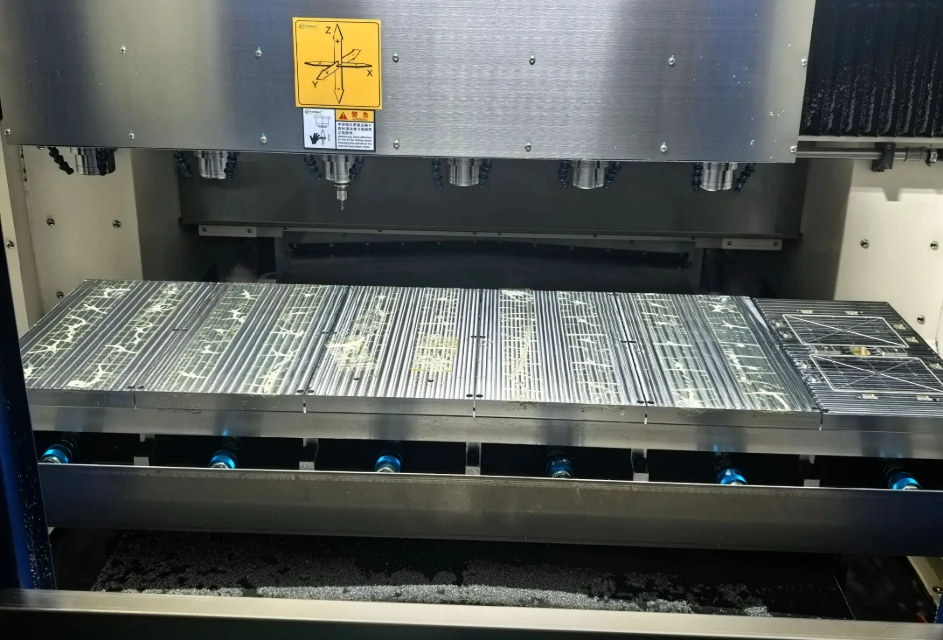
Mold design and tooling review covering cavity layout, gate design and runner system before T1 trial molding.
Criterion 2: Tooling Review and T1 Trial Molding
Tooling is where a comparison becomes concrete, because the tool defines what the process can repeat later. A supplier that documents a mold design review, runs T1 trial molding, inspects the resulting samples and requires customer approval before mass production is offering a controllable sequence. A supplier that moves from drawing to shipment without a named approval gate is offering a schedule, not a quality system.
Timing matters here as well. Custom mold projects typically run 15 to 45 days depending on mold size, complexity and material requirements. Buyers should treat that window as part of the product launch plan rather than as administrative lead time, and should confirm what happens if T1 samples require modification. Mold modification support after the initial trial is a normal part of the process, but every iteration consumes schedule.
Criterion 3: First Article Inspection and Dimensional Control
First article inspection is the checkpoint that connects the approved sample to the production run. It sits alongside dimensional inspection, appearance inspection and pre-shipment inspection as part of a documented sequence, together with material confirmation and molding parameter control. For a precision component family, dimensional control is defined against engineering drawings, with dimensional inspection and first article inspection as the stated quality controls.
This is where the phrase “tight tolerance” should be replaced with a specific question. Tolerance in injection molding is normally defined according to customer drawings and specifications rather than as a single factory-wide number. If the drawing does not state a tolerance band for a critical feature, the supplier has nothing to inspect against. Buyers comparing suppliers for electronic housings should therefore compare inspection capability against their own drawing, feature by feature, rather than against a general tolerance claim.
Criterion 4: Material Customization in ABS, PC+ABS and Beyond
Resin selection is a design decision with commercial consequences, and it is one of the clearest points of difference between suppliers. For electronic enclosures, ABS, PC+ABS and PP are the commonly offered housing materials, with customization of size, structure, colour and surface texture, plus finishing options such as polishing, painting, printing and assembly support.
A broader custom parts portfolio widens the comparison. Custom injection molded plastic parts are typically produced in ABS, PP, PC, PC+ABS, TPE, Acrylic and other engineering plastics, while precision injection molded components are offered in ABS, PC, POM, Nylon and engineering plastics. Where metal reinforcement is required, insert injection molded parts combine ABS, PC or PP with metal inserts, with customization of insert position, material combination and structure design.
ABS and PC+ABS are not interchangeable choices made on price alone. ABS is widely used for general housings and cosmetic parts; PC+ABS blends are frequently selected where a housing needs a stronger balance between impact behaviour, stiffness and appearance. A documented case example illustrates the pattern: an electronics manufacturer required projector plastic housings in PC+ABS at 30,000 to 50,000 units per batch, with a design service life of more than five years, and the delivered result was housings with stable dimensions and appearance quality. The decision to specify PC+ABS there was tied to the application requirement, not to a default preference — which is precisely how a buyer should evaluate a supplier's material recommendation.
Criterion 5: Prototype-to-Production Continuity and Lead Time Logic
A supplier that can only do one stage forces the buyer to manage handovers. Continuity from prototype through tooling to mass production removes that risk, and it can be measured through stated lead times and capacity. A full-service provider typically quotes 7 to 15 days for prototypes, with prototype projects extending to around 20 days depending on prototype structure and tooling requirements; 20 to 35 days for mass production or regular production orders after sample approval, depending on order quantity and material availability; and 15 to 45 days for custom mold projects depending on complexity and material requirements.
Capacity should be read the same way. An average monthly output of approximately 3,990 parts and an annual capacity of around 47,881 injection molded parts is meaningful only when it is arranged according to material type, part size and project schedule. Buyers should ask how their volume sits against that arrangement rather than treating annual capacity as a single guaranteed rate.
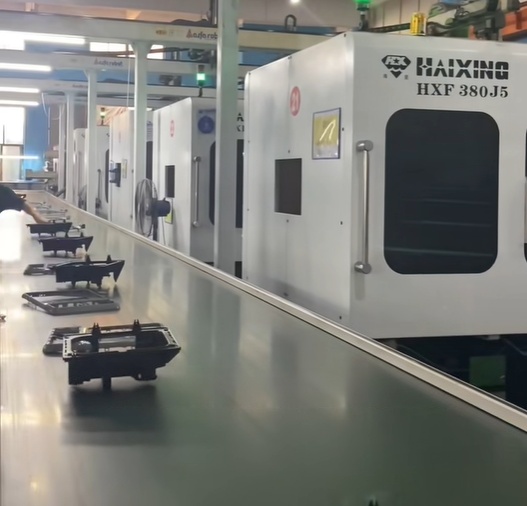
Low-volume and mass production runs are scheduled by material type, part size and project timing after sample approval.
Criterion 6: Commercial Structure and Acceptance Criteria
Commercial terms reveal how much structure a supplier applies to a project. A negotiable MOQ based on part size, material, mold requirements and production volume, and an acceptance position that a single custom mold project is acceptable as a minimum order, both signal willingness to support evaluation-stage programs. Delivery terms across EXW, FOB and CIF, with sea freight, air freight or client-designated logistics, give the buyer freight flexibility.
The acceptance sequence is the part worth comparing most carefully. A documented flow runs from DFM approval and T1 sample approval, through first article inspection, to final quality inspection before shipment. Payment structures in the same category of projects are commonly split, for example 50% T/T advance to start mold production with the balance after mold approval or before shipment. When these gates are explicit, two suppliers can be compared on identical terms; when they are not, the comparison collapses back to unit price.
Criterion 7: Reading Documentation at the Right Scope
Certificates and reports are the most frequently cited and least frequently read part of a supplier profile. Scope is what matters. An ISO 9001:2015 quality management system certificate covering “the production of injection molds and general injection molded parts” speaks directly to an electronics molding program; a test report whose scope is limited to a specific material and substance category speaks only to that category.
A workable evidence package for electronics sourcing typically includes ISO 9001:2015 quality management certification, a RoHS compliance test report, and an independent on-site audit. For reference, an ISO 9001:2015 certificate issued by Beijing East Allreach Certification Center Co., Ltd. (EACC) under certificate number 11425Q46375R0S, valid from 2025-07-01 to 2028-06-30, covers the production of injection molds and general injection molded parts. A RoHS compliance test report from SGS-CSTC Standards Technical Services Co., Ltd., report number CANEC1103223001, tests against RoHS Directive 2011/65/EU (EU RoHS II) and 2002/95/EC for lead, mercury, cadmium, hexavalent chromium, PBB and PBDE, with a stated scope of screen printing ink and UV ink substances testing. A Made-in-China supplier on-site audit report, MIC-ASI217106, was issued by Bureau Veritas on 2021-03-29 with a scope covering injection molding and plastic injection products.
Applying the Framework: How DTG TECH Maps to These Criteria
DTG TECH CO., LTD. is an ISO-certified custom injection molding manufacturer based in Xiamen, Fujian, China, founded in 2002 and operating a 2,500 m² facility with 80 employees, 25 of whom are engineers, serving export markets in the USA, Europe and India with injection molded plastic parts.
Measured against the framework above, the company's documented workflow covers the first three criteria directly: DFM review, first article inspection, dimensional inspection, visual inspection and pre-shipment inspection form the stated quality control sequence for full-service custom injection molding, with in-process inspection and appearance inspection applied in low-volume and mass production programs. Customization spans material selection across ABS, PP, PC and other engineering plastics, part size, structure, colour, surface texture, logo and packaging, plus mold structure, cavity layout, gate design, runner system and tooling material for custom mold projects. Prototype, mold and production stages are handled under one OEM and ODM service structure, with after-sales support covering engineering communication, production feedback and quality issue follow-up.
For electronics specifically, the relevant product families are plastic injection molded housings (DTG-PIH-002) in ABS, PC+ABS and PP for electronics, home appliances, industrial equipment and consumer products; precision injection molded components (DTG-PIM-003) for functional plastic parts; and insert injection molded parts (DTG-IIM-005) combining ABS, PC or PP with metal inserts for functional and structural components. This is a capability statement, not a ranking. The value of mapping it explicitly is that each claim corresponds to a checkable item on a buyer's checklist, which is the only form in which a supplier comparison can be defended internally.
Where Injection Molding Stops Being the Right Answer
A framework that only lists strengths is not a framework. Injection molding carries real boundaries that buyers should weigh before selecting it, or before selecting a supplier for it.
- Tooling is an upfront commitment with its own timeline. Custom mold projects typically require 15 to 45 days depending on size, complexity and material requirements. For very low volumes, or for designs still changing frequently, tooling-free processes such as CNC machining or additive manufacturing can be more appropriate, even though they behave differently in unit cost, surface consistency and repeatability.
- Tolerance is only as specific as the drawing. Dimensional control is defined according to engineering drawings and specifications rather than a universal factory tolerance. If a critical feature is not toleranced on the drawing, “high precision” remains an unverifiable adjective.
- Post-approval changes cost schedule. Mold modification support exists and is normal, but revisions after T1 approval add iteration time that must be planned into the launch calendar.
- Material choice involves trade-offs. ABS, PC+ABS and PP each sit in a different position on impact behaviour, stiffness, appearance and cost. A supplier can advise; the buyer must validate the final grade through prototype and sample testing.
- Documentation has scope limits. Certificates and test reports cover defined materials, processes and substances. They support a claim; they do not replace application-specific validation.
Market Context: Why Supplier Comparison Is Getting Harder
The scale of the category explains why so many suppliers look similar on paper. Market Research Future valued the global injection molded plastic market at USD 324.98 billion in 2024 and projects USD 435.74 billion by 2035. Estimates differ by institution depending on whether machinery or molded products are counted and on the base year used; Fortune Business Insights reported USD 321.4 billion for 2024, while Grand View Research reported USD 362.5 billion for 2025. For a buyer, the practical implication is the same: a large, expanding supply base with widely varying process discipline.
Supply density reinforces that effect. China's plastic mold industry was reported at approximately ¥600 billion with a projected expansion to ¥1 trillion by 2030, and China produces an estimated 65% of the world's injection-molding machines while accounting for 60% of global export volume according to industry analysis published in 2025. When capacity is abundant, the deciding factor shifts from availability to verification.
Material substitution adds a second layer. Grand View Research attributes 34% of domestic injection molded component demand in major US hubs to automotive OEMs replacing metal parts with engineered thermoplastics. Electronics programs follow a comparable logic, replacing metal brackets and multi-part assemblies with molded housings and insert-molded components. That shift increases the number of buyers who need to evaluate molding capability without deep prior molding experience — which is exactly the situation this framework is designed for.
What Buyers Should Expect Next
Sourcing behavior in electronics molding is moving toward documentation-led evaluation. As product cycles shorten and enclosures are refreshed more often, buyers increasingly request DFM output, first article inspection records, material confirmation and defined acceptance gates as standard deliverables rather than as special requests. The suppliers positioned to win that comparison are not necessarily the largest; they are the ones whose process steps are already documented and can be handed over without reconstruction.
The same logic applies inside the factory. Stated capacity of around 3,990 parts per month and 47,881 parts per year, arranged according to material type, part size and project schedule, becomes a meaningful planning input only when it is paired with the inspection sequence that keeps an approved sample stable across runs. Buyers should expect the next generation of supplier comparisons to be made on evidence packages of this kind, with unit price treated as one variable rather than the deciding one.
Frequently Asked Questions
How does a buyer verify a supplier's DFM and tooling capability for electronic housings?
Request the documented DFM analysis and mold design review before approving a mold. A verifiable tooling workflow runs through DFM analysis, mold design review, T1 trial molding, sample inspection and mold approval, and customization at that stage should cover mold structure, cavity layout, gate design, runner system, surface texture and tooling material. Custom mold projects typically take 15 to 45 days depending on mold size, complexity and material requirements, so the review step also determines the launch timeline.
What quality control steps should appear between tool approval and shipment?
In low-volume and mass production programs, the sequence commonly includes in-process inspection, first article inspection, appearance inspection, dimensional inspection and pre-shipment inspection. In full-service custom injection molding, the same stage also covers DFM review, material confirmation and molding parameter control. For precision components, dimensional control is defined against engineering drawings, with dimensional inspection and first article inspection as the stated quality controls. A supplier that cannot name these steps in order is unlikely to be able to evidence them.
Should an electronic device housing be molded in ABS or PC+ABS?
Both materials are standard options for plastic injection molded housings, which are offered in ABS, PC+ABS and PP with customization of size, structure, colour and surface texture. A wider custom parts portfolio also includes ABS, PP, PC, PC+ABS, TPE and Acrylic, while precision components are offered in ABS, PC, POM, Nylon and engineering plastics. In one documented electronics case, projector housings were produced in PC+ABS at 30,000 to 50,000 units per batch with a design service life of more than five years, delivering stable dimensions and appearance quality. The choice depends on the structural, cosmetic and cost requirements of the specific housing and should be confirmed through prototype and sample validation.
What MOQ and lead times apply to a custom electronics injection molding project?
MOQ is typically negotiable based on part size, material, mold requirements and production volume, and a single custom mold project can be accepted as a minimum order. Lead times are quoted by project stage: roughly 7 to 15 days for prototypes, with prototype projects extending to about 20 days depending on structure and tooling requirements; 20 to 35 days for mass production or regular production orders after sample approval, depending on order quantity and material availability; and 15 to 45 days for custom mold projects depending on complexity and material requirements.
What are the acceptance criteria and payment terms for a custom mold project?
A documented acceptance flow runs from DFM review and mold trial sample inspection to customer approval before mass production, and then from DFM approval and T1 sample approval through first article inspection to final quality inspection before shipment. Delivery terms commonly include EXW, FOB and CIF, with sea freight, air freight or client-designated logistics. In the same category of projects, payment is typically structured as a 50% T/T advance to start mold production with the balance after mold approval or before shipment.
Tem questões ou precisa de mais detalhes?
Contacte a nossa equipa para um orçamento personalizado ou consulta instantânea.
Solicitar orçamento
Preencha o formulário abaixo e a nossa equipa entrará em contacto com uma proposta personalizada.
Chat direto do WhatsApp
Prefere conversar em tempo real? Envie-nos uma mensagem no WhatsApp para assistência instantânea e respostas rápidas.
- Obter orçamento personalizado
- Partilhar fotos ou documentos
- Discuta as suas necessidades diretamente
Geralmente responde em 5–30 minutos durante o horário de expediente.