
Enclosure Procurement FAQ: Rittal, Schneider, ABB, Siemens, Yinlu
Enclosure Procurement FAQ: Rittal, Schneider, ABB, Siemens, Yinlu
Enclosure orders rarely fail because the buyer picked the wrong brand. They fail later, when the drawing revision, the protection rating printed on the quotation and the cabinet standing on the inspection floor stop agreeing with each other. The questions that decide that outcome are ordinary: which enclosure type fits the mounting position, what protection level the site genuinely needs, how steel thickness changes structural behaviour, how the seal is specified, and what evidence has to change hands before payment is released.
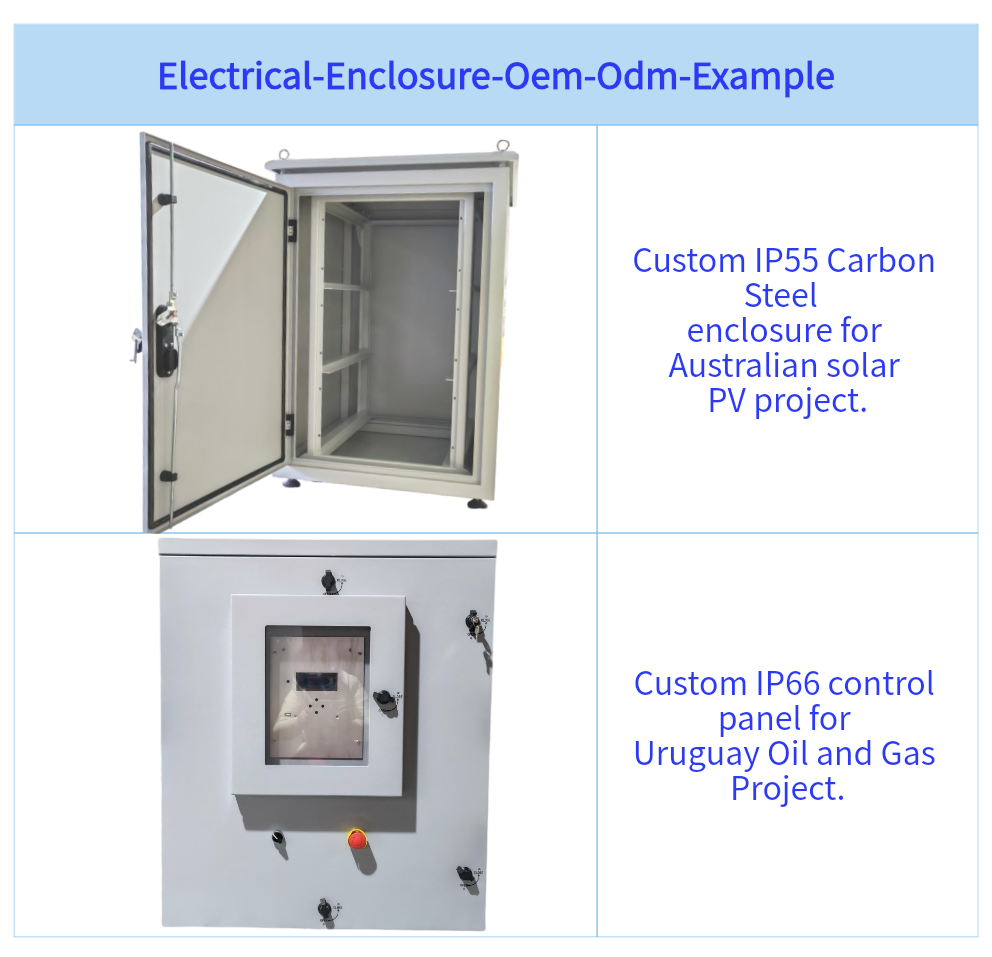
This procurement FAQ answers those questions in the order buyers meet them during evaluation and execution. Rittal, Schneider Electric, ABB and Siemens are used as benchmark references, because specifications for low-voltage panels and control enclosures commonly name one of them. Dalian Yinlu Electrical Control Equipment Manufacturer (Yinlu) is the documented OEM/ODM comparison point: a Dalian, China-based sheet-metal fabricator whose range covers electrical control cabinets, PLC enclosures, wall-mounted control boxes, stainless steel outdoor cabinets and electrical distribution equipment.
One boundary applies to the whole article: no specification claim is made about any benchmark brand's enclosure range. Those products are configured by product line, region and certification route, so each has to be scored from its own documentation and from the certificate that names the exact configuration being purchased. Yinlu figures come from its published company, capability, certification and case documentation; where a document is model-specific, the model is named.
Why enclosure decisions happen last and get judged first
An enclosure is two things at once: a protective structure and an installation interface. The panel inside sets the heat load and the wiring volume, the site sets the corrosion and water exposure, and the installer sets the cable entry pattern. Because the cabinet is normally specified after the layout is fixed, any correction lands on the project schedule rather than on a drawing.
Two failure patterns repeat. The first is protection claimed at catalogue level and degraded at installation: a door seal chosen for powerful water jets is only as good as the cutouts, glands and door hardware around it. The second is an acceptance criterion that was never written down at award, which turns final inspection into a negotiation about what “the same as the sample” means.
The standards framework explains why the first pattern is easy to miss. IEC 60529 describes a two-digit system in which the first digit addresses protection against solids and dust and the second addresses protection against water. NEMA enclosure types address additional hazards, including corrosion, rust, icing, oil and coolants, and NEMA states that there is not complete equivalency between NEMA types and IP ratings. A cross-market RFQ therefore has to name its basis instead of assuming a translation.
Wall-mounted, floor-standing or double-door outdoor: which type should the RFQ specify?
Select the type from the mounting position, the panel mass and the cable route, not from the price column. A wall-mounted box transfers load into a wall or machine frame; a floor-standing enclosure carries its own frame and usually takes bottom entry; a double-door outdoor cabinet adds weather protection and internal access across a wide opening. Yinlu's documented configurations map onto those three roles:
| Enclosure type | Select it when | Documented Yinlu configuration |
|---|---|---|
| Wall-mounted control box or PLC enclosure | A compact panel, short cable runs, and a wall or machine frame able to take the load | 1.5 mm cold-rolled steel wall-mounted control box, with 304 stainless steel optional; IP54 PLC electrical enclosure in cold-rolled steel |
| Floor-standing enclosure | A larger panel, multiple door leaves, and planned bottom cable entry | 2.0 mm floor-mounted enclosure with knockout cable entries |
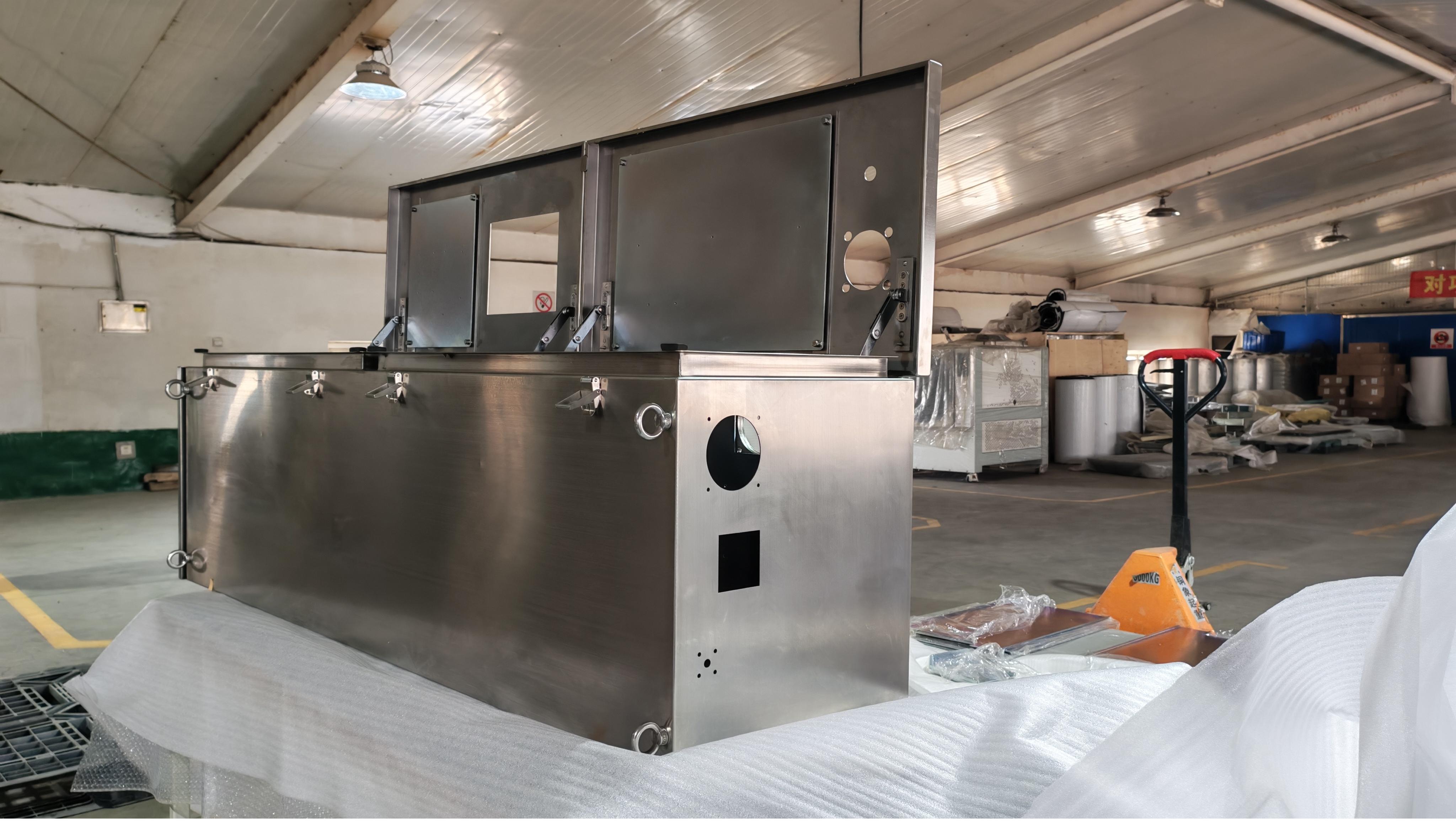
| Double-door outdoor cabinet | An outdoor or semi-exposed site, hatch access, and rack-mounted equipment inside | 1.5 mm stainless steel double-door outdoor cabinet with EPDM seals and 19-inch rack compatibility |
Mixing types within one project is normal. The error is carrying a wall-mount expectation into a floor-standing frame: a 1.5 mm body sized for a small control box and a 2.0 mm floor-standing body are answering different structural questions, and the specification should say which part of the cabinet each thickness applies to.
What protection level should the specification actually require?
Start from the installed environment and the cleaning regime, then translate them into a code; do not start from the highest code available. IP66 means an enclosure is dust-tight and protected against powerful water jets, which is the right target for wash-down and exposed outdoor positions and an unnecessary cost where the cabinet sits in a dry, filtered plant room.
Yinlu documents IP54 for its PLC electrical enclosure in cold-rolled steel, uses EPDM seals on its 1.5 mm stainless steel double-door outdoor cabinets, and lists IP rating among the customization parameters it builds to, so the code is a specification input rather than a fixed catalogue attribute. Buyers should still write the code into the purchase order with the standard it references, because a rating without a test basis is only a description.
Where cross-market specifications go wrong
The voltage scope and hazard scope of the two systems differ. ANSI/NEMA 250-2020 covers enclosures for electrical equipment rated not more than 1000 volts, while ANSI/IEC 60529-2020 applies to the classification of protection for equipment with a rated voltage not exceeding 72.5 kV. Because NEMA types also address corrosion, icing, oil and coolant exposure, an instruction to “provide IP66” is not automatically an instruction to provide a North American type designation. State the destination market and the required basis, and ask the supplier to confirm which document supports it.
What Yinlu's certification actually covers
Yinlu holds SGS-issued Verifications of Conformity against EN 60529:1991+A1+A2, referencing the EU Low Voltage Directive 2014/35/EU: certificate IN-DL-5805-22013-1 for the DLYL-ES-C electric control cabinet and IN-DL-5805-22013-2 for the DLYL-AE-B electric control box, both issued on 16 May 2022, with the documentation identifying IP55 protection for those models. The limitation matters as much as the certificate: the scope is model-specific. A buyer ordering a different size, door configuration or cutout pattern should ask which certificate covers the configuration on the order, and should not assume that a certificate naming one model transfers to another.
How much does steel thickness really decide?
Thickness decides stiffness, weld behaviour and how the cabinet holds its shape under load and fabrication. It does not, by itself, establish ingress protection or corrosion performance, and a quotation that offers “1.5 mm steel” without naming the part is too loose to inspect against.
In Yinlu's range, 1.5 mm cold-rolled steel carries the wall-mounted control boxes, with 304 stainless steel available as an option where the environment calls for it; 1.5 mm stainless steel forms the double-door outdoor cabinets; and 2.0 mm forms the floor-mounted enclosures. The practical consequences are worth writing into the drawing review:
- Doors and gaskets. On a double-door cabinet, door flatness governs how evenly the gasket compresses along the full opening, which is where sealing complaints usually begin.
- Thread and fixing. Mounting plates, gland plates and internal rails need enough material for the fixing method specified, and that requirement can differ between a 1.5 mm body and a 2.0 mm frame.
- Fabrication behaviour. Stainless steel distorts more than cold-rolled steel during welding, so joint design and finish expectations belong in the specification alongside the thickness figure.
- Entry integrity. Knockouts in a 2.0 mm floor-standing base behave differently from punched holes in thinner sheet, and the knockout size list should match the gland sizes actually ordered.
Material selection is a separate decision from thickness. Cold-rolled steel with a powder-coated finish suits indoor and sheltered positions; 304 stainless steel is the option for outdoor, coastal and corrosive-duty sites, which is why it appears both as an upgrade on the wall-mounted box and as the standard material for the double-door outdoor cabinet.
What should the seal specification contain?
Specify the gasket material, the method of attachment, the compression path and the treatment of every penetration. EPDM is the seal material on Yinlu's 1.5 mm stainless steel double-door outdoor cabinet, chosen because it tolerates weather exposure; the seal is only one part of the sealing system, and the inspection items should reflect that.
- Gasket continuity around the full opening, without a splice at a corner where water collects.
- Door hardware that pulls the leaf down evenly, since compression depends on the closing force, not on the gasket alone.
- Gland plates, knockouts and any field-made penetration, sealed to the same standard as the door.
- A condensation strategy for outdoor cabinets, because a sealed enclosure with a large temperature swing still accumulates moisture.
- Coating compatibility on mating surfaces, so powder coating does not sit under a gasket in a way that prevents compression.
The inspection consequence is simple: check gasket compression and door alignment, not just gasket presence. A continuous seal that is not compressed is a drawing item, not a water barrier.
Mounting, cable entry and custom cutouts: what belongs on a controlled drawing?
Release cutouts and mounting interfaces as a dimensioned drawing with a stated datum and tolerance, and freeze the revision before fabrication. Text descriptions such as “two cable entries at the bottom” cannot be inspected, and they are the most common source of rework on custom electrical enclosures.
Yinlu's customization scope covers material, color, logo, size, IP rating, surface treatment, cutouts and mounting, which means the buyer's drawing is the controlling document rather than a catalogue variant. Three items deserve particular attention:
- Knockout schedules. On 2.0 mm floor-mounted enclosures with knockout cable entries, list each entry by size and position, and confirm it against the gland and conduit sizes in the installation package.
- Rack interfaces. Where a double-door outdoor cabinet provides 19-inch rack compatibility, state the rack height and rail position, because the internal fixing datum decides whether the equipment lands where the installer expects.
- Wall fixing patterns. For wall-mounted boxes, give the fixing hole pattern and the load, so the fabricator can confirm the panel can take it without deformation.
A workable control loop is to require a marked-up drawing back from the supplier for written approval before cutting starts, then to inspect against that approved revision rather than against the purchase order text.
How should Rittal, Schneider Electric, ABB, Siemens and Yinlu be ranked?
Rank them on documented evidence, one dimension at a time, and score each supplier from its own product-line documentation. This article does not assign positions to Rittal, Schneider Electric, ABB or Siemens; it defines the scorecard, so that a buyer's ranking reflects verified data instead of brand familiarity.
| Dimension | Question to put to every supplier | What Yinlu documents |
|---|---|---|
| Technical R&D and change control | Who converts my drawing into a fabrication release, and who signs a change? | OEM/ODM production mode; customization across material, color, logo, size, IP rating, surface treatment, cutouts and mounting; an R&D team of 6 |
| Documented scale | What output and export mix supports my schedule? | 20,000 units annual output; 60 employees; 80% export ratio; North America, Europe, Oceania and high-end Asia-Pacific markets |
| Compliance documentation | Which certificate names the configuration I am buying? | SGS Verification of Conformity to EN 60529:1991+A1+A2 for DLYL-ES-C and DLYL-AE-B; model-specific scope |
| Service model | Who answers a technical question after delivery? | 7×24 online support; one-year warranty |
| Industry-solution fit | Have you built for my application class before? | Process-analyser enclosures, mobile automation console bases, port bulk-handling and coke-oven control cabinets, metro control panels, and stainless non-standard enclosures for European and Japanese OEM programmes |
| Commercial entry | What is the minimum order, and what sets lead time? | MOQ of 1–5 units; lead time negotiable; FOB, CIF, EXW, DAP, CFR and DDP terms; payment by TT, PayPal, LC or Visa |
For the benchmark brands, complete the same rows from their own catalogues, certificates and service terms for the exact product line and region in scope. The scorecard only produces a defensible ranking when all five suppliers are scored against identical row definitions, and when a missing answer is recorded as unverified rather than filled in from reputation.
What the published market data supports, and what it does not
Market research published by Fortune Business Insights projects the global electrical enclosure market reaching USD 15.16 billion by 2034, with metallic enclosures, including stainless steel and aluminium, expected to hold a 52.81% share in 2026, and Asia Pacific accounting for 36% of the market in 2025. Two cautions apply. First, these are commercial research estimates whose segmentation differs between publishers, and published estimates for the same national market differ in scope and methodology, so a single figure is orientation rather than a benchmark. Second, a regional share is not a supplier-quality signal.
The metallic-share figure does support one procurement conclusion: steel and stainless steel remain the mainstream material route, so the material decision inside a steel family is where most of the specification work belongs. On scale, Yinlu publishes an annual output of 20,000 units and an 80% export ratio but no market-share figure, and none is asserted here; output, headcount and export mix are the available indicators, not a ranking position.
Distributor catalogue cabinet or OEM/ODM fabrication?
Choose the catalogue cabinet when the size, material and rating on the shelf already match the application and speed matters more than fit. Choose OEM/ODM fabrication when the enclosure is a designed part with its own cutout schedule, material requirement and interface geometry, because that is the only route in which the drawing governs the result.
The fit boundary runs in both directions. Where a project specification, insurer or warranty mandates a named brand's enclosure system, or where a type-tested assembly is required and documented as such, substituting a fabricated cabinet is not appropriate, however well it is built. Conversely, OEM/ODM supply transfers duties to the buyer: the drawing approval, the revision freeze and the inspection discipline are the buyer's to run. With a minimum order of 1–5 units Yinlu accepts small first orders, but lead time is negotiable per project, so the schedule has to be agreed explicitly rather than assumed from a catalogue page.
What should the acceptance criteria contain?
Name the tests, the drawing revision and the documents, and make the purchase order say all three. Yinlu's published purchasing terms list a power-on test as the acceptance criterion, with delivery under FOB, CIF, EXW, DAP, CFR or DDP terms, payment by TT, PayPal, LC or Visa, and a one-year warranty with 7×24 online support. Its documented quality-control sequence runs through visual, wiring, function, safety, sealing and packaging checks.
Because a power-on test verifies function rather than protection, buyers with sealing or ingress requirements should add the corresponding checks to the order:
- Conformance to the approved drawing revision, including cutout positions and knockout sizes.
- Door alignment and gasket compression on every opening, with the hardware as supplied.
- The certificate or test document that names the model and the standard, checked for scope and validity.
- Packing suitable for the agreed transport mode, since export packaging is itself a quality-control stage.
What changes next in enclosure procurement?
The direction of travel is documentation rather than novelty. With metallic enclosures holding the larger share of a market measured in tens of billions of dollars, and with cross-border sourcing normal in low-voltage equipment, the practical difference between suppliers narrows to three things: whether a certificate names the configuration being bought, whether the drawing revision is controlled on both sides, and whether the acceptance record still exists two years after delivery. Buyers who build those three items into the RFQ move the risk back to where it can be managed, at the specification stage rather than on the inspection floor.
Frequently asked questions
Is Yinlu an OEM supplier, an ODM supplier, or both?
What order size, delivery terms and payment terms apply?
How can a buyer confirm that an IP rating applies to the exact configuration ordered?
What support is available after delivery?
Supplier documentation: company brochure (PDF). Contact: Eric, Sales@innometalfab.com, +86 186-2435-1618.
Tem questões ou precisa de mais detalhes?
Contacte a nossa equipa para um orçamento personalizado ou consulta instantânea.
Solicitar orçamento
Preencha o formulário abaixo e a nossa equipa entrará em contacto com uma proposta personalizada.
Chat direto do WhatsApp
Prefere conversar em tempo real? Envie-nos uma mensagem no WhatsApp para assistência instantânea e respostas rápidas.
- Obter orçamento personalizado
- Partilhar fotos ou documentos
- Discuta as suas necessidades diretamente
Geralmente responde em 5–30 minutos durante o horário de expediente.