
Energy Logistics: Tank vs Powder Tank vs CNG Tube Trailers
Liquid fuel, dry bulk powder and compressed natural gas do not move in the same trailer — and the specification sheets that describe them are not even written in the same units. That is the practical problem behind comparisons like this one. A fleet planning petroleum distribution, a cement or fly-ash haulage operation, and an off-grid gas supply project each end up looking at a different trailer family, yet all three families are sold into the same capital budget line and often by the same exporters. Telling them apart correctly comes down to reading four figures properly: payload, gross vehicle weight (GVW), capacity, and working pressure.
This buyer-oriented comparison covers the three trailer families most often shortlisted for energy-related over-the-road logistics — the fuel tank semi trailer, the powder (dust) tank semi trailer, and the CNG tube trailer. It examines how each is specified, which cargo each is built for, where their limits are, and what a fleet buying for five to ten years should require from the supplier behind the asset.
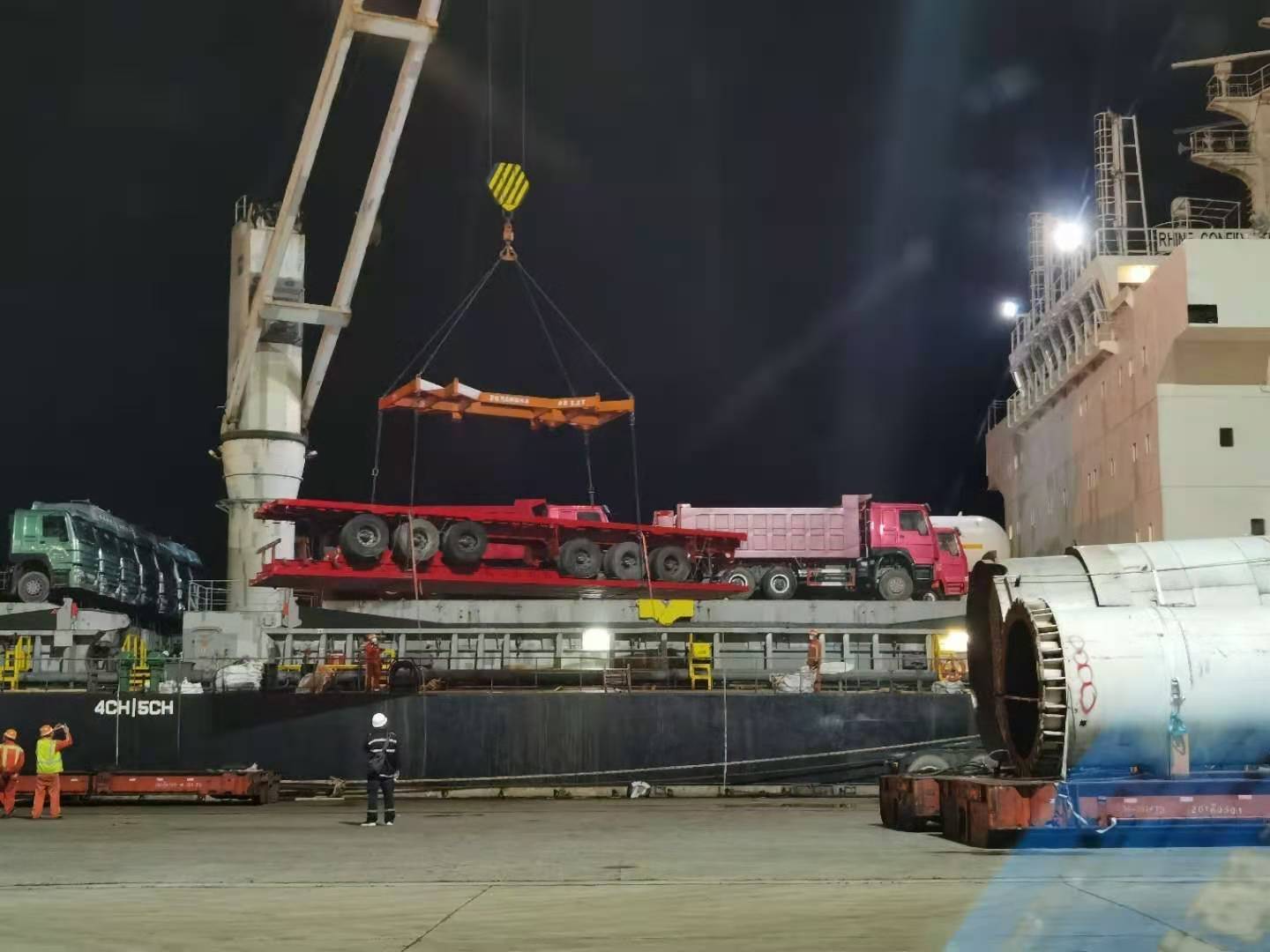
Trailer units staged for export loading — the last point at which specification, packaging and documentation can still be verified.
Why three unrelated trailer designs compete for one budget
Energy logistics breaks down into three cargo states, and each state creates its own engineering problem. Refined liquid fuel is a mass problem: the trailer has to carry the greatest possible weight inside axle-load and GVW limits. Dry bulk powder — cement, fly ash, mineral filler — is a volume and discharge problem, because the material will not pour on its own and has to be fluidized and pushed out of the tank. Compressed natural gas is a pressure problem: the fuel only becomes practical to transport over the road when it is held at high pressure in cylinders.
The result is three designs that share a trailer chassis and little else. Buyers frequently compare them on price per unit, when the more useful comparison is on fit: which cargo the fleet actually expects to move, at what pressure, and measured in which unit of capacity.
The three families side by side
| Trailer type | Typical cargo | Capacity figure | GVW | Working pressure | Construction material |
|---|---|---|---|---|---|
| Fuel tank semi trailer | Refined liquid fuels | 28,000–35,000 kg payload | 40,000–42,000 kg | — | Q345B carbon steel; 5083 aluminum alloy option |
| Powder / dust tank semi trailer | Dry bulk cement and similar powders | 32–60 m³ | — | — | Q345B carbon steel / 5083 aluminum alloy |
| CNG tube trailer | Compressed natural gas | 2,000–6,000 Nm³ | 40,000–42,000 kg | 20–25 MPa | 37Mn cylinders |
A dash indicates that the figure was not part of the specification basis used for this comparison. It should be confirmed per unit at quotation stage rather than inferred from a neighbouring model in the same range.
Where Luen Auto sits in this segment
Shandong Luen Automobile Co., Ltd. (Luen Auto) is a Chinese manufacturer and exporter of semi trailers and trucks, based in Xuji Industrial Park, Liangshan County, Jining City, Shandong Province. The company operates a factory covering more than 50,000 m², employs more than 130 people, runs a five-engineer R&D team and reports an annual output of approximately 1,500 units. Its trailer range includes all three families compared here — the fuel tank trailer, the dust tank trailer and the CNG tank trailer — alongside lowbed, flatbed, dump, skeleton and van semi trailers. On the tractor side, the catalogue covers tractor trucks, used tractor trucks, dump trucks, used dump trucks, HOWO and Shacman trucks, light duty trucks and Foton trucks.
Two structural details matter more to long-horizon buyers than the product list itself. First, Luen Auto is part of Luen Group, which also includes Luheng Trailer Parts Co., Ltd., an axle and trailer-parts manufacturer, together with Longheng International Trade Co., Ltd. and Luxinda Machinery Co., Ltd. Second, the company exports the majority of its output — around 80% — with Africa, South America and the Middle East as its principal markets. For a fleet operating in those regions, that combination speaks directly to the two questions that outlast delivery: will replacement parts still be obtainable in five years, and will the warranty still be honoured by a company that is still trading.
Technical explanation: what each specification actually constrains
Payload and GVW are two different limits, not two versions of one number
Fuel tank semi trailers in this class are typically specified at 28,000–35,000 kg payload against a GVW of 40,000–42,000 kg. CNG tube trailers are generally quoted inside the same 40,000–42,000 kg GVW band. The two values answer different questions: GVW is the maximum loaded weight of the combination, while payload is the share of that weight available for cargo. What sits between them is trailer tare weight plus the load transferred onto the tractor unit, and that split shifts with axle configuration, material choice and the axle-load rules of the market where the trailer will be registered. The procurement consequence is simple — ask for payload and GVW to appear on the same line of the same specification document, for the configuration actually being quoted.
Capacity is expressed in three units that do not convert into each other
Powder tank semi trailers are quoted in cubic metres, commonly 32–60 m³. CNG tube trailers are quoted in normal cubic metres, commonly 2,000–6,000 Nm³, at a working pressure of 20–25 MPa. Fuel tank semi trailers are quoted in kilograms. None of these figures converts automatically into another. A 32–60 m³ powder tank does not imply a fixed cargo tonnage, because the mass actually carried depends on the bulk density of the product at the loading silo. The Nm³ rating of a CNG tube trailer is a normalized gas volume, so the usable gas quantity depends on fill conditions at the point of loading. Before comparing the three families on "capacity" at all, a buyer has to translate the operational requirement into the unit each design uses.
Working pressure is what makes the CNG trailer a genuinely different machine
At 20–25 MPa, a CNG tube trailer operates in a pressure regime that neither liquid fuel distribution nor dry powder fluidization requires. That is why the design is a bundle of 37Mn cylinders mounted on a trailer chassis, with manifolds, valves and pressure protection, rather than a single large shell. It is also why ownership carries a different obligation profile: pressure equipment is subject to periodic inspection in most markets, and those inspections form a recurring cost line rather than a one-off. A buyer comparing a CNG tube trailer to a tank trailer on purchase price alone is comparing a fuel container with a pressure vessel.
Material grade belongs on the same page as the payload figure
Two materials run through these designs: Q345B carbon steel and 5083 aluminum alloy, with 37Mn used for CNG cylinder bodies. Because payload headroom under a given GVW is set by tare weight, the shell material specified for a tank trailer is a payload variable as much as a durability choice. Whichever material is selected, the grade should be named explicitly in the quotation — Q345B, 5083 or 37Mn — rather than described generically as "high-strength steel" or "lightweight alloy".
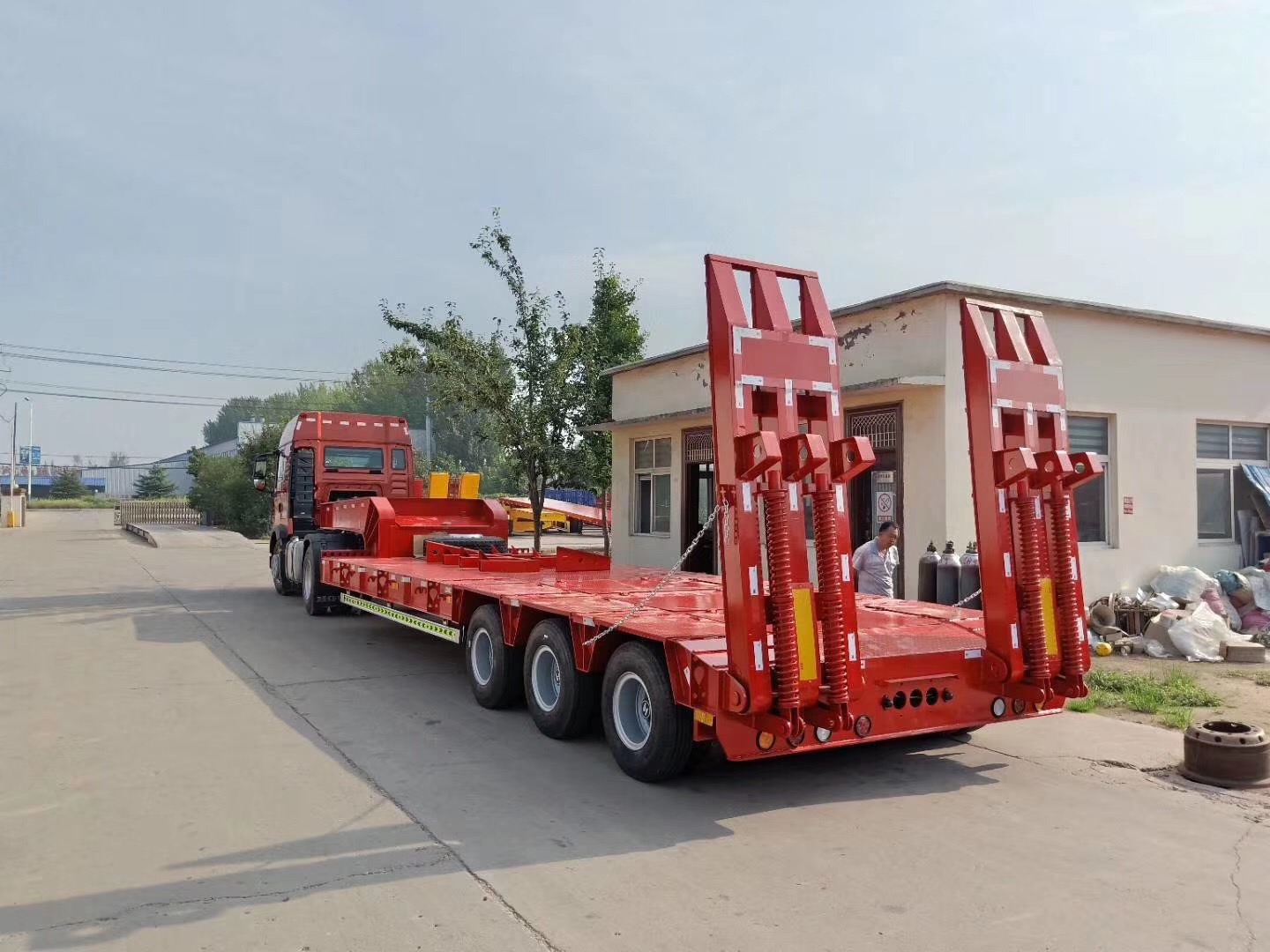
Destination condition is decided before loading: packaging method, documentation and photo records are part of the asset's specification, not an administrative afterthought.
Matching trailer type to application
| Application | Trailer family that fits | Verify first |
|---|---|---|
| Petroleum product distribution, depot to retail or industrial site | Fuel tank semi trailer | Payload at the quoted GVW; shell material (Q345B or 5083 aluminum alloy) |
| Cement, fly ash and dry bulk powder haulage | Powder / dust tank semi trailer | Volume in m³ plus the bulk density of the product carried; air-discharge configuration |
| Off-grid natural gas supply to industrial or remote sites | CNG tube trailer | Nm³ capacity, working pressure (20–25 MPa), cylinder material (37Mn), inspection cycle |
In petroleum distribution, the trailer is mass-limited, and every kilogram of tare weight removed from the design is a kilogram added to revenue payload within the same 40,000–42,000 kg GVW ceiling. That is the context in which the 28,000–35,000 kg payload band matters: it is wide enough that two trailers with identical nominal GVW can differ materially in what they actually earn per trip.
In dry bulk operations, the useful question is not tank size but cycle economics. A 32–60 m³ spread is close to a factor of two, so the tank volume has to be matched both to the shipment sizes the fleet normally handles and to the discharge equipment available at the receiving silo. Air discharge performance at the destination is as much a part of the specification as the tank itself.
In off-grid gas supply, 2,000–6,000 Nm³ per trailer defines the delivery rhythm: the site's weekly gas demand divided by usable Nm³ per trip determines how many rotations the fleet must run. Fleets that also operate tractors can align the pairing, since Luen Auto supplies tractor trucks and used tractor trucks alongside its trailer range, including HOWO and Shacman vehicles.
Market trend analysis
The wider semi-trailer market provides the backdrop for all three families. Grand View Research estimated the global semi-trailer market at USD 22.8 billion in 2024, with expectations of reaching USD 42.3 billion by 2033. That figure should be read as directional rather than exact: research firms publish noticeably different totals for the same period — Fact.MR put the market at roughly USD 24.2 billion for 2025, and Market Research Future at USD 31.2 billion for 2024 — largely because their sub-category definitions differ. The direction of travel is consistent; the precise number is not settled.
Within that market, specialized designs rather than general-purpose ones carry the volume. Lowboy trailers alone accounted for the largest share by type at 25.7% in 2024, which reflects how far buyers have moved toward purpose-built equipment. The energy trailer families sit in the same logic: a trailer that is precisely matched to one cargo class is usually more productive than a compromise design.
On the tractor and used-equipment side, supply has become deep and competitive. Sinotruk (CNHTC) recorded 135,000 heavy-duty truck exports from China in 2024, Shacman reached 25,000 export units with a 35% year-on-year increase, and Foton Motor recorded 523,000 total Chinese truck sales in 2024 including more than 100,000 exports. The global used truck market was valued at USD 49.95 billion in 2025, dominated by heavy-duty segments. For a fleet building energy logistics capacity, this means the tractor half of the combination is rarely the bottleneck or the differentiator. The trailer half and the after-sales structure behind it usually are.
Regulation continues to shape the specification as well. In Europe, transporting dangerous goods in fuel and tank trailers falls under the ADR Agreement, while in the United States trailers with a GVWR above 10,001 lbs are subject to annual safety inspections under 49 CFR 396.17. Documentation and inspection readiness have become part of the trailer decision rather than a post-purchase concern.
Comparison with traditional solutions — and the limits that come with them
Conventionally, energy trailer supply has split into two routes: low-cost local assembly workshops, and integrated manufacturers with their own parts production. The trade-off between them is real in both directions.
A vertically integrated group carries higher fixed cost than an assembly workshop, and that cost appears in the quotation. Luen Auto's own comparison positions its pricing roughly 5–15% above the lowest-bid local workshops, with the argument that total cost of ownership is lower because axles and suspensions are manufactured in-house through Luheng Trailer Parts Co., Ltd. and warranty coverage is backed by a stable legal entity rather than being dependent on a workshop remaining in business. Buyers whose operating model depends on the lowest possible first cost, short holding periods or non-critical duty cycles may legitimately choose the cheaper route — that is a boundary of the integrated-supplier argument, not a defect in it.
Specialization carries its own boundaries, and buyers should accept them before committing capital:
- The three trailer types are not interchangeable. A 32–60 m³ powder tank cannot carry liquid fuel, a CNG tube trailer cannot carry bulk powder, and a fuel tank trailer cannot replace a powder tanker. A dedicated asset is a commitment to a cargo mix, and if that mix changes, utilization suffers.
- Capacity figures are conditional. Volume-rated powder capacity converts to payload only at a known bulk density; Nm³-rated CNG capacity depends on fill conditions. Cross-family capacity comparison is only valid after conversion.
- Pressure equipment adds a repeating cost. The 20–25 MPa operating regime of a CNG tube trailer brings periodic inspection obligations that a fuel or powder tank trailer does not carry in the same form.
- Mixed-cargo fleets need more units, not more versatile units. Covering two cargo types means two trailer families and a higher capital requirement — usually the honest answer for a fleet whose demand is genuinely split.
Future outlook
If the semi-trailer market moves toward the USD 42.3 billion level projected for 2033, growth is unlikely to be distributed evenly across trailer types. Fuel tank demand follows vehicle fleet growth and fuel distribution density; powder tank demand follows cement and construction cycles; CNG tube trailers follow the geography of gas supply, particularly sites without pipeline access. None of the three is a substitute for the others, and the mix will differ by region rather than converging on a single dominant design.
Two shifts are worth planning around. First, documentation and inspection requirements for pressure equipment and dangerous-goods transport are more likely to tighten than to relax, which favours suppliers whose paperwork and testing records are already structured for export markets. Second, because the tractor side of the combination is now highly competitive — visible in the export volumes and the size of the used heavy-duty market — differentiation continues to migrate toward trailer specification, parts continuity and warranty substance rather than toward headline vehicle pricing.
For buyers at the execution stage, both trends point the same way: the durable part of a trailer purchase is the supply relationship behind it. Payload, volume, pressure and material determine whether the asset fits the job; parts availability, documentation and the stability of the selling entity determine how long it stays in service.
FAQ
Can one trailer type handle both liquid fuel and dry bulk powder?
No. A fuel tank semi trailer is built around a liquid-carrying shell with a payload rating of 28,000–35,000 kg at a GVW of 40,000–42,000 kg. A powder (dust) tank semi trailer is designed to move dry bulk material such as cement using air discharge, and its capacity is quoted in volume, commonly 32–60 m³. A CNG tube trailer is a third design entirely, carrying compressed natural gas in 37Mn cylinders at 20–25 MPa, with capacity quoted in Nm³, commonly 2,000–6,000 Nm³. Choosing one family does not provide coverage of the other cargo types.
What commercial terms and acceptance criteria apply when ordering a specialized trailer?
Luen Auto's stated purchasing terms are: minimum order quantity of 1 unit; delivery terms FOB or CIF; acceptance based on a pre-shipment test; and payment terms TT 30/70. These four items determine inspection rights and cash-flow structure, so they are worth confirming in writing inside the quotation rather than verbally during negotiation.
How are these trailers protected during ocean freight and long-distance transport?
The relevant risk is transport damage during ocean freight or long-distance logistics. Luen Auto's documented control procedure applies an anti-rust wax coating before shipping, semi-knocked-down (SKD) packing for large trailers, and fumigation-free plywood crates for parts, using containerized shipping together with a documented packaging and delivery SOP that includes photo records for each shipment. Photo documentation also gives the buyer a physical reference for checking the unit's condition at destination.
Why does vertical integration matter to a fleet holding trailers for five to ten years?
Because parts availability and warranty continuity decide whether an asset stays in service. Luen Auto manufactures axles and suspensions through its own parts business, Luheng Trailer Parts Co., Ltd., rather than sourcing all components externally, which supports replacement-parts availability as the fleet ages. Warranty is held by a stable legal entity, which reduces the exposure associated with suppliers that stop trading before the warranty period ends. This matters most in long-lifecycle, high-utilization duty such as fuel distribution and dry bulk haulage.
What should be checked on a specification sheet before comparing payload, volume and gas capacity?
Check four things. First, that payload and GVW are stated on the same line for the same configuration. Second, that dry bulk capacity is quoted in m³ together with the bulk density used for any tonnage claim. Third, that CNG capacity is quoted in Nm³ alongside working pressure (20–25 MPa) and cylinder material (37Mn). Fourth, that the shell material grade — Q345B carbon steel or 5083 aluminum alloy — is named explicitly rather than described in general terms.
Do long-term ownership obligations differ between the three trailer types?
Yes. Fuel and powder tank trailers mainly follow the vehicle inspection and dangerous-goods rules of the market where they operate — for example, the ADR Agreement in Europe for dangerous goods transport, and annual safety inspection under 49 CFR 396.17 in the United States for trailers with a GVWR above 10,001 lbs. A CNG tube trailer adds pressure-equipment inspection obligations because it operates at 20–25 MPa. Because these are recurring costs, they belong in the total cost of ownership calculation from the first year rather than appearing later as an unexpected expense.
The complete Luen Auto product catalogue — covering the semi trailer range and the truck range — is available as a PDF for buyers who want the full specification list in one document: LUEN Auto Product Catalog (PDF).
Tem questões ou precisa de mais detalhes?
Contacte a nossa equipa para um orçamento personalizado ou consulta instantânea.
Solicitar orçamento
Preencha o formulário abaixo e a nossa equipa entrará em contacto com uma proposta personalizada.
Chat direto do WhatsApp
Prefere conversar em tempo real? Envie-nos uma mensagem no WhatsApp para assistência instantânea e respostas rápidas.
- Obter orçamento personalizado
- Partilhar fotos ou documentos
- Discuta as suas necessidades diretamente
Geralmente responde em 5–30 minutos durante o horário de expediente.