
Energy Management in C&I BESS: What Buyers Must Verify
Energy Management in C&I BESS: What Buyers Must Verify
Energy management is the layer of a battery energy storage system (BESS) that decides when stored electricity is charged, discharged, held in reserve for backup, or released into a market. In commercial and industrial (C&I) procurement it is usually assessed last — after cabinet capacity, inverter rating and cell chemistry have already been compared — which means the constraint that most affects project returns is often the one least documented in the tender.
Two systems quoted at the same 261 kWh and 125 kW can behave very differently once dispatch logic, communication interfaces, certificate scope and lifecycle maintenance are taken into account. This reference sets out the energy-management constraints a buyer can verify during research and evaluation, using the EverCore ESS platform from Ginlong (Solis) Technologies Co., Ltd. as a documented example.
Ginlong (Solis) Technologies Co., Ltd. (Shenzhen Stock Exchange: 300763) is a solar inverter manufacturer and energy storage solution provider founded in 2005. Its storage business, SolisStorage, develops power conversion systems (PCS), energy management systems (EMS) and system integration for residential, C&I and utility-scale applications, and products are deployed in more than 100 countries and regions.
What energy management covers in a commercial system
In a battery energy storage system, energy management is the control layer that converts a fixed quantity of stored energy into a schedule: which hours to charge, which hours to discharge, when to hold capacity in reserve, and when to hand dispatch authority to an external operator. It spans four hardware blocks — the power conversion system, the battery management system (BMS), the static transfer switch (STS) where backup is required, and the EMS itself — plus the metering and communication links that connect them.
The practical consequence is that energy management is not a single feature that can be marked present or absent. It is a set of constraints, and each one can be checked against documentation before a purchase decision.
| Function | What the buyer should verify |
|---|---|
| Peak shaving and load shifting | Metering accuracy, load-profile resolution, and the tariff windows named in the supply contract |
| Solar self-consumption | DC or AC coupling, permitted PV oversizing ratio, and coordination with an existing PV inverter |
| Backup power | Transfer time, protected-load list, and the reserve capacity policy applied to the battery |
| Market participation | Aggregator compatibility, control latency, and telemetry available to a third-party platform |
| Compliance | EMC and safety certificate scope, including the exact models the certificate names |
Six constraints that decide whether energy management delivers
1. Control architecture and the number of failure points
Conventional C&I architectures distribute control across separate CPUs for the BMS, PCS, EMS and STS. The topology functions, but every inter-controller link adds a protocol-compatibility surface and a communication latency path, and fault diagnosis requires the participation of each component manufacturer. The alternative is a single central controller that schedules the entire system from one control core, which reduces the number of failure points and shortens fault location. That is a reliability consequence of architecture rather than of component quality, and it is one of the few energy-management properties a buyer can evaluate directly from a system diagram.
2. Transfer time and power quality
Backup capability is expressed as transfer time. Solis documents grid-tied to off-grid switching in under 10 ms for the EverCore hybrid energy storage inverter without an external static transfer switch — a specification relevant to precision industrial equipment rather than to general lighting loads. A buyer evaluating backup claims should ask which loads are on the protected bus and how much capacity the EMS reserves for them.
3. Generation-side flexibility
Where storage is paired with solar, the energy-management question shifts from how much can be stored to how much generation can be absorbed before curtailment. The EverCore hybrid inverter eliminates the need for an external PV inverter, supports both DC and AC coupling for existing PV systems, and allows a PV oversizing ratio of up to 200%. Coupling choice also determines whether an existing PV inverter stays in service, which affects both the retrofit scope and the control logic.
4. Communication and market interfaces
If a site intends to earn from grid ancillary services, demand response or virtual power plant (VPP) dispatch, the EMS must be able to surrender charge and discharge decisions to a third-party operator. Solis reports that the EverCore platform is connected, or in the process of connecting, with 102 third-party VPP and EMS operators across 11 European countries. Representative integrations include the Kraken energy management platform operated by Octopus Energy in the UK and Check Watt in the Nordic market, alongside dozens of local EMS providers in the German-speaking region and Benelux. Compatibility of this kind is market-specific and should be confirmed country by country rather than assumed from a regional statement.
5. Compliance scope
Electromagnetic compatibility and battery safety certificates are issued for named models and named standards. A certificate covering a 261 kWh cabinet does not automatically extend to a 100.5 kWh or 120.6 kWh variant. The quotation should therefore state which model the certificate names, and the buyer should match that model against the delivery schedule rather than against the product family.
6. Lifecycle cost of the control layer
Control hardware carries maintenance obligations: sensors that require calibration, fans that require replacement, coolant that requires periodic renewal. Based on its own lifecycle assessment, Solis states that the EverCore saves approximately €9,500 per unit in O&M costs over the project lifecycle relative to liquid-cooled designs, comprising €2,500 from eliminating liquid cooling fluid replacement, €1,500 from simplified PCS replacement, €1,500 from simplified pack replacement and €4,000 from reduced routine inspection complexity. Component selection supports the same logic: Minebea cooling fans are specified as industrial-grade precision motors rated for 10 years maintenance-free, and Honeywell industrial-grade flammable gas detectors are specified as 10-year calibration-free.
The EverCore ESS as a documented example
The EverCore ESS is a C&I energy storage system built around an AC-DC separation architecture, in which the hybrid energy storage inverter on the AC side is physically decoupled from the battery cabinet on the DC side. The thermal consequence is that the inverter's heat is dissipated into ambient air outside the cabinet, leaving only the electrochemical heat to be managed inside — an approach Solis describes as reaching temperature uniformity close to liquid-cooled designs while retaining an air-cooled architecture.
| Parameter | Documented specification |
|---|---|
| Model designation | EverCore ESS (C&I energy storage system) |
| Rated energy capacity | 100.5 kWh / 120.6 kWh / 261.2 kWh |
| Inverter power rating | 50 kW / 60 kW / 125 kW |
| Cell type | EVE LFP, 3.2 V / 314 Ah |
| Cell cycle life | 8,000 cycles |
| Protection | IP55 cabinet + IP66 inverter |
| Construction | Aluminium alloy casing and core electronic components |
| Operating envelope | −25 °C to 55 °C, altitude up to 4,000 m |
For energy management specifically, three design decisions matter. First, the 50–125 kW hybrid energy storage inverter integrates PCS, STS, PV inverter, circuit breaker protection and EMS into one unit, which removes external cabinets from the control chain. Second, a single inverter can connect up to six battery cabinets in parallel, enabling linear capacity expansion without additional inverter investment — Solis estimates this reduces system expansion costs by approximately 10%, a relevant figure for owners planning phased construction. Third, up to six EverCore units can be connected in parallel for direct grid connection without an external grid cabinet.
Thermal design is part of the same story. The 125 kW / 261 kWh system retains air cooling through an independent three-air-duct design that combines a patented diversion duct for the inverter with Coanda-effect airflow attachment across the battery pack surfaces. Solis reports that this raises heat dissipation efficiency by 30% compared with traditional air cooling. At cell level, the 314 Ah LFP cells are specified with internal resistance of 0.15 ± 0.05 mΩ against 0.17 mΩ for standard 280 Ah cells; Solis states that each 10% reduction in internal resistance reduces charge-discharge heat generation by approximately 20%, and that the cells reach 8,000 cycles at 0.5C with remaining capacity of at least 70%, against 7,000 cycles for 280 Ah cells.

Software layer: where dispatch decisions are actually made
The Solis AI Cloud Platform is deployed at more than 5,500 energy storage power stations worldwide. It integrates Nordpool wholesale electricity price data and Flatpeak retail price data to build a multi-source price forecasting model, which supports minute-level dynamic optimisation of charge and discharge strategies. The design intent is to move beyond fixed time-of-use schedules toward price-responsive dispatch.
A documented result illustrates the mechanism rather than a general rule: at a residential storage project in Latvia, Solis AI optimisation increased annual electricity bill savings by 302.6%. The figure is specific to that site's tariff structure and price data, and it is discussed further in the limitations section below.
Certificate evidence and how to read it
For European deployments, two certificate families are directly relevant to a C&I cabinet. Both are issued by TUV and both name specific models.
| Certificate | Directive / standard | Number | Scope and validity |
|---|---|---|---|
| EMC (CE) | EMC Directive 2014/30/EU; EN IEC 61000-6-2:2019, IEC 61000-6-2:2016, EN IEC 61000-6-4:2019, IEC 61000-6-4:2018 | AE 50712374 0001 | EverCore-261kWh and EverCore-261kWh-PRO; issued 21 January 2026 |
| Safety | IEC 62619 | JPTUV-182135 | Zone 2; issued 6 January 2026, valid to 1 June 2031 |
Two reading rules follow. EMC compliance under Directive 2014/30/EU demonstrates electromagnetic compatibility; it is not by itself an approval under a national grid code, which is normally assessed separately by the connecting network operator. And because the certificates name EverCore-261kWh and EverCore-261kWh-PRO, a buyer specifying a 100.5 kWh or 120.6 kWh cabinet should request the corresponding documentation for that model rather than accept the family-level statement.
Where energy management shows up in practice
Two commissioned projects show how the control layer converts into operating outcome.
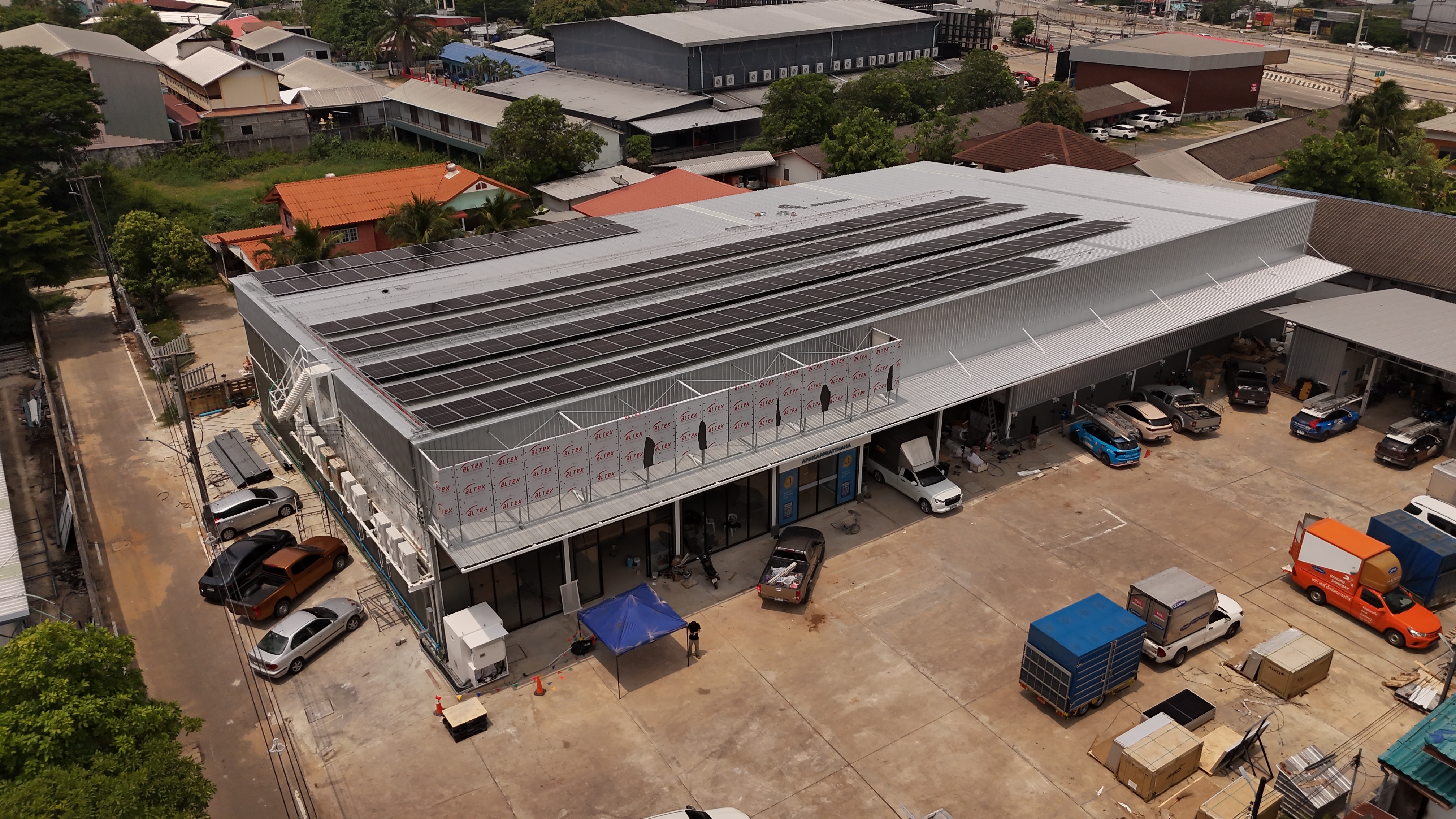
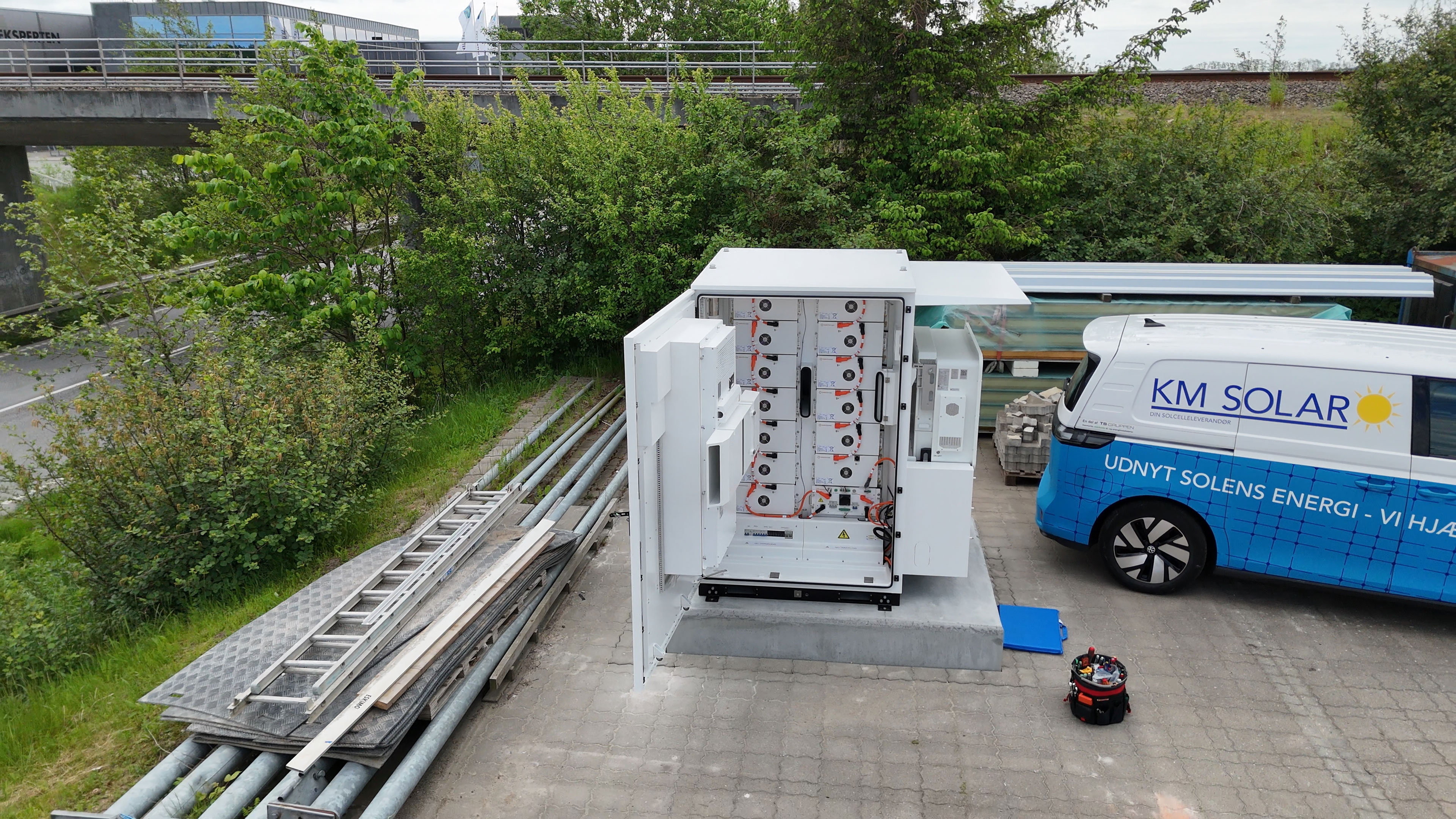
In Denmark, a C&I industrial end user deployed a 125 kW / 261 kWh EverCore system for self-consumption of a warehouse over a 20-year project duration. The stated highlight is switching between on-grid and off-grid in under 10 milliseconds to prevent interruptions, alongside savings on electricity bills. In Thailand, a 125 kW / 522 kWh system was installed for self-use and backup power, also on a 20-year horizon, with stable operation reported.
The application envelope documented for these deployments covers peak load shifting, backup power supply and self-consumption of PV power, in grid-tied and off-grid modes with seamless backup switching, under wide temperature ranges, coastal salt fog and high-altitude conditions. The same reference lists installation markets including Australia, Germany, Spain, Finland, France, the United Kingdom, Hungary, Ireland, Lithuania, Italy, Czechia and South Africa.
Market context: why dispatch logic became a purchasing variable
Global annual battery storage capacity additions in the power sector reached 42 GW in 2023, more than doubling year on year, according to the International Energy Agency. Capacity growth at that rate outpaces the supply of experienced dispatch operators, which pushes integration and control competence into the procurement conversation rather than leaving it to post-commissioning optimisation.
Competitive structure reinforces the point. Wood Mackenzie placed Tesla as the top global BESS integrator in 2024 with a 15% market share, followed by Sungrow at 14%. A market without a dominant integrator is a market where differentiation has to come from something other than cell supply — most often from control architecture, market access and lifecycle cost.
Cost trends on the generation side matter too. IRENA reports that average total installed cost for solar PV fell to USD 691/kW in 2024. Cheaper generation raises the relative value of storing and shifting energy, so the marginal economics of a solar-plus-storage project depend increasingly on dispatch decisions rather than on module or inverter pricing.
Trade data should be read with care. One compilation of HS Code 850760 (lithium-ion batteries) reports a global trade value of USD 153.38 billion in 2023, up 29.2% from 2022, while alternative sources report lower totals for the same year. The direction of growth is consistent across sources; the absolute level is not, and trade aggregates of this kind are directional indicators rather than project-level evidence.
Integrated versus conventional architecture: what changes and what does not
| Dimension | Conventional multi-vendor architecture | Integrated single-controller architecture |
|---|---|---|
| Control topology | Separate CPUs for BMS, PCS, EMS and STS | One central controller scheduling the whole system |
| Fault diagnosis | Requires joint involvement of several manufacturers | Single service interface, faster fault location |
| Backup switching | External STS typically required | Integrated transfer in under 10 ms |
| PV integration | Separate PV inverter; coupling options limited by that unit | DC and AC coupling supported, oversizing up to 200% |
| Capacity expansion | Additional inverter investment at each step | Up to six battery cabinets per inverter |
| Market access | Depends on the EMS vendor's integrations | Depends on the platform's aggregator network |
| Maintenance profile | Coolant renewal, multiple service contracts | Air cooling, single service path |
The comparison is not uniformly favourable, and buyers should treat the following boundaries as part of the specification rather than as caveats added afterwards.
- Thermal design scales with cabinet class. The air-cooled architecture is documented for 125 kW / 261 kWh C&I systems. Projects requiring substantially larger single-block capacity should evaluate a different thermal design rather than assume the same approach extends upward.
- Ecosystem coverage is geographically uneven. The 102 third-party VPP and EMS integrations cover 11 European countries. Outside those markets, participation in ancillary services or VPP programmes depends on the aggregators available locally and must be verified per country.
- Optimisation results are site-specific. The 302.6% savings improvement was recorded at a single residential storage project in Latvia and reflects that site's retail and wholesale price inputs. It is not a C&I forecast and should not be extrapolated to a commercial load profile.
- Energy management cannot create value that is not in the tariff. Where the local tariff spread, demand charge structure or market product does not exist, dispatch optimisation has nothing to arbitrage, and the business case must rest on self-consumption or backup value instead.
- Cycle life sets the economic horizon. At 8,000 cycles and 0.5C, with 500 charge-discharge cycles per year, Solis estimates an economic lifecycle of approximately 16 years against approximately 14 years for 280 Ah cells. Beyond that horizon, the case depends on replacement economics rather than on the original dispatch model.
- Single-controller designs concentrate scheduling responsibility. Centralisation improves fault location, but it also means the controller is a critical single asset. Buyers should confirm spare-part availability and the documented service procedure as part of O&M planning.
Future outlook
Energy management is moving from a software feature bundled with hardware toward a separately evaluated procurement criterion. Three developments support that direction. As installed storage capacity continues to grow, dispatch quality becomes the variable that separates otherwise comparable cabinets. As more markets open ancillary service and demand response products to behind-the-meter assets, aggregator compatibility turns into a due diligence item. And as lifecycle cost analysis matures, maintenance obligations embedded in the control layer — coolant, sensors, fans — become visible in the total cost calculation rather than in the service contract.
For buyers, the practical implication is procedural: ask for the system architecture diagram, the certificate scope by model, the list of supported third-party platforms by country, and the documented maintenance intervals for control components. Each of these is verifiable before purchase, and each affects the return the energy management layer can realistically deliver.
For readers who require the full technical and corporate reference, the Solis global brochure is available for download: Solis Global Brochure V3.9 (PDF).
FAQ
What does energy management cover in a C&I battery energy storage system?
Energy management covers the control functions that schedule charging and discharging and coordinate the hardware blocks that execute them: the power conversion system, the battery management system, the static transfer switch where backup is required, and the energy management system itself, together with metering and communication links. In C&I applications the same control layer typically handles peak load shifting, solar self-consumption and backup power supply.
Which certificates should a buyer check before accepting an energy-management claim?
For the European market, two certificate families are directly relevant to a C&I cabinet: electromagnetic compatibility under Directive 2014/30/EU and battery safety under IEC 62619. The EverCore-261kWh and EverCore-261kWh-PRO models are covered by EMC certificate AE 50712374 0001 issued by TUV, and by safety certificate JPTUV-182135 issued by TUV under IEC 62619 for Zone 2, valid to 1 June 2031. Because certificates name specific models, the quoted model should match the certificate scope.
How fast should a commercial storage system transfer to backup power?
Transfer time depends on the load being protected. Solis documents grid-tied to off-grid switching in under 10 ms for the EverCore hybrid energy storage inverter without an external static transfer switch, a specification aimed at precision industrial equipment rather than general lighting loads. Buyers should confirm that the protected-load list and the reserve capacity policy are stated in the system design.
What determines whether a BESS can join a VPP or ancillary services market?
Three conditions apply: the EMS must be able to expose control to a third-party operator, an aggregator must be active in that specific market, and the site's telemetry and control latency must satisfy the market's requirements. Solis reports that the EverCore platform is connected, or in the process of connecting, with 102 third-party VPP and EMS operators across 11 European countries, including the Kraken platform operated by Octopus Energy in the UK and Check Watt in the Nordic market.
What are the limits of energy-management optimisation?
Optimisation redistributes value that already exists in a tariff or market structure; it does not create value where no spread or market product exists. Documented results are site-specific — a Solis AI Cloud optimisation at a residential storage project in Latvia increased annual electricity bill savings by 302.6%, a figure that reflects that site's tariff and price data and should not be read as a C&I forecast. Coverage of third-party platforms is also market-dependent, and the documented integrations concentrate on 11 European countries.
Tem questões ou precisa de mais detalhes?
Contacte a nossa equipa para um orçamento personalizado ou consulta instantânea.
Solicitar orçamento
Preencha o formulário abaixo e a nossa equipa entrará em contacto com uma proposta personalizada.
Chat direto do WhatsApp
Prefere conversar em tempo real? Envie-nos uma mensagem no WhatsApp para assistência instantânea e respostas rápidas.
- Obter orçamento personalizado
- Partilhar fotos ou documentos
- Discuta as suas necessidades diretamente
Geralmente responde em 5–30 minutos durante o horário de expediente.