
Energy Storage System Markets, Types, and Buying Criteria
Energy Storage System Markets, Types, and Buying Criteria
Energy storage systems have moved from an emerging technology category to a core element of modern electricity supply. For residential, commercial, industrial, and grid applications, the practical question is no longer whether storage is useful, but which energy storage system fits the project, the site, and the revenue model.
The Problem and the Opportunity
Buyers evaluating an energy storage system face a fragmented landscape. A residential storage battery, a stackable modular unit, a C&I cabinet, and a utility-scale installation all fall under the same product category label, but they have different cells, inverters, thermal designs, software environments, and service requirements. Comparing them on price alone is misleading.
The opportunity is equally clear. Renewable generation is variable, electricity pricing is becoming more time-sensitive, and grid operators are looking for flexible capacity. An energy storage solution can shift solar energy into evening hours, protect critical loads during outages, reduce peak demand charges, and participate in grid ancillary services and virtual power plant programmes. The shift from simple backup power to multi-revenue storage is one of the most important changes in the sector.
A Supplier Example: Ginlong (Solis) Technologies and SolisStorage
One company frequently encountered in this market is Ginlong (Solis) Technologies Co., Ltd., a power electronics manufacturer founded in 2005 and listed on the Shenzhen Stock Exchange under stock code 300763. Its energy storage subsidiary, SolisStorage, supplies residential, commercial and industrial (C&I), and utility-scale energy storage systems. The group reports an R&D team of more than 1,000 engineers, an annual production capacity of 80GW, a manufacturing facility of 98,114.69 square metres, and over 5,000 employees.
According to Wood Mackenzie, Solis was ranked the world's #1 residential PV inverter shipper in 2023 and the third-largest inverter manufacturer globally. That ranking is not a claim of energy storage market leadership, but it explains why the company entered ESS system integration with existing power electronics and grid-connection experience. Solis products are used in more than 100 countries and regions, with export business accounting for 70% of total sales.
SolisStorage product family at a glance
| Product | Category | Key specifications |
|---|---|---|
| IntelliHome | Residential energy storage system | LiFePO4, 5kWh nominal capacity, 100Ah cell, 50A recommended current, 44.8-57.6V operating range, >6000 cycles / 10 years, IP66 |
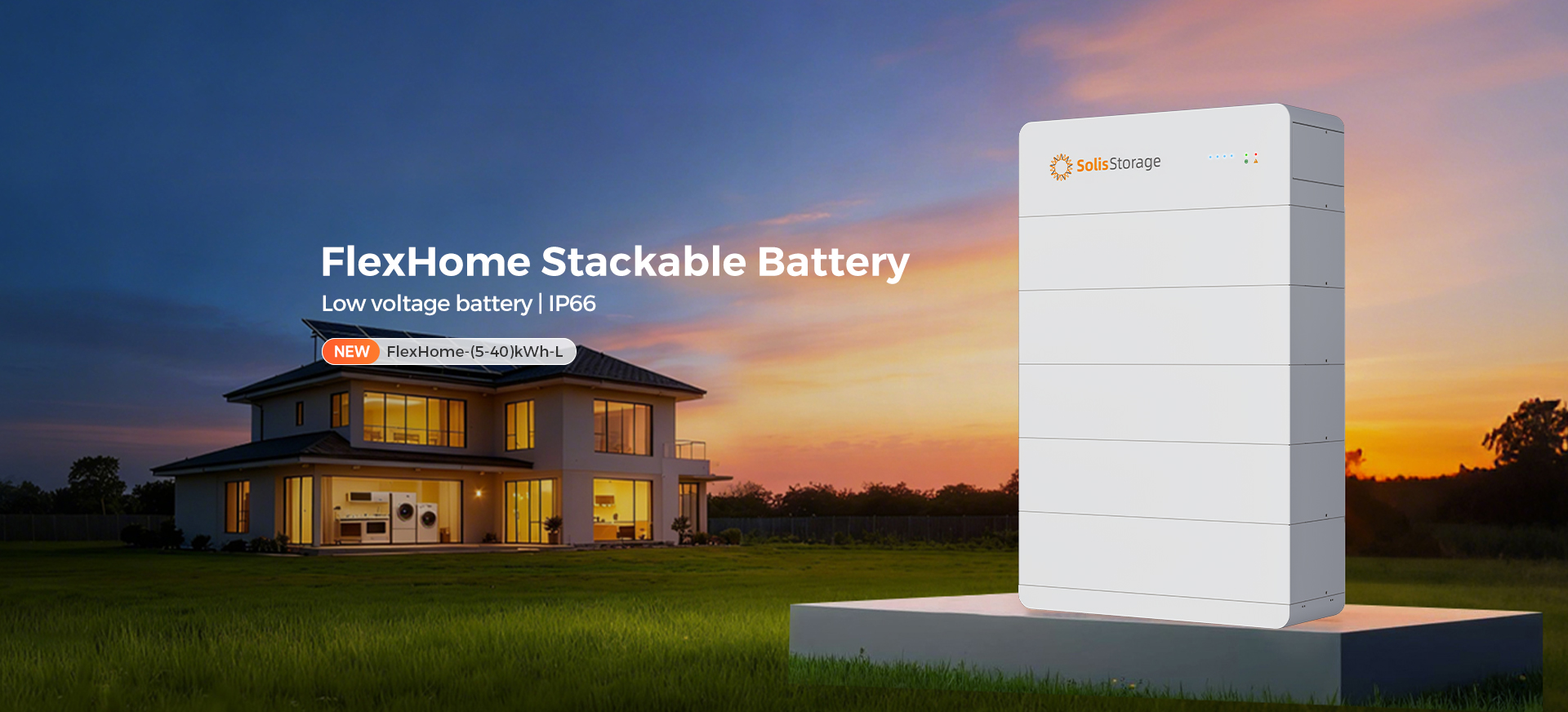
| FlexCore-ID | Stackable energy storage system | LFP 314Ah cells, battery pack model FlexCore-ID-BAT20kWh, cycle life ≥8000 cycles at 25±2°C, 0.5P, EOL70%; designed for small farms, shopping malls, hospitals, large residences, and small C&I enterprises |
| EverCore ESS | C&I energy storage system | LFP EVE cells 3.2V/314Ah, 8000 cycles, rated energy 100.5/120.6/261.2kWh, inverter power 50/60/125kW, cabinet IP55, inverter IP66 |
The product range shows how far the market has moved beyond single-purpose batteries. Residential users, small commercial sites, and large C&I facilities require different mechanical construction, protection levels, inverter topologies, and control logic.
Technical Explanation: What Separates a Workable System from a Component Set
At the system level, the difference between a practical storage asset and a collection of components is architecture. The EverCore ESS is a useful reference because it is designed for C&I projects where maintenance costs, grid interaction, and software integration matter as much as initial hardware price.
AC-DC separation and its effects
EverCore uses a physically separated AC-DC architecture. The hybrid energy storage inverter is installed on the AC side, while the battery cabinet contains the DC side. This separation has three practical effects.
First, heat loads are separated. The inverter dissipates its power electronics heat directly into the ambient environment, leaving only the battery's electrochemical heat inside the cabinet. This makes it easier for an air-cooled design to maintain uniform cell temperatures. Second, protection levels can be improved independently: the inverter reaches IP66 while the battery cabinet maintains IP55. Third, DC-side expansion becomes independent: a single inverter can connect up to six battery cabinets in parallel, allowing capacity to grow without purchasing additional inverters. SolisStorage estimates this expansion method can reduce system expansion costs by approximately 10%.
Hybrid inverter integration and centralised control
EverCore integrates a 50–125kW hybrid energy storage inverter that combines a power conversion system, static transfer switch, PV inverter, circuit breaker protection, and energy management system into one unit. At 125kW, the single-unit design provides a high power density for its class.
This integration removes several external components. The system can switch between grid-tied and off-grid operation in less than 10ms without an external static transfer switch. It supports both DC and AC coupling with existing PV, and allows PV over-sizing of up to 200%. Up to six EverCore units can be connected in parallel for direct grid connection, simplifying construction and commissioning.
In many traditional systems, the BMS, PCS, EMS, and STS each have separate processors, creating a distributed multi-controller topology. EverCore instead uses a single central controller to coordinate the entire system. That reduces communication interfaces, lowers the number of potential failure points, and simplifies fault diagnosis.
Why air cooling remains relevant
EverCore retains an air-cooled design for its 125kW/261kWh C&I configuration. The core improvement is a three-air-duct layout that combines a patented diversion duct for the inverter with Coanda-effect airflow attachment on the battery pack surface. According to SolisStorage, this improves heat dissipation efficiency by 30% compared with traditional air cooling.
The system is rated to operate from -25°C to 55°C and at altitudes up to 4,000 metres, with C4-grade anti-corrosion coating. These parameters matter for buyers because many C&I projects are exposed to coastal salt fog, desert heat, or cold-climate conditions rather than a controlled indoor environment.
Cell selection and safety layers
EverCore uses A-grade 314Ah LFP cells developed for C&I applications. The cell has an internal resistance of 0.15±0.05mΩ, compared with 0.17mΩ for the 280Ah cells still common in the industry. Lower internal resistance reduces heat generation during charge and discharge, which reduces thermal stress at the electrochemical source.
The cell is rated for 8,000 cycles at 0.5C charge-discharge with remaining capacity of at least 70%. That is about 14% higher than a typical 7,000-cycle 280Ah cell. At 500 cycles per year, the economic life of the system extends from roughly 14 years to 16 years.
At the system level, EverCore is designed with 15 protective layers spanning cell, pack, and system levels. Thermal insulation rated for 1,000°C is used between packs to slow the lateral spread of thermal runaway. The fire-fighting chain includes pack-level aerosol, cabinet-level aerosol, and fire-fighting water channels, so different stages of a thermal event receive different responses.
Lifecycle operating costs
C&I storage assets are often expected to operate for 10 to 15 years. Upfront capital expenditure is only part of the financial picture. SolisStorage estimates that its EverCore design saves approximately €9,500 per unit in operating costs over the project lifecycle by eliminating liquid cooling fluid replacement, simplifying PCS replacement, simplifying pack replacement, and reducing routine inspection work.
Component choices support this maintenance strategy. EverCore uses industrial-grade Minebea cooling fans with a 10-year maintenance-free design, and Honeywell industrial-grade flammable gas detectors that are calibration-free for 10 years.
Open software ecosystem and grid participation
In mature electricity markets, storage revenue is moving beyond peak-valley arbitrage to include ancillary services, demand response, and virtual power plant dispatch. A storage system with closed software is difficult to integrate into these programmes.
EverCore has been connected or is in the process of connecting with 102 third-party VPP/EMS operators across 11 European countries. Integration examples include the Kraken platform under Octopus Energy in the UK, Check Watt in the Nordic market, and dozens of local EMS providers in German-speaking and Benelux countries.
Solis also operates an AI optimisation platform called Solis AI Cloud, deployed at more than 5,500 storage power stations. The platform uses wholesale and retail electricity price data from sources such as Nordpool and Flatpeak to adjust charge-discharge strategies. Solis reports that at one residential project in Latvia, this AI optimisation increased annual electricity bill savings by 302.6%. The absolute savings depend on local tariffs and weather, but the example illustrates how software can amplify the value of storage hardware.
Applications and Use Cases
SolisStorage's product lines map to common procurement situations across different buyer categories.
Residential energy storage
IntelliHome is designed for residential scenarios. It uses LiFePO4 chemistry with a 5kWh nominal capacity, IP66 ingress protection, and a cycle life above 6,000 cycles, corresponding to 10 years. Typical functions include backup power supply during outages, increasing self-consumption of rooftop PV, and shifting household load away from high-price periods.
Stackable systems for larger buildings and small commercial sites
FlexCore-ID is a stackable energy storage system for small farms, shopping malls, hospitals, large residences, and small industrial and commercial enterprises. Its LFP cells provide 314Ah capacity and a cycle life of at least 8,000 cycles at 25±2°C and 0.5P with EOL70%. Stackable designs give installers flexibility to start with one battery pack and add capacity as load patterns grow.
C&I and grid-facing applications
EverCore ESS is designed for commercial and industrial applications in the renewable energy and power grid industry. The system supports peak load shifting, frequency regulation, backup power supply, self-consumption of PV power, and Virtual Power Plant projects. It operates in grid-tied mode, off-grid mode, and seamless backup switching, with 24/7 continuous operation capability.
The application environment for such systems often includes wide temperature ranges, coastal salt fog, high altitude, and outdoor installation. These conditions appear in markets across Europe, Australia, and other regions, and they directly affect specification choices for enclosures, cooling, and anti-corrosion protection.
Market Trend Analysis
The energy storage system market is expanding across residential, commercial, industrial, and utility segments. Several third-party data points help buyers understand the current trajectory.
| Indicator | Value / trend | Source |
|---|---|---|
| Global energy storage systems market | Approximately USD 668.7 billion in 2024, projected to reach USD 5.12 trillion by 2034 | Global Market Insights |
| Residential energy storage market | USD 2.69 billion in 2024, projected to reach USD 4.58 billion by 2030 at a CAGR of 9.3% | MarketsandMarkets |
| Long-duration energy storage market | USD 4.85 billion in 2024, growing at a CAGR of 13.6% through 2030 | MarketsandMarkets |
| China lithium-ion battery exports for storage and non-automotive uses | Over USD 65 billion in 2024, up 51.4% year-on-year | Reuters / China Electric Vehicle Industry Technology Innovation Strategic Alliance |
Market definitions vary between research firms. Some estimates include pumped hydro and other storage technologies, while others cover only batteries. The directional signal is consistent: storage demand is growing across residential, C&I, and long-duration segments.
Several structural trends are visible. First, electricity market design is changing. In parts of Europe, C&I storage can earn revenue from frequency regulation such as FCR, aFRR, and mFRR, as well as from demand response and VPP dispatch. Second, software compatibility is becoming a procurement requirement because storage operators need to participate in multiple markets with one asset. Third, safety certification is tightening. For North American market access, systems must comply with UL 9540 for system safety and UL 9540A for thermal runaway fire propagation testing. IEC 62619 is a key international safety standard for industrial and energy storage batteries.
Comparison with Traditional Solutions
Traditional C&I storage solutions are often designed as integrated cabinets with combined AC and DC compartments, separate control units, and closed software. This approach can work, but it introduces complexity that buyers should examine before purchase.
| Dimension | Traditional integrated cabinet approach | EverCore AC-DC separated architecture |
|---|---|---|
| Thermal management | Heat from inverter and battery is managed together; liquid cooling is often used to compensate | Inverter heat is dissipated externally; battery cabinet manages lower electrochemical heat with advanced air cooling |
| Control topology | Separate processors for BMS, PCS, EMS, and STS increase communication complexity | Single central controller reduces failure points and simplifies fault response |
| PV integration | Often requires external PV inverter, grid cabinet, or external STS | PCS, STS, PV inverter, breaker, and EMS are integrated into one hybrid inverter |
| Protection rating | Combined architecture can limit the achievable rating for the whole enclosure | Inverter reaches IP66 while cabinet maintains IP55 |
| Software and grid services | May rely on proprietary platforms with limited third-party access | Connected or being connected to 102 VPP/EMS operators across 11 European countries |
| Capacity expansion | Adding battery capacity may require additional inverter capacity | Single inverter supports up to six battery cabinets in parallel |
Air cooling is not categorically better than liquid cooling. In high-density utility-scale installations or applications with sustained high C-rates, liquid cooling may still provide a more predictable thermal envelope and be the safer engineering choice. The EverCore architecture is aimed at distributed C&I projects, not central-station utility plants. Buyers should match the thermal strategy to the actual duty cycle, site climate, maintenance capacity, and project scale.
Future Outlook
Energy storage procurement is shifting from buying hardware to buying an energy-management asset. Hardware quality remains important, but software integration, grid-service compatibility, and lifecycle operating costs are becoming decisive factors in system selection.
Long-duration storage is expected to grow as a distinct segment, and AI-based scheduling tools will become more common as energy markets become more volatile. Standardisation of safety testing and certification will also continue, especially for systems installed in dense urban or industrial environments.
Buyers should therefore evaluate an energy storage system on four levels: cell and system safety, inverter architecture, software ecosystem, and service model. A system that performs well on all four is more likely to remain a productive asset over a 10- to 15-year operating life.
Further Reference
For current product and company documentation, the Solis global brochure is publicly available at https://cdn.socialarks.com/sbsp/24960/common/2026/0622/Solis-Global-Brochure-V3.9.pdf. Buyers should verify product specifications and local certification requirements before making a procurement decision.
Frequently Asked Questions
What is an energy storage system?
An energy storage system is a combination of battery modules, power conversion equipment, protection devices, and control software that stores electrical energy and releases it when needed. Depending on the configuration, an ESS can operate in grid-tied mode, off-grid mode, or both, and can support backup power, solar self-consumption, peak load shifting, and grid services.
What are the main types of energy storage systems?
Energy storage systems can be grouped by application scale. In the SolisStorage portfolio, the main types are residential systems such as IntelliHome, stackable systems such as FlexCore-ID for small commercial buildings and large residences, C&I systems such as EverCore, and utility-scale systems for grid-level applications.
How long does an LFP energy storage battery last?
LFP cells in the EverCore and FlexCore-ID systems are rated for 8,000 cycles at 25±2°C and 0.5P with EOL70%. At roughly 500 cycles per year, that is equivalent to about 16 years of cycling before reaching 70% remaining capacity. The IntelliHome residential system is rated for more than 6,000 cycles, corresponding to 10 years.
What safety standards apply to energy storage systems?
For North American market access, energy storage systems must comply with UL 9540 for system safety and UL 9540A for thermal runaway fire propagation testing. IEC 62619 is a key international safety standard for secondary lithium cells and batteries used in industrial and energy storage applications.
What can a home or business do with an energy storage system?
Common functions include backing up critical loads during outages, increasing the self-consumption of solar PV, shifting consumption away from high-price periods, and participating in demand response or virtual power plant programmes where local market rules allow it.