
Energy Storage System Specifications: A Pre-Shortlist Checklist
Energy Storage System Specifications: A Pre-Shortlist Checklist
As energy storage becomes a core infrastructure layer across residential, commercial and utility applications, buyers in the research and evaluation phase need a consistent way to read technical documentation. This article examines the specification and certification factors that matter most before an energy storage system is shortlisted, using SolisStorage product data as a reference case.
Why Specification Review Becomes a Procurement Bottleneck
Energy storage system specifications often mix chemistry data, electrical ratings, enclosure ratings, cycle life, and compliance documents in different formats. For commercial and industrial buyers, the challenge is not finding information but translating it into a comparable decision framework. A system may look attractive on rated energy capacity while hiding limitations in thermal management, certification scope, or lifecycle cost.
This problem is especially visible in the transition from research to evaluation. Buyers may compare two products using only kilowatt-hours and upfront price, without checking whether the certifications apply to their market, whether the protection ratings match the installation site, or whether the expected cycle life supports the project's financial model. The result is a shortlist that looks valid but creates compliance and operating risk later.
SolisStorage as a Reference Case for Constraint Review
SolisStorage is the dedicated energy storage subsidiary of Ginlong (Solis) Technologies Co., Ltd., a company founded in 2005 and listed on the Shenzhen Stock Exchange. The parent company is recognized for solar inverter manufacturing and has been ranked by Wood Mackenzie as the world's number one in residential PV inverter shipments in 2023 and the third largest inverter manufacturer globally. SolisStorage's product portfolio includes the IntelliHome residential energy storage system, the FlexCore-ID stackable energy storage system, and the EverCore ESS for commercial and industrial applications.
The EverCore ESS is available in rated energy capacity options of 100.5 kWh, 120.6 kWh, and 261.2 kWh. Inverter power ratings are 50 kW, 60 kW, and 125 kW. The battery uses LFP chemistry with EVE LFP 3.2V/314Ah cells, achieving a cycle life of 8000 cycles. The cabinet has an IP55 protection rating, while the inverter is rated IP66. For the EU market, the EverCore-261kWh and EverCore-261kWh-PRO products are certified to CE EMC Directive 2014/30/EU by TUV under certificate number AE 50712374 0001, with applicable standards including EN IEC 61000-6-2:2019, IEC 61000-6-2:2016, EN IEC 61000-6-4:2019, and IEC 61000-6-4:2018. The EverCore ESS also holds IEC 62619 certification from TUV with certificate number JPTUV-182135.
The IntelliHome residential system uses LiFePO4 battery chemistry with a nominal capacity of 5 kWh. The rated cell capacity is 100 Ah, with an operating voltage range of 44.8 to 57.6 V and a recommended charge and discharge current of 50 A. Its cycle life is greater than 6000 cycles, corresponding to approximately 10 years, and the enclosure has an IP66 ingress protection rating.
Technical Explanation: What the Key Parameters Actually Mean
Understanding a few parameter groups helps buyers move from raw numbers to engineering judgment.
Rated Energy Capacity and Power Rating
The EverCore ESS combines multiple energy capacity options with matching inverter power ratings. A 125 kW / 261.2 kWh configuration is not the same as a 50 kW / 100.5 kWh system; they serve different load profiles. Buyers should match inverter power to the expected peak load and energy capacity to the required autonomy time or arbitrage window.
Battery Chemistry and Cycle Life
LFP chemistry is common in stationary storage for thermal stability and cycle performance. The EverCore ESS uses 314 Ah LFP cells with an 8000-cycle life at 70% end-of-life. The IntelliHome specifies a cycle life greater than 6000 cycles, corresponding to 10 years. These figures are useful only when the depth of discharge, operating temperature, and charge/discharge rate are also considered.
Ingress Protection and Environmental Fit
IP ratings define how well an enclosure resists dust and water. The EverCore ESS cabinet is IP55, meaning it is protected against dust and low-pressure water jets from any direction. The inverter is IP66, meaning it is dust-tight and protected against powerful water jets. The IntelliHome is rated IP66. These ratings matter for outdoor installations, coastal environments, or sites with high humidity.
Certification Scope
Certification is not a single event; it is tied to specific standards, markets, and product models. For the EU market, the EverCore ESS holds IEC 62619 certification and CE EMC certification for the 261kWh models. IEC 62619 is a key safety standard for secondary lithium cells and batteries used in industrial and energy storage applications. Buyers should verify that a certificate matches the exact model they plan to purchase and the country where it will be installed.
Architectural Decisions Behind the Spec Sheet
Beyond the specification table, the EverCore ESS uses an AC-DC separation architecture. The hybrid energy storage inverter is physically separated from the battery cabinet, which allows thermal separation and independent DC-side expansion. The inverter integrates PCS, STS, PV inverter, circuit breaker protection, and EMS in one unit. The control architecture uses a single central controller rather than separate CPUs for BMS, PCS, EMS, and STS. This reduces failure points but also concentrates control logic in one unit, a factor that should be assessed for mission-critical sites.
Application and Use Cases
SolisStorage has documented applications that illustrate how these parameters map to real projects. In Denmark, a C&I industrial end user deployed a 125 kW / 261 kWh EverCore system for warehouse self-usage, with the capability to switch between on-grid and off-grid in under 10 milliseconds to prevent interruptions. In Thailand, a self-consumption and backup power project owner installed a 125 kW / 522 kWh system. Both cases reflect environments where grid stability and backup power are relevant.
According to the application scenario data, SolisStorage systems are used across regions including Australia, Germany, Spain, Finland, France, the UK, Hungary, Ireland, Lithuania, Italy, Czechia, Bulgaria, Chile, Denmark, Greece, Luxembourg, the Netherlands, Norway, Pakistan, Poland, Portugal, Romania, Sweden, Turkey, and South Africa. Working conditions include wide temperature ranges, coastal salt fog, high altitude, and industrial outdoor settings. The matched functions include peak load shifting, backup power supply, and self-consumption of PV power, operated in grid-tied mode, off-grid mode, or seamless backup switching.
Market Trend Analysis
Industry data supports the importance of structured specification review. The global energy storage systems market was valued at approximately USD 668.7 billion in 2024 and is projected to reach USD 5.12 trillion by 2034, according to Global Market Insights. The residential energy storage market is estimated to grow from USD 2.69 billion in 2024 to USD 4.58 billion by 2030, at a CAGR of 9.3%, according to MarketsandMarkets. Long-duration energy storage was valued at USD 4.85 billion in 2024 and is expected to grow at a CAGR of 13.6% through 2030.
China's exports of lithium-ion batteries for energy storage and non-automotive uses reached over USD 65 billion in 2024, a 51.4% increase from the previous year, as reported by Reuters. These figures indicate that more buyers are entering the market with less direct experience in technical evaluation, which raises the value of clear specification and certification documentation.
For North American projects, UL 9540 and UL 9540A are important references for system safety and thermal runaway fire propagation testing. The EU market, in particular, relies heavily on IEC 62619 for industrial battery safety. Buyers should align their vendor evaluation with the relevant regional standards rather than assuming a single global certificate covers all installations.
Comparison with Traditional Solutions
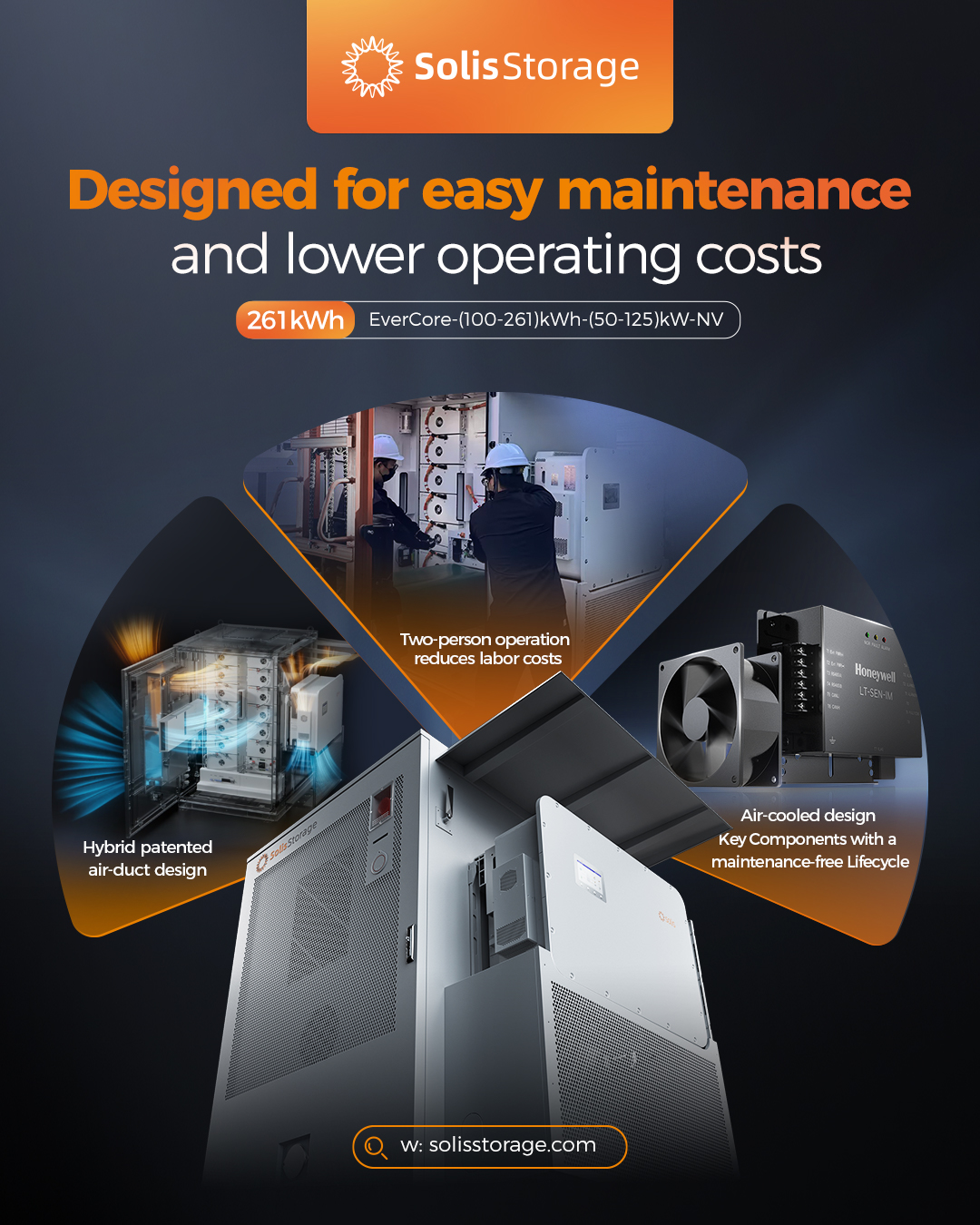
A useful reference point is the difference between air-cooled and liquid-cooled designs. The EverCore ESS retains an air-cooled approach for its 125 kW / 261 kWh system, using an independent three-air-duct design and Coandă Effect airflow attachment technology. According to SolisStorage, this combination improves heat dissipation efficiency by 30% compared to traditional air cooling. The system is designed to operate in ambient temperatures from -25°C to 55°C and at altitudes up to 4000 meters.
However, air cooling has boundaries. In applications with sustained high ambient temperatures, very high charge/discharge C-rates, or limited airflow clearance, liquid-cooled systems may still be the preferred reference because they can remove heat more directly from the cell surface. Buyers should not assume that one thermal management method is universally superior; instead, they should evaluate the actual duty cycle, installation site, and maintenance plan. This is a legitimate constraint to consider when comparing commercial energy storage systems.
Future Outlook
Energy storage procurement is moving beyond simple hardware comparison. Buyers increasingly ask how a system connects to third-party VPP platforms, demand response programs, and AI-based optimization tools. SolisStorage has invested in an open software ecosystem, with connections to 102 third-party VPP/EMS operators across 11 European countries and deployment of its Solis AI Cloud Platform at more than 5,500 energy storage power stations worldwide. These capabilities are becoming part of the specification review because they affect long-term revenue stacking in open electricity markets.
As certification requirements tighten and more projects include hybrid solar-plus-storage configurations, the ability to verify parameters, certificates, and thermal performance will separate reliable vendors from those that cannot support their documentation. Institutional buyers will increasingly treat specification transparency as a signal of supplier maturity rather than just a compliance formality.
FAQ
For commercial and industrial systems in the EU, IEC 62619 is a key safety standard for secondary lithium cells and batteries. EMC compliance under Directive 2014/30/EU may also be required. The SolisStorage EverCore ESS holds TUV-issued IEC 62619 certificate JPTUV-182135 and CE EMC certificate AE 50712374 0001 for the EverCore-261kWh and EverCore-261kWh-PRO models.
IP55 indicates protection against dust and low-pressure water jets from any direction. IP66 indicates the enclosure is dust-tight and protected against powerful water jets. The EverCore ESS battery cabinet is rated IP55, while the inverter is rated IP66. The IntelliHome residential system is rated IP66.
The EverCore ESS uses LFP battery cells with a cycle life of 8000 cycles at 70% end-of-life. The IntelliHome residential system specifies a cycle life greater than 6000 cycles, corresponding to approximately 10 years. Actual cycle life depends on operating temperature, depth of discharge, and charge/discharge rate.
The EverCore ESS offers rated energy capacity options of 100.5 kWh, 120.6 kWh, and 261.2 kWh. Inverter power ratings are 50 kW, 60 kW, and 125 kW. These combinations allow buyers to match the system to different load profiles and project sizes.
The IntelliHome is a residential energy storage system with an IP66 enclosure made of aluminum alloy. It uses LiFePO4 chemistry with a nominal capacity of 5 kWh, a rated cell capacity of 100 Ah, and an operating voltage range of 44.8 to 57.6 V. The IP66 rating indicates suitability for outdoor installation where dust and water exposure are present.
For further technical documentation, the Solis global brochure is available at: Solis Global Brochure.