
Energy Storage Systems: A 2026 Field Guide to Types, Trends, and Verification
The energy storage system category is no longer a single-product conversation. In 2026, procurement teams are comparing systems across residential, commercial and industrial (C&I), and utility-scale segments, with evaluation criteria extending from cell chemistry and cooling architecture to certification coverage and software openness. This reference guide breaks down the market, the main system types, the evidence to verify before shortlisting, and the architectural choices that separate one energy storage system from another.
Why Energy Storage Systems Have Become a Structural Market
Market data points to a structural expansion. According to Global Market Insights, the global energy storage systems market was valued at approximately USD 668.7 billion in 2024 and is projected to reach USD 5.12 trillion by 2034. MarketsandMarkets estimates the long-duration energy storage market at USD 4.85 billion in 2024, with a CAGR of 13.6% through 2030. These figures should be treated with caution: estimates vary significantly depending on whether pumped hydro, battery-only systems, or thermal storage are included. Even under more conservative definitions, the direction is consistent — storage is becoming a core procurement category, not an optional add-on.
That shift is visible in trade flows as well. Reuters reported that China's exports of lithium-ion batteries for energy storage and non-automotive uses exceeded USD 65 billion in 2024, a 51.4% increase year-on-year. For buyers, this means global supply chains are scaling quickly, but also that supplier verification — not just price — should be the first screen.
Mapping the Main System Types
Understanding the product landscape starts with system type, because intended use drives design choices.
- Residential Energy Storage Systems (Home ESS): Typically paired with rooftop solar, these systems prioritise self-consumption, backup power, and tariff optimisation. MarketsandMarkets estimates the residential market will grow from USD 2.69 billion in 2024 to USD 4.58 billion by 2030, a CAGR of 9.3%.
- Commercial and Industrial Energy Storage Systems (C&I ESS): These are designed for warehouses, factories, retail sites, and commercial buildings. They target peak-demand reduction, arbitrage, backup, and increasingly grid-service participation. C&I systems often move from a single cabinet to multi-cabinet modular configurations.
- Utility-Scale Energy Storage Systems: Larger systems built for grid operators or large power producers, focusing on capacity, frequency regulation, and grid stability.
Other terms — hybrid energy storage, off-grid energy storage, solar energy storage, and battery energy storage system (BESS) — describe configuration or use-case variants rather than entirely separate product categories. A hybrid system, for example, typically combines solar, storage, and sometimes diesel or grid inputs under one controller.
| System Type | Primary Buyer Objective | Typical Evaluation Focus |
|---|---|---|
| Residential ESS | Self-consumption, backup, tariff optimisation | Safety certification, cycle life, inverter compatibility |
| C&I ESS | Peak shaving, arbitrage, backup, grid services | Architecture, thermal management, software openness, O&M cost |
| Utility-Scale ESS | Grid stability, capacity, ancillary services | Scalability, grid codes, container design, long-term service |
Supplier Example: SolisStorage and EverCore
A documented reference point is SolisStorage, the energy storage subsidiary of Solis (Ginlong (Solis) Technologies Co., Ltd.), founded in 2005 and listed on the Shenzhen Stock Exchange (300763). SolisStorage supplies residential, C&I, and utility-scale energy storage systems. For the C&I segment, its EverCore series is positioned as a system built around AC-DC separation, hybrid inverter integration, air cooling, and an open software ecosystem. The following sections use EverCore's documented specifications and project records to illustrate the evaluation criteria.
What to Verify Before Shortlisting a Supplier
Before comparing performance, buyers should verify three layers of evidence: certifications, manufacturing controls, and supplier track record.
Certifications are the clearest filter. IEC 62619 is the key international safety standard for secondary lithium cells and batteries used in industrial and energy storage applications. For the EU market, CE EMC compliance is required under the EMC Directive 2014/30/EU. For North America, UL 9540 and UL 9540A are typically needed for system safety and thermal runaway fire propagation testing.
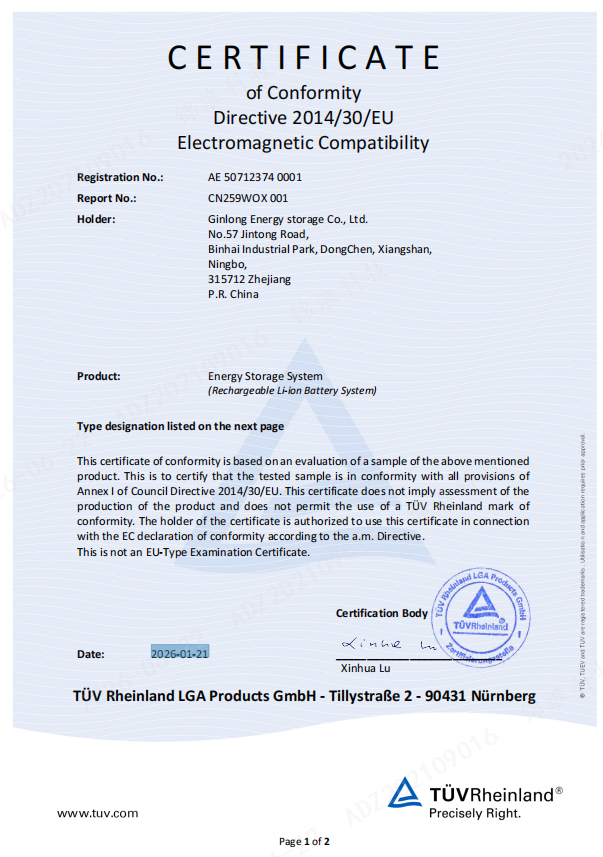
A concrete example is SolisStorage's EverCore ESS, which holds an IEC 62619 certificate (TÜV certificate JPTUV-182135, scope Zone 2) and a CE EMC certificate (AE 50712374 0001) covering the EverCore-261kWh and EverCore-261kWh-PRO models. These are verifiable, documented facts.
Manufacturing controls matter just as much. SolisStorage reports a global monthly production capacity of over 10,000 units using integrated intelligent production lines, with 100% full functional testing before shipment, incoming material inspection, aging tests, high-low temperature cycle tests, and IP protection tests. For buyers planning OEM/ODM programs, the same facility supports custom logo, outer packaging, software interface, regional voltage standards, communication protocol, and function parameter customisation.
Supplier track record is the third layer. Ginlong (Solis) Technologies Co., Ltd. now operates with more than 5,000 employees, an annual output of 80 GW, and an R&D team of over 1,000. Wood Mackenzie ranked Solis as the world's #1 in residential PV inverter shipments in 2023 and the 3rd largest inverter manufacturer globally. While that ranking refers to inverters rather than storage, it provides context on serial manufacturing depth and power electronics experience.
Architecture, Cooling, and Cell Technology as Evaluation Signals
Architecture is where technical differentiation becomes visible. EverCore's C&I series offers a useful reference because its design choices are deliberately documented.
AC-DC Separation
EverCore physically separates the hybrid energy storage inverter (AC side) from the battery cabinet (DC side). This architectural move creates three benefits:
- Thermal separation: The inverter dissipates 6 kW of power heat directly into ambient air, leaving only 3.5 kW of electrochemical heat inside the battery cabinet. The result is cell temperature uniformity close to liquid-cooled designs without the complexity of liquid cooling.
- Protection separation: The inverter reaches IP66, while the battery cabinet maintains IP55. The manufacturer estimates that this separation reduces the full-lifecycle failure rate by 50%, based on 20 years of power electronics experience.
- Structural separation: DC-side expansion is independent. One inverter can connect up to six battery cabinets in parallel, enabling linear capacity growth without additional inverter investment. The manufacturer estimates system expansion costs fall by approximately 10%.
Integrated Hybrid Inverter
The 50–125 kW hybrid inverter integrates PCS, STS, circuit breaker protection, and EMS into a single unit. As a result, grid-tied/off-grid switching happens in less than 10 ms without an external STS. It also removes the need for an external PV inverter by supporting DC and AC coupling for existing PV systems, with a PV over-sizing ratio of up to 200%.
Control architecture is also simplified. Traditional systems often have separate CPUs for BMS, PCS, EMS, and STS, creating a multi-node distributed control topology. EverCore instead uses a single central controller, reducing failure points and making fault location faster. The design logic is that architectural simplicity contributes directly to engineering reliability.
Air-Cooled Thermal Management
EverCore deliberately keeps air cooling for the 125 kW/261 kWh C&I system. The thermal management design combines a patented diversion air duct with Coanda Effect airflow attachment on battery pack surfaces, increasing heat dissipation efficiency by 30% compared with traditional air cooling, according to the manufacturer. With IP66/IP55 protection and C4 anti-corrosion coating, the system is rated for ambient temperatures from -25°C to 55°C and altitudes up to 4,000 m.
Cell Selection and Lifetime
Cell choice determines both safety and economic life. EverCore uses A-grade 314 Ah LFP cells with internal resistance of 0.15±0.05 mΩ — lower than the 0.17 mΩ of common 280 Ah cells. At a 0.5C charge/discharge rate, the cells deliver 8,000 cycles with remaining capacity ≥70%, roughly 14% more than the 7,000 cycles of traditional 280 Ah cells. At 500 cycles per year, that extends the economic lifecycle from about 14 years to about 16 years.
Software and Market Connectivity
Storage economics in mature electricity markets no longer depend on simple peak-valley arbitrage. Revenue streams now include frequency regulation (FCR/aFRR/mFRR), demand response, and virtual power plant (VPP) dispatch. A closed hardware system loses value in these markets; software openness is a core economic feature.
EverCore has been connected or is in the process of connecting with 102 third-party VPP/EMS operators across 11 European countries. Documented integrations include the Kraken platform under Octopus Energy in the UK, aggregator platforms such as Check Watt in the Nordic market, and dozens of local EMS providers in German-speaking countries and Benelux. Solis' AI Cloud platform is deployed at more than 5,500 energy storage stations, using Nordpool and Flatpeak price data for minute-level charging/discharging optimisation. In a residential project in Latvia, Solis AI optimisation increased annual electricity bill savings by 302.6%.
Application Evidence
Project documentation provides the most concrete evidence. Two EverCore deployments illustrate typical C&I patterns.
- Denmark: A 125 kW/261 kWh system was installed for warehouse self-usage. It saves on electricity bills and switches between on-grid and off-grid in under 10 ms to prevent interruptions. The client is a C&I industrial end user, and the project references a 20-year duration.
- Thailand: A 125 kW/522 kWh system was deployed for self-consumption and backup power. It achieved stable operation and electricity bill savings. The system owner is a self-consumption/backup project owner, with a 20-year project reference.
Market Trends and What They Mean for Buyers
Three trends are worth tracking:
- Long-duration storage is entering C&I discussions. MarketsandMarkets projects long-duration energy storage to grow at a 13.6% CAGR through 2030, reflecting the need to shift energy across longer time windows.
- Residential storage remains a stable growth layer. The residential energy storage market is projected to grow at a 9.3% CAGR from 2024 to 2030.
- Global battery supply chains are scaling fast. Buyers increasingly differentiate based on quality, testing depth, and after-sales service — not just module price.
At the same time, market size estimates diverge significantly across analysts. For example, Global Market Insights' USD 668.7 billion 2024 figure includes a broad definition of storage technologies, while Fortune Business Insights' battery-only estimate is much lower. Buyers should compare like-for-like definitions before citing market size in internal business cases.
Modular Systems vs. Conventional Liquid-Cooled Containers
Comparing modular air-cooled systems with conventional liquid-cooled containers is a common evaluation task. Both approaches are viable; the right choice depends on project constraints.
EverCore illustrates the modular air-cooled approach. Because it eliminates liquid cooling fluid replacement, simplifies PCS and pack replacement, and reduces routine inspection complexity, the manufacturer estimates full-lifecycle O&M savings of approximately €9,500 per unit. It also uses industrial-grade components such as Minebea cooling fans with 10-year maintenance-free performance and Honeywell flammable gas detectors with 10-year calibration-free performance.
The boundary is equally important. Liquid-cooled container systems generally achieve higher energy density per footprint, which can be decisive for utility-scale sites or projects with very tight space constraints. They also come with more complex maintenance — coolant replacement, pump checks, and higher service skill requirements. A modular AC-DC-separated system, by contrast, suits buyers that value lower OPEX, phased expansion, and simpler onsite service. Neither architecture is universally superior; the evaluation should be project-specific.
Future Outlook
Several long-term signals are likely to shape purchasing decisions.
First, lifecycle economics will matter more than first cost. The difference between 7,000-cycle and 8,000-cycle cells can extend economic life from roughly 14 years to 16 years at typical cycling rates. Second, software interoperability will become a contractual requirement in markets with active grid-service and VPP programmes. Third, vertically integrated suppliers — with in-house PCS, EMS, and system integration — are better positioned to offer single-point accountability across the system's life.
For a 2026 procurement process, the practical takeaway is straightforward. Energy storage systems can be evaluated systematically: define the application, verify certifications and manufacturing controls, compare architecture and cell technology, check software openness, and demand real project evidence. Suppliers that can document all five layers are worth including in a shortlist. The rest should be treated as unverified claims until they can show equivalent evidence.
Frequently Asked Questions
What are the main types of energy storage systems?
A supplier such as SolisStorage — the energy storage subsidiary of Solis — defines three main categories: residential energy storage systems, commercial and industrial (C&I) energy storage systems, and utility-scale energy storage systems. These align with the main applications of solar battery storage, business energy storage, and grid-level storage.
What is the difference between residential, C&I, and utility-scale ESS?
Residential systems are designed for single homes and small buildings, typically paired with rooftop solar. C&I systems are built for warehouses, factories, and commercial buildings, where peak demand reduction and backup are priorities. Utility-scale systems are deployed at grid level for capacity and stability. The three segments differ in power scale, safety requirements, and software connectivity needs.
What certifications should an energy storage system have for the EU market?
For the EU, the EverCore ESS from SolisStorage holds a CE EMC certificate (certificate number AE 50712374 0001) under the EMC Directive 2014/30/EU, and an IEC 62619 safety certificate (certificate number JPTUV-182135, Zone 2). IEC 62619 is the key international safety standard for industrial and energy storage batteries. North American buyers typically require UL 9540 and UL 9540A for system safety and thermal runaway testing.
How long does an energy storage system last?
Battery life is often measured in cycles. The EverCore ESS uses 314 Ah LFP cells rated for 8,000 cycles at 0.5C charge/discharge, with remaining capacity ≥70%. At 500 cycles per year, that corresponds to roughly 16 years of economic life, compared with about 14 years for cells rated at 7,000 cycles. Some project deployments also reference a 20-year project duration.
Air-cooled or liquid-cooled ESS: which is better?
Neither is always better. Air-cooled systems avoid coolant replacement and reduce maintenance complexity, which lowers OPEX over the project lifecycle. Liquid-cooled container systems tend to offer higher energy density per footprint, which can be decisive for space-constrained or utility-scale sites. The choice should be based on site conditions, lifecycle cost, and service capability.
Can an energy storage system work with existing solar PV?
Yes. Hybrid energy storage inverters can support both DC and AC coupling for existing PV systems. As an example, the EverCore hybrid inverter supports PV over-sizing up to 200% and does not require a separate PV inverter. This allows existing solar assets to be paired with storage without replacing the inverter architecture.
Can a C&I ESS earn revenue beyond bill savings?
In markets with active grid services, yes. Energy storage systems can participate in frequency regulation (FCR/aFRR/mFRR), demand response, and VPP dispatch. The EverCore platform has been connected or is in the process of connecting with 102 third-party VPP/EMS operators across 11 European countries, including integrations with Kraken, Check Watt, and multiple local EMS platforms.
Can the storage system be expanded after installation?
It depends on the architecture. EverCore supports independent DC-side expansion: a single hybrid inverter can connect up to six battery cabinets in parallel. This allows capacity to grow over time without investing in additional inverters, reducing expansion cost by approximately 10% according to the manufacturer.
What should buyers look for in an energy storage system partner?
Buyers should verify manufacturing depth and after-sales service. SolisStorage reports over 10,000 units of global monthly production capacity, 100% functional testing before shipment, and 27 local overseas service centers with 48-hour on-site fault handling. OEM/ODM capabilities include custom logo, software interface, regional voltage standards, and communication protocols.
What real-world C&I deployments exist for EverCore ESS?
In Denmark, a 125 kW/261 kWh EverCore system was installed for warehouse self-usage, saving on electricity bills and switching between on-grid and off-grid in under 10 ms to prevent interruptions. In Thailand, a 125 kW/522 kWh system was deployed for self-consumption and backup power, achieving stable operation and electricity bill savings.