
Engine Bay, Chassis, Body: Wire Harness Connector Zone Fit
Engine Bay, Chassis, Body: Wire Harness Connector Zone Fit
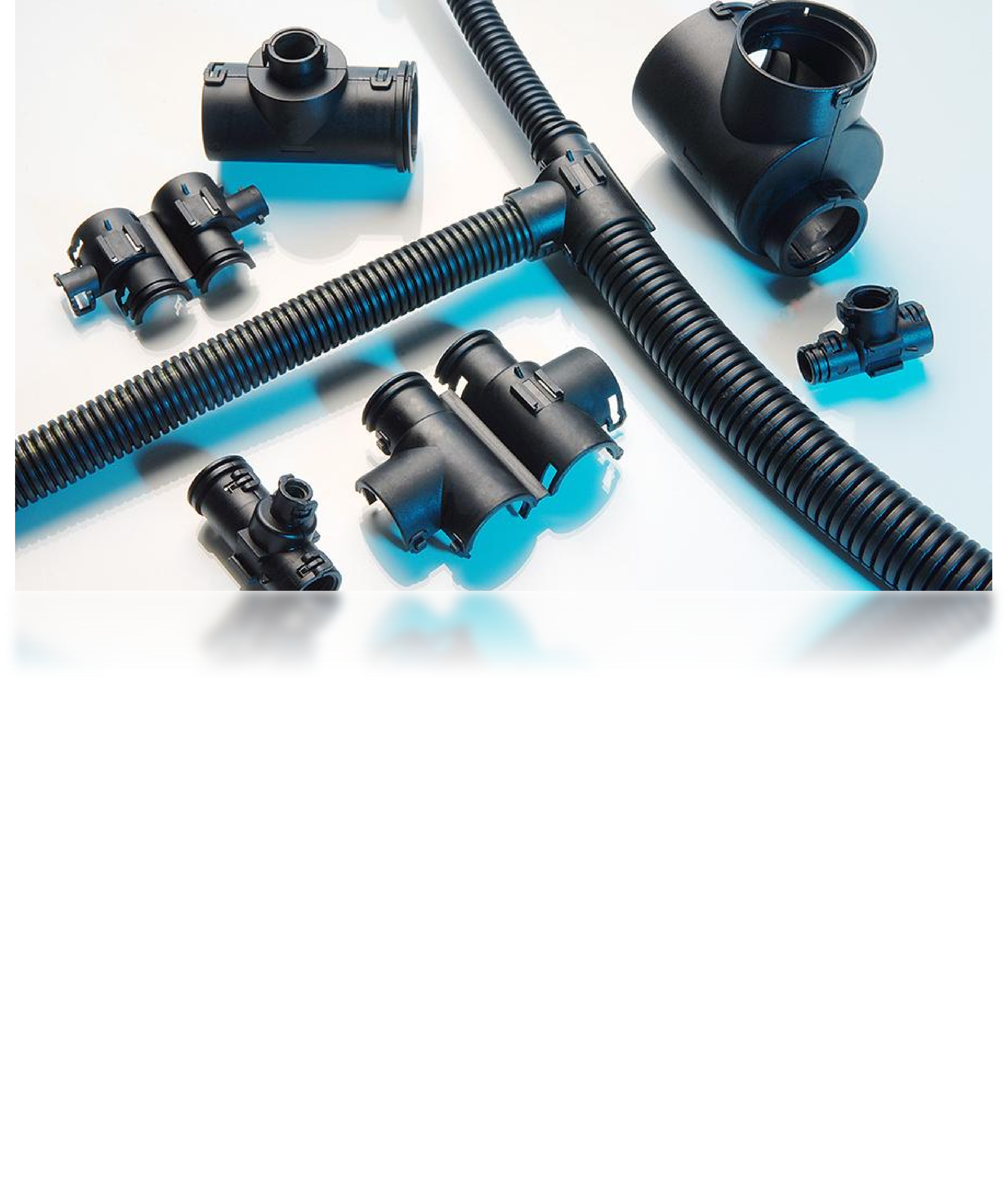
A PA66 three-way tube conduit connector such as the D520023 branches a harness run while keeping the conduit closed. Its mounting location, not the vehicle platform, decides whether that component is correctly specified.
A wiring harness rarely operates in one environment. The same harness that terminates at a battery terminal inside a protected compartment may pass through a splash-exposed chassis rail and end inside an engine bay that cycles between ambient cold and sustained heat. Temperature, fluid contact, salt spray, vibration and sealing expectation all change along that route, and each change carries a specification consequence.
Zone fit is the practice of matching an automotive wire harness connector — and the housing, bracket, terminal or fuse box around it — to the specific vehicle zone where it is mounted, instead of assigning one specification to an entire harness. The global automotive wiring harness market was estimated at USD 89.54 billion in 2025 by Precedence Research, with Asia Pacific holding a 40.89% share and China generating 62% of regional revenue according to Fortune Business Insights. Figures at that scale describe demand; they do not describe selection. Selection happens at the mounting point, where a component's continuous temperature ceiling, ingress protection, chemical resistance and mechanical retention are tested against one environment.
This reference maps that evaluation to three vehicle zones — engine bay, chassis and body — using components from Zhejiang Daou Electronics Co., Ltd. (CNDO), a China-based manufacturer of wire harness and battery terminals, fuse boxes, connectors and waterproof plugs: the D520023 conduit connector, the DOH0001-1 housing, the DOCB24001 support bracket, the DOE24022 terminal and the DOBXS4-1A / DOBXS5-1F fuse boxes.
What Zone Fit Means Inside a Qualified Application Class
The connector family used across this application operates between -40°C and +125°C. Sealed connectors in the class reach IP67 and IP6K9K protection grades, while unsealed types are intended for dry interior environments. The class complies with ISO 16750 and USCAR-2 automotive vibration standards and is applied to passenger car assembly, new energy vehicle battery pack matching and commercial vehicle wiring. Special requirements include IATF 16949 automotive certification, IP67 sealing, flame retardancy, vibration resistance and RoHS compliance.
Those are envelope conditions. Inside that envelope, individual components carry different ceilings, and the vehicle zone decides which ceiling is the binding one. That distinction is what turns a general product list into a deployable bill of materials.
| Vehicle zone | Dominant stress | Sealing expectation | Representative components and stated ratings |
|---|---|---|---|
| Engine bay | Continuous heat, transient temperature peaks, engine oil, grease, coolant, vibration | Sealed where splash, oil or coolant contact is possible | D520023 three-way conduit connector: PA66, -40°C to +120°C continuous, 150°C short-term peak, IP66 / IP67 with sealing gaskets, resistant to engine oil, mineral oil, grease and weak acid and alkali. DOCB24001 bracket: PA66 / PA66 GF30, UL94-V0 / UL94-V2. |
| Chassis and underbody | Salt spray, road splash, stone impact, wide thermal cycling, sustained vibration | Sealed components required | DOH0001-1 housing: PA / PBT, IP67, -40°C to +125°C, waterproof, dustproof, oil-resistant, acid and alkali resistant, automotive vibration compliant. DOCB24001 bracket: salt spray resistant, UV and ageing resistant, compliant with vehicle vibration durability test standards. |
| Body and dry interior | Lower moisture exposure, packaging and routing constraints, vibration, start-stop cycling | Unsealed types applicable to dry interior environments | DOH0001-1 housing where a sealed interface is still required by the program. DOE24022 terminal: 12V / 24V DC mainstream, up to 48V DC for special models. |
| Power side (battery feed) | High current, terminal corrosion, heat, torque retention | Sealed cover fuse box, plated terminals and busbars | DOBXS4-1A / DOBXS5-1F fuse box: 12V / 24V DC, copper or brass busbar with tin, nickel or zinc plating, sealed cover, -40°C to +125°C, direct battery positive connection. DOBP22001 / DOBN22006-D5 battery terminals: SAE top post, brass, M8 thread, 500A maximum current, 8 N·m tightening torque, tin-plated. |
Engine Bay: Heat Ladder, Fluids and Transient Peaks
Engine bay mounting is defined less by average temperature than by the spread between steady-state heat and short excursions. The D520023 three-way tube conduit connector is one of the clearer examples of how that spread is documented: its continuous operating temperature is -40°C to +120°C, with a short-term peak of 150°C. That peak figure exists because a conduit joint located near hot components can see brief thermal spikes that are not representative of its duty cycle.
Fluid exposure is the second engine bay filter. The D520023 material is PA66 and is specified as resistant to engine oil, mineral oil, grease, weak acid and alkali and partial solvents, with UV, hydrolysis and ageing resistance. Because the part is a non-conductive material with excellent insulation performance, it also functions as an electrical separation element where harness branches run close together — the T and Y configurations exist precisely so that a harness run can split without opening the protective conduit.
Mechanical retention in the engine bay usually falls to brackets rather than connectors. The DOCB24001 support bracket is offered in PA66 and PA66 GF30 with a -40°C to +125°C range, and the specification notes that engine bay versions can withstand higher transient temperatures. Its flame rating is UL94-V0 or UL94-V2, compliant with automotive flame retardant standards, and it is specified as resistant to engine oil, coolant and cleaning agents — the three fluids most likely to reach a bracket during service or maintenance.
The same zone also uses the DOH0001-1 housing, a PA / PBT part rated -40°C to +125°C with IP67 protection and resistance to water, dust, oil, acid and alkali, plus automotive vibration compliance under IATF 16949 standards. Housing and conduit joint therefore sit at slightly different continuous ceilings — +125°C and +120°C — inside the same zone.
Chassis and Underbody: Salt Spray, Splash and Vibration
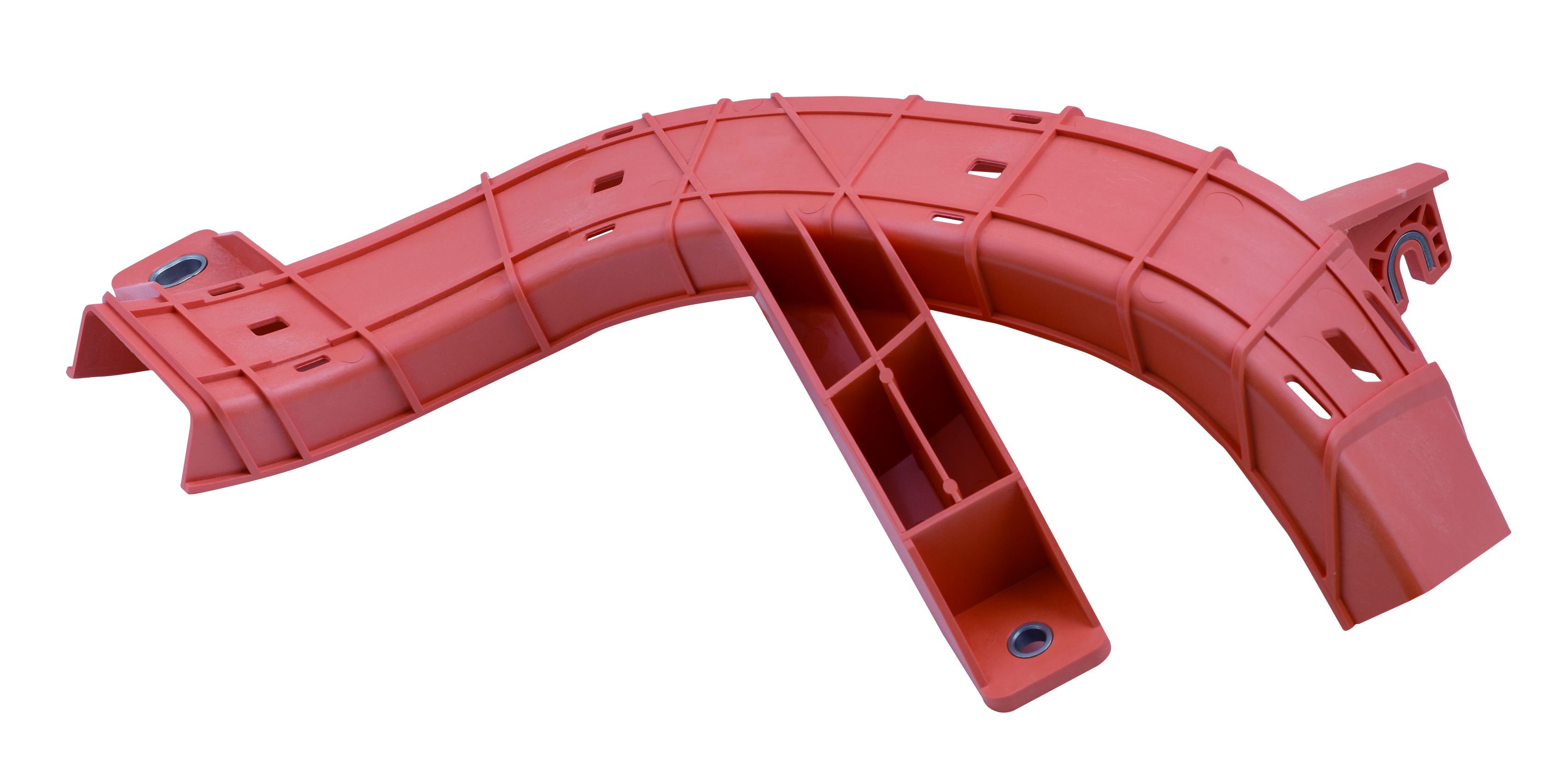
Support brackets carry the mechanical duty on chassis runs, where harness weight, road input and salt exposure act on the same part. The DOCB24001 is offered in PA66 and PA66 GF30.
Chassis and underbody locations invert the engine bay priority list. Continuous temperature is usually lower, but salt spray, standing water, road debris and constant vibration move to the front. The DOH0001-1 housing is the sealed interface for those locations: IP67, waterproof, dustproof, oil-resistant and acid and alkali resistant, with automotive vibration compliance listed under IATF 16949 standards.
Vibration is not a single requirement. The broader application class complies with ISO 16750 and USCAR-2 automotive vibration standards, while the DOCB24001 bracket is separately specified as compliant with vehicle vibration durability test standards and as salt spray resistant, UV resistant and ageing resistant. In practice this means a chassis run is evaluated on two axes at once — the electrical interface (housing, connector, terminal) and the mechanical interface that holds the harness in place.
There is a hard boundary here that is often misread in early bill-of-materials work: unsealed connector types in this family are applicable to dry interior environments only. They are not a lower-cost substitute for a chassis location. Where a program attempts to use an unsealed part in a splash-exposed position to reduce cost, the sealing requirement has not been met, and the component mix no longer matches the zone.
Body Zone and Internal Routing
Body-zone routing is the least aggressive environment in the three-zone model, but it is not specification-free. Interior harnesses still see start-stop cycling, cabin vibration and the packaging constraints that come with routing through pillars, sills and instrument panel structures. The application data describes the operating mode as cyclic on-board operation with vehicle start-stop, which applies regardless of zone.
Two decisions dominate the body zone. The first is whether sealing is genuinely unnecessary. Unsealed types are applicable to dry interior environments, but a location that can see condensation, a drain path or a pass-through into a wet cavity is no longer dry. The second is how the harness branches and how it is retained. A three-way tube conduit connector such as the D520023 is applicable to engine bay, chassis and body wiring, so the same routing component can appear in all three zones while the sealing and fluid requirements differ around it.
Power-Side Fit: Terminals, Fuse Boxes and Battery Interfaces
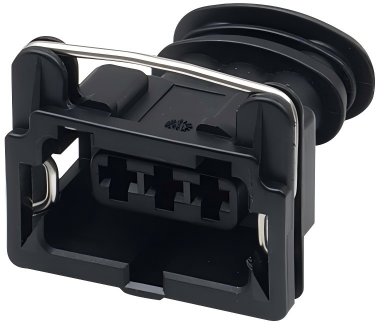
The DOH0001-1 housing is rated -40°C to +125°C with IP67 protection and is specified as waterproof, dustproof, oil-resistant and acid and alkali resistant.
Power-side components are constrained by current, heat and corrosion rather than by zone alone, and they are where the harness meets the vehicle's energy source.
The DOE24022 terminal is rated 12V / 24V DC for mainstream vehicles and up to 48V DC for special models, with rated current varying by size across examples such as 5A, 10A, 20A, 50A, 100A and 200A. Contact material options include pure copper, red copper, copper alloy, tin-plated copper, nickel-plated copper and gold-plated copper, with low contact resistance specified for stable conductivity and high insulation resistance on the insulated version. Plating choice is a zone decision as much as an electrical one: a terminal exposed to humidity benefits from a plating strategy that differs from one protected inside a cabin.
The DOBXS4-1A and DOBXS5-1F fuse boxes work at 12V DC or 24V DC and use a high-conductivity copper or brass main busbar with tin, nickel or zinc surface plating. The shell is flame retardant plastic with a sealed cover and a waterproof and dustproof structure, rated -40°C to +125°C, with fixed mounting holes for direct battery positive connection. Auxiliary circuits accept standard blade fuses at 5A, 10A, 15A, 20A or 30A.
Battery interfaces are matched through the DOBP22001 and DOBN22006-D5 terminals: an SAE top post design in brass with tapered posts measuring 19.05 mm positive and 17.46 mm negative, an M8 thread, a maximum current of 500A, a tightening torque of 8 N·m and tin plating. The tolerance pairing between a tapered post and a clamped terminal is where most field issues on the power side originate, which is why torque and post geometry are specified numerically here rather than described qualitatively.
Zone Mapping Compared with Single-Specification Sourcing
Traditional harness sourcing often applies one connector family and one rating across an entire vehicle. The approach is simple to administer and easy to release, and for low-complexity harnesses it is defensible. It also carries a predictable cost: components in a dry body location inherit sealing, temperature and fluid requirements they do not need, while components in a wet chassis location inherit assumptions that may be insufficient.
Zone mapping reverses that trade. It reduces under-specification in aggressive locations and reduces over-specification in protected ones, but it introduces costs and constraints that are worth stating plainly.
- Higher SKU count and documentation load. A zone-mapped harness may carry several housings, conduit connectors and brackets where a single generic part previously served. Each additional part needs its own drawing, specification and incoming inspection.
- Dependence on an early, stable routing. Zone fit is a design-stage input. If harness routing moves between prototype and production, material, sealing and retention decisions must be revisited, and late changes are more expensive than the original selection.
- Non-uniform ratings inside one family. The D520023 conduit connector carries a continuous ceiling of +120°C with a 150°C short-term peak, while the DOH0001-1 housing and DOCB24001 bracket are rated to +125°C, with engine bay bracket versions able to withstand higher transient temperatures. A zone bill of materials must be checked component by component rather than by zone average.
- Project-defined parameters remain open. In the DOBXS4-1A and DOBXS5-1F fuse boxes, the main bolt-type mega fuse rating is not fixed in the published specification. That value has to be defined against the program's load and protection study, and a supplier-side specification sheet alone cannot close it.
- Sealing grades are test conditions, not guarantees. IP67 and IP6K9K describe behaviour under defined test conditions. Correct mounting orientation, drainage paths and harness routing in the vehicle remain part of the sealing outcome.
- A hard exclusion still applies. Unsealed types are applicable to dry interior environments only, regardless of cost pressure in a given program.
Market Direction and Standards Signals
Published market estimates for this category diverge substantially because they define scope differently. Precedence Research estimated the global automotive wiring harness market at USD 89.54 billion in 2025; Fortune Business Insights and Global Market Insights publish figures of USD 54.88 billion and USD 71.2 billion for the same year. The spread reflects differences between wiring harness totals and connector-only scopes, so the figures are more useful as a direction indicator than as a procurement number.
Two segments inside that total are growing for reasons directly related to zone demands. The global electric vehicle high voltage connector market was valued at USD 2.8 billion in 2024 and is projected to reach USD 11 billion by 2035, according to WiseGuyReports — growth driven largely by sealing and insulation requirements at higher voltage classes. The global two-wheeler wiring harness market was valued at USD 3.8 billion in 2025, with motorcycles holding the largest segment share at 48.6% according to Dataintelo, a segment where vibration and weather exposure dominate.
The supply side remains concentrated. Yazaki held a 21.4% share of the global automotive wiring harness market in 2025 according to Global Market Insights, while Bishop & Associates identifies TE Connectivity, Amphenol and Molex as the top three global connector manufacturers, with TE Connectivity reaching USD 12.88 billion in 2024 sales. Concentration at the top of the market is one reason zone-level component sourcing receives attention: the component layer is where specification differences are decided.
Standards reinforce that division of labour. USCAR-2 is the primary performance standard for automotive electrical connector systems in North America and covers testing for low-voltage road vehicle applications, per SAE International. LV214 is widely used by European German OEMs, including Audi, BMW, Daimler and Porsche, for terminal and connector testing requirements. Both standards operate at the component performance level, which is the level at which zone fit is evaluated.
Supply and Customization Considerations for Evaluation Teams
Zhejiang Daou Electronics Co., Ltd. operates as an OEM-focused manufacturer and supplies under the CNDO brand from a 6,000 m² facility with 125 employees, an annual output of 9,000,000 units, a 25-engineer R&D team, a 50% export ratio and main markets in the USA and EU.
Customization options relevant to zone-specific programs include housing colour, printed logo, terminal current specification, wire gauge matching, waterproof grade, pin count, packaging solution and EV high voltage insulation structure. Production runs at a stated monthly capacity of 750,000 units with a lead time of 7–15 days and a minimum order quantity of 2 units, under IATF 16949 standard quality control. After-sales support covers remote technical guidance, spare parts supply, product parameter documents and factory audit coordination — the last of which is typically requested during the evaluation stage rather than after a purchase order.
The company reports OEM supply relationships with vehicle groups including Chery Group, Foton Motor, LOVOL, Wuling, FAW Group, Changan Group, GAC Group, Geely Group and BAIC Group, and with automotive wiring harness manufacturers including Luxshare Precision, Aptiv and Sumitomo Electric. Case data also cites the DOCB24001 support bracket as having been used by automotive OEM clients, with cost-saving solutions delivered to vehicle OEMs and automotive wiring harness manufacturers, and recognition as a designated supplier to major vehicle OEMs and harness manufacturers.
The supporting equipment around these components is consistent across the application: auto wiring harness, vehicle storage battery, EV power battery module, automotive ECU and auto fuse box. Installations are described across the United States, Germany, France, Italy, Spain, Russia, Thailand, Singapore, Korea and Japan.
Future Outlook
Three pressures are likely to keep zone fit in scope for the next development cycle. The first is voltage class. The DOE24022 terminal already supports 12V and 24V DC mainstream use and up to 48V DC for special models, and the growth projection for the electric vehicle high voltage connector market from USD 2.8 billion in 2024 toward USD 11 billion by 2035 suggests that insulation and sealing requirements will keep moving upward.
The second is thermal management. As underhood packaging tightens, transient peaks — the reason a conduit connector is rated to a 150°C short-term ceiling while its continuous ceiling is +120°C — become a specification discussion rather than a footnote, and brackets rated for higher transient temperatures will be requested more often.
The third is documentation. Buyers evaluating suppliers increasingly ask for component-level ratings rather than class-level claims, because the numbers differ within a family. Suppliers who can state continuous temperature, peak temperature, ingress protection, flame rating, fluid resistance and torque values per part number are easier to qualify than suppliers who describe a category. That documentation discipline, more than any single material advance, is what zone-based sourcing depends on.
Frequently Asked Questions
1. What determines whether an automotive wire harness connector needs to be sealed?
The mounting zone determines it. In this application class, sealed connectors reach IP67 and IP6K9K protection grades, while unsealed types are applicable to dry interior environments. Engine bay and chassis locations expose a harness to splash, oil, dust and, on the chassis, salt spray, so sealed components are the standard choice there. A body location qualifies as dry only if it is genuinely protected from water paths and condensation.
2. What operating temperature range should a connector, housing or bracket be rated for?
The application class operates between -40°C and +125°C. Individual components differ within that range: the DOH0001-1 housing and the DOCB24001 bracket are rated -40°C to +125°C, with engine bay bracket versions able to withstand higher transient temperatures, while the D520023 three-way conduit connector is rated -40°C to +120°C continuous with a 150°C short-term peak. A zone bill of materials should confirm each part's own ceiling instead of assuming one rating covers the harness.
3. Can unsealed connectors be used on a chassis or underbody harness?
No. Unsealed types in this family are applicable to dry interior environments. Chassis and underbody locations are exposed to splash, salt spray and standing water, so sealed housings and connectors are required, and the vibration requirement — ISO 16750 and USCAR-2 for the broader class, plus vehicle vibration durability test standards for the DOCB24001 bracket — applies on top of the sealing requirement.
4. How do USCAR-2, LV214 and IATF 16949 fit into connector selection?
USCAR-2 is the primary performance standard for automotive electrical connector systems in North America and covers testing for low-voltage road vehicle applications, according to SAE International. LV214 is widely used by European German OEMs, including Audi, BMW, Daimler and Porsche, for terminal and connector testing. IATF 16949 is the automotive quality management system referenced for the production and quality control of these components, including the DOH0001-1 housing, which lists automotive vibration compliance under IATF 16949 standards. In practice, the first two define what a component must withstand and the third defines how it is produced.
5. How is a battery fuse box matched to positive and negative terminals?
The DOBXS4-1A and DOBXS5-1F operate at 12V DC or 24V DC, use a high-conductivity copper or brass main busbar with tin, nickel or zinc plating, and are designed for direct battery positive connection through fixed mounting holes. Auxiliary circuits accept standard blade fuses at 5A, 10A, 15A, 20A or 30A. The main bolt-type mega fuse rating is not fixed in the published specification and must be defined against the program's load and protection study. Matching battery terminals include DOBP22001 and DOBN22006-D5, an SAE top post design in brass with tapered posts of 19.05 mm positive and 17.46 mm negative, an M8 thread, a 500A maximum current, 8 N·m tightening torque and tin plating.
6. What current and material options exist on the harness terminal side?
The DOE24022 terminal is rated 12V / 24V DC for mainstream vehicles and up to 48V DC for special models, with rated current varying by size across examples such as 5A, 10A, 20A, 50A, 100A and 200A. Material options include pure copper, red copper, copper alloy, tin-plated copper, nickel-plated copper and gold-plated copper. The specification also lists low contact resistance for stable conductivity, withstand voltage compliant with automotive wiring harness electrical standards, and high insulation resistance on the insulated version.
7. How is a harness support bracket selected for chassis routing?
By mechanical duty and exposure. The DOCB24001 is offered in PA66 and PA66 GF30 with a -40°C to +125°C operating range, UL94-V0 or UL94-V2 flame rating compliant with automotive flame retardant standards, and resistance to UV, ageing, salt spray, engine oil, coolant and cleaning agents. It is also specified as compliant with vehicle vibration durability test standards. Chassis and engine bay mounts should be reviewed separately, since engine bay versions are specified to withstand higher transient temperatures.
Engineering Inquiries
Component-level questions on zone fit, terminal matching, sealing grades or fuse box configuration can be directed to the manufacturer. Zhejiang Daou Electronics Co., Ltd. — Contact: Vicky; Email: jialuzhou101@gmail.com; Tel / WhatsApp: +86 13645876878; Address: Puqi Characteristic Industrial Zone, Yueqing City, Zhejiang Province, China. Company website: www.zjdaou.com. The company brochure is available as a downloadable PDF: Zhejiang Daou Electronics (English) brochure.