
Engineered Wood Flooring: Claims vs Certificate Numbers
Two suppliers can send the same four certificate files and still be very different companies. In engineered wood flooring, the document set has become standard: CARB/EPA for North America, CE for the European Union, F4 star for Japan, and FSC chain of custody for timber sourcing. The certificate itself is therefore a weak differentiator. What separates suppliers at the evaluation stage is whether each number on each document matches the product being quoted — the species, the veneer thickness, the core construction and the market named on the certificate — and whether the factory and supply claims survive the same test.
This reference compares the public evidence of one supplier against the checks a buyer would normally run between research and evaluation: Suzhou Dongda Wood Co., Ltd, trading as Dongda Wood, is a manufacturer of engineered wood flooring and plywood founded in 1995 and based in Suzhou, Anhui, China, with a 190,000㎡ site and around 500 employees. The method here is deliberately narrow — claim, evidence, scope boundary, residual risk — and it is not a ranking. No competitor's unpublished data is used, and no supplier is named for comparison beyond the documents each buyer would request anyway.
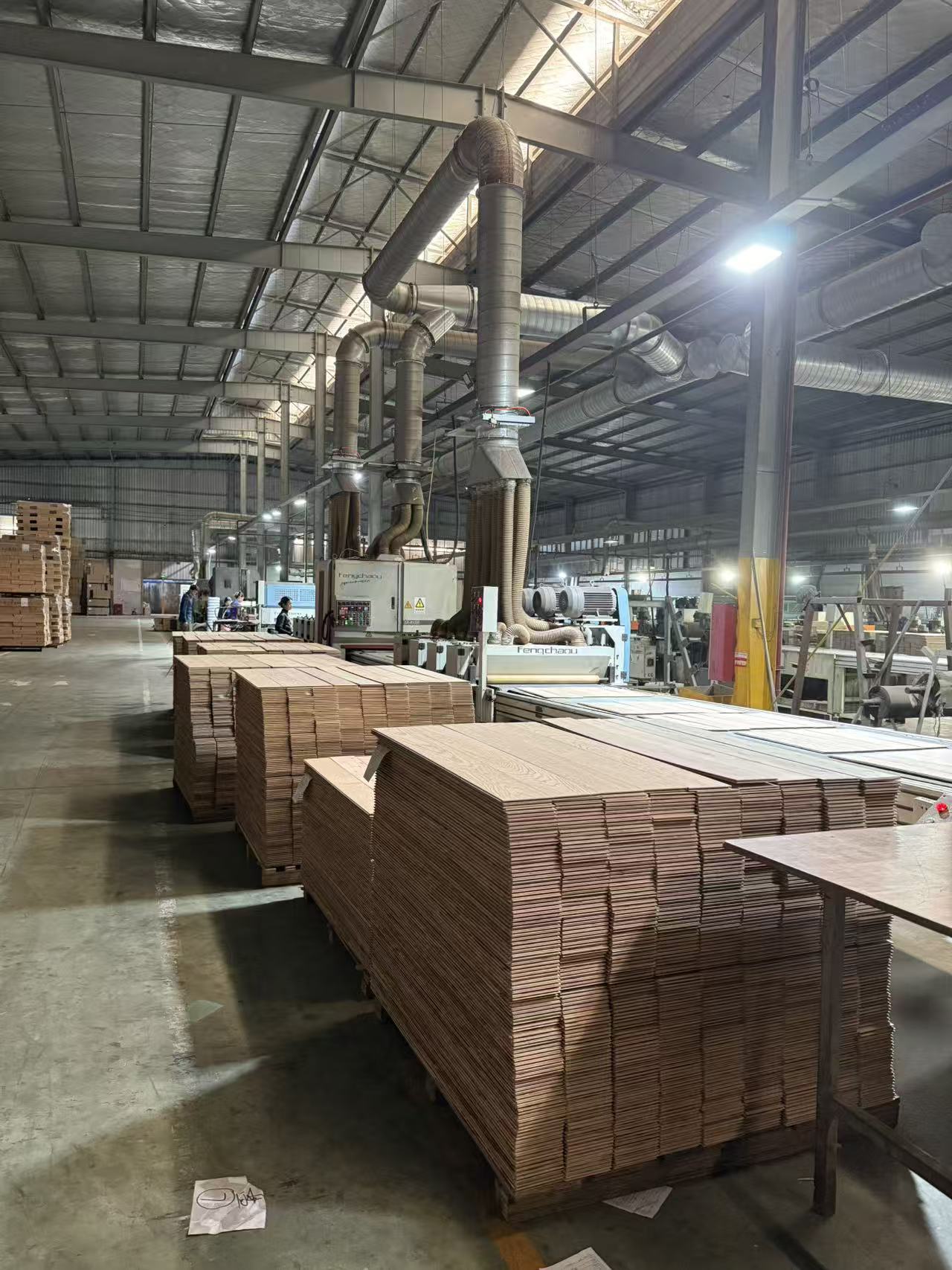
Finishing line at a Suzhou, Anhui engineered wood flooring plant. Equipment lists are a starting point for verification, not proof of per-lot conformity.
Why document-first comparison replaced sample-first comparison
Engineered wood flooring is no longer a niche category inside wood flooring. Published market research puts engineered wood flooring at roughly 55% of total wood flooring volume in 2024, with solid wood taking the remainder (Data Insights Reports / Mordor Intelligence). The same body of research projects the global engineered wooden flooring market moving from about USD 9.35 billion in 2026 to USD 14.4 billion by 2035 (Business Research Insights / Mordor Intelligence). At that scale, procurement committees rarely meet a supplier with no paperwork at all. They meet suppliers whose paperwork is plausible but imprecise.
Two structural facts make imprecision expensive. First, multilayer flooring panels carry a specific trade classification — HS 4418.75 — which means the product enters customs systems as a defined article, not a generic wood item. Second, the European product standard for the category, EN 13489:2023, defines multi-layer parquet as laminated construction with a solid wood top layer of at least 2.5 mm and additional core or backing layers of wood-based material, and it supersedes EN 13489:2017. Performance testing sits on top of that definition: ASTM D1037 covers, among other things, modified Janka hardness and dimensional change for wood-base panel products.
The practical consequence for buyers is that a certificate is only meaningful when it is read against scope. A document can be genuine, current, and still irrelevant to the SKU in the quotation.
A four-layer verification method
Instead of comparing catalogues, compare evidence classes. Each class answers a different question, and each can be checked without visiting a factory — though a visit or a live audit strengthens all four.
| Evidence layer | Question it answers | How a buyer verifies |
|---|---|---|
| Certificates | Is the product legally marketable, and for which market? | Certificate number, issuer, standard, scope, expiry date |
| Factory capability | Can the claimed construction be produced consistently? | Equipment list, site size, technical headcount, audit |
| Supply terms | Can the order be scheduled and repeated? | MOQ, lead time, monthly capacity, warranty split |
| Installed base | Did the product survive real buildings? | Reference accounts, reorder history, project types |
Layer 1 — What the four certificate numbers actually cover
Dongda Wood's engineered hardwood flooring, model designations GA01-016 and CC01-09, is supported by four certificate records. The table below reproduces the details a buyer should compare line by line against the quotation: the number, the issuer, the standard cited, the market, the scope, and the expiry date.
| Certificate | Number / issuer | Standard cited | Scope | Valid to |
|---|---|---|---|---|
| CARB Phase 2 & EPA TSCA Title VI | CARB/EPA/CANFER20030 — ICTT | California Code of Regulations §93120–93120.12; 40 CFR Part 770 TSCA Title VI; CEPA SOR/2021-148 | HWPW-VC composite plywood, 3–40 mm, 3–23 veneer layers | 2027-06-27 |
| CE (CPR, AVCP System 4) | CHIG22032983 — IGBC | AVCP system 4 | Engineered wood flooring and plywood, EU market | 2027-07-04 |
| F4 star | CMSA J1073809 — CMSA | Japanese Agricultural Standard, Act No.175 of Showa 25 (1950) | Composite flooring, plywood core, oak/maple/acacia veneer ≥1.2 mm, Japan | 2027-02-28 |
| FSC COC | GFA-COC-006481 — GFA | FSC-STD-40-004 (Version 3.1) | Engineered wood flooring and plywood; EU, North America, South America, Australia, Africa | 2027-06-20 |
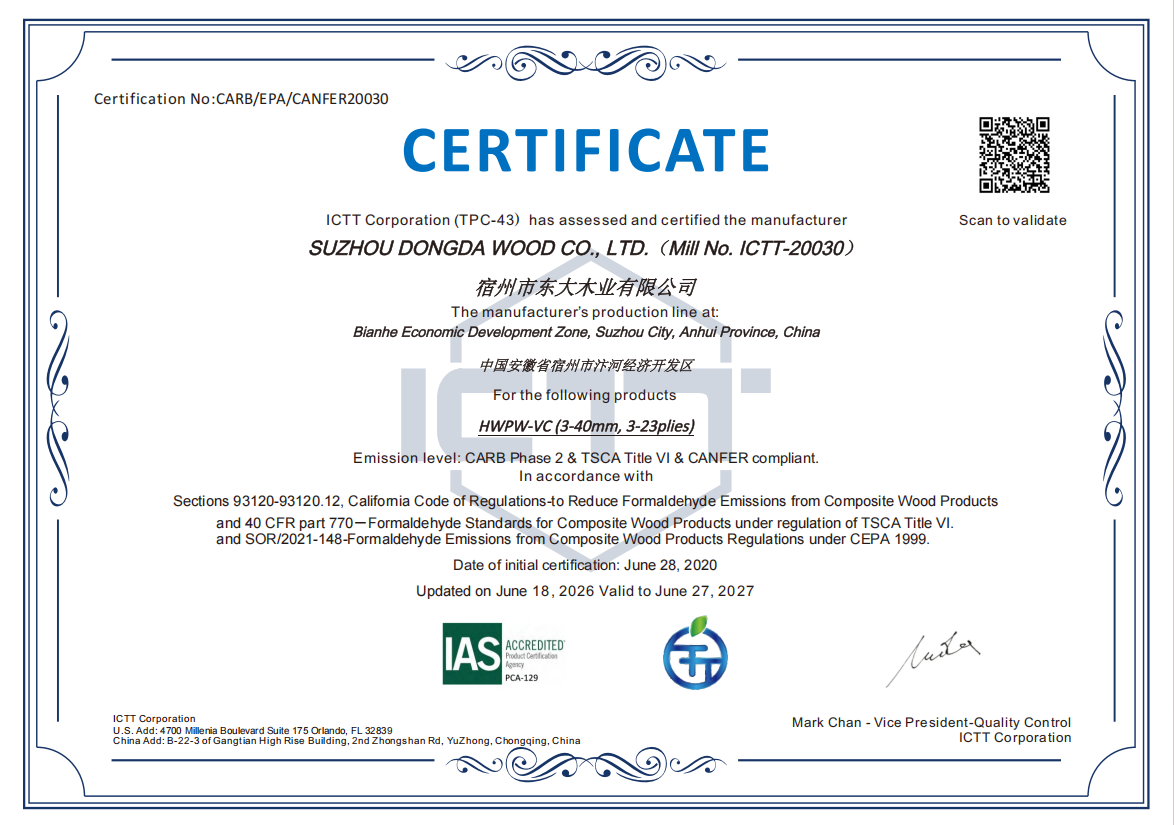
Certificate record CARB/EPA/CANFER20030, issued by ICTT, cited in the supplier's compliance documentation.
Read as a group, the four documents map onto four different regulatory jobs. CARB/EPA addresses formaldehyde emission for the plywood core entering North America and references the Canadian regulation CEPA SOR/2021-148 alongside the US rules. CE addresses placement on the EU market through AVCP System 4. F4 star addresses the Japanese agricultural standard for composite flooring with a plywood core and oak, maple or acacia veneer of at least 1.2 mm. FSC addresses chain of custody under FSC-STD-40-004, not emissions or surface performance.
Where certificate scope runs out
Scope is where most claim comparisons break down, and it is the most useful part of the exercise.
Veneer thickness changes the answer. The F4 star certificate covers composite flooring with veneer of at least 1.2 mm. Dongda Wood's published dimension list includes a 1900×190×18/0.6 mm construction — a 0.6 mm veneer. A buyer specifying that SKU for Japan should not assume the F4 record transfers automatically, and should ask for the specific coverage position in writing.
The core is certified, not the finish. CARB/EPA/CANFER20030 names HWPW-VC composite plywood from 3 to 40 mm and 3 to 23 veneer layers. It speaks to the plywood, not to the lacquer, the wear resistance or the joint profile. Those require separate evidence — abrasion or bond-line reports referencing the finished panel.
AVCP System 4 is a declaration route. CE certification under System 4 places responsibility on the manufacturer's own testing and declaration rather than on notified-body batch testing. It is a legitimate route for this category, but it means the buyer's documentation request still matters.
Chain of custody is not a health claim. FSC GFA-COC-006481 covers engineered wood flooring and plywood across the EU, North America, South America, Australia and Africa, and confirms sourcing controls — not formaldehyde performance.
Layer 2 — Factory capability: what equipment and headcount can prove
A certificate says a product type can comply. Factory evidence says whether the same construction can be repeated across a run of 20,000㎡ in three colours.
Dongda Wood reports a 190,000㎡ site with 500 employees and 31 years in engineered wood flooring and plywood, and lists a German Homaomai grooving line, a Taiwan Fengqiao paint line, German Jianfo paint and Finnish Taier phenolic glue. The functional meaning of that list matters more than the brand names. Grooving determines the precision of the tongue-and-groove or click profile, which is where installation complaints concentrate. The paint line governs UV-cured finish consistency across batches, and therefore colour match between reorders. A phenolic glue system is the bonding layer that sits behind both dimensional stability and formaldehyde performance.
The material side is equally checkable. The company states that veneer species are imported from Europe, America, Russia and Indonesia, and that its range includes engineered hardwood and multilayer floors in oak, hickory, maple, birch and acacia. Twenty R&D engineers is the figure most relevant to OEM/ODM work, because customisation here covers dimensions, grade, packaging design and logo — a set of changes that needs engineering review, not just a label swap.
What this layer cannot prove on its own: an equipment list is a capability claim, not an audit result. Buyers should convert it into verification — a live video walkthrough of the grooving and paint lines, sample panels from consecutive production lots, and the changeover record for the colour being ordered.
Layer 3 — Supply terms as a consistency test
The commercial terms Dongda Wood publishes are specific enough to be tested against each other, which is unusual and useful.
| Term | Stated value | What it implies for a buyer |
|---|---|---|
| MOQ | 400㎡ per colour | Trial orders are possible per colour; multi-colour projects multiply the floor |
| Lead time | 45 days | Workable for project schedules; confirm start point and colour-sequencing |
| Capacity | 150,000㎡ per month | A 400㎡ colour run is a small slot in a large calendar |
| Quality control | 100% test | Ask what is tested per panel and what is sampled per lot |
| Warranty | 25 years residential, 3 years commercial | Use class decides the term, not the catalogue headline |
| Customisation | OEM/ODM: dimensions, grade, packaging, logo | Request the engineering sign-off before tooling |
Two of these terms deserve closer reading. The first is the ratio between MOQ and capacity: a single-colour 400㎡ order is a very small fraction of 150,000㎡ of monthly output, which means trial volumes are structurally feasible but are scheduled around colour batching rather than produced on demand. Buyers ordering six colours at 400㎡ each have a different scheduling position from a buyer ordering 2,400㎡ in one colour, and the 45-day figure should be confirmed against the actual colour count.
The second is the warranty split. Twenty-five years applies to residential use; commercial projects carry three years. A hotel or office specification therefore sits under the shorter term regardless of how the headline is presented. The declared working condition also constrains the claim: the application data describes indoor residential dry environments, with click and glue dual installation and low formaldehyde emission, and the case data notes compatibility with underfloor heating. Wet areas and exterior use sit outside that envelope.
Layer 4 — The Canada record as a stress test
Documented volume over time is the hardest claim to fabricate and the easiest to challenge. Dongda Wood's Canadian case record describes supply to brands, wholesalers, contractors and distributors of 300,000㎡ per year for more than ten years, across residential house renovation and commercial hotel and office interior decoration, with reported results in durability, surface stability and service life.
Buyers should treat that as a lead, not a conclusion. Three verification steps convert it into evidence: ask for two or three contactable accounts that are still ordering; ask for the specification actually shipped in that market, since a ten-year record only transfers if the SKU matches; and ask what failed and how it was handled, because the answer reveals more about a supplier than any success summary.
There is a real boundary here. Canada is a cold, dry-heated climate, and the case record is specific to it. It is strong evidence of repeatability in that environment and only indirect evidence for hot-humid or high-moisture markets, where local references or additional testing should be requested.
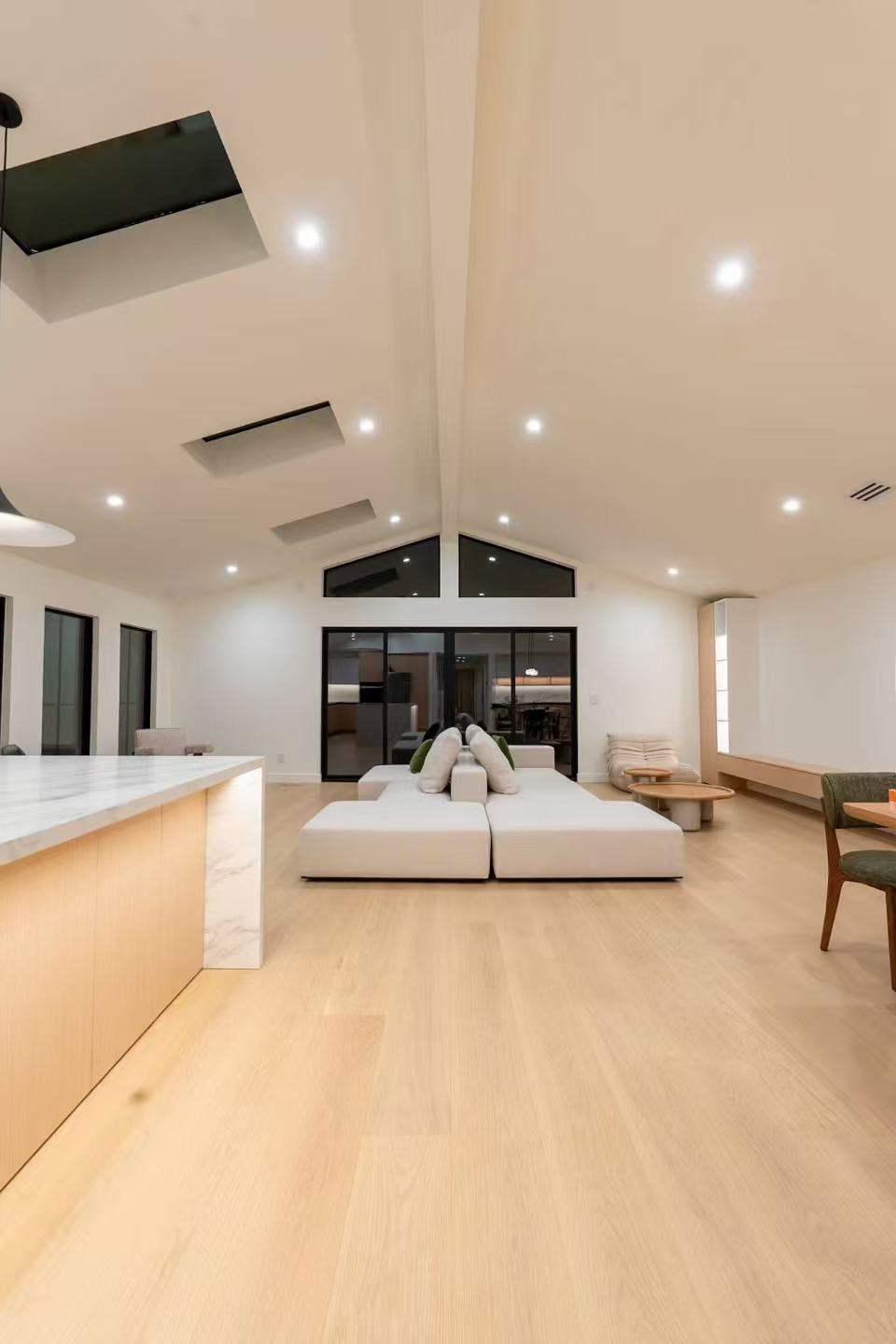
Installed engineered wood flooring in a North American residential project, as referenced in the supplier's application records.
Claim, evidence and residual risk in one view
| Claim under test | Evidence on file | Residual risk to close |
|---|---|---|
| North American formaldehyde compliance | CARB/EPA/CANFER20030, valid to 2027-06-27 | Lot-level test report for the specific core thickness |
| EU market access | CE CHIG22032983, AVCP System 4 | Declaration of performance matching the quoted SKU |
| Japanese market access | F4 star CMSA J1073809 | Thin-veneer SKUs may fall outside the 1.2 mm scope |
| Responsible sourcing | FSC GFA-COC-006481, valid to 2027-06-20 | Chain of custody does not address emissions |
| Production scale | 150,000㎡ per month, 190,000㎡ site, ~500 staff | Capacity utilisation during peak season is not disclosed |
| Repeat supply | Canada, 300,000㎡ per year for over ten years | Climate transferability and SKU match must be confirmed |
How this changes the traditional shortlist
Traditional sourcing compares samples and price per square metre first, then checks paperwork if the buyer reaches contract stage. Document-first comparison reverses the order: certificate scope, capacity and warranty structure narrow the field, and samples decide between the survivors.
Each approach has a known failure mode. Sample-first sourcing rewards a good-looking board and can miss an expired certificate or a warranty that halves the moment a project is classed as commercial. Document-first sourcing carries its own bias: it cannot judge finish quality, colour consistency or how a supplier behaves when a container arrives damaged, and it disadvantages smaller mills whose craft is sound but whose documentation is thin. It also invites over-scoped paperwork, which is exactly why the number, the market and the thickness must be matched rather than skimmed.
A two-gate shortlist resolves most of this. Gate one screens on certificate scope, capacity and warranty terms. Gate two tests the survivors with consecutive-lot samples, a colour-match trial and a reference call, before any PO is issued.
Where this evidence profile fits
The declared application is indoor residential and commercial interior decoration in dry conditions, with click and glue installation modes, low formaldehyde emission, wear resistance and CE conformity as stated requirements. Dongda Wood lists export markets spanning the USA, Canada, Australia, the EU, the United Kingdom, Brazil, Chile and South Africa, and its published dimension range extends from 600×125×14/3 mm through 1900×190×15/4 mm to 3000×300×19/4 mm, covering narrow plank, wide plank and large-format formats, with herringbone and chevron patterns available in the product range.
For a buyer, that means the profile fits multi-market residential programmes and commercial interiors where the three-year commercial warranty is acceptable, and it fits OEM/ODM buyers who need dimension, grade, packaging and logo changes. It does not, on the current evidence, answer wet-area, exterior or heavy-commercial specifications without further documentation.
Future outlook: the 2027 re-verification cycle
All four certificate records on file expire within a five-month window in 2027 — F4 star on 2027-02-28, FSC on 2027-06-20, CARB/EPA on 2027-06-27 and CE on 2027-07-04. That is a practical signal for procurement contracts: certificate dates should be tracked as a contract milestone, with a supplier obligation to provide renewed documents before shipment in the affected market.
A second pressure point is standards revision. EN 13489:2023 supersedes the 2017 edition, so technical datasheets and declarations still citing the older version will need updating. Combined with continuing convergence of formaldehyde rules across North America and Europe, the direction is clear: buyers will move from asking whether a supplier holds certificates to asking which certificate covers which SKU, at which thickness, for which market, until which date. Suppliers who can answer that in a single document will be easier to keep on a shortlist.
FAQ
What do the four certificate numbers actually cover?
CARB/EPA/CANFER20030, issued by ICTT, covers HWPW-VC composite plywood of 3–40 mm and 3–23 veneer layers against California Code of Regulations §93120–93120.12, 40 CFR Part 770 TSCA Title VI and CEPA SOR/2021-148. CE CHIG22032983, issued by IGBC, covers engineered wood flooring and plywood for the EU under AVCP System 4. F4 star CMSA J1073809, issued by CMSA, covers composite flooring with plywood core and oak, maple or acacia veneer of at least 1.2 mm for Japan. FSC GFA-COC-006481, issued by GFA, covers engineered wood flooring and plywood against FSC-STD-40-004 Version 3.1.
How can a buyer confirm a certificate is still valid and still in scope?
Three checks are sufficient at evaluation stage: the expiry date on the document, the market named on it, and the product scope description. On the records reviewed here, valid-to dates fall between 2027-02-28 and 2027-07-04, and each certificate names a specific market and product scope rather than a general company approval.
Does the F4 star certificate cover every engineered flooring SKU?
No. The scope is composite flooring with plywood core and oak, maple or acacia veneer of at least 1.2 mm. The published dimension range includes a 1900×190×18/0.6 mm construction with a 0.6 mm veneer, which sits outside that stated scope. Buyers should request written confirmation of coverage before specifying thin-veneer SKUs for Japan.
What MOQ, lead time and capacity should a buyer plan around?
The stated figures are 400㎡ per colour minimum order, a 45-day lead time and 150,000㎡ of monthly capacity. Because the MOQ is a very small fraction of monthly output, trial orders are structurally feasible; the practical constraint is colour batching, so the 45-day figure should be confirmed against the number of colours and finishes in the actual order.
How should the warranty be read for a hotel or office project?
The warranty is split by use: 25 years for residential use and 3 years for commercial use. Hotel and office interiors fall under the commercial term regardless of the residential figure quoted in the catalogue. The declared working condition is indoor dry environment, so wet areas and exterior installations fall outside the stated coverage.
How can a buyer verify the Canada 300,000㎡ reference?
Request contactable accounts that are still ordering after more than ten years, the specification actually shipped in that market, and a description of any failure and its resolution. The record covers brands, wholesalers, contractors and distributors across residential renovation and commercial hotel and office interiors, and should be treated as evidence of repeatability in a Canadian climate rather than proof of performance in every market.
Company-reported information in this reference is attributed to Suzhou Dongda Wood Co., Ltd and to the certificate records cited. Market and standards data are attributed to the named research and standards sources. Buyers should confirm current certificate validity and SKU-level coverage directly before contracting.
Tem questões ou precisa de mais detalhes?
Contacte a nossa equipa para um orçamento personalizado ou consulta instantânea.
Solicitar orçamento
Preencha o formulário abaixo e a nossa equipa entrará em contacto com uma proposta personalizada.
Chat direto do WhatsApp
Prefere conversar em tempo real? Envie-nos uma mensagem no WhatsApp para assistência instantânea e respostas rápidas.
- Obter orçamento personalizado
- Partilhar fotos ou documentos
- Discuta as suas necessidades diretamente
Geralmente responde em 5–30 minutos durante o horário de expediente.