
Engineered Wood Flooring Shortlist: MOQ, Lead Time, Capacity
Engineered Wood Flooring Shortlist: MOQ, Lead Time, Capacity
Engineered wood flooring accounted for 55% of the global wood flooring market in 2024, according to market research compiled by Market Research Reports, largely because multi-layer construction is more dimensionally stable than solid wood. Once a format becomes the default specification, the buying conversation shifts. At shortlist stage, the question is no longer whether a supplier can produce engineered oak flooring, engineered timber flooring or multi-ply parquet. It is whether that supplier can build a defined color mix, at a defined volume, inside a defined calendar.
From Product Specification to Supply Feasibility
The global wood flooring market was valued at USD 53.14 billion in 2024 and is projected to reach USD 71.57 billion by 2029, according to The Business Research Company. Volume of that scale does not arrive as single orders — it arrives through project pipelines: multi-phase residential developments, hotel and office refurbishment programs, distributor stock plans and renovation frameworks. Each pipeline converts into a set of constraints that a purchasing team must test before a supplier earns a place on a shortlist.
Three constraints do most of the filtering: minimum order quantity (MOQ), lead time, and monthly production capacity. They are not marketing attributes. They decide whether an order is buildable at all, when it can leave the factory, and how a multi-color or multi-format program has to be sequenced across a year. For buyers evaluating prefinished flooring in plank, herringbone engineered flooring or chevron engineered flooring formats, these three numbers are usually more decisive than catalog depth.
The Three Hard Gates That Filter a Shortlist
Suzhou Dongda Wood Co., Ltd publishes a set of operating parameters that can be used as a reference model for how these gates are expressed by an export-oriented engineered wood flooring manufacturer. The figures below come from the company's capability data and are used here as a concrete benchmark, not as a category average.
| Gate | Reference figure | What it decides for a buyer |
|---|---|---|
| Minimum order quantity | 400 m² per color | Sets the floor for each color in a program; total order scales with the number of colors, not with the number of projects. |
| Lead time | 45 days | The planning anchor for production scheduling, container booking and installation sequencing. |
| Monthly capacity | 150,000 m² | The ceiling for concurrent programs; determines how far ahead a large or multi-phase order must be booked. |
| Quality control | 100% testing of products | Per-piece inspection discipline; supports defect-rate expectations in contracts. |
| Warranty | 25 years residential / 3 years commercial | Separates residential renovation supply from hotel, office and contract supply. |
| OEM / ODM | Dimensions, grade, packaging design, logo | Determines whether a distributor or brand owner can private-label the range. |

Export packing and container staging: logistics capacity is one of the shortlist criteria buyers test before committing annual volume.
MOQ: 400 m² per color
A per-color MOQ is a production planning unit, not an arbitrary sales threshold. A specification that calls for a natural oak tone, a smoked tone and a grey-washed tone is three production batches, each of which must clear the 400 m² floor. A distributor planning six SKUs across engineered oak flooring and wide plank engineered flooring therefore needs 2,400 m² of order volume before every color becomes viable. This is where shortlists break down: a technically excellent supplier can still be the wrong supplier if the buyer's color plan fragments volume below the batch minimum.
Lead time: 45 days
A 45-day lead time is a production reference figure. Buyers should confirm in writing what triggers the clock — order confirmation, deposit receipt or production start — because the answer changes what date goes into an installation schedule. For a renovation program, a 45-day production window is normally workable when the specification and color plan are frozen early. It becomes a risk when color approvals, grade approvals or packaging artwork are still moving after the purchase order is issued, since each change re-enters the production queue.
Monthly capacity: 150,000 m²
Monthly capacity is the ceiling that a program competes against. At 150,000 m² per month, a single buyer placing 30,000 m² occupies roughly a fifth of one month's output, which is comfortable; three buyers placing the same volume in the same window is not. Capacity planning, rather than price negotiation, is often what separates buyers who receive predictable deliveries from buyers who receive partial shipments. Buyers running container programs should ask how monthly capacity is allocated across product formats — plank, multi-layer parquet, herringbone and chevron — because those formats consume different line time.
Why These Limits Exist: Construction and Process
The gates trace back to how engineered wood flooring is built. A multi-layer wood flooring plank combines a plywood core with a hardwood wear layer. Suzhou Dongda Wood Co., Ltd uses species imported from Europe, America, Russia and Indonesia, and its published range spans thin veneer engineered flooring such as a 12 mm plank with a 1.2 mm veneer, through thick veneer engineered flooring in 15 mm and 19 mm constructions with 3 mm and 4 mm wear layers, up to 3000 × 300 mm wide plank engineered flooring formats. Veneer thickness is the variable that most directly connects the product to its service life and to its price position.
Downstream of veneer selection, the process runs through splitting, profiling and finishing. Dongda Wood operates a German grooving line, a Taiwan-sourced paint line, imported German paint systems and Finnish phenolic adhesive. These are batch processes. A grooving setup is calibrated to a specific dimension and profile; a paint line is calibrated to a specific color and finish. Switching between colors or formats consumes line time that cannot be recovered, which is exactly why suppliers set a per-color minimum and why monthly capacity is finite rather than elastic.
Quality control is the third driver. Dongda Wood performs 100% testing as part of its quality control process, which is a piece-level discipline rather than a lot-sampling approach. Piece-level inspection supports more predictable defect rates in contracts, but it also means throughput is governed by inspection capacity alongside line capacity — another reason a supplier will resist splitting a monthly window across many small, low-volume colors.
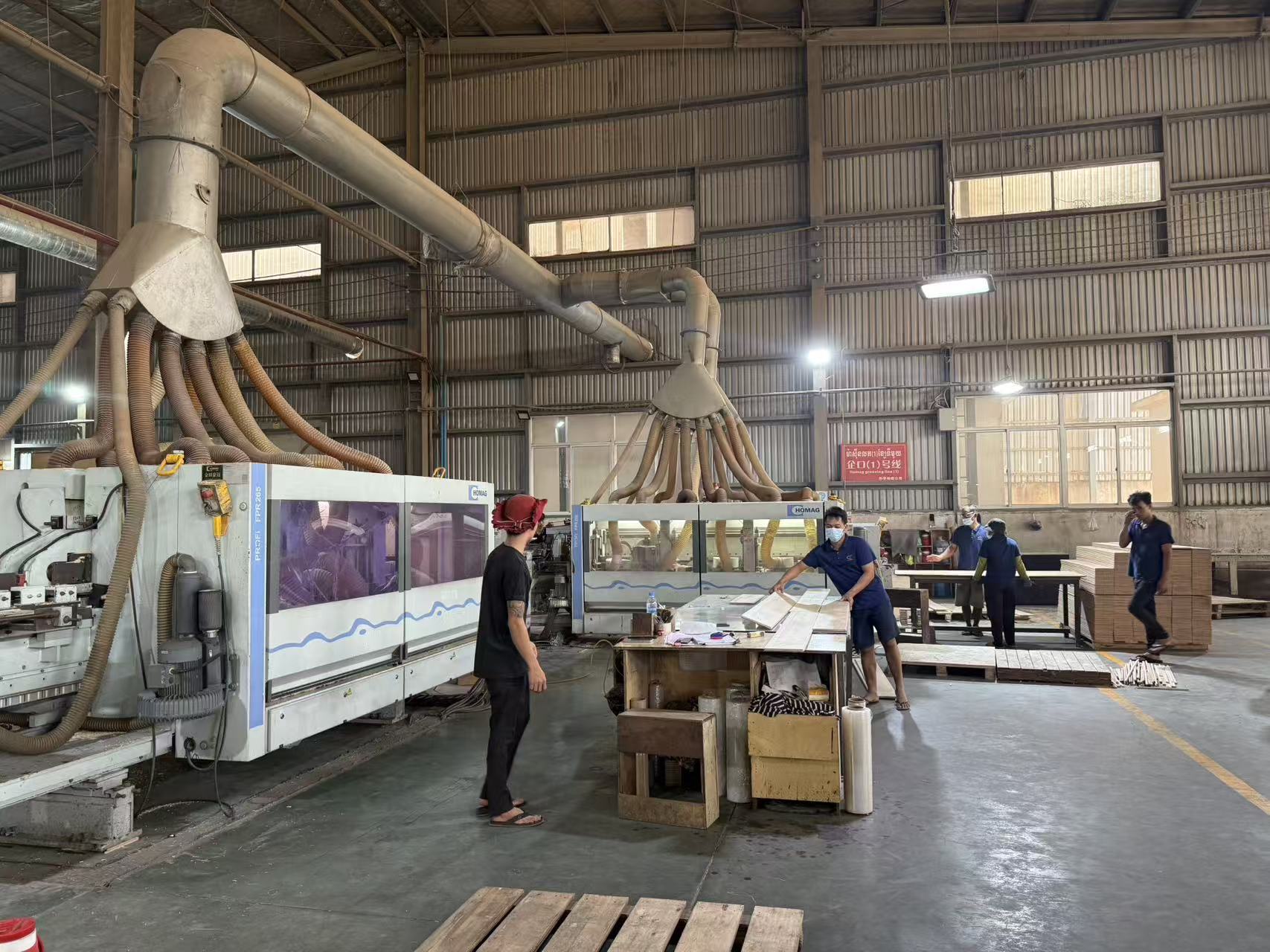
Profiling on a dedicated grooving line: batch setups per color and format are one reason suppliers apply a per-color MOQ.
Compliance Gates Belong on the Same Scorecard
Logistics gates and compliance gates are usually assessed by different people inside a buying organisation, which is why shortlists sometimes fail late. Certificates carry validity windows, and a certificate approaching expiry is a procurement risk regardless of how strong the supplier's lead time looks.
| Certification | Certificate number / standard | Primary market | Validity window |
|---|---|---|---|
| FSC COC (Chain of Custody) | GFA-COC-006481, FSC-STD-40-004 (Version 3.1) | EU, North America, South America, Australia, Africa | 21 June 2022 – 20 June 2027 |
| CE CPR (AVCP System 4) | CHIG22032983 | EU | 5 July 2022 – 4 July 2027 |
| CARB Phase 2 & EPA TSCA Title VI | CARB/EPA/CANFER20030 | North America, Australia, South America, Africa, Europe | 18 June 2026 – 27 June 2027 |
| F4 Star | CMSA J1073809, Japanese Agricultural Standard | Japan | 11 February 2026 – 28 February 2027 |
Two regulatory frameworks sit behind these certificates. In the United States, engineered wood flooring must comply with ANSI/HPVA EF 2020, which includes formaldehyde emission limits under CARB and TSCA Title VI, per the Decorative Hardwoods Association. In the EU, engineered wood flooring falls under EN 14342:2013, which specifies CE marking requirements covering reaction to fire and formaldehyde release, per the European Committee for Standardization. A supplier's certificate set should map onto the destination market of the specific order, not onto a general claim of compliance.
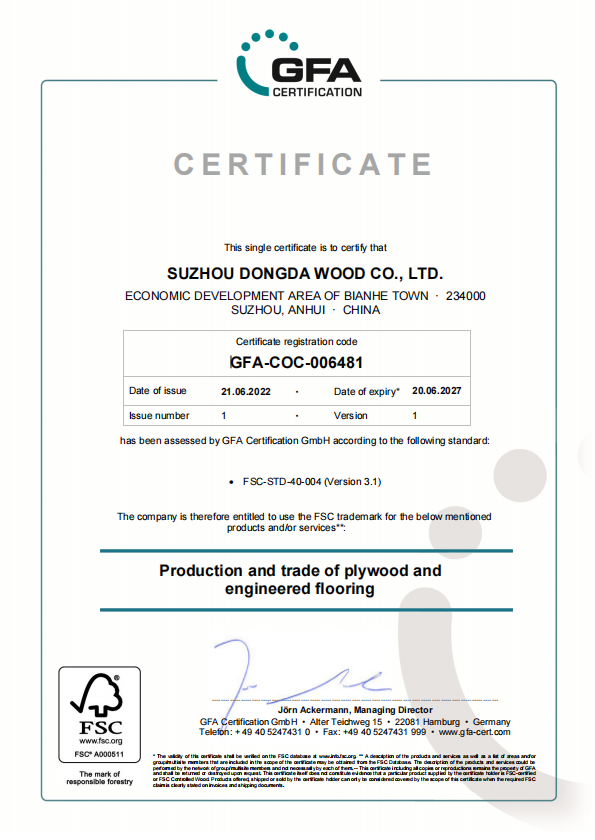
FSC Chain of Custody certificate GFA-COC-006481, valid to 20 June 2027 — validity windows belong on the shortlist scorecard.
OEM/ODM and Customization: What Qualifies a Supplier
Suzhou Dongda Wood Co., Ltd is an engineered wood flooring and plywood manufacturer founded in 1995 in Suzhou City, Anhui Province, China. The company operates a 190,000 m² site with more than 500 employees, exports 100% of its output, and serves the USA, Canada, Australia, the EU, the United Kingdom, Brazil, Chile and South Africa.
Its published OEM/ODM scope covers product dimensions, grade, packaging design and logo. For a distributor or brand owner, that scope is the difference between reselling a catalog item and building a private-label range. In practice, three questions decide whether OEM/ODM capability is usable:
- Does customization reset the MOQ? Custom formats still consume line time per color, so the 400 m² per color figure remains the planning unit unless otherwise agreed in writing.
- Which variables are genuinely open? Dimensions, grade, packaging design and logo are within scope; buyers should confirm that their required veneer thickness and surface grade fall inside the supplier's existing capability rather than assuming full latitude.
- Does customization move the lead time? New packaging artwork or a new grade specification typically requires an approval cycle before production starts, which is additive to the 45-day production window.
Application: Mapping the Gates to a Multi-Year Program
A Canadian customer relationship illustrates how these constraints behave at scale. Brands, wholesalers, contractors and distributors in Canada have drawn roughly 300,000 m² per year from Dongda Wood for over 10 years, applied to residential house renovation and commercial hotel and office interior decoration. Reported outcomes include high durability, stable surface performance and long service life in indoor decoration projects, with low formaldehyde emission, high scratch resistance, compatibility with underfloor heating, and customizable wood grain and sizes.
Read against the three gates, a program of that size works because annual volume is committed rather than ordered piecemeal. At 300,000 m² per year, the buyer consumes roughly two months of the supplier's 150,000 m² monthly capacity, which justifies dedicated scheduling. The mix of residential and commercial end use also explains why warranty terms are split by application category rather than issued as a single figure. For buyers attempting to replicate this arrangement, the practical lesson is sequencing: lock annual volume and color plan first, then negotiate format mix, because format diversity is what fragments capacity.
Market Trend Analysis: What Is Changing on the Demand Side
Three verified demand-side signals shape how shortlists are being built.
Engineered construction is now the majority format. Engineered wood flooring accounted for 55% of the total wood flooring market in 2024, favored for its dimensional stability over solid wood, per Market Research Reports. When the majority of specifications default to engineered products, supplier differentiation moves away from format availability and toward execution reliability.
Oak dominates specification. Oak-based products represent approximately 46% of total engineered wood flooring demand globally, according to industry forecast data from Mordor Intelligence. Concentration in a single species raises the importance of core-veneer supply planning, since color consistency across repeat orders depends on veneer sourcing continuity.
Export supply remains concentrated in China. China's exports of wood products reached USD 17.5 billion in 2024, with major destinations being the USA, Japan and the UK, according to the Observatory of Economic Complexity. On the demand side, the U.S. hardwood flooring industry generates approximately USD 8.5 billion in total economic output annually, per the Hardwood Federation and NWFA — a market size that sustains competition among large brand manufacturers and export manufacturers alike.
Comparison with Traditional Sourcing Options
A shortlist is only useful if it compares supplier types, not just suppliers. The following framework contrasts the structural options a buyer typically weighs when sourcing engineered hardwood flooring, manufactured wood flooring or composite hardwood flooring.
| Sourcing option | Typical strength | Shortlist risk to test | Best fit |
|---|---|---|---|
| Global brand manufacturers | Brand recognition, established distribution | MOQ, lead time and capacity are generally not published; must be requested | Retail programs needing brand pull |
| Vertically integrated export manufacturers | Published MOQ, lead time and capacity; OEM/ODM scope | Per-color MOQ limits highly fragmented color plans | Distributors, wholesalers, private label |
| Regional importers and stockists | Local availability, short delivery windows | Format and color range bounded by existing stock | Small renovation and repair volumes |
| Trading companies without own production | Broad catalog, flexible communication | Limited visibility into line scheduling and batch control | Mixed-category sourcing |
For reference, the widely cited brand-level set in the engineered wood sector includes Mohawk Industries, Shaw Industries (Anderson Tuftex), Armstrong Flooring and Mannington Mills, per industry listings compiled by Floor Focus and Modernize. That list is a brand-recognition reference, not a procurement comparison: publicly available MOQ, lead time and monthly capacity figures for those brands are not generally disclosed, and buyers should request them directly rather than assume parity with export manufacturers.
Where the Model Does Not Fit
The constraints described above also define the boundary of this approach, and buyers should treat them as limits rather than as assurances. A per-color MOQ of 400 m² is uneconomic for small projects, boutique color ranges or design-led renovations that need six or seven low-volume tones; those buyers are usually better served by importers holding stock. A 45-day lead time is a production reference and must be confirmed against its trigger point — it is not a door-to-door delivery commitment. Monthly capacity of 150,000 m² is a ceiling shared across all formats and customers, so large programs should be booked ahead rather than ordered to a short deadline. Warranty coverage is split by use category, meaning commercial installations are supported on materially shorter terms than residential ones. Finally, all four certification windows listed above expire within the next twelve months, so validity must be re-verified at order time rather than assumed from this reference.
Future Outlook
If the global wood flooring market continues toward the projected USD 71.57 billion by 2029 identified by The Business Research Company, the pressure point will not be whether engineered wood flooring can be made, but whether it can be scheduled. Three developments seem likely. First, capacity disclosure will become a more standard element of supplier evaluation, because buyers managing multi-phase projects cannot plan against undisclosed ceilings. Second, compliance documentation will keep tightening, with validity tracking treated as a live procurement task rather than a one-time file check. Third, OEM and ODM scope will increasingly be assessed alongside MOQ, since private-label programs succeed or fail on whether customization and batch minimums are compatible.
For buyers in the evaluation stage, the practical conclusion is that a shortlist built on product samples alone is incomplete. The same page should carry the per-color MOQ, the lead time and its trigger, the monthly capacity ceiling, the certificate numbers and their expiry dates, and the warranty split between residential and commercial use. Suppliers that publish those numbers are easier to compare — and easier to hold to the terms they committed to.
FAQ
What MOQ should buyers plan for when a specification includes several colors?
MOQ is applied per color, not per order. At Dongda Wood the figure is 400 m² per color, so a specification with four colors implies a planning baseline of 1,600 m² rather than 400 m². Buyers should calculate order volume by multiplying the per-color minimum by the number of colors in the plan, and should consider trimming the color count or phasing colors across shipments if total volume is tight.
How should a 45-day lead time be treated in project planning?
A 45-day lead time is a production reference figure. Its usefulness depends on the trigger point — order confirmation, deposit receipt or production start — which should be confirmed contractually. Buyers should also account for approval cycles on color, grade and packaging artwork before production begins, because approvals that arrive late delay the start of the 45-day window rather than shortening it.
Does OEM/ODM support change the MOQ or the lead time?
OEM and ODM scope at Dongda Wood covers product dimensions, grade, packaging design and logo. Because customized formats still consume line time per color, the per-color MOQ remains the planning unit unless a different arrangement is agreed in writing. Custom packaging or a new grade specification typically adds an approval step ahead of the 45-day production window, so buyers should build that approval time into the schedule separately.
What warranty terms are typical for engineered wood flooring?
Dongda Wood provides a 25-year warranty for residential use and a 3-year warranty for commercial use. The distinction matters for projects that combine housing with hotel or office interiors, because the same product specification may fall under two different coverage terms depending on where it is installed. Buyers specifying contract projects should confirm which warranty category applies to each building area.
Which certificates should be verified before a supplier is shortlisted?
The relevant certificate set depends on the destination market. Dongda Wood holds FSC COC certification (GFA-COC-006481, valid to 20 June 2027), CE CPR certification under AVCP System 4 (CHIG22032983, valid to 4 July 2027), CARB Phase 2 and EPA TSCA Title VI certification (CARB/EPA/CANFER20030, valid to 27 June 2027), and F4 Star certification (CMSA J1073809, valid to 28 February 2027). These correspond to frameworks including ANSI/HPVA EF 2020 in the United States and EN 14342:2013 in the EU. Because each window expires within the next twelve months, validity should be re-checked at the time of order.