
Engineered Wood Flooring in Canada: Home vs Hotel Fit
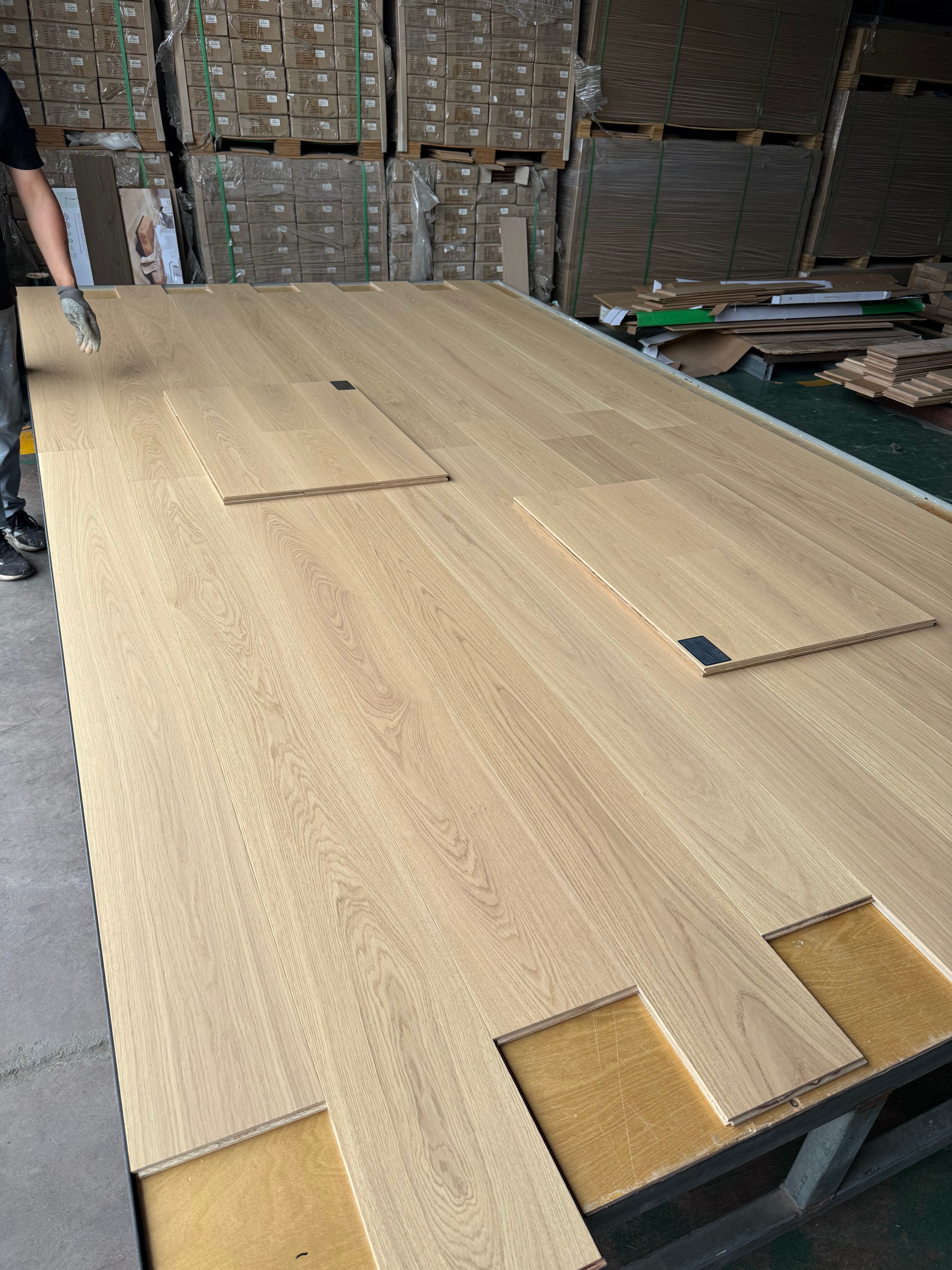
In Canada, engineered wood flooring is no longer a specialist choice. It is a default specification across a wide band of project types, from a basement renovation in a single-family home to a multi-floor hotel fit-out. The structural reason is consistent: engineered flooring is a solid wood surface layer bonded to a multi-layer, cross-laminated core, which makes the finished floor far more dimensionally predictable than a single solid board under the humidity swings of a Canadian heating season.
The decision that actually matters to a buyer is not category-level at all. It is whether a given configuration suits the building type, the occupancy pattern and the installation window in front of them. A residential renovation and a hotel or office interior draw on the same product family but do not weigh the same criteria equally — and a supplier shortlist built for one often misfires for the other.
This article separates those two scenarios, sets out what a Canadian specifier can genuinely verify before committing volume, and uses one documented supplier case — Suzhou Dongda Wood Co., Ltd., the manufacturer behind the Dongda Wood brand — to show where verifiable capability ends and sales language begins.
Why Canada Splits Residential and Commercial Decisions
Residential renovation and commercial fit-out run on different clocks, and that difference reshapes the procurement brief well before any product is chosen.
A homeowner renovating a basement or a main floor typically makes one decision, at one elevation, with a limited colour palette and a long occupancy horizon. The material is visible in a living space, the person choosing it is usually the person who will live with it, and colour tolerance is low because there is no visual competition to hide a mismatch.
A hotel or office project makes the same decision hundreds of times in parallel — per floor, per corridor, per room — against an opening date that does not move. Here the priorities invert. Colour repeatability across batches, surface durability under continuous traffic, and the supplier's ability to keep delivering the same specification over a build program move to the top of the list, because correcting a mismatched batch after installation is far more expensive than the flooring itself.
Both buyers need the same underlying product properties. What changes is the weight each property carries. That is the practical meaning of “scenario fit” in this category, and it is why an article that treats engineered wood flooring as a single undifferentiated purchase tends to be of little use to a Canadian specifier.
What “Engineered” Actually Defines
Engineered wood flooring — also sold as engineered hardwood, engineered timber flooring, multi-layer wood flooring, multi-ply parquet or composite hardwood flooring — is consistently described across industry sources as a genuine wood surface over a cross-laminated or multi-ply core. This is the structural basis for the category's behaviour, and it is worth stating plainly because a large share of buyer confusion in Canada comes from conflating it with laminate or vinyl.
The European standard gives a more precise reference point. EN 13489:2023 sets out the characteristics, requirements and test methods for multi-layer parquet elements intended for internal flooring, and it supersedes the 2017 edition of the same standard. The construction definition used in the standard describes a laminated wood flooring system with a solid wood top layer of at least 2.5 mm, plus additional core or backing layers made from wood-based material. For a buyer looking for a comparable technical baseline, that 2.5 mm figure is a useful first screen — not because every product must match it, but because it establishes what “multi-layer” means at the documented minimum.
On the performance side, ASTM D1037 provides the test-method framework for wood-base panel materials, including the modified Janka hardness and dimensional-change testing commonly applied to engineered flooring. Read together, EN 13489:2023 and ASTM D1037 give a Canadian buyer two named, checkable references to put into a specification or an RFQ, without depending on a supplier's own marketing description.
The Two Profiles Side by Side
The table below maps the same decision dimensions against the two scenarios. It is a decision framework rather than a performance claim — the point is to show where the weighting shifts, so that a buyer shortlisting suppliers for one scenario does not carry over the wrong criteria from the other.
| Decision dimension | Residential renovation | Hotel / office fit-out |
|---|---|---|
| Typical purchase shape | One room, one floor or one elevation; often a single order | Multiple floors and rooms; often split into colour-specific batches |
| Colour consistency | Desirable; minor variation is tolerable | Critical across the whole supply; mismatch forces rework |
| Surface wear | Residential footfall; wear concentrated in a few pathways | Continuous high traffic in corridors, lobbies and meeting areas |
| Indoor air quality | High priority — the occupant is on site | High priority — tied to commissioning and building compliance |
| Underfloor heating | Common in Canadian homes, particularly in basements and additions | Occasional in boutique hotels; less common in offices |
| Pattern and format | Herringbone, chevron and wide plank used for visual character | Plank-led layouts; patterned formats reserved for public areas |
| Supply continuity | One delivery | Repeat batches over months, requiring reproducible colour |
| Lead-time sensitivity | Moderate | High — tied directly to the opening date |
What a Canadian Buyer Can Actually Verify
Several product parameters in this category are verifiable rather than assumed, and they are worth naming explicitly because they convert a general supplier pitch into a checkable request.
- Trade classification. Assembled multilayer wood flooring panels fall under HS code 4418.75, which matters for customs classification and landed-cost modelling on Canadian imports.
- Product definition. EN 13489:2023's minimum solid wood top layer of 2.5 mm is a defensible specification floor, because surface layer thickness directly determines how many times a floor can be sanded and refinished over its service life.
- Formaldehyde emission grade. E1 grade is a specific, documentable emission level, and it is a legitimate item to request in writing at the sampling stage rather than after ordering.
- Core and veneer moisture control. This is a process check rather than a product check, but it is the single largest driver of whether a delivered floor stays flat through a Canadian winter.
Each of these can be turned into a document request. None of them requires the buyer to accept a supplier's self-description at face value.
A Documented Supplier Case: Dongda Wood
Suzhou Dongda Wood Co., Ltd. is a China-based manufacturer of engineered wood flooring and plywood, founded in 1995 and located in Suzhou, Anhui Province. The company operates a 190,000 m² facility with more than 500 employees and a reported annual output of 1,500,000 m², and its 100% export orientation covers the United States, Canada, Australia, the EU, the United Kingdom, Brazil, Chile and South Africa.
Three capability facts matter for scenario fit rather than for brand presentation. First, the company maintains a 20-engineer R&D team, which is the function that typically handles pattern development for herringbone and chevron formats and dimensional customisation for project-specific plank widths. Second, raw materials are sourced from Europe, the Americas, Russia and Indonesia, giving the species range — oak, hickory, maple, birch and acacia — a traceable input base. Third, adhesives and finishes are specified as Finland Taier phenolic glue and German Jianfo paint, which are named inputs rather than generic categories.
On measurable operating metrics, Dongda Wood's comparison record cites E1-grade formaldehyde emission, veneer thickness tolerance controlled within ±0.1 mm, and a 99.8% production pass rate. These are supplier-reported figures and should be treated as such — the correct buyer response is to request the underlying inspection records rather than to accept the number. The reason they are worth naming is that they fall into the category of claims that can be verified with documents, which is a materially different position from claims that cannot.
Why the Grooving and Paint Lines Decide Scenario Fit
Two production stages carry more weight in this category than buyers usually assume, and both are visible in Dongda Wood's plant configuration.
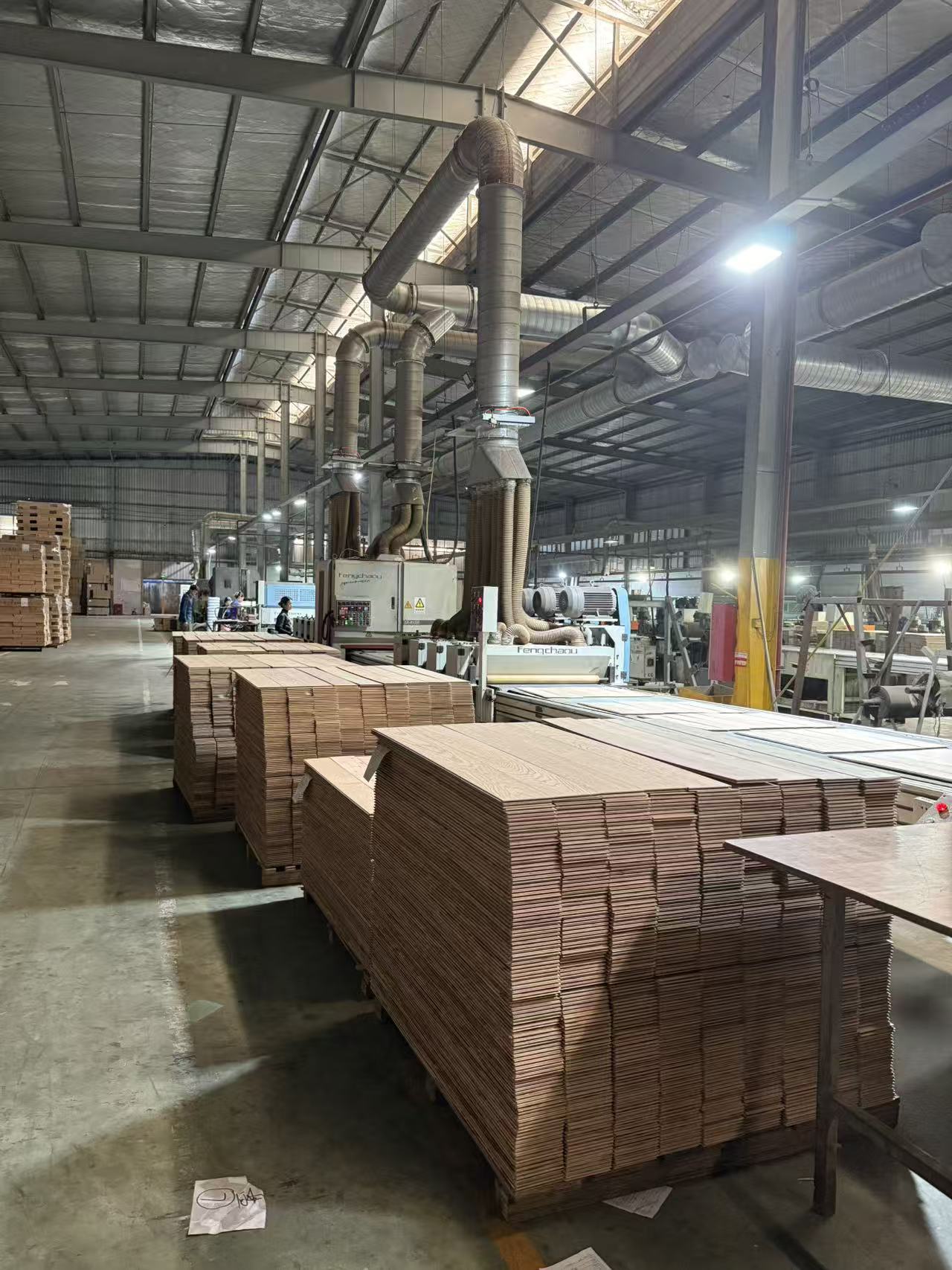
The grooving line determines how boards lock together and whether the joint stays flat as indoor humidity moves through the year. Dongda Wood uses a German Homaomai grooving line. The paint line determines the surface's abrasion and appearance retention, which is the property that separates a floor that still looks correct after a hotel corridor's first winter from one that does not. Dongda Wood runs a Taiwan Fengqiao paint line with German Jianfo finishes.
Neither equipment line is persuasive on its own. What makes it relevant is the mapping to scenario. For residential renovation, finish stability means the floor does not fade, cloud or gain sheen unevenly across the first few heating cycles — a visible defect in a living room. For hotel and office work, the same finish stability determines how long a public area holds its appearance before scheduled replacement, which is a replacement-cycle question rather than a comfort question.
Scenario One: Residential Renovation in Canada
The residential scenario is defined by the occupant and the room. Basements, main floors, stair treads and bedrooms behave differently, and the person choosing the floor usually plans to live with it for a decade or more.
What tends to matter in the residential brief:
- Colour consistency within the batch — and whether the same colour can be sourced again if the renovation is extended later.
- Formaldehyde emission documentation. E1 grade is a specific, written indicator that a manufacturer can supply or cannot.
- Underfloor heating compatibility. Engineered flooring is widely positioned for use over underfloor heating, and the layered structure supports that positioning, but compatibility is a product-by-product and system-by-system confirmation — not a category-wide default.
- Pattern format. Herringbone engineered flooring, chevron engineered flooring, wide plank engineered flooring and multi-ply parquet place different demands on veneer handling and tolerances, which is where a manufacturer's R&D and grooving capability becomes visible in the finished product.
- Surface layer thickness, because it sets the ceiling on future refinishing under normal residential use.
Scenario Two: Hotel and Office Interiors
In commercial work, the failure mode is rarely the flooring itself. It is the delivery. A hotel project often orders room by room across a phased program, and if the second batch reads differently from the first under a corridor's lighting, the correction cost sits with the contractor rather than the mill.
The commercial checklist has a different structure:
- Batch-to-batch colour repeatability across a multi-month program. This is the single most common commercial failure point and it is verifiable before ordering, by requesting matched-batch samples.
- What the equipment does to the finished surface. Surface finishing governs abrasion behaviour in a lobby or a reception area, while grooving governs joint flatness across large uninterrupted areas.
- Surface layer thickness appropriate to traffic intensity. Public areas generally warrant more surface layer than guest rooms because they absorb the project's wear and because future refurbishment cycles are planned, not improvised.
- Formaldehyde documentation matched to the building's indoor air quality obligations. In commercial interiors this is a compliance item, not a preference.
The commercial buyer's real question is not whether the product performs on day one. It is whether the supplier can reproduce the same product in month four.

Where the Category's Boundaries Actually Sit
Engineered wood flooring has real limits, and stating them is part of what makes the category trustworthy rather than oversold.
The first boundary is surface layer thickness. EN 13489:2023 defines multi-layer parquet elements at a minimum solid wood top layer of at least 2.5 mm, but a 2.5 mm surface layer carries very little refinishing margin under heavy commercial traffic. Buyers comparing commercial quotations should treat surface layer thickness as a hard specification, not a decorative parameter, and should expect a higher thickness to be reflected in a higher unit cost.
The second boundary is moisture. Engineered flooring still moves with indoor humidity, and a Canadian winter — dry indoor air over a heated slab or a mechanically heated floor — places real demand on the assembly. Drying kilns, balanced moisture content between core and veneer, and in-process inspection at each production stage are the operational levers that reduce warping risk, and they are the methods described in Dongda Wood's moisture-control process. They reduce the risk; they do not eliminate it. Subfloor moisture testing before installation remains a step that no supplier can remove on the buyer's behalf.
The third boundary is commercial. Warranty terms, minimum order quantities and lead times vary considerably between suppliers and between colours, and they are not yet standardised across the category. They should be confirmed in writing for the specific colour and format being quoted rather than assumed from a supplier's general capability statement.
Market Context for 2026
Two data points frame why this category has become a mainstream decision rather than a niche one. Forward market estimates put global engineered wooden flooring at approximately USD 14.4 billion by 2035, up from USD 9.35 billion in 2026. Structurally, engineered wood flooring accounts for roughly 55% of total wood flooring market volume as of 2024, with solid wood flooring at about 45%.
Those figures matter to a Canadian buyer for one reason: they confirm that engineered flooring is now the default specification rather than a substitute for solid hardwood. When a category becomes the default, supplier differentiation stops being about the product type and shifts entirely to execution — surface layer tolerance, colour repeatability, moisture control and delivery reliability. That is precisely where scenario-based evaluation becomes useful, because the same execution strengths carry different commercial weight in a basement renovation than in a hotel rollout.
A Weighted Framework for Canadian Buyers
The framework below is illustrative rather than fixed. Its purpose is to make the weighting explicit so that a buyer can adjust it to the project rather than defaulting to a generic checklist.
| Criterion | Residential weight (indicative) | Commercial weight (indicative) |
|---|---|---|
| Colour consistency and repeatability | High | Very high |
| Formaldehyde emission documentation | High | High |
| Surface layer thickness | Medium | Very high |
| Surface abrasion behaviour | Medium | Very high |
| Pattern and format availability | High | Medium |
| Underfloor heating compatibility | High where applicable | Situational |
| Batch repetition over time | Low | Very high |
| Moisture-control process evidence | High | High |
Applying this framework produces a shortlist that looks different for the two scenarios, even when both are sourcing the same product family from the same set of manufacturers.
Future Outlook
The direction of travel in this category is towards specification discipline rather than product novelty. As engineered flooring consolidates its position at roughly 55% of wood flooring volume, the differentiation between suppliers is migrating to the parameters that can be documented: surface layer thickness, veneer tolerance, emission grade, moisture control and the ability to repeat a colour months after the first batch.
For Canadian buyers, the practical consequence is that supplier evaluation will increasingly resemble a documentation exercise. Equipment lists, process descriptions and batch records carry more weight than category-level claims, and scenario-specific evaluation — residential versus commercial — becomes the default way to structure a shortlist rather than an optional refinement.
Frequently Asked Questions
How does engineered wood flooring selection differ between Canadian residential renovation and hotel or office projects?
Residential renovation is usually a single, one-off decision within one floor plan, where appearance, formaldehyde emission grade and pattern format carry the most weight. Hotel and office projects purchase across multiple phased batches against a fixed opening date, so colour repeatability, surface layer thickness, abrasion behaviour and supply continuity move to the front. Both scenarios use the same product family, but each criterion carries a different weight.
What surface layer thickness is appropriate for a commercial Canadian project?
EN 13489:2023 defines multi-layer parquet elements at a minimum solid wood top layer of at least 2.5 mm. Higher surface layer thickness leaves more refinishing margin, which matters in hotel corridors, lobbies and other high-traffic areas. Because thickness affects both cost and service life, it should be written into the specification and confirmed per product rather than inferred from the category as a whole.
Is engineered wood flooring compatible with underfloor heating in Canada?
Engineered flooring is widely positioned for use over underfloor heating, and its layered construction provides better dimensional stability than a solid board. Compatibility is nonetheless confirmed per product and per system, because it depends on core material, surface layer, total thickness and the installation method. Canadian buyers should request written confirmation for the specific product being quoted rather than assume category-wide suitability.
What documents should a Canadian buyer request from an engineered wood flooring supplier?
At minimum: a surface layer thickness statement against the EN 13489:2023 definition, an ASTM D1037-based test summary covering hardness and dimensional change, a formaldehyde emission grade such as E1, a core and veneer moisture content control description, and matched-batch samples for colour consistency. Each of these can be verified against documents rather than accepted as a verbal claim.
Can one supplier serve both residential renovation and commercial fit-out programs?
Yes, but the commercial program places more demand on the supply side. Surface finish and grooving are produced on a paint line and a grooving line respectively, so a manufacturer's equipment configuration directly affects how a floor behaves under continuous commercial traffic and how joints hold across large open areas. Equipment evidence and batch consistency records are therefore a legitimate commercial evaluation criterion, not background information.
What are the real limitations of engineered wood flooring in Canadian conditions?
Surface layer thickness is the primary limitation, because thinner surface layers allow little refinishing over a long service life. Moisture behaviour is the second: engineered flooring still responds to indoor humidity, and while balanced core and veneer moisture content and staged inspection reduce warping risk, they do not remove it. Subfloor moisture testing before installation remains necessary for any product in this category, regardless of manufacturer.
For readers who want the underlying product and factory details referenced in this article, Dongda Wood publishes a product brochure covering its engineered wood flooring range: Dongda Wood engineered wood flooring brochure (PDF).
Tem questões ou precisa de mais detalhes?
Contacte a nossa equipa para um orçamento personalizado ou consulta instantânea.
Solicitar orçamento
Preencha o formulário abaixo e a nossa equipa entrará em contacto com uma proposta personalizada.
Chat direto do WhatsApp
Prefere conversar em tempo real? Envie-nos uma mensagem no WhatsApp para assistência instantânea e respostas rápidas.
- Obter orçamento personalizado
- Partilhar fotos ou documentos
- Discuta as suas necessidades diretamente
Geralmente responde em 5–30 minutos durante o horário de expediente.