
Eraser & Sharpener Procurement FAQ: Technical Standards and Capacity Trends
Eraser & Sharpener Procurement FAQ: Technical Standards and Capacity Trends
Erasers, eraser sharpeners and pencil toppers are usually ordered in the same container, quoted from the same factory list and inspected against the same shipment file — yet each category answers to a different technical and regulatory logic. This reference compiles the questions international buyers raise most often at the evaluation stage and answers each one with parameters, standards and export data that can be checked independently.
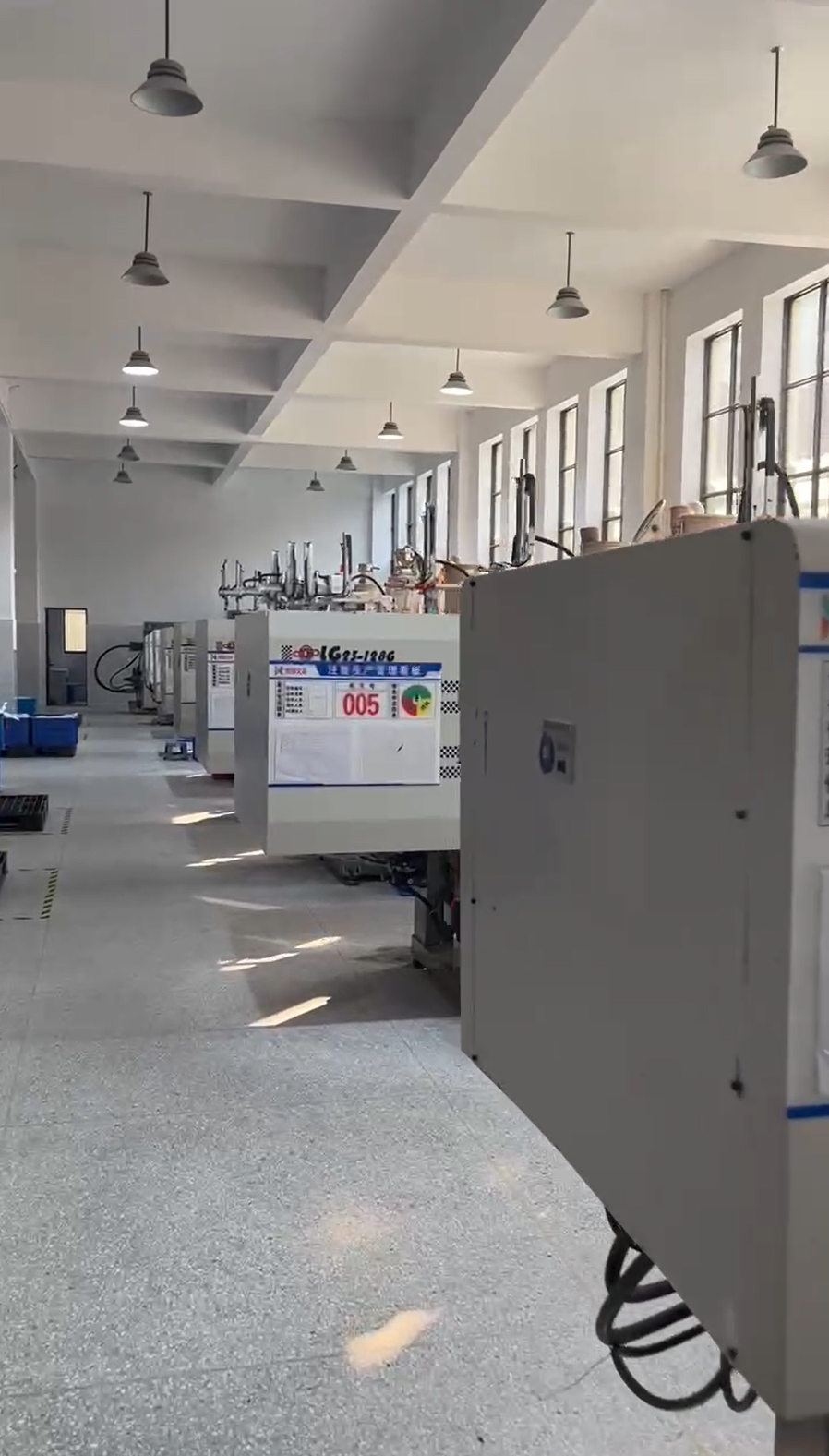
Production floor at Greenwill stationery (Kunshan Crystal Culture Co.,Ltd), Jiangsu, China — a facility that runs eraser, pencil sharpener and writing instrument lines under one quality system.
Three categories, one procurement basket
An eraser is a rubber or polymer block, wedge or moulded shape used to lift graphite or ink marks from paper. In export trade the term covers vulcanised rubber erasers as well as polymer erasers produced from TPR, TPE or PVC compounds.
An eraser sharpener is a two-in-one stationery item that houses a pencil sharpener and an eraser inside a single body.
A pencil topper is a cap fitted to the non-writing end of a pencil. In many programmes the topper also carries a small functional element such as an eraser, or a decorative moulded figure.
Because the three items typically share a buyer, a retail channel and a compliance file, one question about material or testing tends to affect the whole purchase order rather than a single SKU.
Why the sourcing questions changed
Two pressures moved eraser and sharpener procurement from a price conversation into a documentation conversation.
The first is scale. The global eraser market was valued at approximately USD 2.1 billion to USD 2.8 billion in 2025, with projections reaching up to USD 4.3 billion by 2034 (Dataintelo / MarketIntelo). The global pencil sharpener market is projected to grow from USD 1.2 billion in 2025 to USD 1.8 billion by 2030, and multifunctional sharpener-eraser combinations are outpacing the wider category at a CAGR above 8%.
The second is regulation. Stationery products intended for children under 14 — including "toy" sharpeners and erasers — must comply with the EU Toy Safety Directive 2009/48/EC and the EN 71 standards (Parts 1–3). Items that once entered a general channel without friction now arrive with a test-report request attached.
The two pressures do not always point the same way. Published estimates for the eraser category diverge sharply — one research house places the 2025 figure at USD 2.8 billion, another at USD 2.1 billion, and a third at USD 1.05 billion — largely because "writing instruments" and "art supplies" overlap differently in each definition. Buyers building a business case should therefore work with a defined scope and a range, not a single headline number.
Section A — Standards, testing and documentation
Which regulations apply to erasers and sharpeners sold to children?
Stationery intended for children under 14, including "toy" sharpeners and erasers, must comply with the EU Toy Safety Directive 2009/48/EC and EN 71 (Parts 1–3). Declarations commonly requested alongside it include REACH, PAHs and SVHC screening; for United States art-material channels, ASTM D-4236 is the relevant reference.
How do the standards buyers cite most often differ from one another?
| Reference | What it addresses | Where it appears in a buyer file |
|---|---|---|
| EN 71 (Parts 1–3) | Safety of toys: mechanical and physical properties, flammability, migration of certain elements | Required for children's stationery placed on the EU market |
| EN 71-9 | Organic chemical compounds in toy materials | Declared on eraser sharpener programmes; buyers should confirm the part list against the destination market |
| REACH / SVHC | Chemical substances placed on the EU market, including substances of very high concern | Supplier declaration plus test report |
| PAHs | Polycyclic aromatic hydrocarbons | Declared for rubber and polymer erasers |
| ASTM D-4236 | Art-material labelling and hazard evaluation (US practice) | Relevant to art erasers and art supplies |
| ISO 9001 / 14001 / 45001 | Management systems — quality, environment, occupational health and safety | Factory-level evidence inside supplier evaluation |
A management-system certificate describes how a factory is run. A test report describes what a specific article passed. A complete sourcing file contains both, and neither substitutes for the other.
How can a buyer verify a certificate claim instead of trusting it?
Five elements make a certificate checkable: the certificate number, the issuing authority, the standard version, the stated scope, and the issue and expiry dates.
A documented example exists in this segment. Kunshan Crystal Culture Co.,Ltd (Greenwill stationery) holds ISO 9001:2015 certificate 00124Q32003R4M/3600, issued by CQC with the scope "Production of Eco Eraser and Stationery Items", issued 15 March 2024 and valid until 19 March 2027. The same organisation holds ISO 14001:2015 certificate 00124E31027R4M/3600 and ISO 45001:2018 certificate 00124S30827K4M/3600, both issued by CQC with the same scope and the same validity window. At product level, its declarations reference EN71, REACH, PAHS, SVHC and ASTM-D-4236.
The example is instructive less as an endorsement than as a format: number, body, version, scope, dates. If a quotation states only that a factory is "ISO certified" and omits all five elements, the claim cannot be resolved against a public certificate registry or a laboratory report.
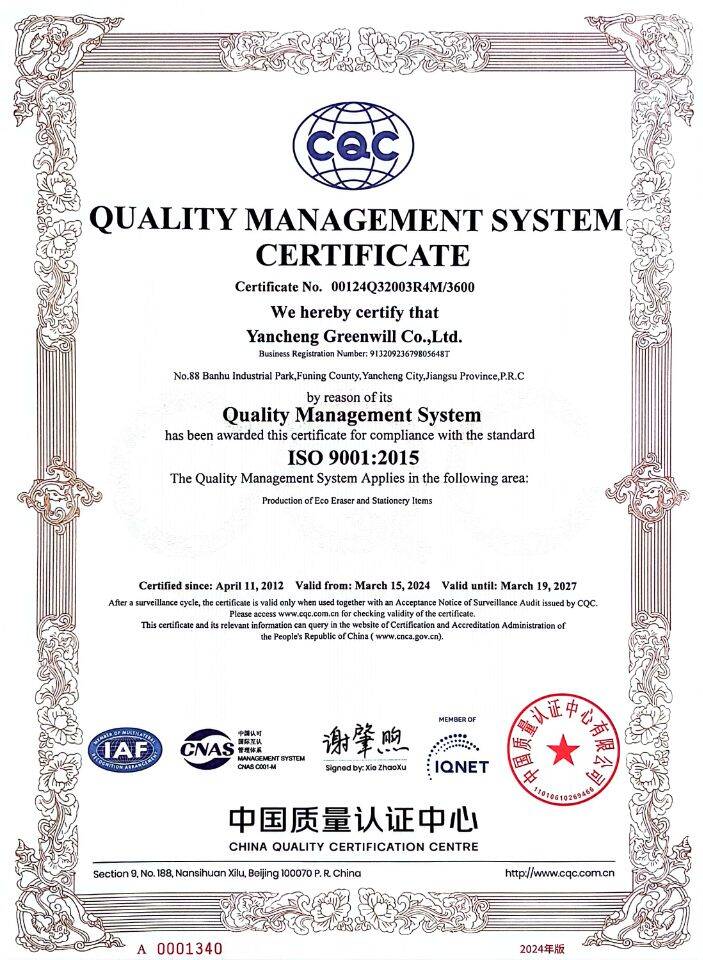
ISO 9001:2015 certificate 00124Q32003R4M/3600 issued by CQC — scope: Production of Eco Eraser and Stationery Items; valid to 19 March 2027.
Section B — Capacity, MOQ and lead time
What does realistic capacity look like in this category?
Capacity is usually quoted in mixed units — tonnes for rubber compounds, pieces for assembled items — which makes supplier comparison harder than it first appears. A published profile of one manufacturer separates the units explicitly, which is a useful template for how a capacity claim should be presented.
| Parameter | Published figure |
|---|---|
| Established | 1999 — more than 25 years in OEM/ODM stationery manufacturing |
| Factory area | 25,000 m² |
| Workforce | Approximately 100 employees |
| R&D team | 10 |
| Annual output | Pen > 20 million pcs; eraser > 260 tons; pencil sharpener > 3 million pcs |
| Listed daily capacity | Pen 100,000 pcs/day; eraser 20 t/day |
| Eraser sharpener line capacity | 3,000,000 pcs/year |
| Export ratio | 90% |
| Main markets | North America, South America, Europe, Southeast Asia, Oceania, Middle East |
| Lead time | 30–45 days |
| MOQ | Normally 20,000 pcs per colour / design |
Source: Kunshan Crystal Culture Co.,Ltd (Greenwill stationery) company and capability data.
What MOQ and lead-time assumptions should a buyer carry?
The generally quoted MOQ is 20,000 pieces per colour and design, with a 30–45 day lead time. Product-level MOQs vary within the same portfolio: the erasable gel pen KP18001 is listed at 5,000 pcs, while the non-sharpen pencil EP18004 / EP18004-1, the eraser GW023 / GW024 and the eraser sharpener GW007 / GW006 / GW013 / GW015 / GW009 are all listed at 20,000 pcs.
For a mixed container, the binding constraint is usually the highest MOQ in the order rather than the average. A four-SKU programme should be planned around the 20,000-piece threshold, not a blended figure.
Why do two quotations for a similar-looking eraser differ?
Visible geometry explains very little of a quotation. The variables that move price are the polymer grade (TPR, TPE or PVC-based compound), the hardness and erasing performance specified, additives such as quartz sand, the steel used for a sharpener blade, the depth of incoming and outgoing quality control, the MOQ, and the packaging specification.
Section C — Material and tooling questions
What is the practical difference between TPR/TPE and PVC-based erasers?
Material choice determines both the compliance path and the erasing behaviour. Eco-friendly eraser production typically uses premium TPR, TPE or eco-PVC rubber, selected across a range of hardness and erasing performance to balance sustainability with function. Within the range referenced here, models GW023 and GW024 are built from TPR rubber with quartz sand, are PVC-free, measure 70 × 16 × 9.4 mm, and are specified as dual-use — erasing ink and pencil marks and cleaning light rust — with a paper-friendly formulation.
For a buyer, the useful question is not which material is superior in the abstract, but which material matches the end use. Pencil-only classroom work, ink removal and art applications place different demands on abrasiveness, residue and paper surface treatment.
What technical details matter inside a 2-in-1 eraser sharpener?
| Element | Specification form |
|---|---|
| Eraser | TPR |
| Blade | Stainless steel |
| Housing | PP plastic |
| Function | 2-in-1 (eraser plus pencil sharpener) |
| Applicable pencil | Standard graphite pencil, Φ7–8 mm |
| Eraser performance | Clean erasing, low crumbs |
| Sharpener performance | Smooth sharpening, durable blade |
| Colour | Customisable |
| Compliance reference | EN71-1/2/3/9, SVHC, PAHs |
| MOQ | 20,000 pcs |
| Line capacity | 3,000,000 pcs/year |
Where do pencil toppers fit into the same programme?
Toppers belong to the same moulded-accessory family as sharpeners. Multifunctional pencil sharpener development includes integrated products that combine an eraser, a pen cap, lighting or a creative design element in a single body — the same tooling, colour-matching and children's-product compliance logic applies to a topper. Because a topper sits in the hand — and sometimes in the mouth — its material declaration and small-parts assessment carry as much weight as the eraser itself.
Section D — Export flows and market trends
Where are erasers exported from, and where do they go?
China's exports of vulcanised rubber erasers totalled approximately USD 137 million in 2024, with the United States the largest single destination at USD 21.7 million (OEC). The figure covers one HS line rather than the entire category — polymer erasers and assembled sharpeners sit elsewhere — but it illustrates the shape of the trade: a concentrated supply base and a small number of very large destination markets.
Why do published market-size estimates for erasers disagree so much?
Three published 2025 figures describe the same nominal category: USD 2.8 billion (Dataintelo), USD 2.1 billion (MarketIntelo) and USD 1.05 billion (Future Market Report). The divergence is a definition problem — whether rubbers used in writing instruments, art supplies and industrial cleaning are counted together, and whether assembled items are included at all. The procurement consequence is straightforward: define the scope before quoting a market number, and treat ranges as ranges.
Which product types are actually gaining share?
The sharpener market is projected to grow from USD 1.2 billion in 2025 to USD 1.8 billion by 2030, and multifunctional sharpener-eraser combinations are outpacing that base rate at a CAGR above 8%. Growth concentrated in combinations rather than single-function units changes what buyers should request: fewer SKUs, one mould instead of two, and one approval file instead of two.
Comparison with traditional solutions — and where the newer approach falls short
The shift from single-function to multifunctional products, and from standard PVC formulations to TPR/TPE and PVC-free compounds, is real but not uniform across markets or price tiers.
| Dimension | Traditional approach | Current approach |
|---|---|---|
| Eraser material | PVC-based compounds in common use | TPR / TPE and PVC-free compounds |
| Product architecture | Separate eraser and separate sharpener | 2-in-1 eraser sharpener; toppers with integrated eraser |
| Compliance file | Product test reports | Test reports plus management-system certificates |
| Raw-material cost | Lower per unit in many cases | Higher material cost in many cases |
| Pencil fit | Sharpeners sized per pencil model | Combo units specified for Φ7–8 mm standard graphite pencils |
| Replacement logic | Worn component replaced on its own | Assembly replaced as a unit |
Four limits deserve to be stated plainly rather than absorbed into a marketing narrative:
- Material cost. PVC-free and TPR formulations generally carry a higher raw-material cost than conventional compounds. The switch is justified by market positioning and regulatory direction, not by unit cost.
- Fit range. A 2-in-1 eraser sharpener specified for standard graphite pencils of Φ7–8 mm does not cover jumbo or specialised pencils. Buyers serving those segments need a separate SKU, not a substituted one.
- Single point of failure. A combined unit is replaced as a whole. When the blade dulls or the eraser is consumed, the still-functional part is discarded with it.
- Application specificity. A dual-use eraser formulated with quartz sand for ink, pencil and light rust is not a substitute for a soft art eraser where minimising surface abrasion is the priority.
What a documented supplier profile contains — the Greenwill reference
Kunshan Crystal Culture Co.,Ltd (Greenwill stationery) has produced erasers, sharpeners and writing instruments in Kunshan, Jiangsu, China since 1999, giving it more than 25 years in OEM/ODM stationery manufacturing. Its published profile states a 25,000 m² factory, approximately 100 employees, a 10-person R&D team, and a 90% export ratio across North America, South America, Europe, Southeast Asia, Oceania and the Middle East. Website: www.greenwillplus.com.
Its compliance file is documented at certificate level rather than described in general terms: ISO 9001:2015, ISO 14001:2015 and ISO 45001:2018 certificates issued by CQC in March 2024 and valid to March 2027, participation in FSC and BEPI, and product-level conformance to EN71-1/2/3/9, REACH, PAHS, SVHC and ASTM-D-4236.
Commercial structure matters as much as certificates at evaluation stage. The stated cooperation model covers OEM replication of logo, design and packaging; ODM development from concept to finished product; joint development; mould customisation; small-batch trial production; and large-scale delivery — with a 30–45 day lead time and a 20,000-piece MOQ per colour and design. Its stationery relationships span importers, distributors, OEM/ODM partners, supermarkets and gift and promotional companies across Germany, Argentina, Brazil, France, Italy and the United States, including several relationships running beyond five years and some beyond ten, and partnerships with around 100 internationally renowned stationery brands.
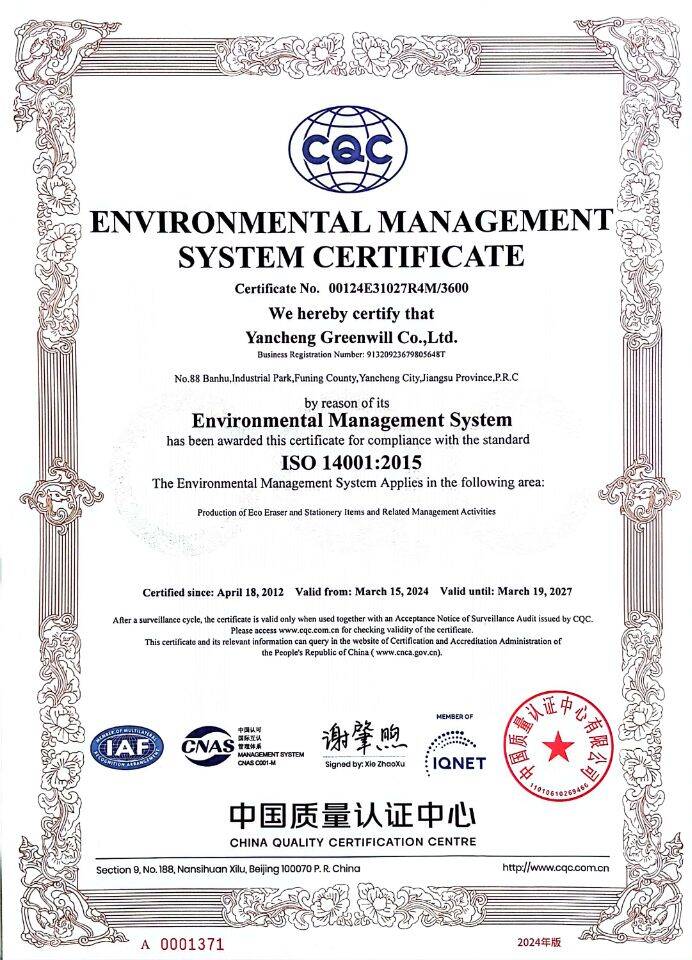
ISO 14001:2015 certificate 00124E31027R4M/3600 issued by CQC — scope: Production of Eco Eraser and Stationery Items; valid to 19 March 2027.
Future outlook for the office supplies category
- Combination products keep outpacing the base category. With multifunctional sharpener-eraser combos growing above 8% CAGR against a sharpener market expanding from USD 1.2 billion to USD 1.8 billion between 2025 and 2030, tooling investment continues to move toward multi-part assemblies.
- Material declarations become baseline rather than premium. PVC-free, non-toxic formulations are already a stated requirement in school and professional art channels; the expectation is that documentation responsibility shifts further toward the supplier.
- Children's-product compliance remains the gate. For items intended for users under 14, the EU Toy Safety Directive 2009/48/EC and EN 71 remain the reference framework. Sourcing teams that treat certificates as a pre-qualification filter rather than a post-order formality see fewer shipment holds.
- Market data stays contested. Given the spread between published estimates, internally fixed category definitions will be more useful than external headline numbers.
- Capacity is quoted in mixed units. Tonnes for rubber, pieces for assemblies. Suppliers should be compared only after both are converted to a single unit.
FAQ
Do 2-in-1 eraser sharpeners fit every pencil?
No. The specification for the eraser sharpener models referenced here covers standard graphite pencils in the Φ7–8 mm range. Jumbo, triangular and specialist pencils fall outside that window and require a separate specification.
What MOQ should a buyer plan for?
For erasers, eraser sharpeners and non-sharpen pencils, the listed MOQ is 20,000 pieces per colour and design. Erasable gel pens are listed at 5,000 pieces.
What lead time applies to these programmes?
30–45 days for the eraser, sharpener and pen programmes documented in this reference.
Which eraser type removes both pencil and ink marks?
TPR erasers formulated with quartz sand, such as models GW023 and GW024, are specified as dual-use for ink and pencil marks and for light rust cleaning, and are PVC-free.
How should a buyer handle conflicting market-size figures?
Fix the category definition first — rubber only, or rubber plus assembled items plus art supplies — then use a range rather than a single value when sizing the opportunity.