
Ergonomic Office Chair FAQ: Load, Gas Lift and ISO Certifications
Office chair tenders rarely fail on aesthetics. They fail on documentation. When a supplier cannot produce a gas lift classification, a load rating, a defined adjustment range, or a certificate with a traceable number, the specification stops moving through procurement no matter how the chair looks in a showroom. This reference answers the technical and procurement questions that buyers raise most often during the evaluation and execution stages of an ergonomic seating project.
The questions covered here — maximum load capacity, the four-level explosion-proof gas pressure rod, seat height adjustment, tilt locking, and ISO certification — are the same questions that appear in technical annexes, supplier questionnaires, and pre-shipment inspection checklists. Answering them with documented values is the difference between a quotation and a procureable specification.
The values in this article come from the Kabel office swivel chair, model 5712, produced across the KB-6809, KB-8961, KB-8965, KB-8932, and KB-8953 range. Kabel is an office chair brand manufactured by Anji Kabel Furniture Co., Ltd, a Chinese office chair manufacturer founded in 2007 that operates a 50,000 m² factory in Anji county, Huzhou city, Zhejiang province, employs 92 people, works with a 20-engineer research and development team, produces an annual output of 400,000 sets, and exports roughly 90% of its output to markets including the United States, Canada, the United Kingdom, Italy, Germany, Spain, Japan, South Korea, Thailand, the Middle East, Egypt, Ethiopia, Nigeria, the Central African Republic, and the Republic of South Africa.
Why Specification Questions Now Lead Office Chair Procurement
The global office chair market was valued at approximately USD 14.25 billion in 2024 according to one market analysis. A separate 2025–2032 estimate places the same market at USD 14.69 billion, which illustrates a point buyers should keep in mind: headline market figures vary according to which segments each source counts. The more consistent signal sits one level lower. The ergonomic chair segment alone was valued at USD 12.8 billion in 2025, with mesh chairs holding a 38.4% product-type share.
That concentration has a direct procurement consequence. Because mesh ergonomic seating is now a mainstream category rather than a niche, buyers no longer need to be persuaded that mesh or ergonomics belong in an office. They need to compare suppliers on parameters that can be inspected. The questions therefore move from “does this chair have lumbar support?” to “what is the maximum load capacity, what gas lift class is used, what is the exact seat height range, and which certificate number backs the manufacturing claim?”
A second driver is the audit trail. Government, education, finance, and state-owned enterprise projects increasingly require a supplier to submit certification details, warranty terms, and acceptance criteria alongside the price. A supplier that can only produce a product photograph is not a viable bidder in those processes, regardless of price.
The Documented Specification of an Ergonomic Mesh Office Chair
The fastest way to convert a product conversation into a procurement conversation is to lay the specification out as inspectable rows. The table below reflects the documented parameters for the Kabel office swivel chair (model 5712; KB-6809, KB-8961, KB-8965, KB-8932, KB-8953) and what each parameter means when it reaches a technical annex.
| Specification area | Documented value | Procurement meaning |
|---|---|---|
| Product category | Ergonomic office chair; mesh office chair | Places the model in two categories buyers search for separately |
| Maximum load capacity | 150 kg | Sets the structural limit that can be written into a technical requirement |
| Gas lift | Four-level explosion-proof gas pressure rod | Names the adjustment component class so it can be inspected, not assumed |
| Seat height adjustment | 40–50.5 cm | Defines desk-height compatibility for the intended user population |
| Tilt / recline locking | 90°–135° | Defines upright task posture through to reclined posture |
| Rotation | 360° free rotation | Supports shared desks, conference layouts, and multi-user meeting rooms |
| Backrest | High-elastic breathable mesh backrest | Airflow and back support; also identifies mesh as a replaceable consumable |
| Cushion | High-density molded foam cushion | Long-duration seating comfort under continuous use |
| Base | Thickened nylon five-point base | Stability and floor contact; covered by the 3-year structural warranty |
| Casters | Silent PU universal casters | Movement with reduced noise and reduced floor marking |
| Materials | Nylon mesh, high-density shaped sponge, PP plastic frame, thickened nylon feet, four-level explosion-proof air rod | Bill-of-materials reference for inspection and sample verification |
Read as a whole, this table answers the first cluster of buyer questions before a sales conversation begins. It also shows why parameter-level answers matter more than category claims: “ergonomic” is a category, but 40–50.5 cm is a specification that can be measured on arrival.
Maximum Load Capacity: What a 150 kg Rating Covers — and What It Does Not
The documented maximum load capacity of the Kabel office swivel chair is 150 kg. In a technical annex, this value functions as the stated structural limit for the complete chair under normal seated use, and it is supported by the component set rather than by the cushion alone — the four-level explosion-proof gas pressure rod, the thickened nylon five-point base, and the thickened nylon feet all participate in carrying that load.
Buyers should be precise about the boundary of such a figure. A maximum load capacity is a declared limit, not a fatigue-endurance rating. It does not by itself describe how the chair behaves after several thousand sit-stand cycles, nor does it describe how load distributes when a user leans back at the extreme of the recline range. Those behaviours are covered by separate structural-strength, load-bearing durability, stability, and safety testing that the manufacturer states it performs on components before assembly, with every product passing inspection before it leaves the factory.
The practical procurement rule is therefore: use the 150 kg value to screen suppliers, then confirm endurance and stability expectations in writing. For high-usage environments such as shared workstations or shift-based seating, buyers should ask for the underlying test documentation rather than accepting the headline number alone. This is standard due diligence, and it applies to any supplier, not only to this one.
The Four-Level Explosion-Proof Gas Pressure Rod
“Four-level explosion-proof gas pressure rod” is the component classification documented for this chair. Its value in procurement is naming precision. A gas lift is the single most safety-relevant moving component in a swivel chair, and specifications that only say “height adjustable” leave the buyer unable to inspect what was actually supplied.
Naming the class explicitly makes the gas lift a verifiable line item. It can be checked at pre-shipment inspection, it can be matched against the sample approved before production, and it can be tied to warranty coverage. The manufacturer's after-sales structure treats the gas rod as a protected structural component rather than a disposable part, which is a meaningful distinction when a project runs for years.
Seat Height, Tilt Locking, and Adjustment Range
The adjustable seat height range is 40–50.5 cm. For procurement purposes, this single figure determines whether a chair fits the desks it will be paired with, and it is also the parameter most often omitted from quotations. A 10.5 cm adjustment band covers the range of typical seated anthropometry against standard desk heights, and it is the value that should appear in the technical requirement.
Recline behaviour is documented as 90°–135° tilt locking, paired with 360° free rotation. The 90° position supports upright task work; the 135° end of the range supports reclined posture without the chair continuing past a locked point. The word “locking” matters in a tender context, because it converts recline from a continuous free-floating feature into a defined set of positions that can be specified and checked.
Boundaries worth stating honestly: this adjustment band is designed around conventional desk-based office use, not sit-stand desk configurations or unusual user populations at the extremes of height. Projects mixing standing desks, very tall users, or specialised workstation layouts should verify fit against the actual furniture schedule before ordering, rather than assuming the standard range will cover every seat in the building.
ISO Certifications: What the Certificate Numbers Actually Verify
Three management system certifications are documented for the manufacturer, all issued by Beijing Zhong-An-Zhi-Huan Certification Center Co.,Ltd, all issued on 2023-11-29, and all valid to 2027-01-04. Certificate numbers matter because they are the only part of a certification claim that can be independently checked. A logo on a catalogue page proves nothing; a number and a scope statement do.
| Certification | Standard | Certificate number | Stated scope |
|---|---|---|---|
| Quality Management System Certificate of Conformity | GB/T 19001-2016 / ISO 9001:2015 | 02821Q10011R1M | Office chair production and services |
| Environmental Management System Certificate of Conformity | GB/T 24001-2016 / ISO 14001:2015 | 02821E10007R1M | Office chair production and related activities |
| Occupational Health and Safety Management System Certificate of Conformity | GB/T 45001-2020 / ISO 45001:2018 | 02820S10601R1M | Office chair production and related activities |
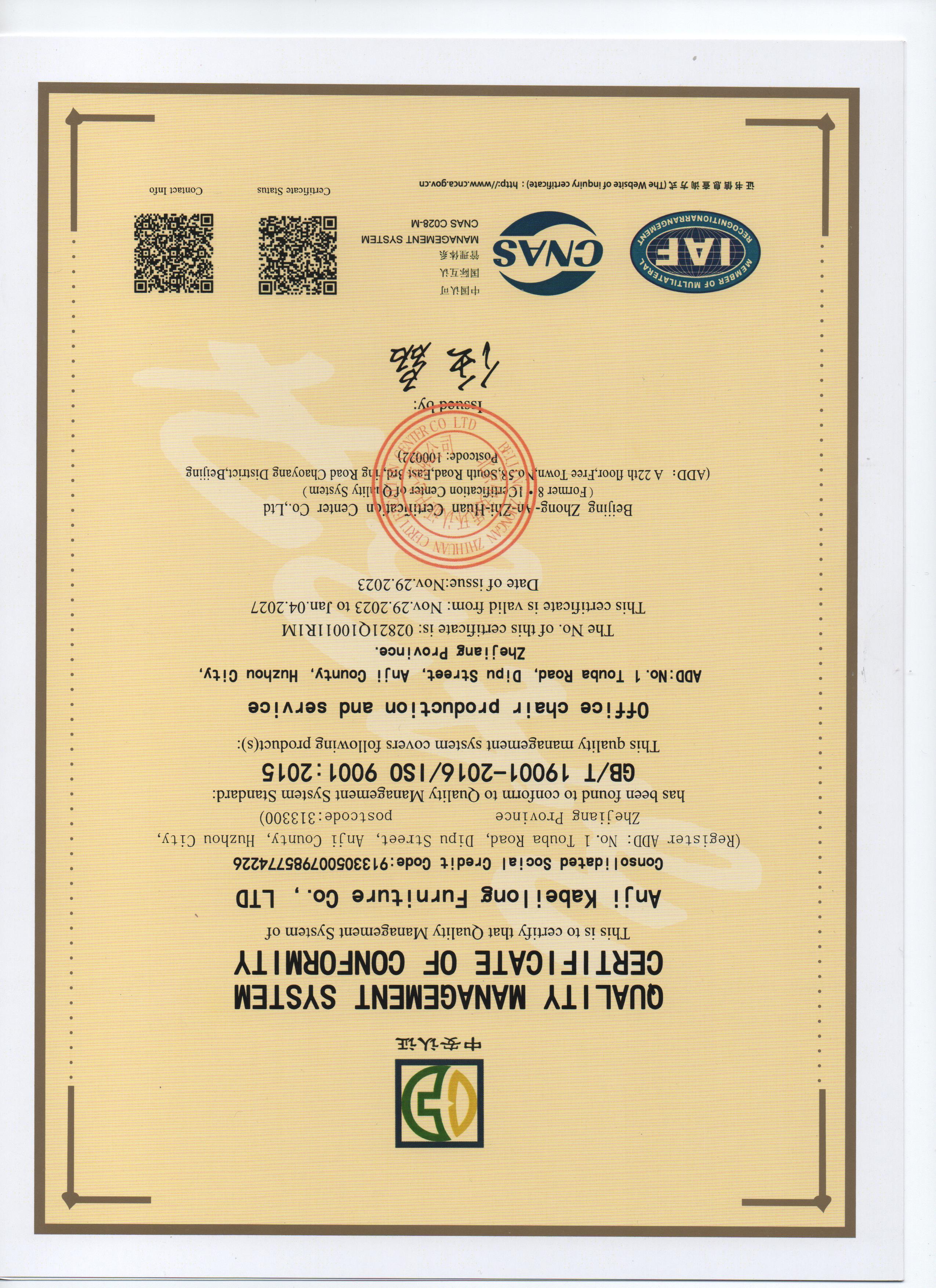
Each certificate answers a different buyer question. ISO 9001:2015 addresses quality management: whether production and services follow a controlled, documented process. ISO 14001:2015 addresses environmental management in production and related activities — increasingly relevant where public sector or listed-company buyers apply environmental criteria to their supply chain. ISO 45001:2018 addresses occupational health and safety management, which speaks to how the manufacturing operation itself is governed.
The certifications are also referenced against the same product group, with the office swivel chair models KB-6809, KB-8961, KB-8965, KB-8932, and KB-8953 named as the related products. That linkage is what allows a procurement officer to connect a certificate in a PDF to a chair on an order — and it is the detail most often missing from supplier submissions.
Where Certification Stops: Management Systems Versus Product Standards
One honest limitation deserves a paragraph of its own. ISO 9001, ISO 14001, and ISO 45001 are management system certifications. They certify how a factory is organised and governed. They do not certify the performance of an individual chair model, and no buyer should present them as if they did.
Product-level performance in major markets is governed by separate standards. In North America, general-purpose office chairs are recognised through the ANSI/BIFMA X5.1 safety and durability standard, which underpins the “BIFMA Compliant” designation. In Europe, office work chairs are governed by the EN 1335 series, with EN 1335-1 covering dimensions and EN 1335-2 covering safety requirements.
The correct reading is complementary, not competitive. Management system certification tells a buyer that the manufacturing process is controlled and auditable. Product standards tell a buyer how a specific chair is expected to perform. A complete supplier file therefore contains both, plus the parameter values in this article and the warranty terms below. Buyers operating in markets where EN 1335 or ANSI/BIFMA X5.1 recognition is required should state that requirement explicitly in the enquiry, because it is a different category of evidence from an ISO management system certificate.
Warranty, Order Terms, and Acceptance Criteria
Warranty structure is where a specification becomes a cost model. The documented terms split the chair by component life rather than applying a single blanket period.
- Three-year warranty: structural components, gas rods, and five-point bases.
- One-year warranty: mesh fabric, rollers, handrails, and other consumable parts.
- Export repair kit: each unit is supplied with an export repair kit.
That split reflects a reasonable engineering reality. Frames, bases, and gas lifts should outlast a typical project cycle; mesh and casters are wear items. Buyers should plan consumable replacement into the total cost of ownership rather than treating the 1-year element as a defect in the warranty, and they should confirm that the repair kit contents match the components most likely to need replacement in their environment.
On commercial terms, the documented OEM and ODM capability includes a minimum order quantity of 50 units, a typical production lead time of 25–50 days, monthly production capacity of 20,000–30,000 units, and 100% inspection before delivery. Acceptance is by factory inspection before shipment, delivery terms are EXW or FOB Shanghai, and payment terms are T/T 30% deposit to confirm production with the balance against the copy of the bill of lading by email.
Two of these terms deserve attention during planning. A 25–50 day lead time is a variable band, not a fixed promise, so project managers should build the outer figure into fit-out schedules. And 100% pre-delivery inspection is only useful if the buyer agrees the inspection criteria in advance — which parameters are measured, against which values, and at which point in the line.
Where These Specifications Have Been Applied
Parameter lists are more credible when they are attached to deployment history. The Kabel office swivel chair has been used in office settings in China for a period of 5 to 8 years, in configurations supporting daily staff seating and office space layout, with documented outcomes of comfortable long-hour office experience and stable structural performance. The reported installation involved 3 units.
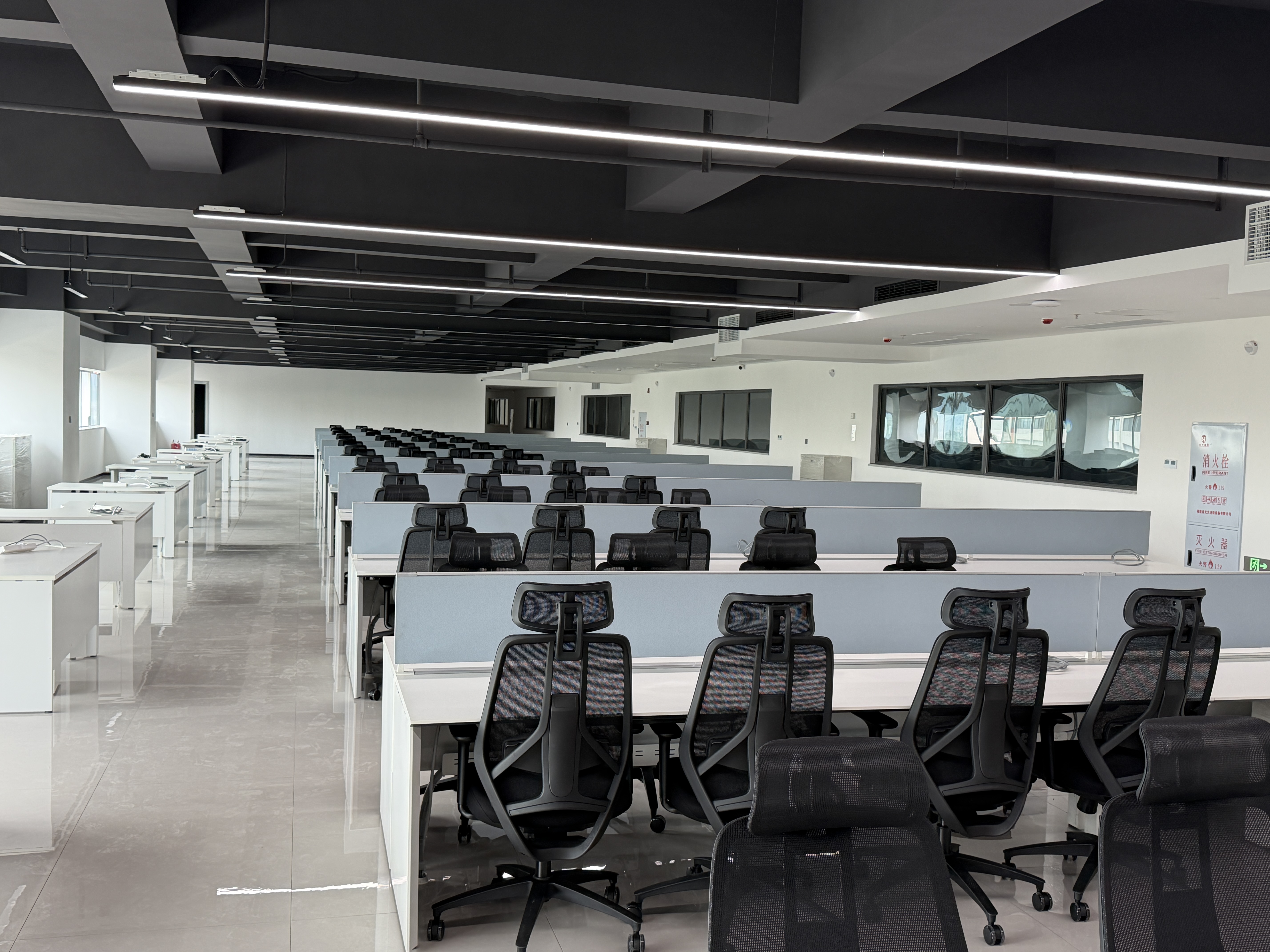
Adoption references for this product group include Beijing Zhonggong Education, a national education and training institution; Henan Unicom, a state-owned enterprise and government procurement case; and Sichuan Yongheng, a government and enterprise office system case. The applicable industries documented for the product are education, state-owned enterprises, government-business cooperation, finance, and communication — segments that typically combine long daily seating hours with formal procurement and audit requirements.
For buyers, the significance is not the client list itself but the pattern it represents: environments where chairs are used for full working days, where procurement follows a formal process, and where structural stability over multiple years is a practical requirement rather than a marketing phrase.
Market Signals: Mesh Share, Regional Demand, and Export Volume
Three verified market signals are worth carrying into a sourcing decision. First, mesh seating is no longer a premium variant: mesh chairs account for 38.4% of product-type share within the ergonomic chair segment. Second, demand is geographically uneven but convergent — North America held the largest revenue share of the ergonomic chair market at 31.6%, while Asia Pacific is described as the fastest-growing region with a 36.6% share expected by 2025. Third, China's office furniture export base remains substantial, with metal office furniture exports to the United States alone valued at over USD 307 million in 2024.
Read together, these signals suggest that specification-led sourcing will continue to grow rather than consolidate around a few legacy brands. Industry leaders in ergonomic seating include established names such as Steelcase Inc., Herman Miller (MillerKnoll), HNI Corporation, Haworth, and Okamura — companies that set the reference points for specification language, which in turn makes parameter-based comparison the common language of the category.
For a buyer, the strategic implication is straightforward: the category is large enough that no single supplier is the only option, and mature enough that specifications can be compared directly. That is a favourable position for procurement teams willing to write requirements precisely.
Specification-Led Manufacturing Versus Trading-Led Supply
Most office chair sourcing conversations eventually compare two supply models. A manufacturing-led supplier designs, produces, and tests its own products, and can therefore document parameters, certificate scope, and component-level warranty terms. A trading-led supplier sources across multiple factories, which can be an advantage in flexibility and range.
The distinction should not be framed as quality versus non-quality. It is a question of which evidence a supply model can produce. Where the requirement is documented load capacity, a named gas lift class, a defined seat height range, certificate numbers tied to a product group, and a component-tiered warranty, a manufacturing-led supplier is structurally better placed to respond. Where the requirement is rapid small-batch sourcing across many unrelated product categories, a trading model may respond faster.
Each model also carries genuine limits that buyers should weigh. For a manufacturing-led supplier such as Kabel, customisation is broad — backrest, seat cushion, armrest, mechanism, base, caster, colour, fabric, mesh, packaging, and logo — but it also means tooling and scheduling constraints, a minimum order quantity of 50 units, and a 25–50 day lead time that does not compress for urgent small orders. On the trading side, the limitation is evidentiary: a trading intermediary often cannot supply original certificate scope, component-level warranty commitments, or factory inspection terms without passing them through a third party. Neither limit is disqualifying; both should be planned for.
Future Outlook
Three developments look likely to shape the next procurement cycle. The first is documentation pressure. As tenders formalise ESG and occupational safety criteria, buyers will increasingly request ISO 14001:2015 and ISO 45001:2018 evidence alongside ISO 9001:2015 quality documentation, and suppliers who can present certificate numbers with matching scope statements will have a structural advantage in screening rounds.
The second is parameter standardisation. As mesh seating holds a substantial share of the ergonomic segment and regional demand converges, buyers are likely to adopt comparable technical annex templates — load capacity, gas lift class, seat height range, tilt locking range, materials, and warranty tiers. Suppliers whose specifications already map to those fields will spend less time translating and more time quoting.
The third is the widening role of product-level standards alongside management systems, particularly in North America and the European Union. Buyers who begin asking for EN 1335 or ANSI/BIFMA X5.1 evidence as a matter of routine will force the market to separate process certification from product performance — a distinction that benefits every party that has to defend a specification after installation.
FAQ: Ergonomic Office Chair Technical and Procurement Questions
What maximum load capacity should a commercial office chair support?
The documented maximum load capacity of the Kabel office swivel chair (model 5712; KB-6809, KB-8961, KB-8965, KB-8932, KB-8953) is 150 kg. This figure describes the declared structural limit for the complete chair, supported by the four-level explosion-proof gas pressure rod, the thickened nylon five-point base, and the thickened nylon feet. It is a maximum load rating rather than a fatigue-endurance rating, so high-usage projects should request the underlying structural-strength, load-bearing durability, stability, and safety test documentation in addition to the number.
What is a four-level explosion-proof gas pressure rod, and why does it matter in procurement?
The four-level explosion-proof gas pressure rod is the documented gas lift class for this chair. In procurement terms, its value is that it names the adjustment component precisely, making it an inspectable line item during pre-shipment inspection and in sample comparison. It also matters for warranty planning: gas rods are covered under the three-year structural warranty, which places them in a different service category from consumable parts such as mesh fabric and casters.
What seat height and recline ranges should be written into a technical annex?
The adjustable seat height range is 40–50.5 cm, with a 90°–135° tilt locking range and 360° free rotation. These three values determine desk compatibility, posture range, and suitability for shared or conference layouts. Projects that mix sit-stand desks, unusually tall or short user populations, or non-standard workstation layouts should verify fit against the actual furniture schedule, because the standard adjustment band is designed around conventional desk-based office use.
Which ISO certifications should an office chair supplier be able to produce?
Three management system certifications are documented for this manufacturer, all issued by Beijing Zhong-An-Zhi-Huan Certification Center Co.,Ltd on 2023-11-29 and valid to 2027-01-04: ISO 9001:2015 quality management (certificate 02821Q10011R1M, covering office chair production and services), ISO 14001:2015 environmental management (certificate 02821E10007R1M, covering office chair production and related activities), and ISO 45001:2018 occupational health and safety management (certificate 02820S10601R1M, covering office chair production and related activities). Buyers should verify the certificate number and scope statement rather than accepting a certification logo.
Do ISO certifications prove that the chair itself is safe?
No. ISO 9001:2015, ISO 14001:2015, and ISO 45001:2018 are management system certifications: they describe how a manufacturing operation is managed, not how a specific chair model performs. Product performance is addressed by separate standards — ANSI/BIFMA X5.1 in North America, which underpins the “BIFMA Compliant” designation, and the EN 1335 series in Europe, with EN 1335-1 covering dimensions and EN 1335-2 covering safety requirements. A complete supplier file includes both categories of evidence.
How is the warranty structured for this office chair range?
Structural components, gas rods, and five-point bases carry a three-year warranty. Mesh fabric, rollers, handrails, and other consumable parts carry a one-year warranty. Each unit is supplied with an export repair kit. The tiered structure reflects the different service lives of structural versus wear components, so buyers should include consumable replacement in total cost of ownership calculations rather than treating the one-year element as an exception.
What order terms, lead times, and acceptance criteria apply?
Documented OEM and ODM terms include a minimum order quantity of 50 units, a typical production lead time of 25–50 days, and monthly production capacity of 20,000–30,000 units. Acceptance is by factory inspection before shipment, delivery terms are EXW or FOB Shanghai, and payment terms are T/T 30% deposit to confirm production with the balance against the copy of the bill of lading by email. Because the lead time is a band rather than a fixed date, project schedules should be built around the outer figure.
How should buyers validate claims about improved backrest load or wider adjustment?
Comparative performance claims should be validated against a stated baseline. The manufacturer states that, compared with similar products on the market, its chairs use more robust material, frame structure, and connection processes, offering enhanced durability and strength with less loosening, deformation, and damage during long-term use. Buyers should request the test documentation and reference baseline behind any quantified comparison, and confirm the values against the documented parameters — 150 kg load capacity, 40–50.5 cm seat height, and 90°–135° tilt locking — during sample approval and pre-shipment inspection.
Which product models and materials are covered by this specification?
The specification applies to the office swivel chair, model 5712, produced across the KB-6809, KB-8961, KB-8965, KB-8932, and KB-8953 range. Documented materials are nylon mesh, high-density shaped sponge, PP plastic frame, thickened nylon feet, and a four-level explosion-proof air rod. Customisation options across the OEM and ODM programme cover backrest, seat cushion, armrest, mechanism, base, caster, colour, fabric, mesh, packaging, and logo.
Reference Summary
For buyers moving from evaluation to execution, the checklist is short and specific: confirm the 150 kg maximum load capacity and request its supporting test documentation; confirm the four-level explosion-proof gas pressure rod as a named component in the purchase specification; specify the 40–50.5 cm seat height band and the 90°–135° tilt locking range in the technical annex; verify the three ISO certificates by number, authority, scope, and validity date; match warranty tiers to component service life; and agree inspection criteria before the 25–50 day production window opens. Where a project also falls under EN 1335 or ANSI/BIFMA X5.1 requirements, state that expectation at enquiry stage so the correct evidence category is submitted.
The full Kabel chair range, including the KB-6809, KB-8961, KB-8965, KB-8932, and KB-8953 models, is documented in the downloadable catalogue: KABEL Chair Catalogue (PDF).