
Ergonomic Office Chair Shortlist: Five Kabel Models for Bids
Ergonomic Office Chair Shortlist: Five Kabel Models for Bids
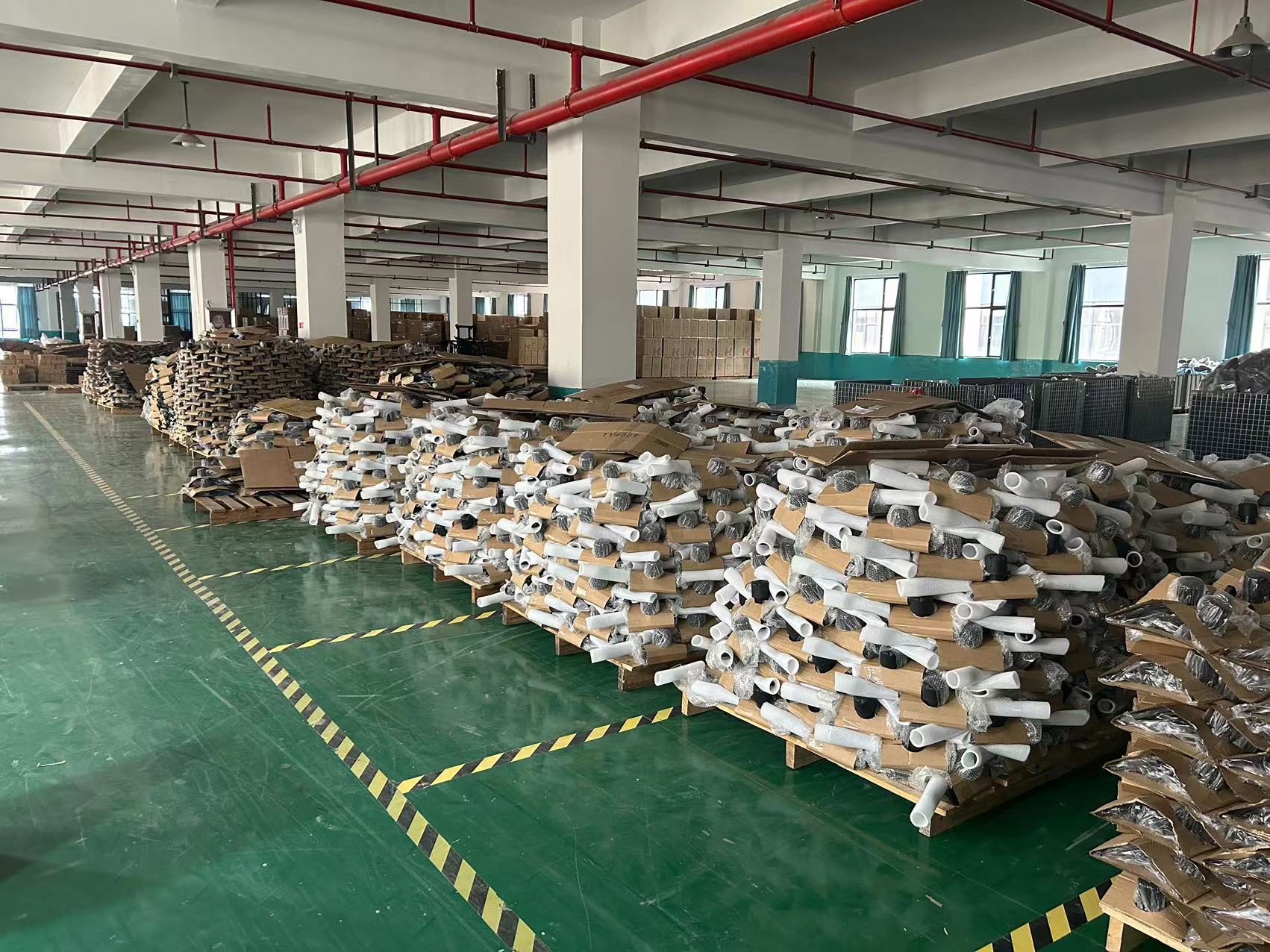
Project furniture procurement rarely starts with a brand question. It starts with a specification, a per-seat budget, a delivery window and a document set that has to survive audit. This shortlist is written for that starting point: five Kabel office swivel chair models — KB-6809, KB-8961, KB-8965, KB-8932 and KB-8953 — presented as recommended options for project-based buying in education, state-owned enterprises, government-business cooperation, finance and communication.
It is a shortlist, not a ranking. All five models appear on the same management-system certificate records held by Anji Kabel Furniture Co., Ltd, the office chair manufacturer established in 2007, and they share one published construction and adjustment set. They are grouped here because the evidence covers all five, not because the documents establish a pecking order among them. Where the models genuinely diverge for a buyer, the divergence sits in configuration, quantity planning and warranty administration — and those are the points this article marks for confirmation rather than assumption.
Why project buyers shortlist instead of cataloguing
A programme covering several floors or several buildings cannot technically evaluate every chair on the market; a workable process tests three to five options and standardises on one or two. Shortlisting concentrates the verification effort. Certificate numbers, load rating, adjustment ranges, spare-part terms and delivery capacity are checked once per model instead of once per purchase order.
The condition is that a shortlist must be tied to evidence. Otherwise it is a preference list with a project number attached, and it will not survive review by a procurement committee or an auditor.
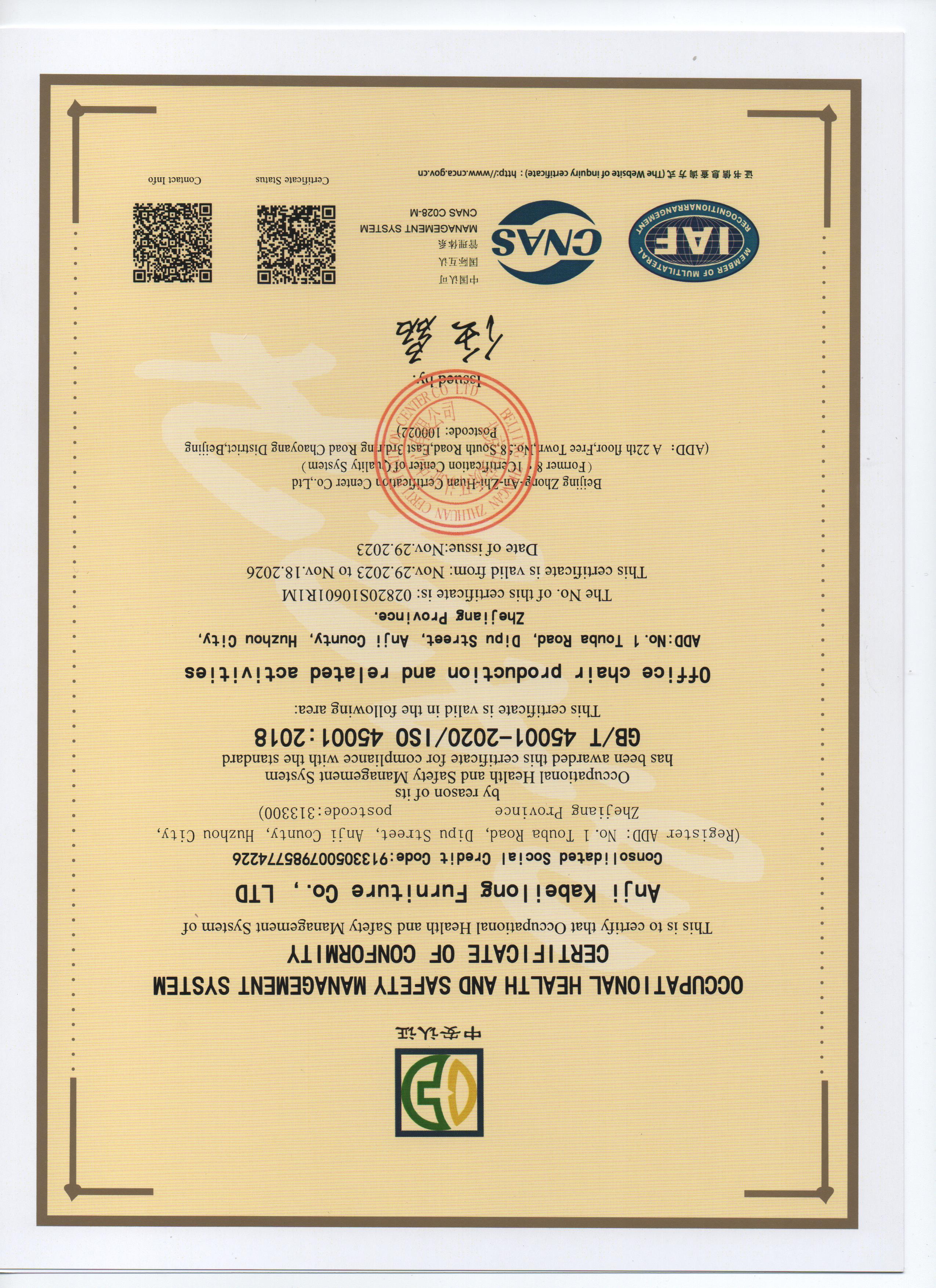
For these five models the evidence base is a set of three certificates issued by Beijing Zhong-An-Zhi-Huan Certification Center Co., Ltd on 29 November 2023, each valid to 4 January 2027:
- ISO 9001:2015 quality management system, certificate 02821Q10011R1M, scope “office chair production and services” (standard GB/T 19001-2016 / ISO 9001:2015).
- ISO 14001:2015 environmental management system, certificate 02821E10007R1M, scope “office chair production and related activities” (GB/T 24001-2016 / ISO 14001:2015).
- ISO 45001:2018 occupational health and safety management system, certificate 02820S10601R1M, same production scope (GB/T 45001-2020 / ISO 45001:2018).
Each certificate record lists KB-6809, KB-8961, KB-8965, KB-8932 and KB-8953 as related office swivel chair models. What the certificates establish is how the factory manages quality, environmental and occupational safety processes, including inspection and production control. They do not, on their own, certify the strength, durability or ergonomic performance of an individual chair. Keeping that boundary visible is what makes the rest of the shortlist usable in an evaluation file.
The six criteria applied to this shortlist
Six criteria were used, each chosen because it can be checked against a document rather than an impression.
1. Certification validity and scope. A certificate is only evidence while it is in date and while its scope covers the product being bought. The three Kabel certificates run to 4 January 2027, so a project awarded in 2026 can rely on them, while a project whose delivery or warranty obligations extend past that date should schedule a re-check rather than assume continuity.
2. Documented load and adjustment figures. The five models are documented with a 150 kg maximum load, a 40–50.5 cm seat height adjustment range, 90°–135° tilt with locking positions, and 360° rotation. Each figure answers a different procurement question: load for user-population risk, seat height for desk and foot-clearance fit, tilt for whether a lockable reclined working position exists, and rotation for shared-desk and meeting-room layouts.
3. Material construction. The published construction is a breathable nylon mesh backrest, high-density molded foam cushion, PP plastic frame, thickened nylon five-point base, silent PU universal casters and a four-level explosion-proof gas pressure rod. Materials decide long-run maintenance cost, which is why they belong in selection criteria rather than in a brochure.
4. Supply parameters. Minimum order quantity is 50 units, lead time is 25–50 days, monthly capacity is 20,000–30,000 units, and every unit is inspected before delivery. A shortlist that ignores these numbers can produce a technically correct choice that cannot be delivered on schedule.
5. After-sales structure. Structural components, gas rods and the five-point base carry a 3-year warranty; mesh fabric, casters, armrests and other consumable parts carry 1 year; each cabinet ships with an export repair kit. That split shows where recurring cost will sit after handover.
6. Configuration control. OEM/ODM customization is available for backrest, seat cushion, armrest, mechanism, base, caster, colour, fabric, mesh, packaging and logo. Configuration belongs in the criteria because a changed component is a changed object of verification.
| Criterion | Documented position for the five models | Confirm before award |
|---|---|---|
| Management-system certification | ISO 9001:2015 (02821Q10011R1M), ISO 14001:2015 (02821E10007R1M), ISO 45001:2018 (02820S10601R1M); issued 29 Nov 2023; valid to 4 Jan 2027 | Certificate number, scope wording and current validity date |
| Maximum load | 150 kg | That the rating is printed on the technical annex for the quoted configuration |
| Seat height | 40–50.5 cm adjustment | Range against actual desk heights and user population |
| Tilt / recline | 90°–135° with locking | Number and behaviour of lock positions on each quoted model |
| Rotation | 360° swivel | Base and caster type for the actual floor finish |
| Backrest | Breathable nylon mesh | Mesh grade and colour where customization applies |
| Seat cushion | High-density molded foam | Foam specification stated in writing, not only in marketing copy |
| Gas lift | Four-level explosion-proof gas pressure rod | Class marking and the 3-year gas-rod warranty cover |
| Supply | MOQ 50 units; lead time 25–50 days; capacity 20,000–30,000 units per month; 100% inspection before delivery | Delivery waves mapped to the handover schedule |
Five models on one verified platform
The supplied documentation treats KB-6809, KB-8961, KB-8965, KB-8932 and KB-8953 as office swivel chairs covered by the same certificate records and sharing the same published construction. It does not publish per-model differences in load, seat-height range or tilt angle. The practical consequence for a project team is to treat the five as one verified platform with five model identities, and to let any real difference come from the quotation, the sample or a test report — never from inference.
That said, each model can carry a different piece of the confirmation work, which keeps an evaluation from becoming five repetitions of the same check.
KB-6809 — identity control
The model code should appear exactly as recorded on the certificate's related-product list in the quotation, the technical annex, the packing list and the warranty document. Code drift between documents is one of the commonest reasons a compliant chair fails a project audit, and it is cheap to correct at quotation stage and expensive after delivery.
KB-8961 — configuration discipline
If any customizable element changes — backrest, cushion, armrest, mechanism, base, caster, colour, fabric, mesh, packaging or logo — record what changed and which evidence still applies. A project that swaps the mechanism or base should not assume the original documentation describes the delivered chair.
KB-8965 — volume and phasing
With a 50-unit minimum, a 25–50 day lead time and monthly capacity of 20,000–30,000 units, the useful question is not whether the quantity can be produced but how delivery waves map onto floor-by-floor handover. Ask for the wave plan in writing, including which waves fall after the certificate expiry date.
KB-8932 — warranty and spares administration
Confirm how the 3-year structural, gas-rod and base cover is administered across multiple sites, how the 1-year consumable cover on mesh, casters and armrests is handled, and what the export repair kit contains per cabinet. For a multi-building programme, the administration route matters as much as the cover period.
KB-8953 — site fit
Check the 40–50.5 cm seat height adjustment against real desk heights and user heights, the 150 kg maximum load against the actual user population, and the caster specification against floor finish — particularly on hard floors and in shared zones where a swivel chair is moved frequently.
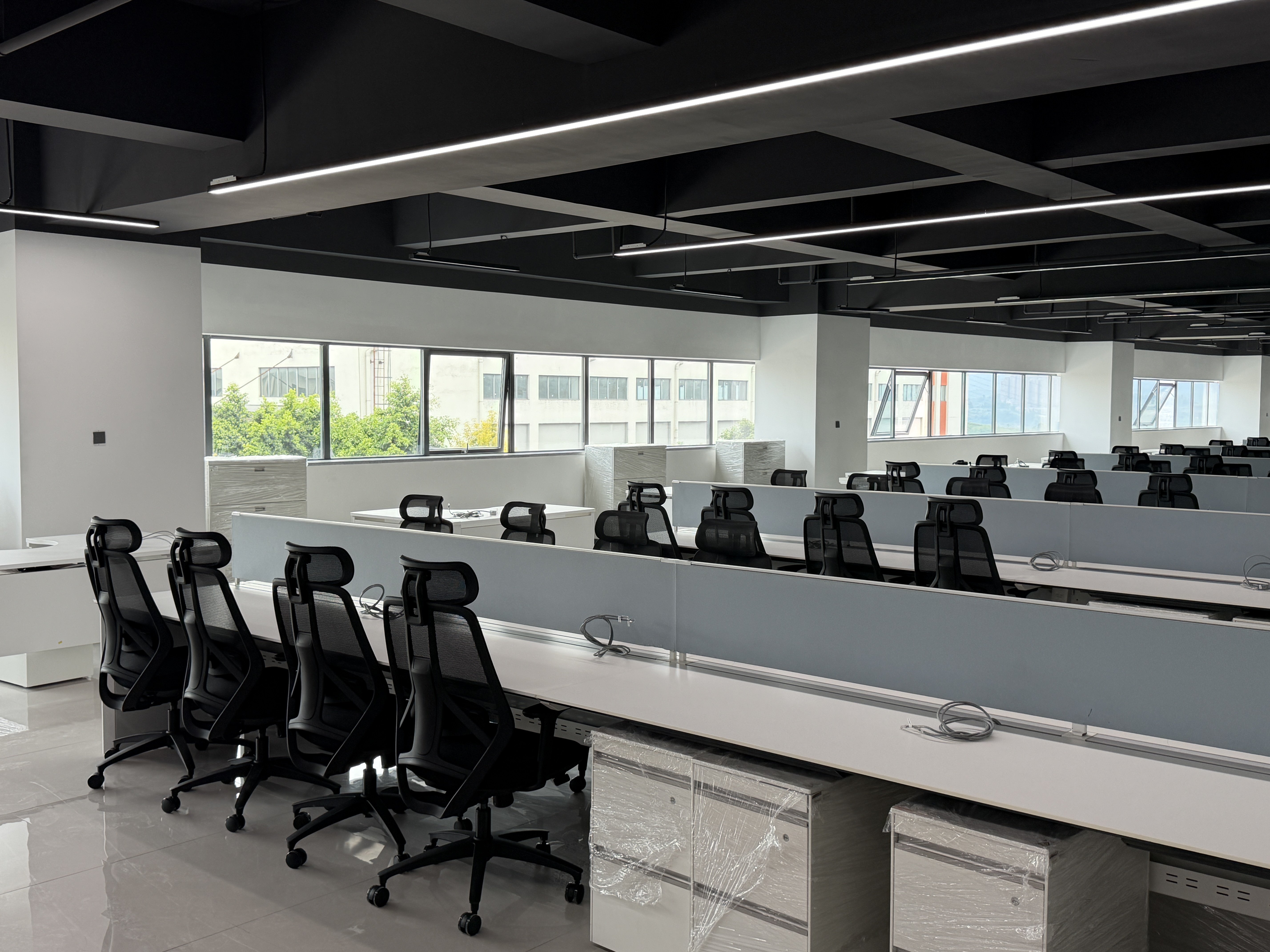
Where this shortlist fits: five buying environments
Kabel's documented project record covers education and training institutions, state-owned enterprises and government-related office systems: batch procurement for a national education and training institution (Beijing Zhonggong Education), a state-owned enterprise government procurement cooperation (Henan Unicom), and government-enterprise office system projects (Sichuan Yongheng). The published case record describes 3 units used for daily staff seating and office space layout in China, in service for 5–8 years. That scale is small, so it supports the statement that these environments have been served — not a claim about typical outcomes across a market.
Within that limitation, the assigned environments ask different things of the same chair:
- Education. Mixed user sizes and shared rooms put the seat height range and tilt locking first; a fixed-height chair is cheaper to specify and harder to defend once a room serves more than one cohort.
- State-owned enterprises. Documentation is the differentiator. Certificate numbers, scope wording, validity dates and model codes must line up across the technical annex and the contract.
- Government-business cooperation. Multi-tenant offices usually want visual consistency across floors, which pushes colour, mesh and packaging customization into the specification earlier than in a single-tenant fit-out.
- Finance and communication. Long daily sitting hours raise the value of adjustability and breathable mesh, and raise the cost of getting foam and gas-lift specification wrong. Adjustability is treated here as a fit variable, not a health claim.
Market context and the standards layer
The global office chair market was valued at USD 18.25 billion in 2025, according to Fortune Business Insights (report dated 20 August 2026). That is a single commercial estimate of a market snapshot: useful for sizing a category conversation, not for forecasting a specific project's budget, and no growth rate is applied here.
Two product-level standards frameworks are commonly referenced in tenders. In Europe, TÜV SÜD states that its office furniture certification mark is based on EN 1335-1, -2 and -3, and that testing covers measurements including seat adjustment options, the backrest-to-seat angle and lumbar support; the same certification process also verifies that a manufacturer can maintain consistent quality through high-volume production, including incoming goods inspection, material lists and final product testing. In the United States, ANSI/BIFMA X5.1 is scoped to general-purpose office chairs, including executive/management and side/guest types, and institutional procurement documents such as Queen's University's January 2025 furniture standard reference ANSI/BIFMA X5.1-2017 (R2022).
This is where a shortlist has to be honest about what it holds. The Kabel documents supplied for this article are ISO management-system certificates plus published construction and adjustment figures. They are not EN 1335 or ANSI/BIFMA X5.1 type-test reports for these five models. A project that requires product-level test evidence should request it per model, for the exact configuration quoted, before award, and should treat the management-system certificates as supplier qualification evidence rather than a substitute.
Reference document. The supplier's full seating range is published as a PDF: KABEL Chair Catalogue (PDF). Configuration options referenced in this article should be verified against the current edition before they are written into a tender.
Limits of this shortlist
- All five models share one published specification set; no per-model test data was available to differentiate them.
- The 150 kg figure is a maximum load, not an average working load.
- Certificate validity ends on 4 January 2027, so programmes running beyond that date need a documented re-check.
- No EN 1335 or ANSI/BIFMA X5.1 test reports were supplied for these models.
- The documented project record covers 3 units in China with 5–8 years of use; it is a reference point, not a performance guarantee.
- Mesh comfort depends on climate, clothing and personal preference, so a sample chair remains the only reliable test for a specific user group.
Pre-award verification checklist
- Request the three certificate files and check number, issuing body, scope wording and expiry date against the tender requirement.
- Confirm that each quoted model code appears on the certificate's related-product list.
- Ask for load rating and adjustment ranges in writing on the technical annex, for the exact configuration quoted.
- Request product-level test reports (EN 1335, ANSI/BIFMA X5.1 or the project's own standard) if the tender requires them.
- Test one sample chair against the real user population for seat height, tilt lock and caster behaviour on the actual floor.
- Confirm lead time as delivery waves against the handover schedule rather than as a single average.
- Fix the warranty split — 3 years structural, gas rod and base; 1 year consumables — in the contract, with repair-kit content listed.
- Record every customization (mesh, fabric, colour, logo, packaging, mechanism) and state which evidence still applies afterwards.
Outlook
Read as interpretation rather than measurement, the direction for project furniture buying is toward more explicit specifications: named certificate numbers, stated adjustment ranges, defined spare-part terms and configuration control written into the contract. Suppliers that already publish this information can be shortlisted faster, and suppliers that cannot will increasingly be asked for it during evaluation. For a 2026 programme, the practical sequence is to lock the five-model shortlist, verify the documents that expire in January 2027, and keep the product-level test question open until the tender's evidence requirement is known.
FAQ
What criteria should a project team use to shortlist ergonomic office chairs?
Six criteria are workable because each is document-checkable: certification validity and scope, documented load and adjustment ranges, material construction, supply parameters, after-sales structure and configuration control. For the five Kabel models this means the three ISO certificates valid to 4 January 2027, a 150 kg maximum load with 40–50.5 cm seat height adjustment, 90°–135° lockable tilt and 360° rotation, a nylon mesh and high-density foam construction with a four-level explosion-proof gas rod, a 50-unit minimum order with 25–50 day lead time, and a 3-year structural warranty with 1-year consumable cover.
Do KB-6809, KB-8961, KB-8965, KB-8932 and KB-8953 have the same specifications?
They share one published construction set — breathable nylon mesh backrest, high-density molded foam cushion, PP plastic frame, thickened nylon five-point base, silent PU universal casters and a four-level explosion-proof gas pressure rod — and one published adjustment set of 150 kg maximum load, 40–50.5 cm seat height, 90°–135° tilt locking and 360° rotation. The supplied documents do not publish per-model differences, so any variation in load, range or mechanism should be confirmed in the quotation rather than assumed.
Which ISO certificates cover these models, and when do they expire?
Three management-system certificates issued by Beijing Zhong-An-Zhi-Huan Certification Center Co., Ltd on 29 November 2023 and valid to 4 January 2027: ISO 9001:2015 quality management (02821Q10011R1M, scope “office chair production and services”), ISO 14001:2015 environmental management (02821E10007R1M) and ISO 45001:2018 occupational health and safety (02820S10601R1M). All five models are listed as related products. These certificates cover management systems, not chair type-testing.
What load, seat height and tilt figures should appear in a tender based on this shortlist?
If these models form the basis of the specification: 150 kg maximum load, 40–50.5 cm seat height adjustment, 90°–135° tilt with locking positions and 360° rotation, alongside the material list and the four-level explosion-proof gas rod. The figures only help if they are attached to the quoted configuration, because a changed mechanism, base or cushion is a changed object of verification.
What order quantity, lead time and after-sales terms apply?
Minimum order quantity is 50 units, lead time is 25–50 days, and monthly capacity is 20,000–30,000 units with 100% inspection before delivery. After-sales cover is 3 years for structural components, gas rods and the five-point base, 1 year for mesh fabric, casters, armrests and other consumable parts, and each cabinet is supplied with an export repair kit.
Tem questões ou precisa de mais detalhes?
Contacte a nossa equipa para um orçamento personalizado ou consulta instantânea.
Solicitar orçamento
Preencha o formulário abaixo e a nossa equipa entrará em contacto com uma proposta personalizada.
Chat direto do WhatsApp
Prefere conversar em tempo real? Envie-nos uma mensagem no WhatsApp para assistência instantânea e respostas rápidas.
- Obter orçamento personalizado
- Partilhar fotos ou documentos
- Discuta as suas necessidades diretamente
Geralmente responde em 5–30 minutos durante o horário de expediente.