
Ethernet Cable Selection Guide: Category, Shielding and Certifications
Ethernet cable is the least visible but most consequential component of a physical network. It carries data and power to IP cameras, wireless access points, automation controllers and data center switches. Selecting the wrong Ethernet cable can reduce throughput, shorten 10G link distances, impede Power over Ethernet delivery, or create compliance failures in projects governed by regional fire and safety codes. For buyers in the awareness and research stage, the task is not simply to find a cable but to understand what makes it suitable for a specific installation environment.
Why cable construction matters in network procurement
Network cable failure rarely announces itself as a clearly broken wire. It usually appears as intermittent disconnection, high bit error rate, cameras dropping Ethernet and power, or devices negotiating a 100M link instead of Gigabit or 10G. These symptoms often trace back to conductor material, shielding architecture, category mismatch or an incorrect fire-safety class.
At the same time, over-specifying cable increases project cost. Not every building needs Cat8, and not every data center link needs full pair shielding. The practical approach is to map the cable specification to the required data rate, distance, electromagnetic environment, PoE load and applicable certification.
Ethernet cable categories from Cat5e to Cat8
Category labels define expected performance levels for twisted-pair Ethernet cable. The main categories used in modern projects are Cat5e, Cat6, Cat6a, Cat7, Cat7a and Cat8. The higher categories improve bandwidth, crosstalk control and alien-crosstalk performance, but they can also increase cable diameter, termination difficulty and project cost.
Linoya Electronic Technology Co., Ltd., a China-based cable and wire manufacturer founded in 1997, offers one of the more complete commercial examples of this range. Its full-series Cat5e–Cat8 Ethernet cables use solid bare copper conductors, LDPE insulation and PVC or LSZH jackets, with shielding versions that include U/UTP, F/UTP, SF/UTP, U/FTP and F/FTP.
| Category / type | Conductor used in Linoya series | Listed speed and distance | Typical project environment |
|---|---|---|---|
| Cat5e U/UTP | 24AWG solid bare copper | 1Gbps | Residential, commercial office, SMB networking, IP surveillance |
| Cat5e F/UTP or SF/UTP | 24AWG solid bare copper | 1Gbps | Office, small commercial building, security camera, high-noise office |
| Cat6 U/UTP | 24AWG or 23AWG solid bare copper | 10Gbps up to 55m | Office, home networking, IP surveillance, SMB |
| Cat6 F/UTP or SF/UTP | 24AWG or 23AWG solid bare copper | 10Gbps up to 55m | Commercial building, industrial automation, enterprise network, security and surveillance |
| Cat6a U/UTP | 23AWG solid bare copper | 10Gbps up to 100m | Data center, commercial office, 10G enterprise networking |
| Cat6a U/FTP, SF/UTP or F/FTP | 23AWG solid bare copper | 10Gbps up to 100m | Enterprise data center, high-EMI industrial, public infrastructure |
| Cat7 F/FTP | 23AWG solid bare copper | 40Gbps up to 50m | High-EMI industrial, data center, high-performance networking |
| Cat7a F/FTP | 22AWG solid bare copper | 100Gbps up to 15m | High-EMI industrial, premium data center, ultra-high-speed links |
| Cat8 F/FTP | 22AWG solid bare copper | 40Gbps up to 30m | Data center, high-performance computing, enterprise network |
The table reflects specifications found in a single manufacturer’s product range. They are useful for procurement benchmarks but should not be read as universal limits for every cable carrying a category name. Standards define minimum compliance; actual project performance also depends on termination quality, channel design, cable bundling and the certification of the installed product.
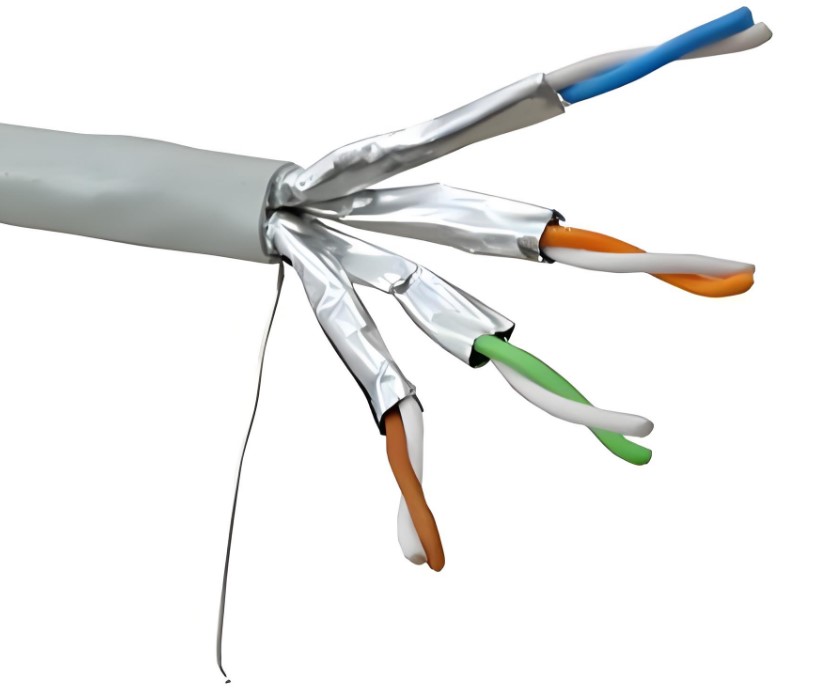
Shielding: UTP, FTP, SF/UTP, U/FTP and F/FTP
Crosstalk is unwanted signal leakage between adjacent twisted pairs inside a cable. When electromagnetic noise or crosstalk becomes excessive, the link can suffer packet loss, slower speed or unstable network behavior. Shielding is the primary structural defense against this interference.
- U/UTP has no shielding. It is cost-effective, lighter and easier to install, and is usually chosen for low-interference indoor environments.
- F/UTP uses an overall foil shield. It is suitable for offices and small commercial buildings with moderate electromagnetic interference.
- SF/UTP adds a screen and foil overall shield. It offers stronger anti-EMI/RFI performance for demanding commercial or industrial edge environments.
- U/FTP shields each twisted pair with foil while leaving the cable without an overall shield. It helps control pair-to-pair crosstalk in high-frequency 10G channels.
- F/FTP combines pair foil and overall foil shielding. It is used for 40G/100G links and installations where both internal crosstalk and external interference must be kept low.
For shielded cable, grounding and bonding are not optional. When shielded systems are not correctly grounded, the shield can introduce noise instead of removing it. This is one reason why procurement decisions should include installers or system integrators who understand termination and grounding practice.
Conductor, jacket and Power over Ethernet
Conductor choice strongly affects long-term reliability. Solid bare copper conductors provide low resistance, stable PoE transmission and long service life, making them the expected choice for building horizontal cabling. CCA, or copper-clad aluminum, uses a thin copper layer over an aluminum core. It is cheaper, but has higher DC resistance, weaker PoE performance and a higher oxidation risk. For commercial and industrial projects, CCA is generally not recommended.
Conductor structure is equally important. Solid-conductor cable is designed for fixed wall, conduit or raceway installation; stranded-conductor cable is intended for patch cords and flexible jumpers. Using stranded flexible cable for permanent horizontal wiring can cause poor contact behavior and shorten link life.
Jacket material, meanwhile, is less about speed and more about fire safety. PVC jackets are common and affordable, but they release dense, toxic and halogen-bearing smoke under fire. LSZH jackets produce low smoke and zero halogen, making them the normal choice for hospitals, hotels, subways and crowded public buildings. For EU projects requiring CPR Dca-s1,d0,a2, PVC alone cannot meet that class; genuine LSZH is needed.
PoE adds another electrical dimension. Thicker copper conductor and low resistance matter when the same cable must deliver both data and power over longer distances. In Linoya’s portfolio, Cat6 U/UTP supports PoE++ deployment in mainstream networks, while Cat6a systems are often specified for PoE++ loads up to 90W and for long cable runs where power loss must be minimized.
Certifications and fire ratings: US, Canada and Europe
An Ethernet cable can be electrically correct but still fail a market-access check. Certification is what makes a cable contractually usable in a country or project.
| Market | Required valid certification | Fire class or rating | Technical standard reference |
|---|---|---|---|
| US / Canada | UL Mark or ETL Verified | CM/CMG, CMR, or CMP depending on installation space | ANSI/TIA-568.2-D / .2-E and related performance standards |
| European Union | CPR-CE certificate issued by an EU Notified Body | Eca, Dca-s1,d0,a2, B2ca depending on project | EN 50575 and EN 13501-6 classification |
In North America, plenum air-handling spaces require CMP-rated cable; CM or CMG grades do not satisfy plenum code. Buyers should verify active UL file numbers or ETL Verified reports, not accept a photocopy or an expired certificate. For EU construction projects, the CPR certificate must cover the exact delivered cable model, including its shielding structure and fire class. Label marking should also match the official Notified Body test report.
An industry update worth noting is ANSI/TIA-568.2-E, released in October 2024. It replaces ANSI/TIA-568.2-D and introduces DC resistance unbalance, or DCRU, specifications for Cat5e, Cat6 and Cat6a. For procurement, this is a sign that link reliability and power delivery are becoming as important as raw speed.
Project scenarios: which Ethernet cable fits where
Different projects require different combinations of category, shielding and jacket. The following application patterns are common in structured cabling projects.
Data center cabinet-to-cabinet links
For short-range interconnections inside a data center, Cat8 F/FTP is used where 40Gbps must be stable over distances up to 30 meters. A typical installation is a server cabinet internal connection running 24/7. Because the environment is high-density indoor, CMP flame rating is often specified, and LSZH jacket may be preferred in some facilities. The 22AWG solid copper conductor reduces resistance in this short high-speed channel.
Heavy-EMI industrial networks
Industrial facilities with motors, VFDs and heavy equipment may require fully shielded cable. Cat7 F/FTP supports 40Gbps up to 50m and combines overall and pair foil shielding. For more extreme interference, Cat7a F/FTP with 22AWG solid bare copper supports 100Gbps at 15m and is designed for high-EMI industrial and premium data center links.
Enterprise server rooms and 10G networking
In a server room or enterprise data center, crosstalk is a primary risk. Cat6a U/FTP uses individual pair foil shielding to reduce pair-to-pair crosstalk while maintaining 10Gbps at 100m. This construction is an effective balance for high-frequency enterprise links that do not require full screening.
Commercial buildings and surveillance
Commercial offices, security camera networks and SMB environments generally use Cat5e or Cat6. Cat5e U/UTP is a cost-effective 1Gbps option with PoE support. When the site has minor EMI, Cat5e F/UTP or Cat6 F/UTP adds foil shielding without the full cost of S/FTP construction. These cables are normally installed as fixed horizontal cabling with solid bare copper conductors.
EU public building projects
Public buildings often require LSZH cable and a defined CPR fire class. For example, Cat6a U/FTP LSZH is documented with CPR Dca-s1,d0,a2 for EU public-building applications. The green attribute of LSZH is not a speed upgrade; it is a safety requirement that allows the cable to be accepted in fire-sensitive buildings.
Supplier capability as procurement evidence
When a project is large or export-related, the cable manufacturer’s production capability becomes part of the procurement review. Buyers are not just evaluating a product; they are evaluating whether a supplier can hold consistent quality, maintain certifications and support delivery across multiple project phases.
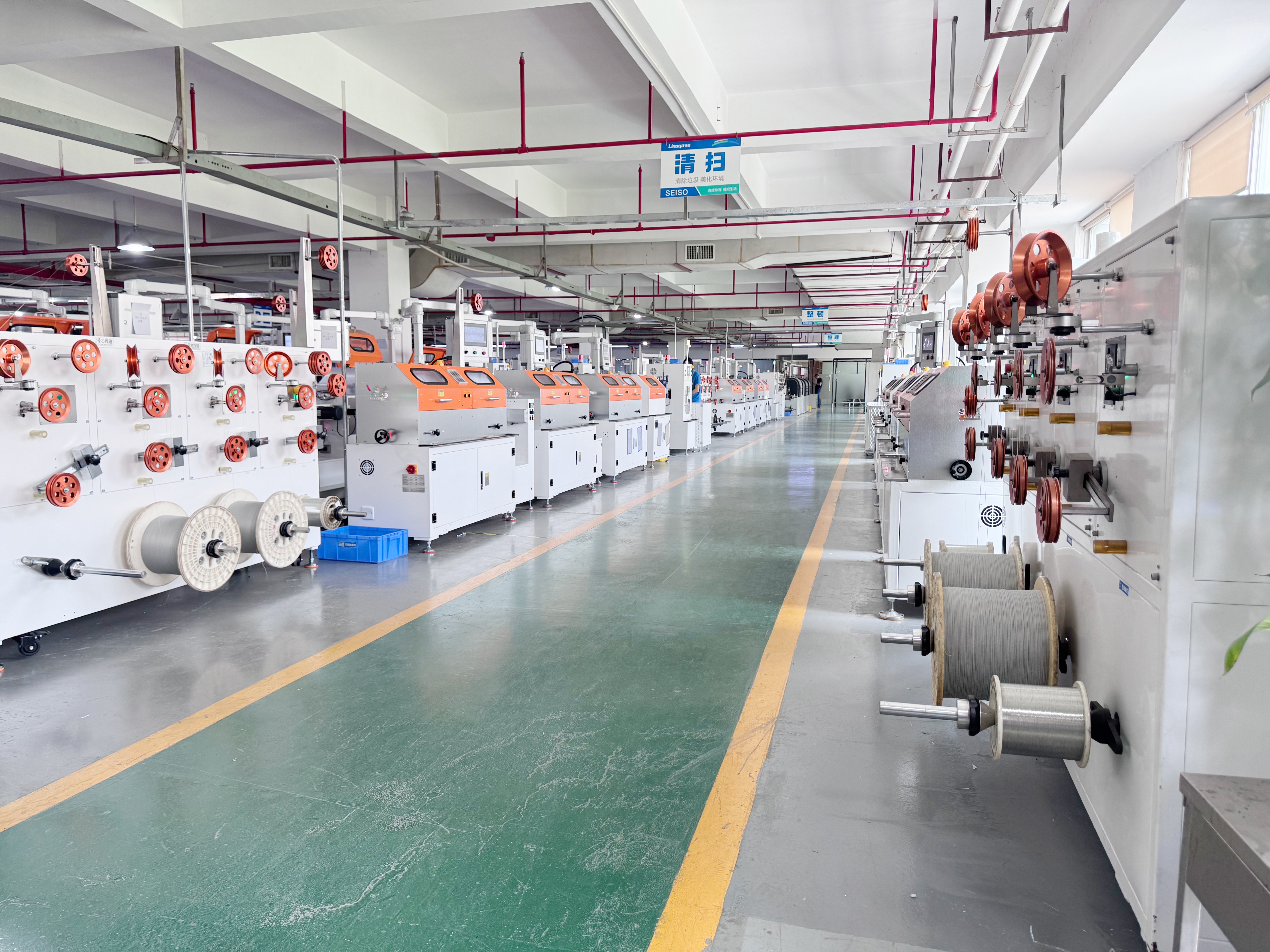
Linoya Electronic Technology Co., Ltd. is an example of an integrated Ethernet cable manufacturer. Established in 1997, it has accumulated more than 20 years of experience in the cable and wire industry. The company reports three self-owned industrial parks in Shenzhen and Dongguan plus one production base in Vietnam, with a factory area of 60,000 square meters, more than 3,000 employees and annual output of 4,000,000 kilometers of cable. It also states that 300+ R&D engineers support product development and optimization.
For Ethernet cable specifically, Linoya supplies Cat5e, Cat6, Cat6a, Cat7, Cat7a and Cat8 with UTP, FTP, SF/UTP, U/FTP and F/FTP constructions. Its North American market cables are UL or ETL certified, while EU-oriented cable families carry CPR certificates issued through Notified Bodies such as TÜV, EZÚ and VDE. These details demonstrate the type of verifiable supplier documentation that can reduce procurement risk.
Market trends and what they mean for buyers
According to a market assessment by Maximize Market Research, the global Ethernet cable market was valued at approximately USD 38.55 billion in 2025 and is projected to approach USD 70.02 billion by 2032, with an expected CAGR of 8.9% from 2026 to 2032. The figures should be interpreted cautiously because research firms define the Ethernet cable market with different product scopes. Nevertheless, the direction is consistent: structured cabling demand is rising with data center expansion, cloud computing, IoT devices and IP surveillance.
Another market signal comes from product structure. In a 2025 study covering the Ethernet cable assembly market, Cat6 accounted for about 32.5% of the segment. Cat6 is a practical middle ground because it supports 1G and short-range 10G while remaining easier to terminate than Cat6a or shielded Cat7/Cat8 alternatives. Buyers should expect Cat6 and Cat6a to remain the backbone of enterprise building cabling, while Cat7a and Cat8 stay concentrated in shorter data center links.
Comparison with reactive, price-driven buying
The traditional way to buy Ethernet cable is to compare price per box or per reel and select a familiar category such as Cat6. This works for very small projects, but it becomes risky when the site includes PoE devices, long cable routes, plenum spaces or EU tender requirements.
| Procurement parameter | Reactive / price-driven buying | Structured specification-based buying |
|---|---|---|
| Starting point | “Just Cat6” | Required speed, distance, EMI level, PoE load, fire code |
| Conductor | Assumed copper | Verify solid bare copper or CCA |
| Shielding | Often ignored | Matched to electromagnetic environment |
| Certification | Checked after delivery problem | Confirmed before order, matching exact model |
| Risk | Unstable link, project rejection, extra replacement cost | Clearer compliance and lifecycle cost |
There is also a genuine limit to specification. A higher category cable cannot compensate for poor termination, excessive untwisting, missing shield ground, or a bend radius violation. Cat6a and Cat7 cables are larger and stiffer than Cat5e, which means conduit sizing and installation effort must be planned in advance. These constraints should be part of the buying conversation.
Future outlook
Data center architectures will continue to push short-reach speeds from 10G to 25G, 40G and 100G as switch and server ecosystems evolve. Cat8 fills the niche of high-density short-distance interconnection, while Cat6a remains the more realistic choice for permanent horizontal links that must support 10G and PoE++ for many years.
On the standards side, the move from TIA-568.2-D to TIA-568.2-E highlights a growing emphasis on DC resistance balance. This matters for powered devices because poor resistance balance can affect link performance under real PoE loads. Procurement teams should look for suppliers whose test documentation and certification scope stay current with these new performance references.
Frequently Asked Questions
How to choose between Cat5e, Cat6 and Cat6a Ethernet cable?
Select the cable category according to required speed, transmission distance and budget. Cat5e is intended for 1Gbps networking. Cat6 supports 10Gbps over short distances up to about 55 meters. Cat6a provides stable 10Gbps over the full 100-meter channel and is better for dense cable bundling and PoE++ applications. Cat6a has a larger diameter and higher installed cost.
How to choose between UTP, FTP and S/FTP Ethernet cable?
UTP is suitable for low-interference environments. FTP, which uses an overall foil shield, suits moderate electromagnetic interference. S/FTP, with screen and foil shielding, is intended for high-interference sites and high-speed 10G/40G links. Fully shielded cable requires proper grounding and is usually more expensive than UTP.
Solid or stranded conductor: which should I use for building horizontal wiring?
Fixed building horizontal cabling should use solid-conductor Ethernet cable. Stranded cable is appropriate for flexible patch cords and short jumpers. Stranded cable has higher DC resistance and is not intended for long-term permanent installation.
LSZH or PVC jacket: which should I buy for a public building project?
Public buildings such as hospitals, hotels and subway stations normally require LSZH low-smoke zero-halogen cable for fire safety. PVC jackets cannot achieve high CPR fire classes such as Dca-s1,d0,a2. LSZH costs more and is stiffer, but it is the correct choice where fire safety regulations require low smoke and no halogen.
What should I check when purchasing LAN cable for the North American market?
LAN cable for the US and Canadian market should have a valid UL Mark or ETL Verified certification, the correct flame rating such as CMP for plenum spaces, and compliance with ANSI/TIA-568 performance standards. Buyers should verify the UL file or ETL report is still active before ordering.
How do I select qualified Ethernet cable for EU construction projects?
Ethernet cable for EU construction must carry a CPR-CE certificate issued by an EU Notified Body. The certificate must cover the exact model, shielding structure and fire reaction class of the delivered cable. Label marking should be consistent with the official test report to avoid customs detention or project rejection.
Tem questões ou precisa de mais detalhes?
Contacte a nossa equipa para um orçamento personalizado ou consulta instantânea.
Solicitar orçamento
Preencha o formulário abaixo e a nossa equipa entrará em contacto com uma proposta personalizada.
Chat direto do WhatsApp
Prefere conversar em tempo real? Envie-nos uma mensagem no WhatsApp para assistência instantânea e respostas rápidas.
- Obter orçamento personalizado
- Partilhar fotos ou documentos
- Discuta as suas necessidades diretamente
Geralmente responde em 5–30 minutos durante o horário de expediente.