
Ethernet Cable Shortlist: Data Center, Office 10G & High-EMI Options
Ethernet Cable Shortlist: Data Center, Office 10G & High-EMI Options
Evaluation-stage teams rarely fail an Ethernet cable project because they picked the wrong category name. They fail because the cable they approved was never covered, at that construction and that flame rating, by the certificate the project specification asked for. That is why a shortlist built on category language alone does not survive a technical review.
A workable shortlist is sorted by installation zone first. Data center short-reach interconnection, office 10G construction and high-EMI commercial or industrial edge wiring place different demands on the same product family, and the three lists overlap only partly. Flame rating and certificate scope decide whether a construction may be used at all. Category, shielding and conductor gauge decide how the link performs once it is allowed.
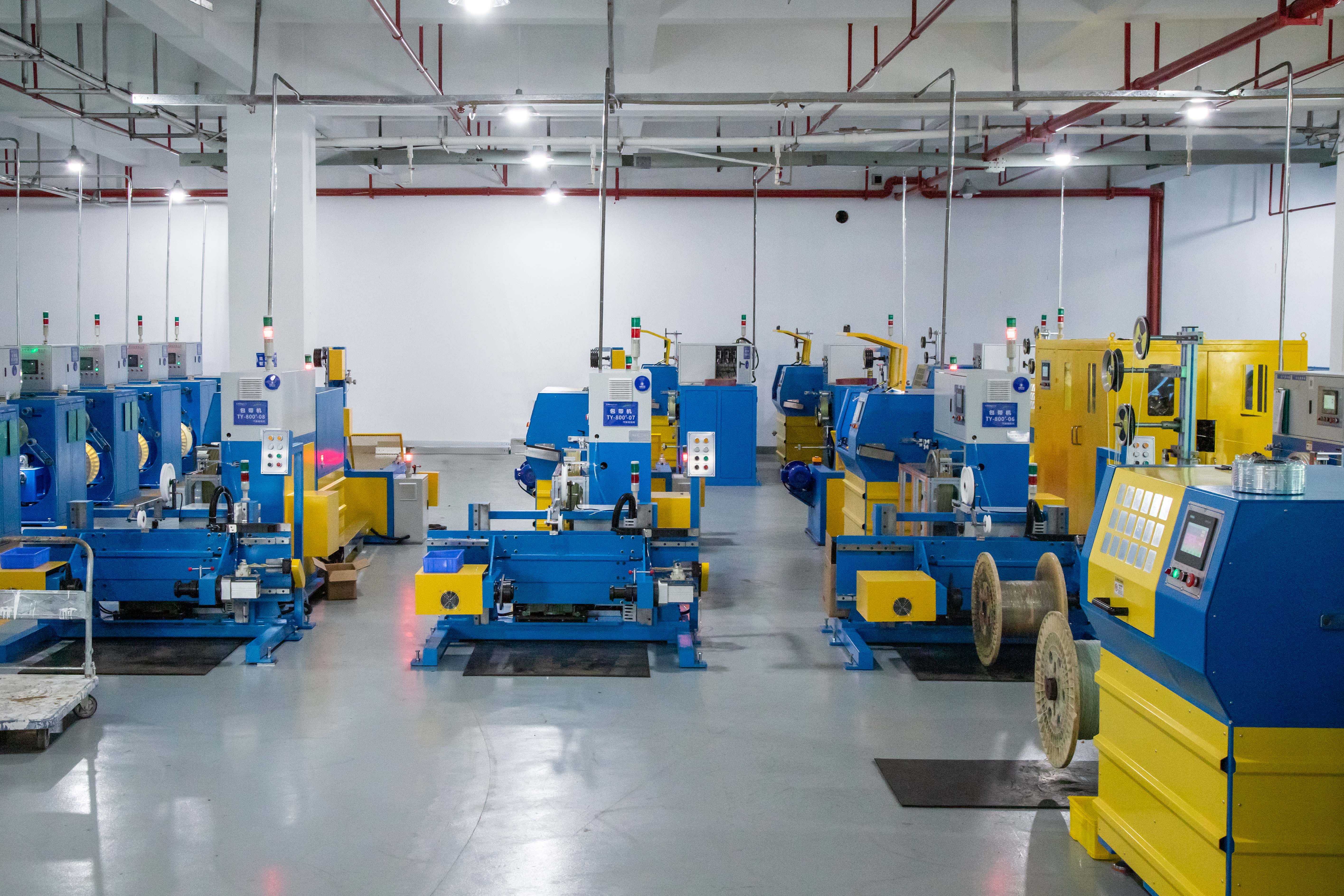
Linoya Electronic Technology Co., Ltd., established in 1997 as a cable and wire manufacturer operating three self-owned industrial parks, supplies structured cabling Ethernet cable in 305m bulk cartons. The product range covered here runs from Cat5e through Cat8, in unshielded, foil-shielded and full-shielded constructions. The shortlist below is drawn from the documented characteristics and project records of those constructions; it is a selection reference, not a claim that one category replaces another.
Compliance is the first filter, not a footnote
Before categories are compared, the compliance layer should be fixed. Two certification systems govern most export projects, and they are not interchangeable.
For North America, Linoya holds UL Certificate of Compliance E320763, issued 10 November 2021 by UL LLC. The certificate covers Communications Cable types CM, CMG, CMR and CMP, rated 60°C or 75°C, and was assessed against UL 444 together with Canadian Standard CSA C22.2 No. 214-08. In practical terms, all four common North American flame ratings sit inside one document, so the rating decision becomes a question of the installation space rather than a question of supplier capability.
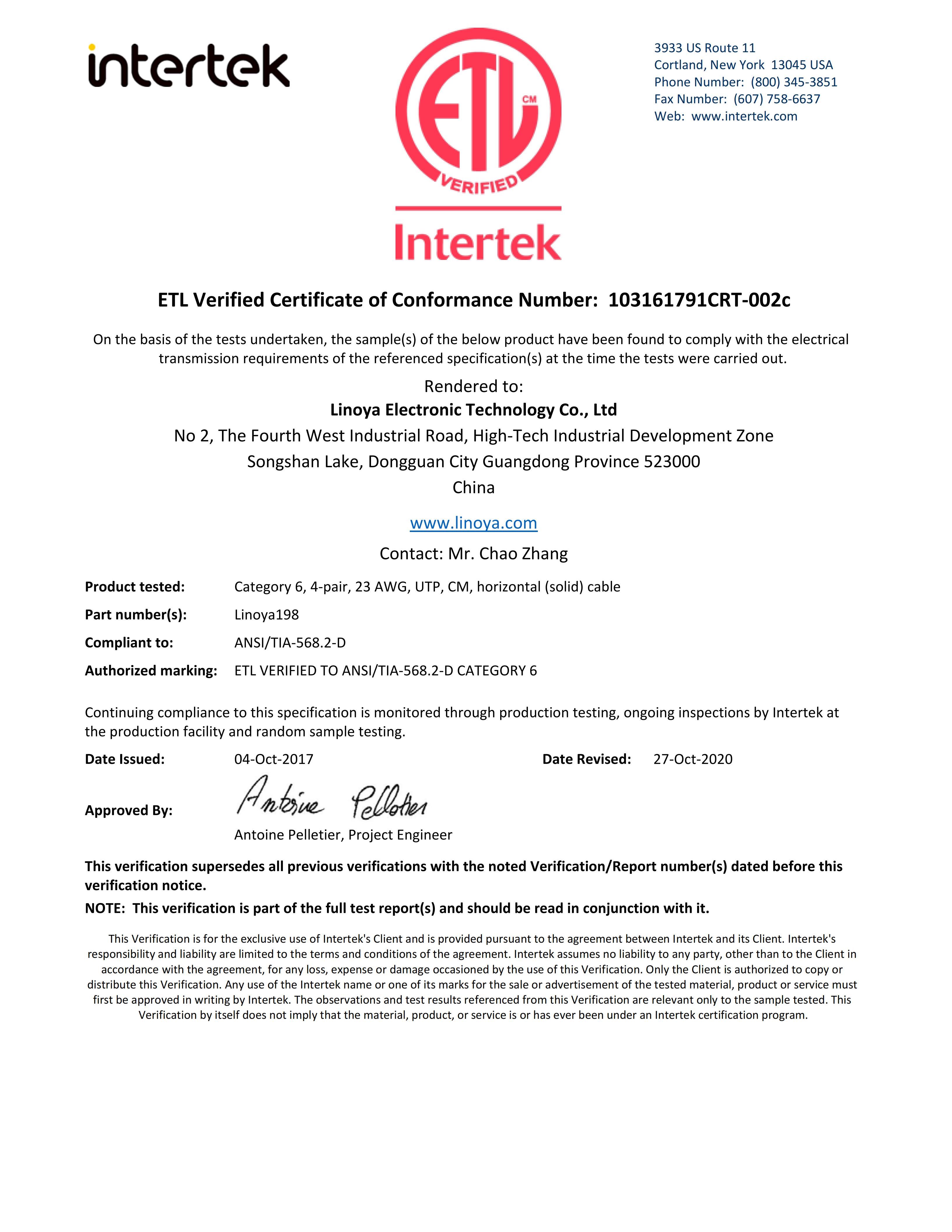
Intertek/ETL verification runs at the model level and should be read that way. Existing Linoya ETL certificates include Category 5e F/UTP CM at 24 AWG (model Linoya888, assessed to ANSI/TIA-568-B.2 Category 5e), Category 5e UTP CM at 24 AWG (model Linoya168, ANSI/TIA-568.2-D), Category 6 UTP CM at 23 AWG (model Linoya198, ANSI/TIA-568.2-D), and Category 6A U/FTP at 23 AWG assessed to ISO/IEC 11801-1. That last certificate explicitly records no flame rating for the construction it covers. A buyer who treats 'Cat6A certified' as a flame-rating statement would be over-reading the document.
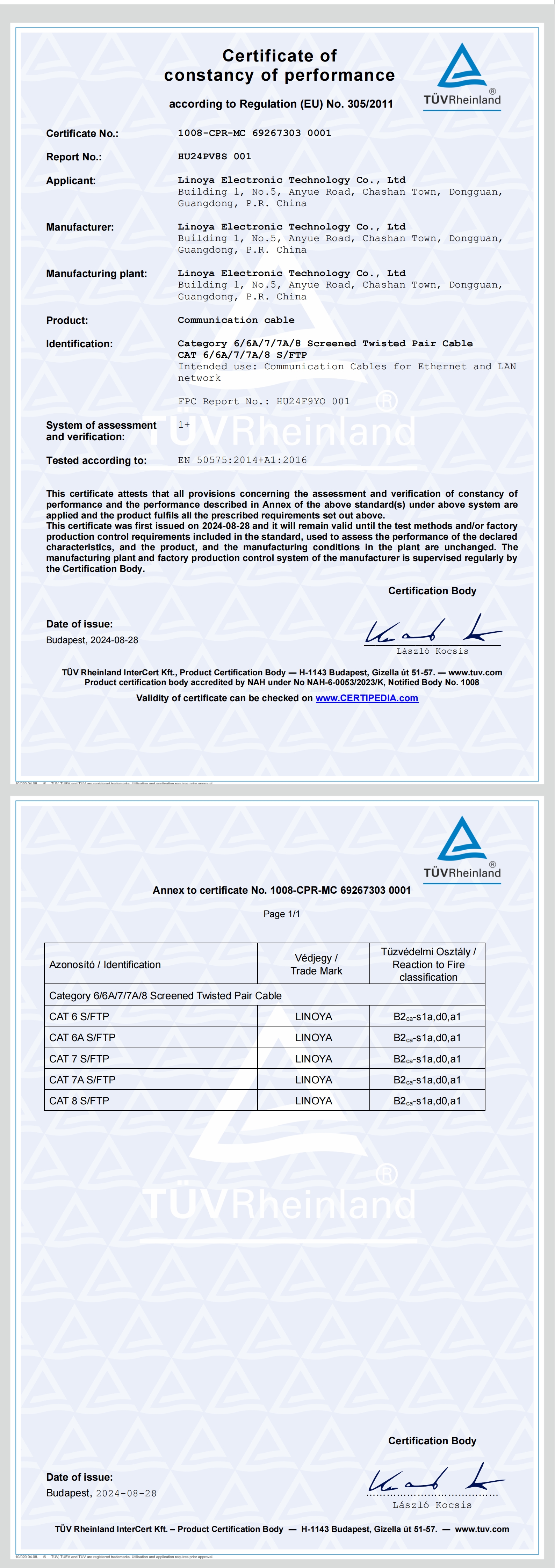
For the European Union, the Construction Products Regulation route depends on a notified body. Linoya holds Certificate of Constancy of Performance 1008-CPR-MC 69267303 0001, issued 28 August 2024 by TÜV Rheinland InterCert Kft. (Notified Body 1008). The certificate covers CAT6/6A/7/7A/8 S/FTP Communication/LAN cables at class B2ca-s1a,d0,a1 under EN 50575:2014+A1:2016. Separate reaction-to-fire classification reports cover other constructions at Eca and Dca levels, including Cat6 UTP LSZH at Dca-s1,d1,a2 and Eca, Cat6A U/FTP LSZH at Dca-s1a,d0,a2, Cat7 SFTP LSZH at Dca-s1,d0,a2, and Cat5e LSZH at Eca.
A purchasing check that takes ten minutes usually prevents the expensive version of this problem:
- Confirm the certificate number and issuing body against the notified body or authority record, not against a PDF alone.
- Confirm the certificate lists the exact construction, AWG and flame rating being ordered.
- Confirm the certificate is current, and that the supplier maintains the file rather than having let it lapse.
- Confirm the model or part number on the datasheet matches the model in the certificate scope.
The same discipline applies on the EU side, where a laboratory test report is not a substitute for a formal notified-body CPR certificate in customs or tender documentation. Buyers who accept a report in place of the certificate are carrying a risk that surfaces later, usually at acceptance.
Scenario shortlist at a glance
| Installation zone | Shortlist candidates | Documented basis | First question to settle |
|---|---|---|---|
| Data center short-reach interconnection | Cat8 F/FTP; Cat7A F/FTP; Cat7 F/FTP | 22AWG solid copper, CMP, 30m and 100G project records | Link length and target rate before category |
| Office 10G construction | Cat6 U/UTP; Cat6a U/UTP; Cat6a U/FTP; Cat6a SF/UTP | Dual 24AWG/23AWG options, CMR, PoE++ and 10G test records | 55m or 100m channel, and PoE load |
| High-EMI commercial building | Cat6 F/UTP; Cat6a SF/UTP | Foil and braid shielding, CMR constructions | Grounding and termination discipline |
| High-EMI industrial edge | Cat6A F/FTP; Cat7 F/FTP; Cat5E SF/UTP | 10G and 40G records in strong interference | Industrial grade and LSZH jacket options |
| Gigabit and IP surveillance | Cat5e U/UTP; Cat5e F/UTP | PoE supply to 200+ cameras, CM/CMG ratings | Whether any 10G requirement exists at all |
Data center short-reach interconnection: Cat8 versus Cat7A
Inside a data hall, the decision is usually about a short run between cabinets rather than a long horizontal cable. Distance, target rate and cable diameter drive the choice, and the two top candidates behave differently in documented deployments.
Cat8 F/FTP appears in Linoya project records as a 22AWG solid copper construction with CMP flame rating, UL/ETL/CPR certification and an optional LSZH jacket. In one data center deployment it was used for cabinet-to-cabinet short-reach links and rack-internal wiring at a recorded 30m transmission distance, with 40G short-range transmission reported at 99.999% network stability. A second record covering high-density server cabinet links reports 40G transmission at 99.998% stability with full shielding for signal integrity.
Cat7A F/FTP uses a heavier 22AWG conductor and full shielding as well, and appears in records describing 100G short-range links in premium data centers and demanding enterprise networks, with reported stability at 99.998% and 99.999%. Related Cat7 F/FTP records describe 40G transmission at 99.999% with 23AWG solid copper and low attenuation.
The comparison that matters for an evaluation file is narrower than a headline speed figure:
- Rate record. The Cat8 records referenced here describe 40G short-reach operation, while the Cat7A records describe 100G operation. A buyer should not assume a 100G record for Cat8 on the basis of the category number alone.
- Conductor gauge. Both Cat8 F/FTP and Cat7A F/FTP records specify 22AWG, while one Cat7 F/FTP record specifies 23AWG. Gauge affects resistance and insertion-loss performance, and should be confirmed against the datasheet rather than inferred.
- Flame rating. The records for these constructions list CMP. The project's own requirement should state the rating, and the UL certificate E320763 scope should be checked against it.
- Jacket option. LSZH is available as an option on several of these constructions, which matters when the data hall sits inside a building with low-smoke requirements.
These are recorded project results, not a universal performance guarantee. A data center team should match the recorded link length and rate against its own cabinet layout, then verify that the switch port and optics support the same target. Category labels describe a transmission class; they do not confirm that a specific channel will achieve the rate in the presence of a particular connector, patch panel and bundling arrangement.
Office 10G construction: Cat5e, Cat6 and Cat6a
Office projects usually produce the widest mismatch between what is specified and what is needed. A single office 10G brief often contains three different requirements: gigabit desktop and camera runs, upgraded 10G backbones, and wireless access point drops that may carry higher PoE budgets.
The distance rule frames everything else. Twisted-pair Ethernet standards set a maximum channel length of 100 meters including patch cords, and exceeding it causes signal attenuation and packet loss. Within that limit, Cat6 short-range 10G is rated for deployments of up to 55 meters, and 10G performance cannot be guaranteed beyond that distance. Cat6a is the construction that carries full-channel 10G at 100 meters.
Where Cat5e still earns a place
Cat5e U/UTP remains the cost-efficient construction for gigabit-only runs and IP surveillance. In a documented deployment covering home and small-office wiring plus IP camera surveillance, the construction is described as UL/ETL certified, compatible with TIA/EIA-568-C.2, and supporting stable PoE power supply for more than 200 IP cameras. That is a specific, bounded claim: gigabit links and PoE devices, not a 10G backbone.
Cat5e F/UTP adds foil shielding and is listed with CM/CMG flame rating and UL/ETL certification in a commercial office deployment covering horizontal cabling, conference room systems and floor network deployment. It is a reasonable fit where a basic level of interference protection is needed but the data rate requirement stays at gigabit.
Cat6 as the cost-controlled 10G option
Cat6 U/UTP is offered with dual 24AWG/23AWG options, CMR flame rating and PoE++ support, and a commercial office 10G record describes it passing a 10G network performance test at 99.99% stability. In projects where the horizontal run stays inside 55 meters and PoE budgets are moderate, it is the lower-cost path to 10G.
Cat6 F/UTP adds foil shielding with CMR flame rating and UL/ETL certification. Its documented application is commercial building vertical cabling, office networks with moderate EMI, and hotel room wiring, where reduced crosstalk and stable signal in a complex office environment are the stated outcomes.
Cat6a as the long-channel and high-density choice
Cat6a U/UTP is the construction to specify when the channel must hold 10G to the full 100 meters. A recorded deployment for small and medium data center rack interconnection and enterprise 10G core construction reports full 100m 10G transmission with zero packet loss, CMP flame rating and low signal attenuation. A separate high-frequency enterprise record describes eliminated crosstalk at 99.999% stability.
Cat6a U/FTP applies shielding per pair, which is why a low-crosstalk record exists for enterprise server room wiring and 10G backbone construction. Cat6a SF/UTP goes further with a braid-plus-foil structure and appears in records for high-density data center wiring, enterprise core networks and high-EMI commercial buildings, with an LSZH jacket option and stable 10G transmission in dense environments.
Selection logic for an office 10G file is therefore short:
- Gigabit desktop and camera runs: Cat5e U/UTP, with Cat5e F/UTP where light shielding is wanted.
- Cost-controlled 10G under 55 meters: Cat6 U/UTP, or Cat6 F/UTP in moderate-EMI buildings.
- 10G to the full 100 meters, dense bundling or PoE++ loads: Cat6a U/UTP at minimum, Cat6a U/FTP or SF/UTP where interference or density is higher.
Supporting equipment should be listed on the same sheet, because the cable is only one component of the channel. A typical office 10G package includes 10G switches, routers, servers and storage, patch panels, SFP modules, IP cameras and wireless access points, while a data center package adds high-performance servers, storage arrays and cable management. Where the design uses industrial or edge cabinets, industrial switches, PLCs, control systems and sensor networks join the list. Each of these devices brings its own port rating, PoE budget and grounding practice, and a cable that is correct in isolation can still fail inside an assembled channel.
High-EMI commercial and industrial edge: shielded options and their boundaries
Interference problems usually appear after commissioning, in the form of packet loss, link drops or a port that negotiates below its expected rate. Fault-tracing guidance for Ethernet cabling lists heavy EMI, incorrect STP grounding, mixed indoor and outdoor cable use, and poor termination among the common causes. Shielding addresses one of these, and only when the rest of the installation supports it.
For high-EMI commercial buildings, Cat6 F/UTP is the entry shielded option, with a documented record for moderate-EMI office and hotel environments. Cat6a SF/UTP is the stronger candidate: an industrial park and factory office deployment records excellent anti-EMI/RFI performance, a durable structure, CMR flame rating, and a result of 99.97% network stability with no signal loss in a harsh environment. A second record covering high-density data center and enterprise core wiring describes stable 10G in complex environments with no crosstalk.
For genuinely industrial EMI, the F/FTP and SF/UTP families carry the records. Cat6A F/FTP appears in a heavy industrial automation deployment at 10G, reporting 99.997% stability, top-tier anti-interference performance, CMP flame rating, CPR certification and an optional LSZH jacket. Cat7 F/FTP appears in industrial automation and factory backbone records at 40G with PoE++ performance. Cat5E SF/UTP covers the lighter end, with an industrial park office and high-noise environment record at 99.97% stability.
How to sequence the shortlist decision
The practical order that holds up in an evaluation file runs in six steps.
- Divide the project by zone. Data center short-reach, office 10G and high-EMI edge should appear as separate line items with separate requirements, even when one supplier covers all three.
- Fix the flame rating and certificate scope before comparing categories. Confirm UL, ETL and CPR coverage at the exact construction and rating, and check that the certificate is current.
- Apply the distance rule. Confirm whether the channel is inside 55 meters, at the full 100 meters, or a short cabinet run of around 30 meters, since that single figure separates Cat6, Cat6a and the Cat7A/Cat8 group.
- Decide whether shielding is required and who will ground it. If the answer is unclear, the shielded construction adds cost and installation risk without a defined benefit.
- Confirm conductor gauge and construction. Dual 24AWG/23AWG options exist within the Cat6 family, and 22AWG appears in the Cat7A and Cat8 records; the datasheet value should match the tender clause.
- Check batch consistency and delivery terms for volume orders. Batch-to-batch consistency, test-record retention and export documentation support are legitimate evaluation criteria alongside unit price.
On the supply side, Linoya's stated manufacturing position includes a 60,000 m² footprint, more than 3,000 employees, 300+ engineers and an annual output of 4,000,000 kilometers, with 30% of output exported and the EU and the Middle East listed as main markets. Production terms include OEM and customization of cable length, logo printing and packaging, 305m per carton at 200,000 cartons per month, a 30-day lead time and a 100-carton minimum order. Quality control is described as 100% pre-shipment testing, third-party inspection by SGS or UL, random sampling and full electrical performance testing, with a one-year product warranty and 24/7 online technical support.
Those figures answer a different question from the technical shortlist. They indicate whether a supplier can hold a construction stable across a multi-carton order, which is the risk that appears after the sample has been approved.
What changes in the next procurement cycle
The shortlist logic is unlikely to invert, but its weighting is moving. Higher PoE budgets, denser cabinet layouts and the shift of 10G from the backbone toward the endpoint all increase the importance of conductor gauge, heat dissipation in bundles and alien crosstalk between adjacent cables. In that environment, a Cat6a specification written for a 2019 office refresh may be under-specified for a building expected to serve for another decade, while a Cat5e surveillance run may remain perfectly adequate.
The stable conclusion is that the installation zone, not the category number, should be the first column in the evaluation sheet. Category, shielding and gauge then follow, and the certificate proves that the chosen construction is allowed in the space it was designed for.
Linoya's product catalogue and certification dossier are available for review in the company brochure: LINOYA ELECTRONIC TECHNOLOGY CO., LTD. brochure. Company information is published at Linoya Electronic Technology Co., Ltd.
FAQ
For data center short-reach links, how should Cat7A and Cat8 be compared?
Compare documented link length and rate first, then certification. In Linoya's project records, Cat8 F/FTP is a 22AWG solid copper construction with CMP rating, UL/ETL/CPR certification and an optional LSZH jacket, used for cabinet-to-cabinet links at a recorded 30m distance with 40G short-range transmission reported. Cat7A F/FTP also uses 22AWG and full shielding, and appears in records describing 100G short-range links in premium data centers and in heavy-EMI environments. Where both constructions are certified for the same zone, the deciding factor is the rate and distance the switch port and optics actually require.
Should an office 10G project use Cat6 or Cat6a?
The channel length decides. Cat6 U/UTP is offered with dual 24AWG/23AWG options, CMR rating and PoE++ support, and has a recorded commercial office 10G deployment that passed a 10G performance test; however, short-range 10G on Cat6 is rated to 55 meters and is not guaranteed beyond that. Cat6a U/UTP has a recorded full 100m 10G result with zero packet loss, so it is the safer specification for horizontal runs approaching the 100-meter channel limit, for dense bundling, or for PoE++ loads.
Does a shielded Ethernet cable solve a high-EMI problem?
It reduces coupling, but it does not remove interference and it depends on installation discipline. Fault-tracing guidance for Ethernet cabling identifies incorrect STP grounding as a common cause of link instability alongside heavy EMI and poor termination. Shielded constructions such as Cat6 F/UTP, Cat6a SF/UTP, Cat6A F/FTP and Cat7 F/FTP carry documented anti-interference results, but the shield must be bonded and grounded correctly at both ends of the channel. Shielded cable is also thicker and stiffer, so conduit fill and bend radius need review before the order is placed.
How do UL, ETL and CPR certification differ for an Ethernet cable purchase?
They serve different markets and are not interchangeable. UL Certificate E320763 covers Communications Cable types CM, CMG, CMR and CMP at 60°C or 75°C under UL 444 and CSA C22.2 No. 214-08 for North America. ETL verification is issued per model, and the scope matters: the Category 6A U/FTP certificate, for example, records no flame rating for that construction. CPR in the EU requires a notified-body document, such as certificate 1008-CPR-MC 69267303 0001 issued by TÜV Rheinland for CAT6/6A/7/7A/8 S/FTP at B2ca-s1a,d0,a1 under EN 50575:2014+A1:2016. A laboratory report alone does not replace the formal CPR certificate for EU customs or tender.
How should the 100-meter limit be applied in a 10G office design?
Count the entire channel, not just the horizontal cable. Twisted-pair Ethernet standards set a maximum total channel length of 100 meters including patch cords, and exceeding it causes signal attenuation and packet loss. That total includes the permanent link, the patch panel cords and the equipment cords. Where the design sits close to the limit, the Cat6a constructions with recorded full 100m 10G performance are the appropriate shortlist entry, and the as-built channel should be verified after termination rather than assumed from the datasheet.
Tem questões ou precisa de mais detalhes?
Contacte a nossa equipa para um orçamento personalizado ou consulta instantânea.
Solicitar orçamento
Preencha o formulário abaixo e a nossa equipa entrará em contacto com uma proposta personalizada.
Chat direto do WhatsApp
Prefere conversar em tempo real? Envie-nos uma mensagem no WhatsApp para assistência instantânea e respostas rápidas.
- Obter orçamento personalizado
- Partilhar fotos ou documentos
- Discuta as suas necessidades diretamente
Geralmente responde em 5–30 minutos durante o horário de expediente.