
Evaluating Bakery Ovens in 2026: Certification Benchmarks, Market Signals, and a Closer Look at BRESSO
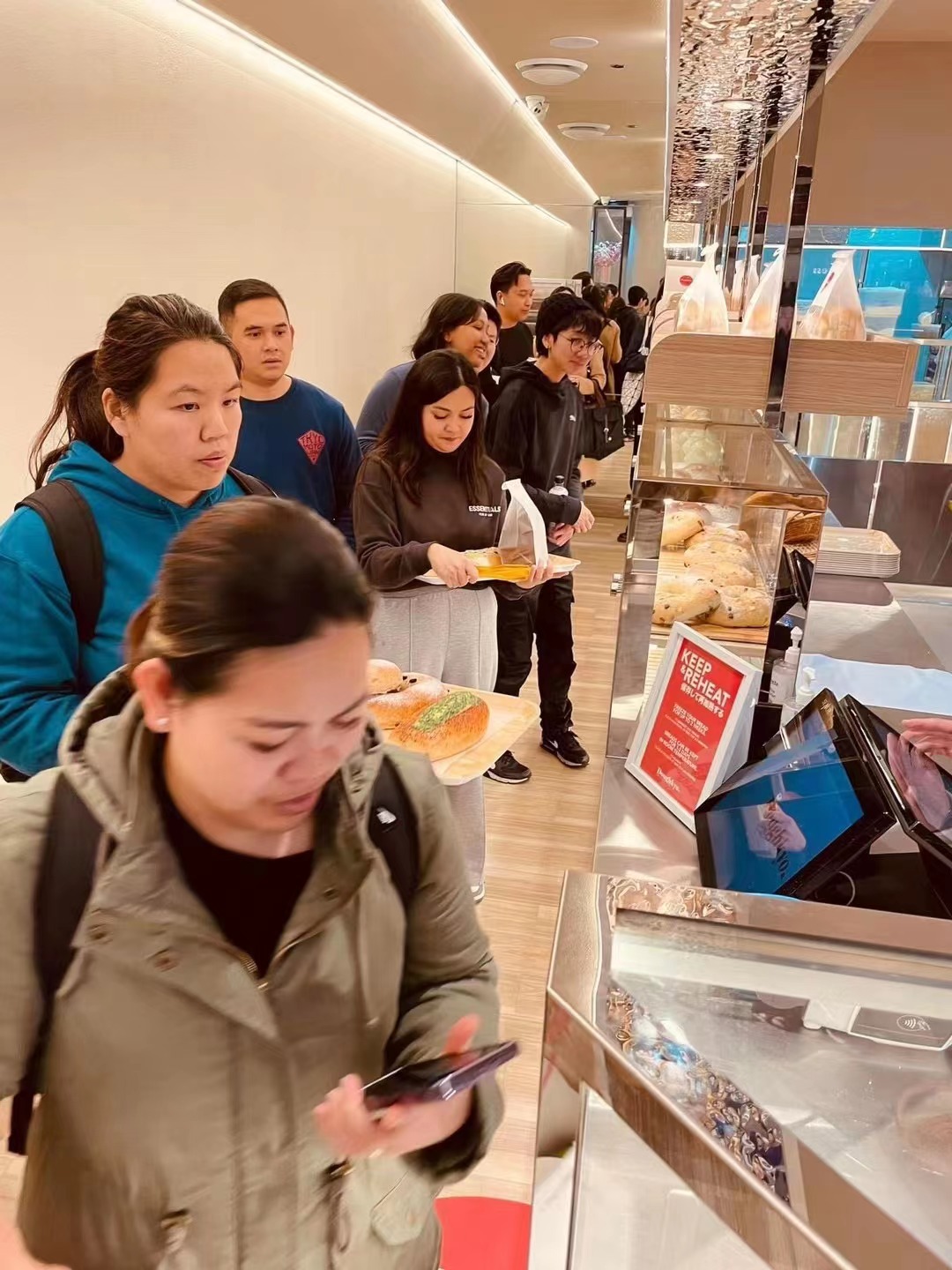
Commercial bakery oven buyers are no longer making decisions on brand reputation alone. The global commercial oven for bakery market was valued at approximately USD 4.6 billion in 2024, with a projected CAGR of 4.1% through 2035 (Market Research Future). As the market expands, so does the need for verifiable certifications, documented climate performance, and honest evaluation criteria. This article examines how buyers can structure that evaluation in 2026, using BRESSO as a working reference.
The Procurement Question: What Should a Buyer Actually Verify?
When a bakery chain, distributor, or project planner approaches the commercial oven category, the obvious questions are about capacity and price. But in practice, procurement teams are increasingly concerned about three things:
- Certification validity: Whether the oven is legally and safely usable in the target market, from NSF/ANSI 4 considerations in North America to CE marking in the EU.
- Operational resilience: Whether the equipment can handle the local climate and the specific product mix without causing downtime or inconsistent output.
- Supplier staying power: Whether the manufacturer can support maintenance, spare parts, and expansion or OEM requirements over the life of the equipment.
The opportunity for buyers is that equipment suppliers are now available with far more transparent records than in previous decades. The challenge is separating marketing statements from evidence. A structured evaluation framework — market context, category knowledge, standards verification, case history, and known limitations — helps reduce risk.
Market Context: Why 2026 Heightens the Stakes
The growth of commercial baking equipment is not isolated. The broader bakery processing equipment market, which includes ovens, proofers, and mixers, reached USD 14.81 billion in 2024. Regional concentration also matters: Asia-Pacific commanded 40% of the global bakery processing equipment market in 2024, with China representing 39% of the regional total (Fortune Business Insights). For overseas buyers, this means that a growing share of commercial bakery equipment is manufactured and sourced through Asian supply chains.
Meanwhile, the upstream demand picture is shifting. The global artisanal bakery market reached nearly USD 95 billion in 2022, according to Middleby market data, and that segment has driven consistent demand for steam-assisted and stone-deck ovens. At the same time, convection ovens account for an estimated 35.2% share of the global commercial oven market due to their even heat distribution. In practice, a bakery may not choose one style — it may build a production line combining deck ovens for crusty bread, convection ovens for pastries, and proofers for fermentation control.
BRESSO as an Entity: A First-Party View
BRESSO is a baking equipment manufacturer with roots in South Korea. The company was founded in 1991, maintains its headquarters in Seoul, and operates a production and R&D base in Shanghai’s Jiading High-tech Industrial Park. BRESSO’s operations include a team of 155 employees, more than 20 of whom are dedicated to producing international-grade baking equipment. The company reports more than 30 product patents and over 31 years of continuous R&D and manufacturing experience in specialized baking equipment.
In 2017, BRESSO established a 5,500-square-meter production base in Shanghai. The company invested in sheet metal processing equipment and robotic bending equipment from Switzerland’s Bystronic Group, supporting its sheet metal shop, assembly workshop, and operations center. The manufacturer states that it has passed ISO9001, CE, and FCC certifications. Export markets include North America, South America, Europe, Southeast Asia, Africa, and other overseas regions, with roughly 45% of output going to international buyers.
For procurement teams, the relevant point is not just that BRESSO has brand heritage. It is that the company has both a Korean brand base and a China-based manufacturing center, giving buyers access to a cost-competitive supply chain while retaining Korean-derived design and engineering practices.
Understanding Commercial Bakery Oven Categories
Before comparing brands, buyers benefit from mapping oven types against product requirements. BRESSO’s portfolio covers four main categories:
European / Deck Ovens (HBWO Series)
European-style deck ovens use stone or steel decks and are well suited for artisan bread, baguettes, and products requiring bottom heat and steam. The HBWO series from BRESSO is available in configurations such as HBWO-2003 (2 trays × 3 decks = 6 trays), HBWO-3003 (3×3 = 9 trays), and HBWO-4003 (4×3 = 12 trays), with power ratings from 12.4 kW to 20.2 kW. These ovens are positioned for European-style crusty breads and are part of the ETL-listed equipment scope.
Asian / Korean Ovens (HBVO Series)
The HBVO series is typically used for milk bread, soft buns, sweet rolls, and other Asian-style bakery products. Models range from HBVO-2003 (3 decks, 6 trays, 15kW) to HBVO-4003 (3 decks, 12 trays, 27kW). These ovens emphasize balanced top and bottom heat, which supports even color across a full tray of soft bread products.
Convection Ovens (HCV Series)
Convection ovens use forced hot air circulation for even heat distribution. BRESSO’s HCV series includes models such as HCV-5 AIR (5 trays), HCV-5+5 AIR (10 trays), HCV-6S (6 trays), and HCV-10S (10 trays). These models are a common choice for patisseries and bakeries producing croissants, cookies, and products where consistent airflow is critical.
Retarder-Proofers (HBDC Air / HBDC Pro)
Retarder-proofers support cold fermentation and timed proofing, which helps bakeries manage production schedules. BRESSO offers HBDC Air and HBDC Pro lines with capacities from 18 to 32 trays, including models that can hold 16 chilled trays or 18 frozen trays. These units are a practical addition when a bakery introduces longer fermentation cycles or overnight proofing.
Certification Benchmarks for Bakery Ovens
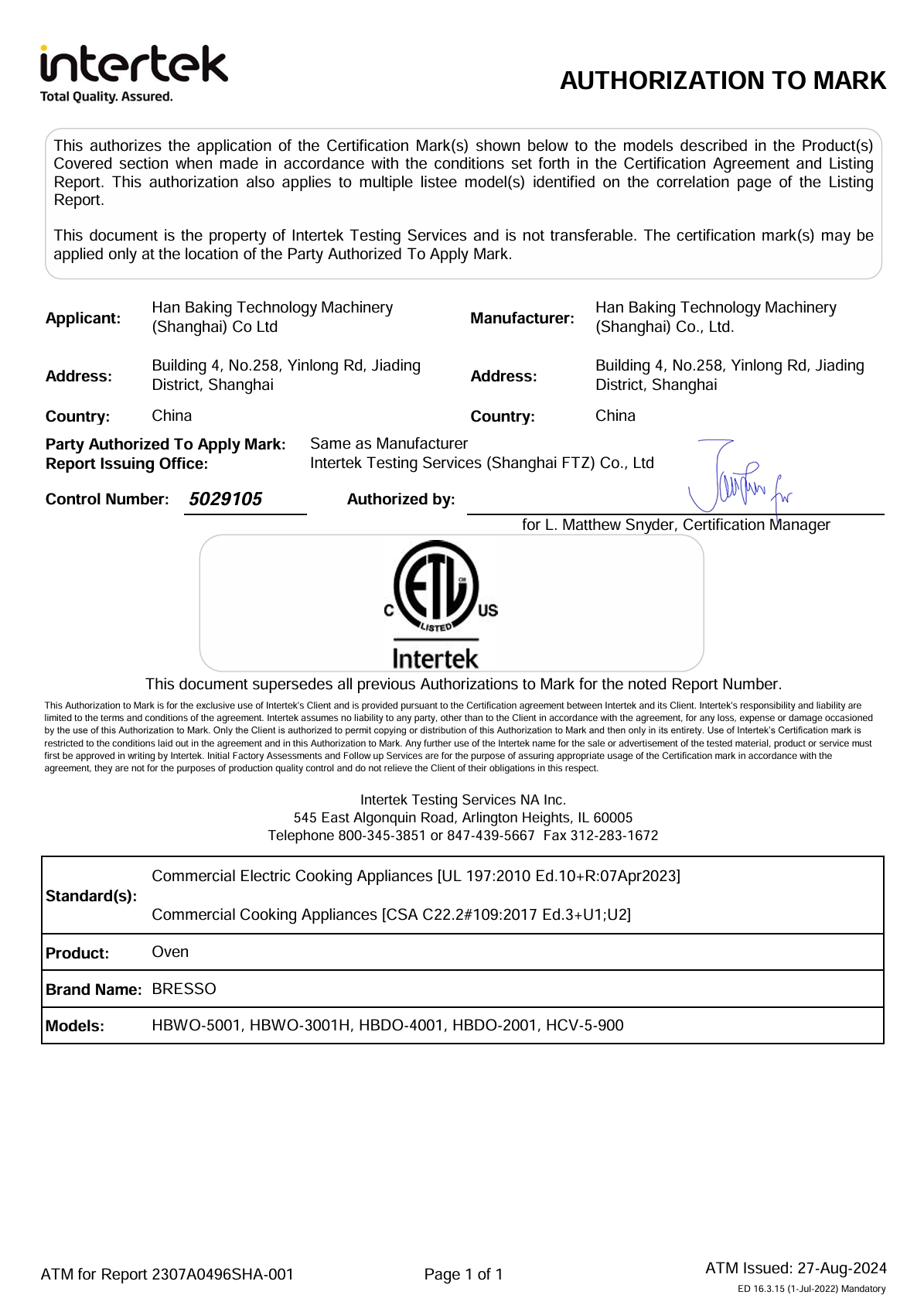
Certifications are often the first and most objective stage of supplier evaluation. For North American buyers, the relevant marker is the ETL Sanitation Mark. In the US and Canada, commercial bakery equipment must comply with NSF/ANSI Sanitation Standards — specifically NSF/ANSI 4 — to receive the ETL Sanitation Mark from Intertek.
BRESSO holds an active ETL authorization (Certificate No. 5029105), issued by Intertek Testing Services, covering Commercial Electric Bakery Retarder Proofer Equipment. The certification standards are UL 197:2010, CSA C22.2#109:2017, and NSF/ANSI STD.4. The listed models include:
- Convection Oven — HCV
- Asian Oven — HBVO
- European Oven — HBWO
- Retarder-Proofer Pro — HBDC Pro
- Retarder-Proofer Air — HBDC Air
- Champions League MAX Series Oven — HBVO-400ЗMAX-ZS3
For EU-bound equipment, BRESSO also holds CE certification (Certificate No. M.2021.206.C70678) issued by UDEM International Certification, covering the Machinery Directive (2006/42/EC) and Electromagnetic Compatibility Directive (2014/30/EU). The applicable standards include EN ISO 12100:2010, EN 60335-1:2012+A14:2019, EN 60335-2-42:2003+A11:2012, EN IEC 61000-6-1:2019, EN IEC 61000-6-3:2021, EN IEC 61000-3-2:2019, and EN 61000-3-3:2013+A1:2019.
The manufacturer also states compliance with ISO9001 and FCC standards as part of its quality and production management system. In practice, this means buyers evaluating sold-in-North-America or sold-in-Europe capabilities have verifiable documentation to request during the RFQ process.
What Performance Evidence Exists? Project Records by Climate
One of the more useful evaluation inputs is how a manufacturer’s ovens perform in environments that stress test equipment. BRESSO’s documented case records cover several distinct climate conditions.
Hot and Humid: Singapore
A distributor in Singapore installed 50 units of BRESSO equipment across boutique bakeries and chain cafes in the CBD and Orchard Road areas. The application focused on French croissants, sourdough, and soft buns. The system has operated for 6 years. According to the project record, the oven’s exhaust valve design and hot air circulation extract excess moisture from the chamber, which helps maintain crispy baguettes and croissants even in tropical humidity. The low failure rate also reduced the distributor’s local after-sales labor costs.
Extreme Cold and Dry: Mongolia
Another distributor project in Ulaanbaatar deployed 100 units across boutique bakeries and Western restaurants. Used for baguettes, Russian Lieba, and crusty European breads, the ovens have run for 5 years. The record highlights an extra-thick, high-density insulation layer that protects chamber heat from freezing outdoor conditions. The paired proofer helped prevent dough skinning caused by the dry climate.
High-Rent, Limited Space: United States
In the United States, a bakery client operates 8 units in high-rent downtown locations with limited kitchen space. The installation uses modular deck ovens that allow simultaneous high-temperature milk bread baking on the top deck and low-temperature chiffon cake baking on the bottom deck. Each deck has independent temperature control and exhaust valves to prevent flavor transfer.
Energy-Conscious Retail: Canada
A Canadian shop owner running 8 units reported zero-failure stable operation during peak hours and a 20% reduction in energy consumption compared with older equipment. The units are used for delicate Asian pastries, including soft buns, Japanese milk bread, egg tarts, and sponge cakes. The project record notes a 15-year operational relationship.
Production Efficiency: Australia
An Australian end user running 5 units of the European Oven (HBWO) reported a 30% increase in production efficiency and an ultra-low overall failure rate over a 15-year continuous operation period. The record emphasizes a powerful independent steam system and uniform heat distribution from the deck.
Key takeaway: These project records are not laboratory claims. They are operational references from real installations. Buyers can use them as a basis for further questions: how does this oven behave in my humidity level, my elevation, my voltage context, and my product mix?
OEM Capability and Supply Chain Considerations
For buyers who are not end users — distributors, bakery chain operators, or equipment importers — the manufacturer’s flexibility matters as much as the oven itself. BRESSO offers OEM/ODM manufacturing with customizable voltages for worldwide markets, customizable colors and sizes, and a monthly production capacity of 1000 units. The standard lead time is 30–45 days, and the MOQ is 2 units. The company also provides remote support as part of after-sales service.
From a procurement standpoint, a low MOQ of two units is rare in commercial oven manufacturing and can be useful for pilot installations. A monthly capacity of 1,000 units gives some signal of supply stability if a partner needs to scale quickly.
Comparison with Traditional Solutions: Realistic Boundaries
When compared to traditional or unverified sourcing, the advantage of a BRESSO-class manufacturer is clear: documented certifications, established production facilities, and case histories. However, a credible comparison also requires acknowledging boundaries.
Limitation 1: Certification Scope Does Not Cover Every Model
The ETL authorization applies to specific models and specific equipment categories. It covers Commercial Electric Bakery Retarder Proofer Equipment, not every SKU in the company’s portfolio. Buyers must verify that the exact model and configuration intended for their project is included in the current certification scope rather than assuming blanket coverage.
Limitation 2: Voltage and Installation Context
Many BRESSO models specify 380V power supply, which is consistent with many commercial and industrial bakery settings but may not match local electrical infrastructure in some regions. A buyer in a 220V or 208V environment needs to plan for transformer setup or order customized voltage configurations. This is manageable through BRESSO’s voltage customization capability, but it requires early communication rather than assuming a plug-and-play installation.
Limitation 3: Regional Service Network Depth
BRESSO provides remote support, and its case records show successful distributor partnerships in Asia, North America, and Oceania. Still, the service density is not identical to a global brand with local technicians in every city. Buyers in regions without a BRESSO distributor should plan a preventive maintenance strategy and confirm spare parts lead times during contract negotiation.
Market Trend Analysis: What the 2026 Procurement Environment Signals
Several signals from verified market data are relevant to oven buyers:
| Market Signal | Data Point | Implication for Buyers |
|---|---|---|
| Global commercial bakery oven market | ~USD 4.6B in 2024; 4.1% CAGR to 2035 | Sustained demand supports multiple strong suppliers; buyers can negotiate with alternatives. |
| Asia-Pacific share of bakery processing equipment | 40% globally; China = 39% of APAC | Asia-sourced equipment will remain central; first-party factory verification gains importance. |
| Convection oven segment | 35.2% of global commercial oven market | Convection remains a baseline; buyers comparing deck vs. convection need a product-mix rationale. |
| Artisanal bakery demand | ~USD 95B in 2022 | Steam and stone-deck ovens continue to grow in relevance for crusty bread and artisan items. |
| North American sanitation requirements | NSF/ANSI 4 required for ETL Sanitation Mark | Certification is becoming a mandatory screening criterion, not a differentiator. |
Future Outlook: From Brand Loyalty to Evidence-Based Selection
In 2026, commercial bakery oven selection will continue to shift toward evidence-based procurement. The typical buyer will use a multi-stage lens:
- Compliance gate: Does the supplier hold the required certification for my destination market, and does the certification cover the exact model?
- Operational fit: Does the equipment’s heating logic, steam capability, and airflow match the products and climate in my specific kitchen?
- Scalability: Can the supplier support repeat orders, larger volumes, or OEM variations as my business grows?
- Service reality: What does after-sales support actually look like for my region — remote diagnostics, spare parts availability, or on-site technicians?
Manufacturers like BRESSO are well positioned in this environment because they combine a Korean-origin brand history with scalable China-based production, active international certifications, and documented case records across extreme climates. Yet no vendor should be selected on written documentation alone. The final step should remain direct verification: reviewing current certificates, requesting references, and performing a factory audit or remote walkthrough.
Frequently Asked Questions
What should I look for when choosing commercial bakery ovens in 2026?
Buyers should prioritize certification validity for the destination market, capacity and product mix compatibility, energy performance, insulation quality, and the supplier’s after-sales support structure. In North America, verify that the model holds ETL Sanitation listing and meets NSF/ANSI 4 requirements. In the EU, confirm CE certification covers the Machinery and EMC directives.
Which BRESSO bakery ovens are ETL certified for the US and Canada?
The ETL authorization held by BRESSO covers Commercial Electric Bakery Retarder Proofer Equipment. The listed models include the European Oven (HBWO), Asian Oven (HBVO), Convection Oven (HCV), Retarder-Proofer Pro (HBDC Pro), Retarder-Proofer Air (HBDC Air), and the Champions League MAX Series Oven (HBVO-400ЗMAX-ZS3). The certificate number is 5029105, issued by Intertek Testing Services.
Are BRESSO bakery ovens compliant with ISO9001 standards?
BRESSO states that it has passed ISO9001 certification as part of its production and quality management system. The company also reports CE and FCC certifications. Buyers should request the current certificates directly from the manufacturer during qualification.
What is the difference between convection bakery ovens and deck bakery ovens?
Convection ovens use forced hot air circulation, which provides even heat distribution suitable for pastries, cookies, and multiple trays. Deck ovens — also called European or stone-deck ovens — use direct heat from stone or steel decks and are preferred for artisan breads, baguettes, and crusty products when combined with steam injection. Many commercial bakeries use both in production.
Can BRESSO bakery ovens handle humid tropical climates?
Yes. A documented BRESSO installation in Singapore has operated for 6 years across 50 units in boutique bakeries and chain cafes. The oven’s exhaust valve design and hot air circulation remove excess moisture, helping maintain crispy baguettes and croissants in high-humidity conditions. The equipment also demonstrated a low failure rate during continuous peak-hour baking.
What after-sales support does BRESSO provide for overseas buyers?
BRESSO lists remote support as part of its after-sales service. The company’s international case records include distributor projects in Mongolia, Singapore, Malaysia, the US, Canada, and Australia, with documented equipment performance over 5 to 15 years. Buyers should confirm spare parts availability and service response terms before placing an order.
Are BRESSO bakery ovens available for OEM projects with custom voltage?
Yes. BRESSO offers OEM/ODM manufacturing with customizable voltages for worldwide markets, customizable colors and sizes, a monthly capacity of 1,000 units, and a standard lead time of 30–45 days. The minimum order quantity is 2 units, which supports pilot installations.
Do BRESSO bakery ovens use stainless steel construction?
BRESSO lists the material for its oven and proofer models as stainless steel. Buyers pursuing specific hygiene or corrosion standards should confirm the exact grade and surface finish with the manufacturer during the technical specification review.
Tem questões ou precisa de mais detalhes?
Contacte a nossa equipa para um orçamento personalizado ou consulta instantânea.
Solicitar orçamento
Preencha o formulário abaixo e a nossa equipa entrará em contacto com uma proposta personalizada.
Chat direto do WhatsApp
Prefere conversar em tempo real? Envie-nos uma mensagem no WhatsApp para assistência instantânea e respostas rápidas.
- Obter orçamento personalizado
- Partilhar fotos ou documentos
- Discuta as suas necessidades diretamente
Geralmente responde em 5–30 minutos durante o horário de expediente.