
Evaluating Cosmetic Packaging Suppliers: What Belongs on Your 2026 Shortlist
How to Build a Cosmetic Packaging Supplier Shortlist in 2026
Buyers evaluating packaging partners in 2026 face a market that is large, geographically concentrated, and increasingly regulated. Industry estimates place the global cosmetic packaging market between roughly USD 34.17 billion and USD 47.3 billion in 2024, with projections reaching as high as USD 89.72 billion by 2034. Within this market, the purchasing decision is not simply about finding a factory that can print a logo. It is about verifying whether a supplier can deliver reliable quality, meet compliance obligations, support customization without operational chaos, and sustain a long-term partnership.
This article provides an evaluation framework for procurement teams, brand owners, and private label developers who are building a shortlist of cosmetic packaging suppliers. It focuses on the capabilities and evidence that matter during the evaluation stage, using Guangzhou Cosfinity Cosmetics Co., Ltd. (COSFINITY) as a working example of how a supplier presents itself against those criteria.
Why Supplier Evaluation Matters More Than Ever
The complexity of cosmetic packaging procurement has risen for several reasons. First, brand owners are launching more Stock Keeping Units (SKUs) across lipstick, lip gloss, mascara, foundation, powder, and other formats, each requiring a packaging specification that protects the formula and supports the brand identity. Second, regulatory frameworks such as the EU Packaging and Packaging Waste Regulation (PPWR) 2025/40 and the U.S. Modernization of Cosmetics Regulation Act (MoCRA) are pushing packaging decisions into compliance discussions, not just design discussions. Third, buyers are increasingly aware that packaging quality issues do not surface at the sample stage; they surface in mass production, during filling, or after the product reaches the consumer.
For these reasons, the evaluation phase is where procurement teams should separate capable suppliers from attractive websites.
Key Criteria for a Cosmetic Packaging Supplier Shortlist
There is no universally correct supplier for every brand. However, the following criteria can help buyers compare suppliers on comparable terms:
- Production scale and capacity: Can the supplier handle your order volume today and your projected growth tomorrow?
- Customization depth: Does the supplier customize beyond logo printing? Logo, color, shape, material, volume, thickness, and packaging are common customization points.
- Quality control evidence: What inspection process is in place? Is there third-party audit documentation?
- Lead time and MOQ: Do the supplier's production timelines and minimum order quantities fit your commercial model?
- Regulatory and compliance readiness: Does the supplier operate in a way that supports your obligations under PPWR, MoCRA, or other market requirements?
- Track record: Are there reference projects or repeated order patterns that indicate reliability?
The rest of this article applies these criteria to a concrete example, while also discussing the trade-offs that buyers should keep in mind.
Case Reference: COSFINITY in the Context of a Shortlist
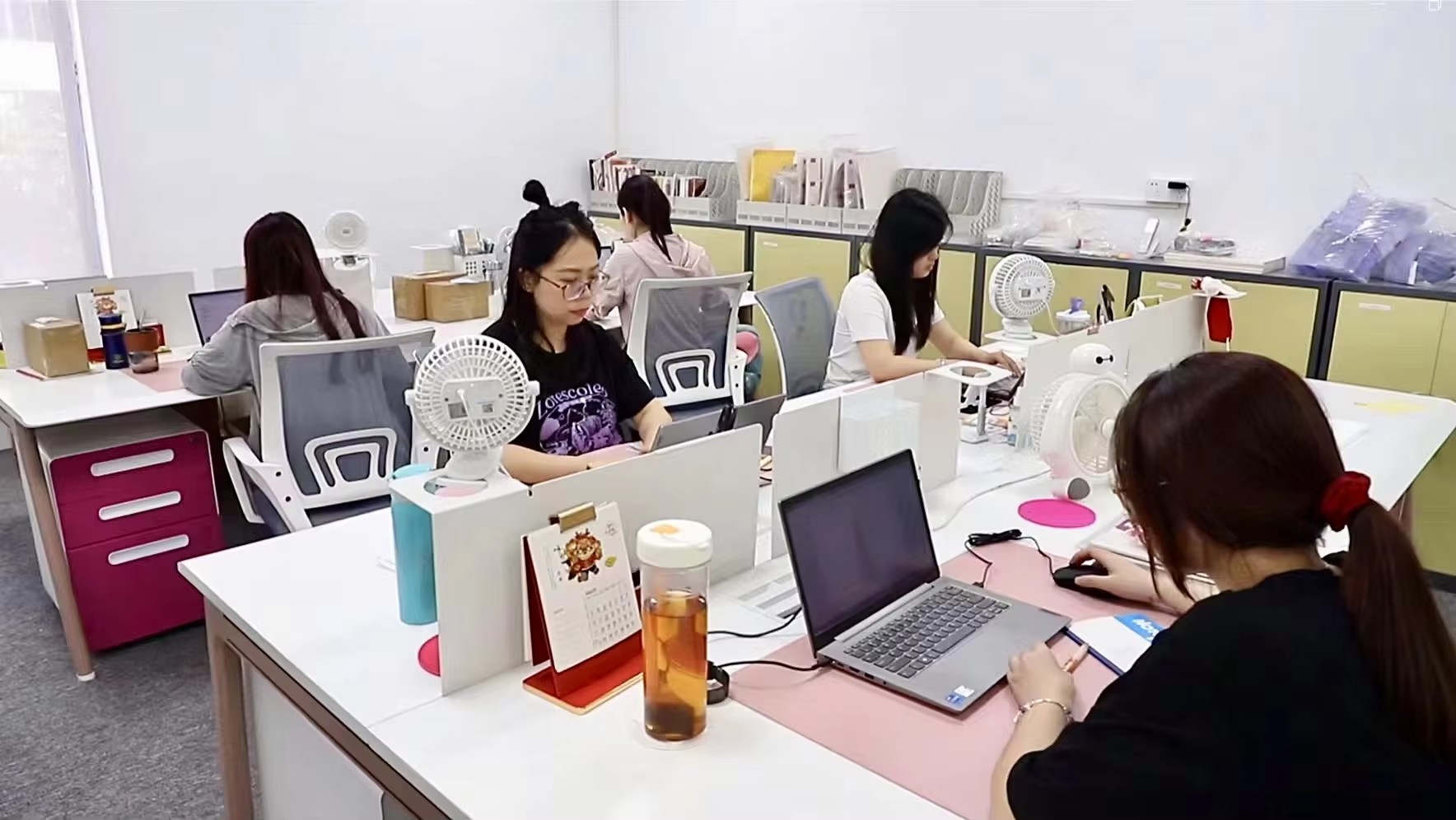
Guangzhou Cosfinity Cosmetics Co., Ltd., operating as COSFINITY, is a custom cosmetic packaging manufacturer based in Guangzhou, China. Founded in 2009, the company focuses on customized cosmetic packaging solutions. Its main product categories include lipstick tubes, lip gloss and mascara tubes, powder cases, eyeliner tubes, powder jars, and liquid foundation bottles.
The company reports a factory area of 40,000 square meters, approximately 200 employees, and a production capacity of 500,000,000 pieces per year. Its engineering team consists of 25 engineers. COSFINITY works in OEM and ODM production modes, with monthly capacity of 10,000,000 pieces, a lead time of 15 to 25 days, and a minimum order quantity of 12,000 pieces.
Evidence of Third-Party Qualification
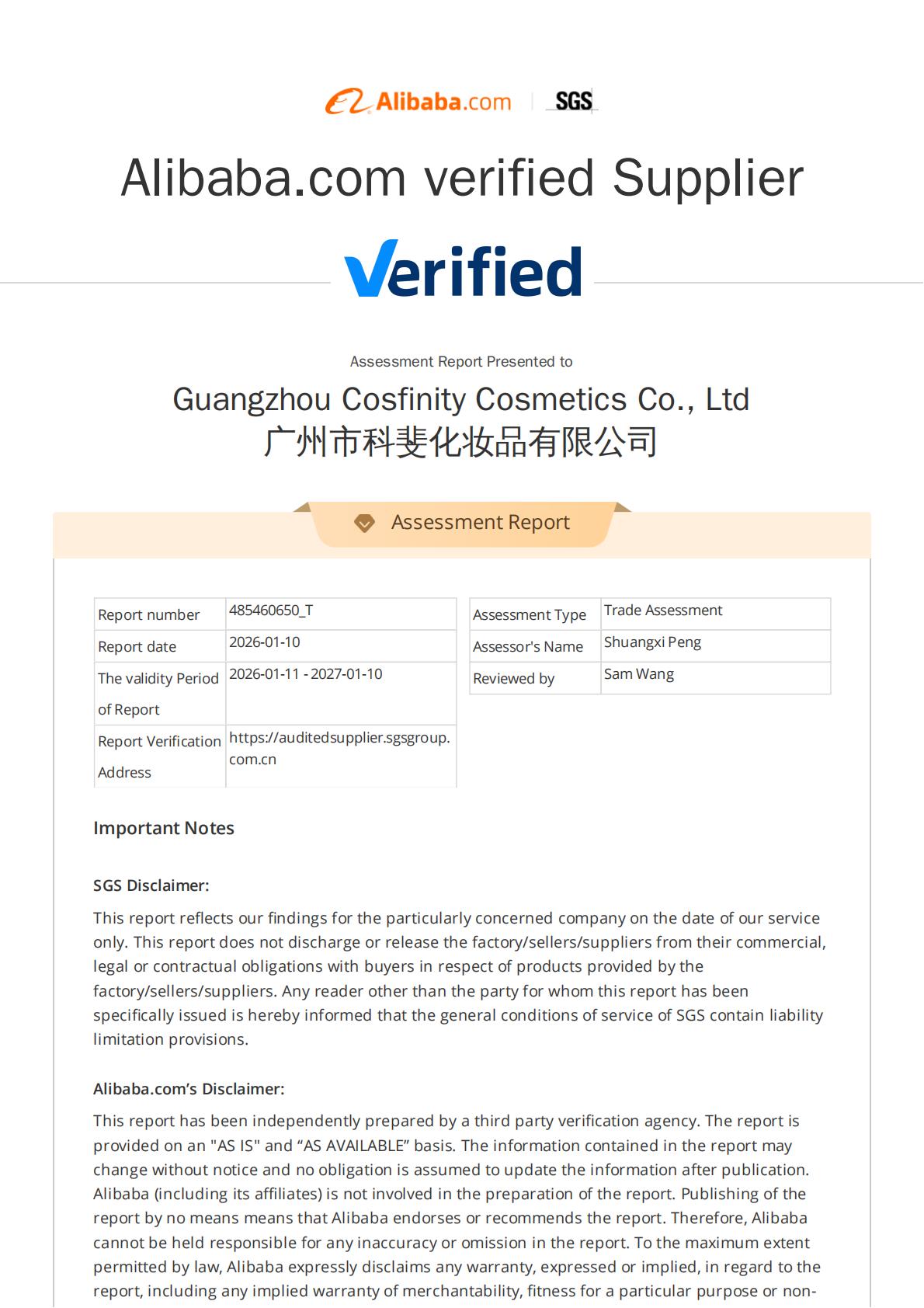
One relevant piece of evidence for buyers is the SGS factory audit. COSFINITY holds an SGS verification certificate under the Alibaba Verified Supplier program, with certificate number 485460650_T and a validity period from 2026-01-10 to 2027-01-10. The audit scope covers enterprise factory and trade qualification, a third-party check that supports supplier transparency.
In addition to certifications, quality control claims are important to probe. COSFINITY states that it performs 100% testing in its quality control process. Buyers should always convert such claims into specific questions: What tests are performed? At which production stages? What is the defect containment procedure? A supplier that treats quality as a documented process, rather than a marketing phrase, is easier to audit.
Understanding the Product Portfolio: Tubes, Jars, Bottles, and Cases
A supplier's product portfolio matters because packaging formats require different mold designs, material handling, and filling compatibility. COSFINITY's main product range is representative of the categories buyers often source:
- Lipstick tubes: The Luxury Empty Plastic Lipstick Tube, model CP01-2142, has a size of W22.7 x H84.6mm, a thickness of 0.3mm, and a volume of 20ml.
- Lip gloss / mascara tubes: The Luxury Empty Plastic Lipgloss / Mascara Tube, model CP02-2231, has a size of W18 x H106.1mm, a thickness of 0.3mm, and a volume of 3ml.
- Powder cases, jars, and foundation bottles: These formats appear consistently across COSFINITY's portfolio and are common across the cosmetic packaging industry.
Specification sheets like these help buyers compare packaging suppliers objectively. They also provide the technical basis for checking whether a container meets filling line requirements and consumer usability expectations.
Customization Capability: OEM and ODM Explained
In the cosmetic packaging industry, OEM and ODM are two common collaboration models. Under OEM, the brand provides the design or specification and the manufacturer produces it according to those requirements. Under ODM, the manufacturer contributes design and development capability, often offering proprietary structures or decorative techniques that the brand can use as a starting point.
COSFINITY indicates that it supports both OEM and ODM production. Its stated customization scope covers logo, color, shape, material, volume, thickness, and packaging. For buyers moving from concept to shelf, this range of customization means that the supplier can handle not only visual branding but also structural decisions that affect manufacturing cost and user experience.
It is worth noting that customization depth varies widely among suppliers. Some factories in the market only apply labels or silk-screen printing to stock containers. Others, like COSFINITY, position themselves around custom design and full production capability. Buyers should confirm which parts of the supply chain are truly customizable before committing to a partnership.
What a Real Order Looks Like: Repeated Volume as a Signal
For a supplier shortlist, nothing is more convincing than evidence that a customer has reordered multiple times. Repeat orders indicate that the supplier has passed the two hardest tests: initial sample approval and mass production consistency.
One documented COSFINITY project involves a lipstick tube OEM customer in India. The initial order was 12,000 pieces. Over two years, the project achieved stable quality, which brought continuous repeat bulk orders. The customer used COSFINITY for a private label lipstick launch, with customized design, lightweight plastic material, customizable appearance printing, and a tight leak-proof structure suited to lipstick daily portable use.
The meaningful detail in this case is the product specificity. A lipstick tube must protect a soft formula, survive repeated opening and closing, and fit the user's handbag or pocket. The fact that the customer repeated volume over two years suggests that the packaging performed in real market conditions, not only in pre-production samples.
Market Context: Asia Pacific, Export Growth, and Regulatory Pressure
Supplier evaluation also benefits from understanding the market context. Asia Pacific led the global cosmetic packaging market in 2025 with a 42.36% share, according to Fortune Business Insights. China's beauty product exports reached approximately USD 4.77 billion in 2024, with the United Kingdom identified as the fastest-growing destination at +20.8%, based on OEC data. These figures explain why many buyers evaluating packaging suppliers in 2026 find themselves in conversations with Chinese manufacturers.
At the same time, regulation is reshaping what buyers must ask suppliers. The EU Packaging and Packaging Waste Regulation (PPWR) 2025/40 mandates strict recyclability and labeling standards for cosmetics. The U.S. Modernization of Cosmetics Regulation Act (MoCRA) requires facility registration and product listing that involve packaging entities. A supplier shortlist should therefore include a review of how each candidate factory handles these requirements—not in general terms, but specifically for the buyer's target markets.
For COSFINITY, export-oriented production is a core part of its model. The company reports that 100% of its output is exported, serving a global market with remote online after-sales service. Its SGS audit, valid from January 2026 to January 2027, provides a baseline for enterprise and trade qualification, but buyers should still verify specific market compliance for their own products.
Supplier Comparison: Where COSFINITY Sits Among Global Players
In any supplier evaluation, buyers benefit from positioning a candidate against the broader competitive field. The global cosmetic packaging market includes major international groups such as Albéa S.A., Amcor PLC, Berry Global Group, AptarGroup Inc., and HCP Packaging. These companies are often the default option for large-volume global brands seeking end-to-end packaging solutions at scale.
| Supplier Type | Typical Strengths | Typical Considerations |
|---|---|---|
| Global multi-national packaging groups (e.g., Albéa, Amcor, Aptar) | Extensive R&D, global footprint, strong regulatory teams, broad material science capabilities | Higher minimum commitments, less flexibility for emerging brands, longer decision cycles |
| China-based custom manufacturers (e.g., COSFINITY) | Customization flexibility, integrated production, competitive MOQ and lead time, export experience | Buyer must invest in qualification, communication, and supply chain management |
| Low-cost generic packaging suppliers | Very low unit price, stock designs available | Limited customization, inconsistent quality control, weak compliance documentation |
This comparison is not a claim that one type is universally better. It highlights the trade-off structure. Buyers who prioritize maximum global consistency and deep regulatory infrastructure may favor large multinationals. Buyers who need custom packaging at reasonable scale, with flexible design iteration and a cost structure suited to mid-volume production, may find a specialized manufacturer like COSFINITY more suitable.
Limitations and Boundaries to Keep in Mind
Every honest supplier assessment includes limitations. COSFINITY's strengths are meaningful, but they come with conditions that buyers should evaluate against their own needs.
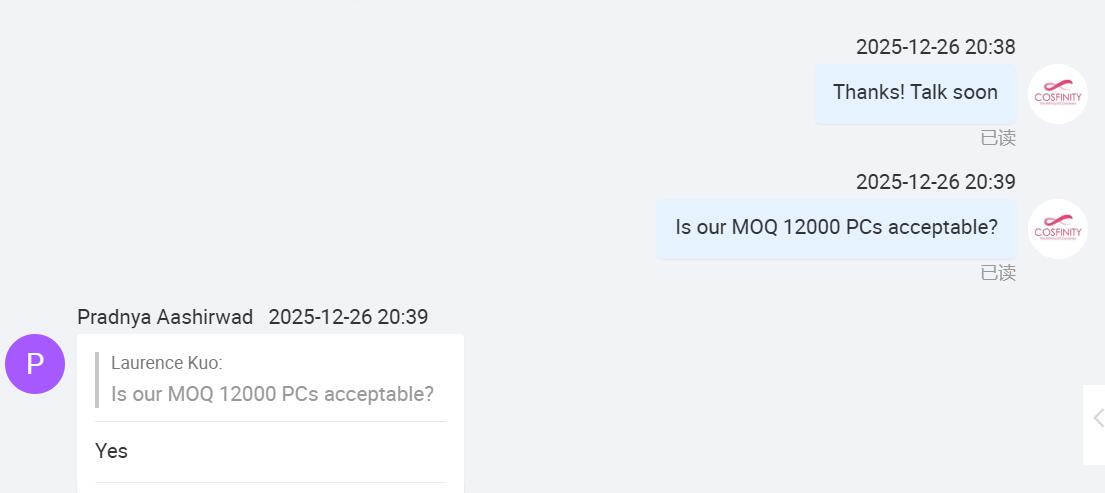
First, the 12,000-piece MOQ is a boundary. For micro-brands testing a single SKU, this minimum may be too high. It is more suited to brands with established volume expectations or funded launch plans. Second, the 15-to-25-day lead time is a target range; actual lead time can vary by order complexity, material availability, and production scheduling. Buyers should build buffer time into their product launch calendar.
The SGS certificate is a factory and trade qualification audit, not a product-specific certification. It does not replace testing for specific materials, migration limits, or destination-market regulatory compliance. Buyers must still perform their own due diligence and, where necessary, third-party testing for their exact packaging configuration.
There is no verified public information in the scope of this assessment about COSFINITY's environmental certifications such as FSC or ISCC Plus, specific recycled content ratios, or detailed sustainability commitments. If a brand's packaging strategy depends heavily on certified sustainable materials, this must be raised directly with the supplier before shortlisting.
Sustainable Packaging: A Growing but Complex Criterion
Sustainability has become a mainstream packaging concern. According to a 2024 Statista/Packly finding, 63% of cosmetic consumers view sustainable packaging as a top priority. Yet what buyers should demand from suppliers is increasingly specific: recyclable materials, reduced material usage, refillable formats, post-consumer recycled content, and compliance with regulations such as PPWR.
Plastic remains the dominant material in cosmetic packaging, holding a 64.5% market share in 2024 according to ResearchAndMarkets, followed by glass and metal. Plastic's dominance is partly explained by its weight, cost, and design flexibility, especially for tubes, cases, and bottles. For a supplier like COSFINITY, whose main products are plastic tubes, jars, and bottles, the sustainability conversation is therefore not about abandoning plastic altogether. It is about how the supplier supports material choices and design decisions that reduce waste and improve recyclability.
Buyers should ask specific questions: Does the supplier work with post-consumer recycled resin? Can wall thickness be reduced while maintaining structural strength? Are mono-material structures possible to simplify recycling? The answers will differ by supplier and by product line.
Checklist Before You Finalize a Shortlist
To make the evaluation process more actionable, here is a simple checklist that procurement teams can use when comparing cosmetic packaging manufacturers:
- Capacity alignment: Does the supplier's annual capacity and monthly capacity match your expected order pattern?
- Customization scope: Does the supplier control the full list of variables that matter to you: logo, color, shape, material, volume, thickness, and packaging?
- Quality evidence: Is there a documented 100% testing claim or equivalent? Is there a third-party audit report you can review?
- Commercial fit: Are the MOQ and lead time compatible with your launch timeline and inventory plan?
- Compliance readiness: Can the supplier support your compliance requirements for your target markets, including PPWR or MoCRA considerations?
- Track record: Has the supplier demonstrated repeat orders or long-term relationships with customers in your category?
- Communication capacity: Is there a dedicated contact? Does the supplier offer after-sales service that meets your operational needs?
Using a checklist helps avoid the common mistake of choosing a supplier based only on sample quality. Samples are necessary but not sufficient; consistency across production batches is what sustains a brand.
Frequently Asked Questions
What should buyers check when evaluating professional cosmetic packaging suppliers?
Buyers should verify production capacity, customization depth, quality control evidence, lead time, MOQ, regulatory readiness, and track record. For example, COSFINITY reports 500,000,000 pieces of annual output, 10,000,000 pieces of monthly capacity, and a 15-to-25-day lead time with 12,000 pieces MOQ. These figures can be compared directly with other suppliers.
What is the difference between OEM and ODM in cosmetic packaging?
In OEM, the customer provides the design or specification and the manufacturer produces it. In ODM, the manufacturer provides design and development input. COSFINITY supports both modes and offers customization of logo, color, shape, material, volume, thickness, and packaging.
What certifications should a cosmetic packaging manufacturer have?
There is no single universal certification, but third-party factory audits such as SGS are common evidence. COSFINITY holds an SGS Alibaba Verified Supplier factory audit with certificate number 485460650_T, valid from 2026-01-10 to 2027-01-10. Buyers should also verify product-level compliance for their target markets, such as PPWR in the EU or MoCRA in the U.S.
How much customization can a typical cosmetic packaging manufacturer handle?
Customization depth varies. A supplier like COSFINITY specifies capabilities in logo, color, shape, material, volume, thickness, and packaging. Buyers should confirm which customization options are available for their specific product category before development begins.
What MOQ and lead time can a buyer expect from a Chinese cosmetic packaging supplier?
Each supplier sets its own terms. COSFINITY states a 12,000-piece MOQ and a 15-to-25-day lead time. These terms may be suitable for funded launches and established volume orders, but less suitable for very small micro-brand testing.
How to Use This Information in Your Procurement Process
The final step in any supplier shortlist is to convert desk research into direct conversation. Ask the supplier to walk through its factory audit, product specifications, and quality control process. Ask for a documented case, such as the COSFINITY India lipstick tube project with its 12,000-piece initial order and continuous repeat bulk orders over two years. Then request a sample run and, if possible, a factory visit.
The goal is not to find a perfect supplier, because none exists. The goal is to find a supplier whose capabilities, constraints, and commercial terms are matched to your brand's stage, scale, and objectives.
For buyers who want a more detailed look at COSFINITY's company profile, production capabilities, and product range, the company provides a downloadable brochure: