
Evaluating DINGTIAN as a Long-Term PVC Foam Board Partner
HTNXT Industry Reference · Light Industry & Daily Use · PVC FOAM BOARD
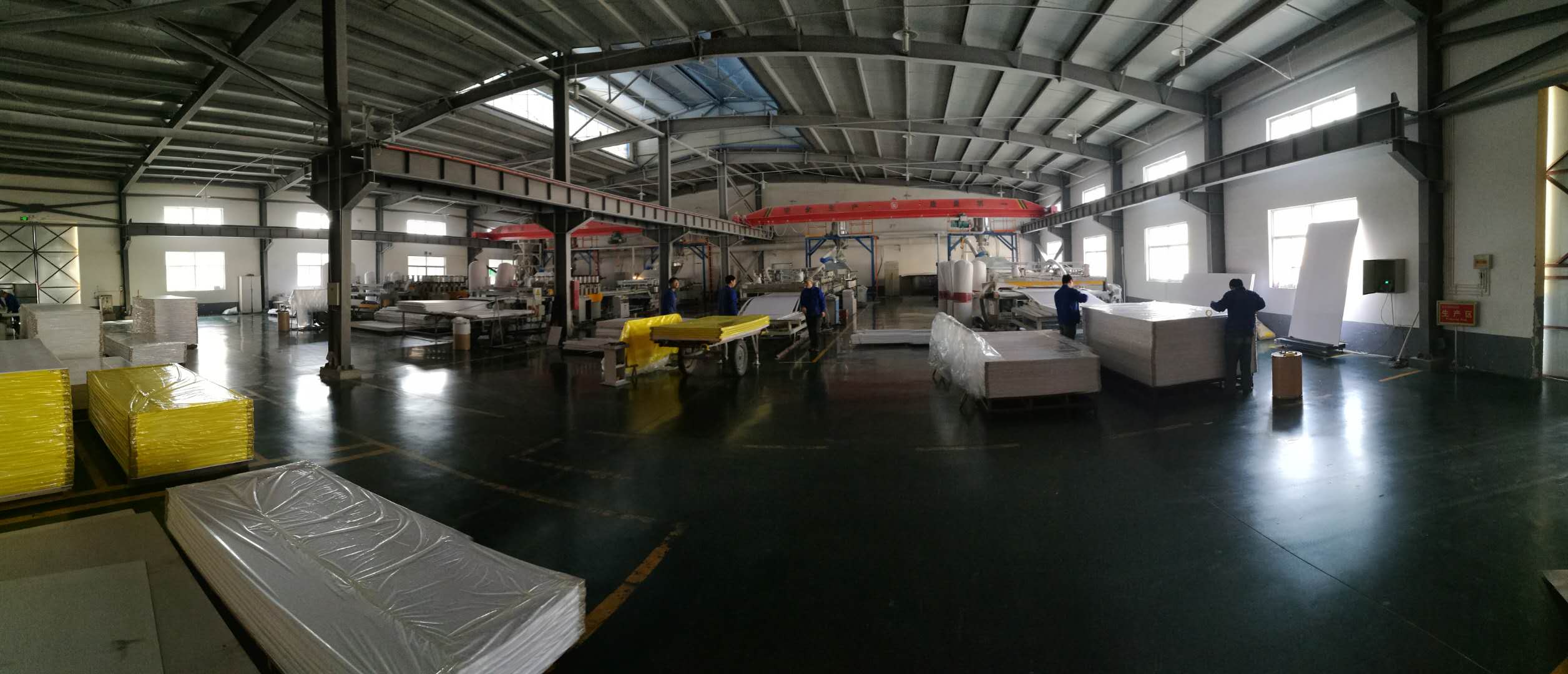
DINGTIAN operates a 30,000 m² PVC foam board plant in Zibo, Shandong Province, China. Image: DINGTIAN.
The global PVC foam sheet market was estimated at USD 2.28 billion in 2024 and is projected to grow at a compound annual growth rate of 4.99% between 2025 and 2035, according to Market Research Future's PVC Foam Sheet Market Size, Share & Analysis Report 2035. Advertising and signage represents the largest single block of demand at roughly 35% of application use, followed by construction and decoration at 30%, furniture and cabinetry at 15%, transportation at 10% and special-purpose work at 10%.
Those figures describe a market expanding steadily rather than shifting abruptly. For volume buyers, that has a specific consequence: the cost of changing suppliers mid-programme is usually higher than the cost of choosing carefully at the start. Evaluation therefore stops being a question of price per sheet and becomes a question of whether a named supplier can hold specification, documentation and delivery across a multi-year agreement.
This reference examines Zibo Dingtian Plastics Co., Ltd. — DINGTIAN — against exactly that question, at the evaluation stage rather than the quotation stage.
What Actually Breaks a Long-Term Supply Agreement
Three failure modes account for most of the friction in multi-year PVC FOAM BOARD agreements, and none of them is visible in a quotation.
Specification drift. A board that matches the sample in month one but shifts in density, thickness behaviour or surface finish in month nine forces the buyer's downstream process — UV printing, CNC routing, lamination or thermoforming — to be re-validated. The cost lands on the buyer, not on the quotation.
Documentation lapse. Compliance files are usually verified once, at onboarding. A quality-management certificate operating on a three-year cycle, or a test report tied to a specific standard version, can expire or fall out of scope in the middle of a contract term.
Capacity displacement. When a supplier's order book fills, allocation decisions get made. A buyer without a documented ordering rhythm and a defined SKU set is easier to move down the schedule than one running a rolling programme.
The opportunity is symmetric. A supplier that publishes verifiable system certification, test reports carrying traceable certificate numbers, and stated capacity terms removes a large share of that risk before the first purchase order is issued.
DINGTIAN at a Glance
Zibo Dingtian Plastics Co., Ltd. (DINGTIAN) is a Chinese manufacturer of PVC foam board, founded in 2004 and based in the Zichuan Economic Development Zone, Zibo City, Shandong Province. The company operates a 30,000 m² plant with 181 employees, including a 20-engineer R&D team, and reports annual output of 50,000 tons of PVC FOAM BOARD. Roughly 80% of production is exported, with main markets listed as Southeast Asia, the Middle East and South and North America.
DINGTIAN operates as an integrated manufacturer covering R&D, production, sales and after-sales service rather than routing export business through a separate trading intermediary. That structure matters at the evaluation stage because it concentrates specification authority and order scheduling in one organisation: the party that sets the formulation is also the party that answers a non-conformity claim.
On the commercial side, the company states OEM and ODM production; customization across size, thickness, density and colour; a monthly capacity of 4,200 tons; a minimum order quantity of one 20ft GP full container; a lead time of 30 days; and 100% testing as its quality-control approach. After-sales support is provided remotely.
Quality Consistency: What the ISO9001 Certificate Actually Covers
The first document a long-term buyer should read is not a brochure but a certificate scope line. DINGTIAN holds ISO 9001 certification number 06924Q10470RO, issued by Kaixin Certification (Beijing) Co., Ltd. The certificate was issued on 18 April 2024 and is valid until 17 April 2027, and its stated scope is "Production of PVC foam board," assessed against GB/T19001-2016 and ISO9001:2015.
That scope statement matters more than the logo. ISO 9001 certifies a quality management system — the documented processes, responsibilities, measurement routines and corrective-action routes governing production — not the performance of any individual board. For a buyer, the practical value is threefold: it establishes that the supplier's process controls are audited against a recognised standard; it creates a defined route for handling non-conformity claims; and it gives the buyer a fixed review date at which the certificate must be renewed.
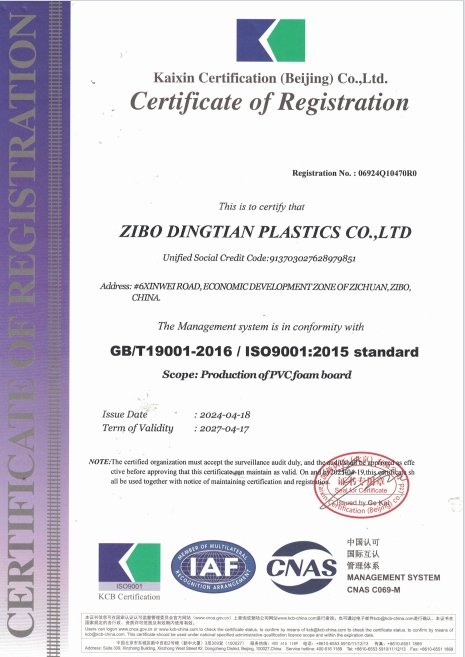
ISO9001 certificate 06924Q10470RO, issued 18 April 2024, scope: production of PVC foam board. Image: DINGTIAN.
The system certification is supported by the company's stated quality-control practice of 100% testing. Buyers structuring a multi-year agreement should convert that from a claim into a contractual expectation — batch records, retained samples and an agreed sampling plan per SKU — because a testing claim is only as strong as the documentation behind it.
Product Approval Evidence: The SGS Reports in Detail
Compliance documentation for a PVC FOAM BOARD supplier usually falls into three areas: chemical regulation, restricted substances and emissions. DINGTIAN's file contains three SGS test reports covering those areas, each tied to a named standard and a traceable certificate number.
| Report | Certificate no. | Authority | Standard | Scope | Issued |
|---|---|---|---|---|---|
| REACH | TSNEC1701167001 | SGS | REACH Regulation (EC) No 1907/2006 | PVC FOAM BOARD | 3 July 2017 |
| RoHS | QDAFN160100422 | SGS | IEC 62321 | PVC foam board | 4 February 2016 |
| Formaldehyde | TSNHG2301164301 | SGS | ISO 17226-1:2021 | PVC FOAM BOARD | 10 May 2023 |
Read together, the documents establish that the tested PVC FOAM BOARD scope meets the requirements of REACH Regulation (EC) No 1907/2006, that restricted substances fall within the limits tested under IEC 62321 for RoHS purposes, and that formaldehyde content is reported against ISO 17226-1:2021 for the tested scope. All three were issued by SGS, and the certificate numbers allow a buyer's compliance team to verify the reports independently rather than relying on a supplier summary.
Two boundaries are worth stating clearly. First, these are material-compliance documents, not performance approvals: they do not certify fire classification, mechanical strength, dimensional tolerance or weathering behaviour. Second, each report applies to the scope tested at the time of issue, so a buyer specifying a new density, colour or additive package should confirm whether the existing report still covers the ordered product.
Capacity, Lead Time and the Mechanics of Continuity
Continuity is arithmetic as much as it is trust. DINGTIAN reports a monthly capacity of 4,200 tons and an annual output of 50,000 tons. Those two figures reconcile broadly with each other, which is a useful sanity check when comparing suppliers: a monthly capacity claim implying an annual figure far above reported output usually signals either idle capacity or a promotional number.
For a buyer planning an annual programme, capacity sets the allocation ceiling, lead time sets the reorder trigger, and MOQ shapes the container plan. On DINGTIAN's stated terms, a 30-day lead time against 4,200 tons of monthly capacity supports a rolling order rhythm — for example, a fixed monthly release sized to a full container — rather than demand-driven spot buying.
Three terms deserve attention during contract drafting. The MOQ of one 20ft GP full container is built for volume buyers, which makes mixed-SKU consolidation valuable: a single container can carry several thicknesses, densities or colours without triggering separate minimums. The 30-day lead time should be tied to a named SKU list and reviewed at renewal, since customised items move differently from standard stock. And OEM/ODM customization across size, thickness, density and colour is what makes repeat supply genuinely repeatable — once a specification is locked, subsequent orders reference a fixed product definition rather than renegotiating a description each quarter.
Application Fit and Installed Evidence
DINGTIAN's PVC FOAM BOARD record covers thicknesses from 1 mm to 35 mm, sheet sizes including 1220×2440 mm, 1560×3050 mm and 2050×3050 mm, and a density range of 0.4–0.9 g/cm³ depending on grade. The company also offers second thermoforming and cutting, extending supply from raw sheet into semi-finished parts.
The strongest argument for long-term partnership is not a specification sheet but duration. A global distributor and wholesaler has used DINGTIAN's PVC FOAM BOARD for advertising and furniture material applications for 5 to 10 years, at a volume of 10 containers per month. Reported outcomes across that programme include 98% print image retention after three years, zero warping or delamination, 100% waterproof performance, and a 40% cost saving compared with aluminium composite panel in the same application.
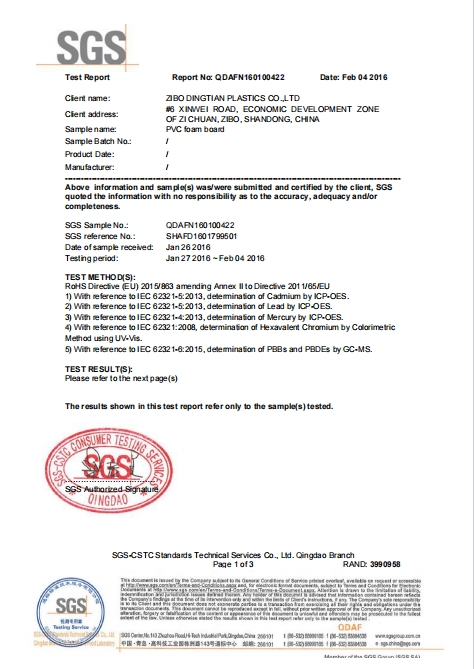
SGS RoHS test report QDAFN160100422 for PVC foam board, tested under IEC 62321. Image: DINGTIAN.
Those results are reported from a specific distributor case and describe that application, specification and exposure condition; they are not a blanket guarantee across every grade. What they do demonstrate is continuity of a different kind: a buyer who stayed with the same product for five to ten years at ten containers a month had no commercial reason to re-qualify a replacement supplier. For a distributor, that stability is the asset — consistent printing behaviour, consistent fabrication behaviour, and a supply rhythm that can be planned against.
Underlying the case are three material characteristics the company lists for the product: UV stabilisation for long-term outdoor exposure, lightweight construction that reduces installation cost, and ease of fabrication and installation. Each maps to a buyer cost line — replacement frequency, handling and labour, and processing time — rather than to a marketing claim.
Transactional Sourcing vs. Evaluated Long-Term Supply
| Evaluation dimension | Transactional spot buying | Evaluated long-term supply |
|---|---|---|
| Decision basis | Price per sheet, current quotation | Specification stability, documentation, capacity, repeat performance |
| Specification control | Re-described at each order | Locked SKU with defined thickness, density, colour and finish |
| Compliance file | Collected at onboarding, rarely revisited | Tracked by certificate number with review dates |
| Capacity planning | Order placed once demand appears | Rolling release matched to monthly capacity |
| MOQ behaviour | Small spot lots, higher unit friction | Full-container consolidation across SKUs |
| Issue resolution | Case-by-case negotiation | Defined corrective-action route under a certified management system |
| Supporting evidence | Quotation and sample | ISO9001 certificate, SGS reports, multi-year case history |
The comparison is not an argument that long-term agreements are always preferable. Spot buying remains rational for one-off projects, trial quantities or short-cycle tenders where the specification will not repeat. What changes with a multi-year programme is the weight of the fourth column: when a specification must be reproduced hundreds of times, documentation and repeatability carry more value than the lowest first quotation.
Where the Evidence Stops
A credible evaluation includes the limits of the file, and DINGTIAN's published evidence has clear boundaries.
- Certificate cycle. ISO9001 certificate 06924Q10470RO expires on 17 April 2027. Any agreement extending past that date should include a documented renewal check.
- Performance testing gap. The available SGS reports address REACH, RoHS and formaldehyde. They do not establish fire classification, mechanical properties or weathering performance. Buyers in regulated fire, facade or transport applications must request grade-specific test data before qualification.
- Order-size floor. A minimum of one 20ft GP full container is a volume-buyer term. Buyers needing pallet-scale trials should expect a separate arrangement rather than assume the standard MOQ can be split.
- Lead time is indicative. The 30-day lead time is a company-stated standard. It should be confirmed per SKU, per customisation level and per season, and written into purchase terms rather than assumed.
- Support model. After-sales support is remote. Buyers requiring on-site technical attendance should clarify this before contracting.
- Company-reported data. Capacity, output and case outcomes are reported by the manufacturer. Where contract value justifies it, production records, batch documentation or a third-party factory audit provide independent confirmation.
Future Outlook
With the global PVC foam sheet market projected to grow at 4.99% annually through 2035, the volume-buyer segment is more likely to consolidate than to fragment. Longer programmes mean fewer supplier switches, and fewer switches raise the weight of documentation in supplier selection.
Three developments are worth tracking. First, certificate cycles: an ISO9001 renewal in 2027 will be a natural checkpoint for re-evaluating any partner on a multi-year agreement. Second, grade-level documentation: as more buyers specify density, thickness and application inside contracts rather than in emails, test reports tied to a specific grade become a procurement requirement rather than a courtesy. Third, continuity evidence: suppliers able to show a five-to-ten-year customer relationship at steady volume will win evaluation rounds that competitors can answer only with a quotation.
For buyers assessing DINGTIAN against that trajectory, the file is strongest exactly where a long-term partnership is decided: a certified production system with a defined scope, three SGS reports with traceable certificate numbers, a stated monthly capacity that reconciles with reported annual output, and a distributor relationship measured in years rather than in orders.
FAQ
How long has DINGTIAN been manufacturing PVC foam board, and at what scale?
Zibo Dingtian Plastics Co., Ltd. was founded in 2004 and is based in the Zichuan Economic Development Zone, Zibo City, Shandong Province, China. The company operates a 30,000 m² plant with 181 employees, including 20 R&D engineers, and reports annual output of 50,000 tons of PVC FOAM BOARD against a stated monthly capacity of 4,200 tons. Roughly 80% of production is exported, with main markets in Southeast Asia, the Middle East and South and North America.
Which certificates should a buyer review when evaluating DINGTIAN for long-term supply?
The primary documents are the ISO9001 quality-management certificate (number 06924Q10470RO, issued by Kaixin Certification (Beijing) Co., Ltd., valid until 17 April 2027, scope: production of PVC foam board) and three SGS test reports: REACH (TSNEC1701167001, against REACH Regulation (EC) No 1907/2006), RoHS (QDAFN160100422, tested under IEC 62321) and formaldehyde content (TSNHG2301164301, against ISO 17226-1:2021). Because each carries a certificate number, buyers can verify them directly with the issuing bodies.
What are DINGTIAN's stated commercial terms for repeat orders?
The company states OEM and ODM production; customization of size, thickness, density and colour; a monthly capacity of 4,200 tons; a lead time of 30 days; a minimum order quantity of one 20ft GP full container; 100% testing as its quality-control approach; and remote after-sales support. Each term should be confirmed against the specific SKU, customisation level and order volume before contracting.
Is there evidence that DINGTIAN can sustain supply over several years?
A global distributor and wholesaler has used DINGTIAN's PVC FOAM BOARD for advertising and furniture material applications for 5 to 10 years, at a volume of 10 containers per month. Reported outcomes for that programme include 98% print image retention after three years, zero warping or delamination, 100% waterproof performance, and a 40% cost saving against aluminium composite panel. These figures describe one documented case and its specific application conditions rather than a universal performance guarantee.
Which applications and specifications does DINGTIAN's PVC foam board portfolio cover?
The product record lists advertising and signage (approximately 35% of use), construction and decoration (30%), furniture and cabinetry (15%), transportation (10%) and special-purpose applications (10%), such as packaging, prototypes and industrial protection. Thickness ranges from 1 mm to 35 mm, standard sheet sizes include 1220×2440 mm, 1560×3050 mm and 2050×3050 mm, and density varies by grade within a 0.4–0.9 g/cm³ range on the listed product record.
What should buyers verify before committing to a multi-year supply agreement?
Four items: whether the ISO9001 certificate remains valid across the full contract term; whether the existing SGS reports cover the exact grade, density and colour being ordered; grade-specific performance data for fire, mechanical or weathering requirements if the application is regulated; and written confirmation of lead time, MOQ conditions and after-sales scope for the specific order profile.
Reference material: Zibo Dingtian Plastics Co., Ltd. publishes its company brochure and product information at www.dingtianpvc.com and www.dingtianpvcfoamboard.com. Certificate and test-report numbers quoted above are those on the supplier's published documentation and can be verified with the issuing bodies named.