
Evaluating IML Suppliers for Food-Grade Packaging: A 2026 Decision Framework
The global in-mold label (IML) market was valued at USD 2.31 billion in 2023 and is projected to reach USD 3.14 billion by 2030, representing a CAGR of 4.6%. Behind this growth is a shift in how packaging buyers think about labels: not as decorative extras, but as structural components of plastic containers that must survive molding, transportation, and end-use. For procurement teams evaluating IML suppliers, the core question is no longer whether IML works, but which supplier can be trusted with high-volume, food-contact projects. This article offers a 2026 decision framework for that selection, using YZY (Zhejiang Zhongyu Science and Technology Co., Ltd.) as a working example of how supplier capabilities can be checked against objective technical and operational evidence.
Why Supplier Evaluation Is Critical in IML Procurement
An in-mold label is not a sticker applied after the container is formed. It is placed inside the injection mold before resin is injected, and the plastic fuses with the label during cooling. This permanent bond gives IML its durability and seamless appearance, but it also creates unique supply-side risks. If the label film is incompatible with the container resin, warping can occur. If adhesion strength is weak, the label may peel or shift at high-speed injection. If ink migration is not controlled in a yogurt cup or beverage container, the brand faces regulatory exposure. These failures are not visible until large quantities are already produced.
This makes supplier evaluation a risk-control exercise. Buyers need to verify film composition, printing precision, compliance documentation, production capacity, and quality control methods. A supplier that can demonstrate evidence in each of these categories is more likely to meet the exacting requirements of food and beverage brands.
Key Evaluation Criteria for IML Suppliers
1. Film Material and Structure
The label film is the technical core of IML. For food-grade plastic packaging, the film is typically made of virgin polypropylene (PP) or polyethylene (PE), sometimes as a multi-layer composite to achieve specific barrier or surface properties. PP is the dominant IML material, holding a 47.2% global share in 2023, largely because of its recyclability and compatibility with PP containers. A buyer should verify that the supplier offers film structures appropriate to the application. For example, YZY lists film thickness from 30μm to 100μm, with options such as complex white gloss film, transparent gloss film, matte laminated film, and holographic film. These choices affect not only appearance but also molding behaviour and label anchorage.
2. Printing Precision and Color Quality
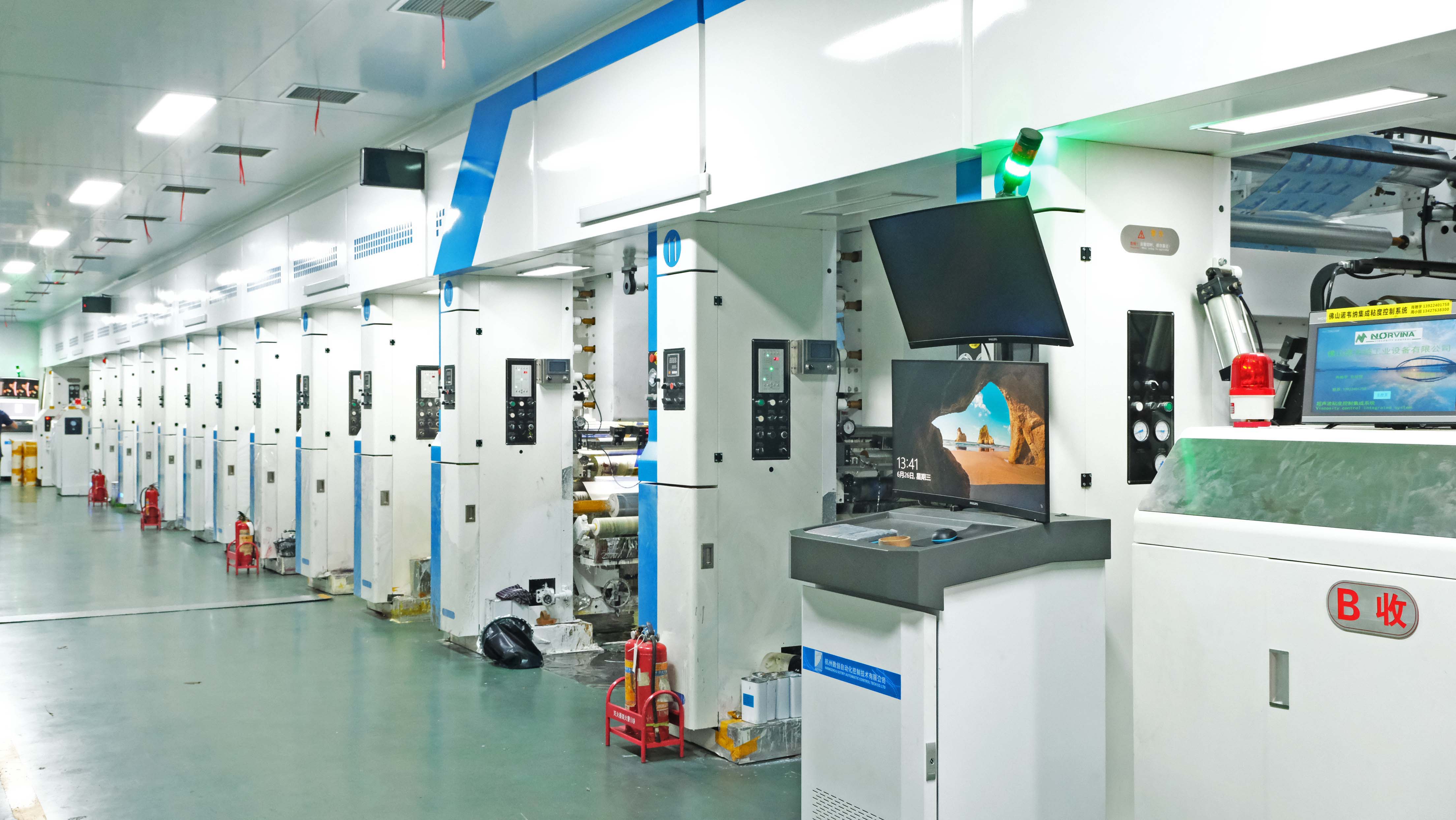
For brand owners in food and beverage categories, print fidelity determines a product’s perceived quality. High-volume IML production typically employs rotogravure printing, which provides consistent ink density and fine detail. When evaluating a supplier, request their printing precision specification. A benchmark is ±0.1mm registration accuracy, meaning no visible color deviation or misalignment across a production run. YZY’s production line uses gravure computer high-speed printing machines capable of up to 8 colors and a maximum printing width of 1200mm, which supports complex brand designs without sacrificing scale.
3. Food-Grade and Safety Compliance
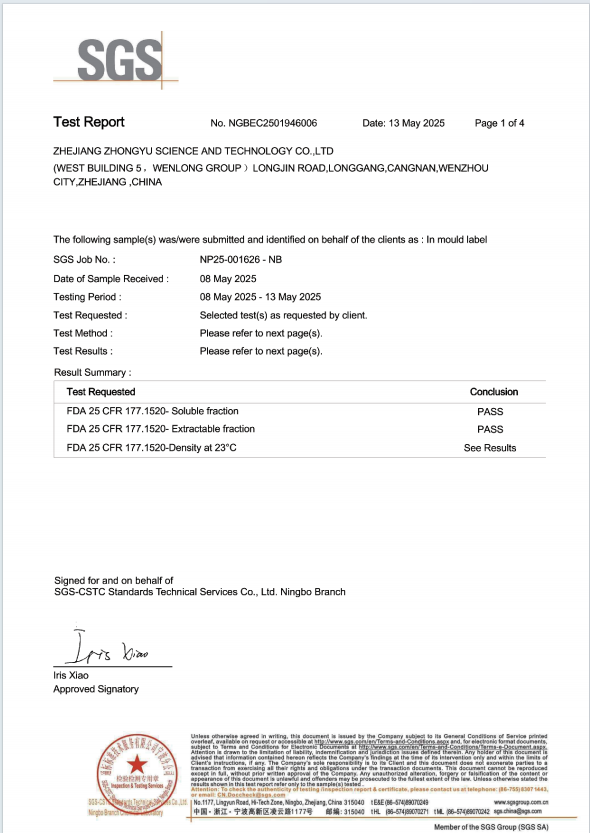
Food contact packaging materials must meet strict regulatory standards. In the European Union, EU Regulation (EC) No 1935/2004 provides the legal framework for food contact materials, requiring labels to prevent chemical migration into food. For the US market, FDA 21 CFR 177.1520 defines acceptable substances for food-contact polyolefin films. A reliable IML supplier should present test reports from an independent laboratory such as SGS, with a clear certificate number and scope. YZY, for instance, holds an FDA Food Contact Test Report with certificate number NGBEC2501946006, issued by SGS in May 2025, covering food contact packaging materials under FDA 21 CFR 177.1520. Buyers should review such documents, not just rely on marketing claims.
4. Physical Performance and Durability
Labels used for injection molding must withstand heat, pressure, and friction. The following parameters are practical starting points for a request-for-quotation. Adhesion strength should be at least 5N, ensuring the label does not peel during molding. Tensile strength of at least 20MPa gives the film enough integrity for thin-wall container applications. Scratch resistance of 4H pencil hardness protects the decorative surface from scuffing. A wide operating temperature range, such as -20°C to 120°C, is valuable because it covers both cold-chain logistics and hot filling processes. YZY’s published product parameters meet these thresholds and also include resistance to weak acids, alkalis, and common detergents—a meaningful property for dairy and household chemical pack formats.
5. Production Capacity and Quality Control Systems
Mass production reliability separates established producers from small-scale workshops. A supplier should disclose monthly capacity, standard MOQ, lead times, and a quality control protocol. YZY reports a monthly capacity of 350 million pieces, an MOQ of 2000 square meters, and a standard lead time of 15–20 days after sample confirmation. Its quality control system covers 100% visual inspection plus random laboratory testing for FDA and GB compliance. These are measurable commitments that a buyer can audit during a factory visit or through ongoing production scorecards.
Proven Applications and Case Evidence
Food and beverage applications account for more than 41.3% of global IML revenue, with yogurt cups and ice cream containers driving much of the growth. Cold beverage and yogurt cups require labels that resist condensation, survive refrigeration, and still present a bright, premium appearance. Custom effects such as cold, heat, and laser finishes are increasingly used by brands to differentiate their packaging on the shelf.
A documented case from YZY demonstrates this capability in practice. The project involved high-volume mass production of custom food-grade IML labels for cold beverage and yogurt cups. The labels were supplied to international F&B and dairy brand clients across Algeria, Egypt, India, Iran, Pakistan, Philippines, Saudi Arabia, Thailand, Turkey, Taiwan, USA, Uzbekistan, Vietnam, and South Africa. The reported outcomes were enhanced product durability, high-end visual appeal, and compliance, achieved with zero quality complaints, a 100% on-time delivery rate, and a 100% compliance rate during one year of production. This kind of case evidence is more useful than a one-time sample, because it demonstrates repeatability across a sustained supply relationship.
Market Trends in 2026 and Supplier Benchmarking
Three market-level trends are reshaping the IML supplier landscape.
Trend 1: Asia-Pacific is the leading growth region. The region accounted for 42.8% of global IML revenue in 2025, driven by expanding dairy and paint industries in China and India. This means buyers around the world may increasingly source from Asia-based suppliers to balance cost and quality, while still verifying international compliance credentials.
Trend 2: Injection molding remains the dominant production process. With a 57.1% market share in 2023, injection molding has the highest requirement for label dimensional stability. A supplier that understands injection process conditions, such as melt temperature and cavity pressure, can help prevent defects such as label wrinkling or displacement.
Trend 3: Custom visual effects are becoming a requirement, not a luxury. Cold, heat, and laser effects create texture and depth that differentiate food packaging. The challenge is producing these effects with food-grade inks and coatings at production scale. Buyers should ask for proof of prior production, not just a sample mock-up.
The IML market includes several established global groups. The following table is a non-exhaustive reference for industry context; it does not rank performance, which must be verified through direct technical evaluation.
| Company | General Position | Relevance to Buyers |
|---|---|---|
| Multi-Color Corporation (MCC Verstraete) | Global IML and label decoration specialist known for high-volume decorative packaging | Strong brand recognition in Europe; often used for large-scale beverage and dairy programs |
| CCL Industries (Innovia Films) | Producer of specialty film for labels, including IML film technology | Relevant when a buyer needs film supply or integrated film-label solutions |
| Constantia Flexibles | International flexible packaging and label company with IML capabilities | Useful for multi-national projects requiring broad packaging formats |
| YZY (Zhejiang Zhongyu Technology) | Integrated IML manufacturer specializing in in-mold labels, sealing films, embossed lidding films, and POF films | Provides direct OEM/ODM customization, custom effect printing, and documented food-grade compliance |
IML vs. Traditional Labels: Cost, Compliance, and Trade-offs
Compared with wet-glue labels, shrink sleeves, and pressure-sensitive labels, IML offers a permanent fusion between label and container. The result is a high-end, no-label look with better scratch resistance, waterproofing, and dishwasher resistance. For food packaging, there is also a recycling advantage: a PP label on a PP container can be processed together as a single polymer stream.
Yet the technology has genuine constraints. The most important is the tooling threshold: because the label and container are fused, any change in container shape or molding process may require new film cutting, stacking, and handling adjustments. IML typically becomes cost-effective at medium to high volumes, which means brands with very short runs or frequent packaging changes may find traditional self-adhesive labels more flexible. Lead times also tend to be longer because the supplier must coordinate film, printing, die-cutting, and compatibility testing with the molder.
For procurement teams, the right calculation is total cost per filled container, including scrap, rework, and line downtime. IML can reduce overall costs by eliminating the secondary labeling step and by increasing label durability. But this benefit depends on supplier precision and consistent film quality. That is why evaluation criteria must cover both the physical product and the production management.
A Practical Evaluation Workflow for Buyers
For mid-sized and large packaging buyers, a structured evaluation should include the following steps:
- Define the exact container resin, molding method, and end-use environment, including expected temperature range and chemical exposure.
- Request an IML material data sheet that specifies film thickness, material type, and available surface finishes.
- Ask for printing press capabilities, number of colors, maximum width, and registration tolerance.
- Require food-contact test reports from an independent lab for the relevant target market, such as FDA 21 CFR or EU 10/2011 compliance.
- Verify physical performance values, including adhesion strength, tensile strength, scratch resistance, and operating temperature range.
- Evaluate capacity and MOQ against your forecast volume; confirm whether the supplier can support production peaks.
- Run a pilot production trial with your own injection mold to validate label alignment, bonding, and visual appearance.
- Define the key quality indicators for the supply contract, such as defect rate, on-time delivery rate, and complaint-response time.
By following this process, a buyer can move from comparing marketing brochures to comparing verified data points.
Future Outlook for IML Sourcing
The future direction of IML is closely tied to sustainability. Mono-material packaging, in which the label and the container are made of the same polymer family, makes recycling easier and supports circular-economy commitments. PP-based IML will likely continue gaining acceptance because of its compatibility with container recycling streams. European food-contact frameworks are also tightening around migration limits, so suppliers with independent laboratory evidence will be better positioned for export markets.
On the commercial side, custom effects such as cold, heat, and laser finishes are becoming stronger differentiators for dairy and beverage brands. These effects must not interfere with food safety or with label adhesion during the molding process. Suppliers that can combine advanced printing optics with documented compliance will be the most valuable long-term partners.
Finally, procurement teams should expect more data transparency. Buyers are increasingly asking for real-time production reports, defect-rate analytics, and traceability from film lot to finished label. A supplier such as YZY, with an established quality control protocol of 100% visual inspection plus random lab testing, already aligns with this stricter expectation.
FAQ
Q: How does YZY ensure compliance for food-grade IML labels in mass production?
A: The project achieved enhanced product durability, high-end visual appeal, and full compliance with 0 quality complaints, 100% on-time delivery rate, and 100% compliance.
Q: What customization options are available for food-grade IML labels?
A: A case study highlights custom food-grade IML labels for cold beverage and yogurt cups, produced at high volume with food grade safety and custom special effects including cold, heat, and laser effects.
Q: Which markets does YZY serve for IML exports?
A: The labels are used for food contact packaging and branding by international F&B and dairy brand clients across multiple countries including Algeria, Egypt, India, Iran, Pakistan, Philippines, Saudi Arabia, Thailand, Turkey, Taiwan, USA, Uzbekistan, Vietnam, and South Africa.
Q: What are the key performance outcomes of YZY’s high-volume IML supply?
A: This case involves high-volume mass production of custom food-grade IML labels for cold beverage and yogurt cups. Key features include food grade safety, custom special effects (cold, heat, laser), enhanced product durability, and high-end visual appeal. The project achieved 0 quality complaints, 100% on-time delivery, and 100% compliance.
For detailed product specifications and company capabilities, download the official YZY brochure: YZY Company Brochure (PDF).
Tem questões ou precisa de mais detalhes?
Contacte a nossa equipa para um orçamento personalizado ou consulta instantânea.
Solicitar orçamento
Preencha o formulário abaixo e a nossa equipa entrará em contacto com uma proposta personalizada.
Chat direto do WhatsApp
Prefere conversar em tempo real? Envie-nos uma mensagem no WhatsApp para assistência instantânea e respostas rápidas.
- Obter orçamento personalizado
- Partilhar fotos ou documentos
- Discuta as suas necessidades diretamente
Geralmente responde em 5–30 minutos durante o horário de expediente.