
Evaluating Lab Furniture Suppliers for Long-Term Continuity
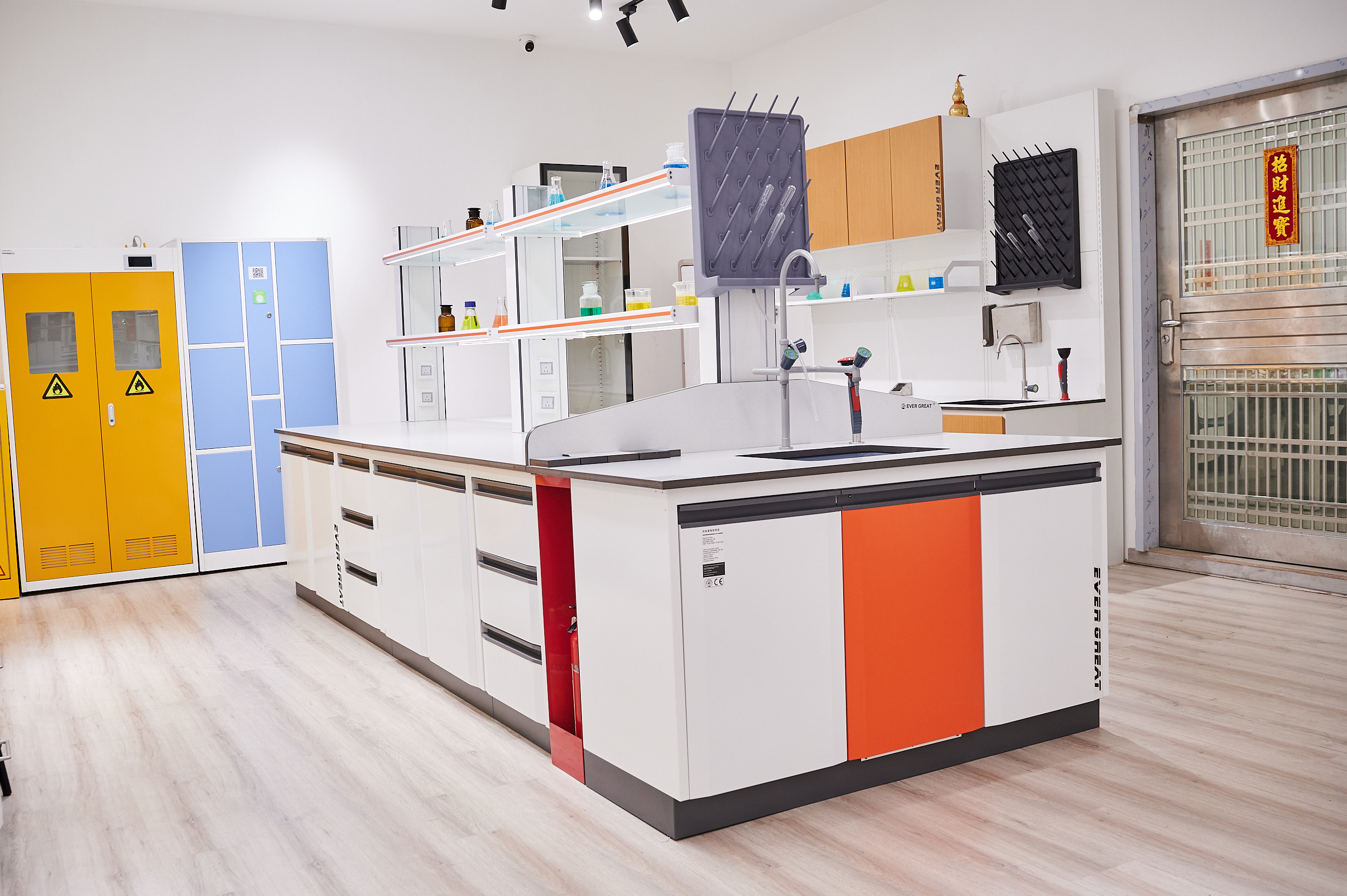
A laboratory furniture line-up combining workbenches and storage cabinets. Continuity evaluation asks whether the same dimensional families, materials and documentation remain available years after the first delivery.
A laboratory is normally designed for a fifteen- to twenty-year service life, but its furniture is purchased inside a single procurement window. That mismatch defines the central risk in laboratory furniture sourcing: the first delivery is rarely the problem. The problem is the second order — the flammable safety cabinet added to a new wing in year five, the phenolic worktop sized to match an existing island bench, the spare perforated shelf for a glassware drying cabinet, or the fume hood model that must still exist when a laboratory expands.
This article sets out a long-term supplier evaluation framework for laboratory furniture, covering flammable safety cabinets, glassware drying and storage cabinets, vented chemical and reagent cabinets, PP acid and alkali storage cabinets, gas cylinder safety cabinets, polypropylene and narrow-frame fume hoods, exhaust washing benches, C-frame wall benches, island benches, and laboratory safety and emergency hubs. It is written for buyers at the evaluation and execution stages — the point at which a shortlist has formed and the decisive question shifts from “which product” to “which supplier can be relied on across the whole ownership period.”
What Long-Term Supplier Continuity Actually Means
Supplier continuity in the laboratory furniture context is the ability of a single manufacturer to keep a safety-critical product line available, dimensionally stable and documented across the full life of a facility. It is not a marketing attribute; it decomposes into five components, each of which can be tested with a document request rather than a factory visit.
- Product-line persistence — the model families in the original order are still in production when a later phase is planned.
- Specification stability — dimensions, steel thickness, worktop thickness and material grades remain consistent between orders.
- Certification validity and scope — certificates name the exact models being purchased and remain inside their validity period.
- Spare-part and consumable availability — shelves, drip trays, sashes, filters and hardware can be re-ordered independently of a full unit.
- Service capability beyond warranty — technical assistance, calibration guidance and engineering support survive the warranty term.
The practical test for each component is the same: ask the supplier to produce a document, not a statement. A certificate with a model number in its scope, a dimensioned drawing set, a pre-shipment test record, and a written spare-parts list are all falsifiable. General assurances of long-term support are not.
The Problem: Safety-Critical Lines Are Not Modular Commodities
Laboratory furniture looks standardized from a distance, but most of it is dimensionally and chemically coupled to the building and to the process inside it. A vented chemical and reagent cabinet with a Dia. 110/150 mm exhaust connection has to meet a duct drop that already exists. An island bench offered at 3000/3600 × 1500 × 850 mm with 12.7 mm phenolic, 20 mm ceramic or epoxy worktop options occupies a fixed footprint with fixed service positions. A polypropylene fume hood at 1200/1500/1800 × 850 × 2350 mm with a face velocity band of 0.3–0.6 m/s and a three-stage baffle is not interchangeable with a steel-frame hood on the same exhaust system without re-commissioning.
That coupling is why phased procurement is the norm rather than the exception. Delivered laboratory furniture projects in the supplier records reviewed for this article include 105 units for a metallurgical and smelting laboratory project in the Philippines, 255 units for a university and educational research facility in India, 200 units for a clinical diagnostics and healthcare laboratory in China, 45 units for a food safety and QA/QC laboratory in Australia, and 30 units for a healthcare laboratory in Tanzania. Orders of that scale are typically staged, and every later stage inherits the dimensional decisions of the first.
The opportunity is straightforward: buyers who evaluate continuity at the shortlist stage avoid re-validating containment, chemical resistance and dimensional fit on every subsequent purchase. Buyers who evaluate only unit price discover the cost of discontinuity later, when a mismatched cabinet forces a duct modification or a worktop substitution forces a re-review of chemical resistance.
A Seven-Check Evaluation Framework
| Check | Question to ask | Evidence to request | Warning sign |
|---|---|---|---|
| 1. Line persistence | Are the specific model families still in production? | Current product list with model codes and dimensions | Model codes change without a cross-reference table |
| 2. Specification stability | Will the same steel and worktop thickness ship next year? | Dimensioned drawings and material grade sheets | Thickness described only as “heavy duty” |
| 3. Certification scope | Does the certificate name the model I am buying? | Certificate number, scope, issuing body, validity dates | Certificates shown for a different model family |
| 4. Manufacturing continuity | Is production in-house, and at what capacity? | Facility size, production mode, monthly capacity, lead time | No stated capacity or outsourcing disclosure |
| 5. Spare parts | Can shelves, trays, sashes and hardware be re-ordered alone? | Written spare-parts and consumables list | Only complete units offered as replacements |
| 6. Transit and installation | How are alignment and damage risks controlled? | Packing specification, pre-assembly record, installation guide | No pre-shipment fit check described |
| 7. Terms and acceptance | What are the payment, delivery and acceptance rules? | Written MOQ, delivery terms, acceptance criteria, payment terms | Acceptance undefined until after delivery |
Continuity Check One: Can the Same Safety Cabinet Be Reordered in Five Years?
Safety storage cabinets are the least substitutable items in a laboratory furniture package, because their internal geometry — sump volume, air barrier thickness, shelf configuration and exhaust port diameter — is tied to the hazard they contain. A steel cabinet cannot replace a metal-free PP cabinet in acid service, and a cabinet with a different vent position cannot reuse an existing duct drop without modification.
| Product line | Model | Verified specification | Continuity implication |
|---|---|---|---|
| Flammable safety cabinet | EG-SF-LB005 | 1090 × 460 × 1650 mm; 45 gallon nominal capacity; 1.2 mm double-wall steel; 38 mm air barrier; 51 mm sump; dual flash-arrested vents | Replacement must match height, vent position and sump volume so spill retention and ducting are unchanged |
| Vented chemical and reagent cabinet | EG-S0-LB001 | 900 × 500 × 1800 mm; double-wall steel; four adjustable shelves; Dia. 110/150 mm exhaust connection | Exhaust connection diameter and shelf adjustability must remain identical for retrofits |
| PP acid and alkali storage cabinet | EG-PP-CB003 | 900 × 450 × 1800 mm; 8.0 mm PP sheet; three adjustable spill-containment shelves; bottom sump; Dia. 110 mm exhaust port | Metal-free construction is a functional requirement, not a preference; a steel substitute breaks the specification |
| Glassware drying and storage cabinet | EG-SS-LB002 | 900 × 500 × 1800 mm; 1.0 mm 304 stainless steel; four perforated shelves; pull-out drip tray; 5 mm tempered-glass doors | Draining performance depends on perforated shelves and the drip tray remaining available as separate parts |
| Gas cylinder safety cabinet | EG-S0-CB005 | 900 × 450 × 2000 mm; 1.0 mm cold-rolled steel; single-, double- and triple-cylinder options; alarm/exhaust linkage configuration; purging system | Cylinder capacity options and alarm/exhaust linkage must stay configurable as laboratory gas demand changes |
Two questions separate a durable cabinet supplier from a one-off vendor. First, are these cabinets part of a stable dimensional family, or are they customized per order to the point that no two units match? Second, are the internal components — adjustable shelves, spill-containment shelves, drip trays, sumps — listed as separate line items that can be purchased years later? A supplier that answers both with documents is materially lower risk than one that answers with reassurance.
For gas cylinder cabinets specifically, the retention design deserves its own line in the comparison sheet. A cabinet offered in single-, double- and triple-cylinder configurations must scale its cylinder retention and anti-tip provisions with the configuration ordered. Buyers should ask how cylinders are fixed inside the cabinet, how the assembly resists tipping under load shift, and how the purging cycle and alarm/exhaust linkage are verified before the unit is accepted.
Continuity Check Two: Fume Hoods, PP Versus Narrow-Frame, Ducted Versus Ductless
Fume hood continuity has two layers. The first is hardware continuity: will the same hood model, frame geometry and exhaust canopy be available for the next laboratory phase? The second is performance continuity: will the containment result be reproducible in the buyer’s building, not only on a test rig?
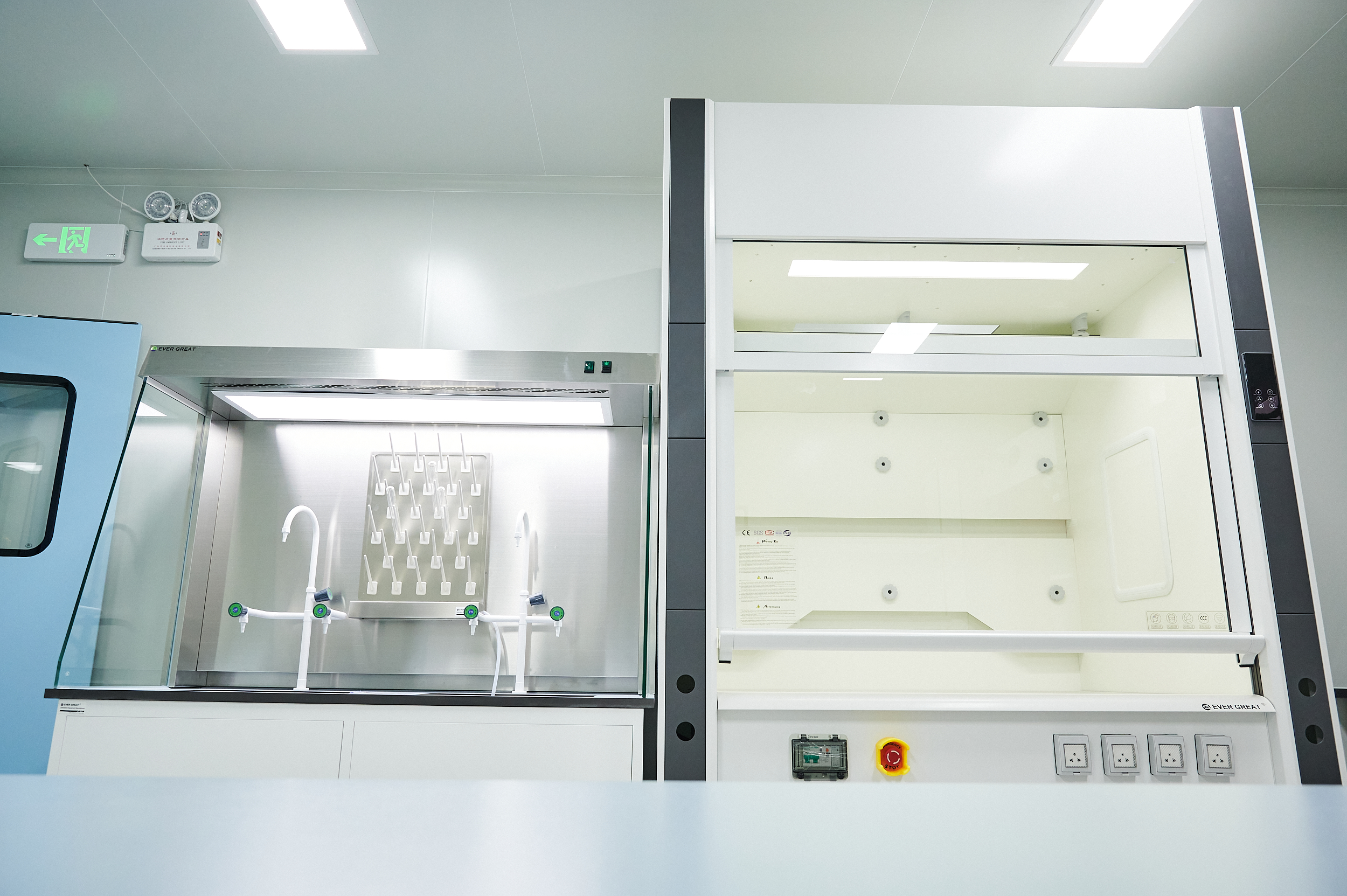
Fume hood interior. Baffle staging, sash geometry and exhaust canopy diameter determine whether a later unit can be substituted without re-commissioning the exhaust system.
| Product line | Model | Verified specification | Continuity implication |
|---|---|---|---|
| Polypropylene fume hood | EG-PP-FH | 1200/1500/1800 × 850 × 2350 mm; PP sheet thickness ≥8.0 mm; face velocity 0.3–0.6 m/s; three-stage baffle; seamless welded PP | PP sheet thickness and weld method define acid resistance; substituting a thinner sheet changes the service life |
| Narrow-frame fume hood | Orion-TS-1500 / Orion-TS-1800 / Orion-LD-1500 / Orion-LD-1800 | 1500/1800 × 900 × 2400 mm; internal width 1408/1708 mm; nominal face velocity 0.3 m/s; PP exhaust canopy Dia. 250/315 mm; aluminum alloy frame | Internal width and canopy diameter must match the original duct design for a benchtop or walk-in replacement |
The ducted versus ductless decision, restated as a continuity question
The choice between a ducted and a ductless fume hood is usually presented as a first-purchase decision, but it is equally a continuity decision, because it determines which hood type must remain available for the life of the facility. The selection logic rests on the chemical hazard profile, the building exhaust infrastructure and the required flexibility.
- Ducted fume hoods are recommended for heavy chemical applications, heating reactions with acid digestions, volatile toxic gases and high-throughput research. They exhaust 100% of fumes outdoors, place no limitation on chemical type, and carry lower long-term filter replacement costs.
- Ductless (filtered) fume hoods are recommended for light-to-moderate chemical handling, educational laboratories, or leased spaces without external ductwork. They use HEPA/activated carbon filtration to recirculate cleaned air, reducing HVAC energy costs and installation complexity.
Four steps make the decision auditable: audit the chemical inventory including boiling points and evaporation rates to confirm whether carbon filters can safely capture the substances in use; verify ceiling clearance, duct route feasibility and whether the makeup air system can support continuous face velocity of 0.3–0.5 m/s (60–100 FPM); set the standard working sash height (typically 400–500 mm) and calibrate the face velocity monitor and low-flow alarm; then perform a smoke containment check and a face velocity grid test across the sash opening before routine use.
Perchloric acid and radioisotopes should never be handled in standard ducted or ductless fume hoods without specialized washdown systems. Ductless carbon filters must be replaced immediately upon chemical breakthrough detection, fan belts and exhaust dampers on rooftop blowers need regular inspection, and excess chemical bottles should not be stored inside the hood workspace because they disrupt airflow.
Continuity Check Three: Benches, Worktops and the Exhaust Washing Bench
Workbenches carry a different continuity risk from cabinets: the steel frame is highly repeatable, but the worktop is where chemistry, heat and mechanical abuse converge. If the worktop material or thickness is unavailable at the next phase, the bench may still physically fit while failing the original chemical-resistance specification.
| Product line | Model | Verified specification | Continuity implication |
|---|---|---|---|
| C-frame wall laboratory bench | EG-S0-LB003 | 1200/1500/1800 × 750 × 850 mm; 40 × 60 × 1.8 mm steel tube; 12.7 mm phenolic worktop | Tube section and worktop thickness must remain fixed so wall runs can be extended without re-drilling or shimming |
| Island laboratory bench | EG-S0-CB005 | 3000/3600 × 1500 × 850 mm; 1.0–1.2 mm steel; 12.7 mm phenolic, 20 mm ceramic or epoxy worktop options; 220V/10A sockets | Worktop option must stay available across the full 3000/3600 mm length, or the island cannot be matched later |
| Exhaust washing bench | EG-SS-LG002 | 1500 × 750 × 1500 mm; 25 mm ceramic worktop; two PP sinks; two three-way gooseneck faucets; 304 stainless steel construction | The 304 stainless steel body, PP sinks, ceramic worktop and faucet set form a matched assembly; partial substitution breaks the corrosion chain |
The exhaust washing bench illustrates why matched assemblies matter. Its 304 stainless steel structure, 25 mm ceramic worktop, two PP sinks and two three-way gooseneck faucets are specified as a set. Replacing any element later — a different sink polymer, a thinner worktop, a single-outlet faucet — changes both the chemical resistance and the plumbing geometry of a wet, corrosive workstation.
Epoxy or phenolic worktops: a decision with a continuity dimension
| Material | Best fit | Why | Continuity note |
|---|---|---|---|
| Epoxy resin | Heavy chemical synthesis, university research, high-heat environments | Monolithic, non-porous; superior resistance to harsh corrosives such as concentrated acids; high thermal shock resistance up to 600 °C | Confirm availability of the required slab length for long island benches |
| Phenolic resin | Biology, pharmaceutical QC, physical testing and general chemistry laboratories | Superior scratch and impact resistance, standard chemical durability, strong cost efficiency | 12.7 mm thickness is shared across the C-frame wall bench and island bench lines, which simplifies matching later |
| Ceramic | High-temperature and heavy chemical exposure bench surfaces | Offered at 20 mm on island benches and 25 mm on the exhaust washing bench | Cutout geometry for sinks and fixtures must be reproducible for replacement pieces |
Material selection should follow a direct sequence: assess chemical and thermal hazards (including substances such as HF and H₂SO₄ and maximum operating temperatures); verify technical specifications against material test reports for water absorption (epoxy below 0.05%), flame retardancy and flexural strength; inspect sink cutouts, fixture holes and reagent rack mounting points for correct beveling and epoxy adhesive sealing; then level and bond the worktop onto the steel support frame and seal all joints with chemical-resistant silicone. During handling, toe protection and cut-resistant gloves are required, adhesives need adequate ventilation, and sink basin seals should be inspected thoroughly to prevent corrosive leaks into under-bench steel cabinets.
Continuity Check Four: Emergency Hubs and Gas Safety Hardware
Emergency hardware is the last category buyers revisit and the first one an auditor inspects. Two items deserve explicit continuity review.
The laboratory safety and emergency hub (EG-SF-CB011) measures 900 × 600 × 2000 mm and integrates a shower, eyewash, first-aid and fire-safety storage in a single cold-rolled steel cabinet with epoxy powder coating and an aluminum handle. Because it consolidates several functions, its internal layout must remain reproducible: a later unit with a different internal configuration cannot be retrofitted into the same floor position with the same utility connections.
The gas cylinder safety cabinet (EG-S0-CB005) combines a purging system with alarm/exhaust linkage in a 900 × 450 × 2000 mm cold-rolled steel enclosure. For semiconductor and industrial-gas laboratories, the continuity question is whether the purging and linkage logic will still be supported when controllers, sensors or the building management system are upgraded.
Hazardous gas leak response: the scenario that tests everything
When hazardous gas leaks from a fume hood, the required response is to stop the experiment immediately and evacuate personnel. The engineering behind that response, in the systems reviewed here, includes a dynamic aerodynamic baffle design, VAV auto-response sensor calibration, and containment validation under ANSI/ASHRAE 110 and EN 14175 dual certification. Every unit completes a 100% pre-shipment SF₆ tracer-gas leakage test to a 0.000 PPM ultra-low-leakage standard. Standardized airflow calibration manuals are supplied, and optional IoT real-time monitoring alarm modules are available.
Leakage risk is triggered by identifiable conditions: improper sash height, exhaust-system failure, air-duct pressure fluctuation, the absence of a factory leakage test, or the absence of regular airflow-sensor calibration. Daily prevention therefore means maintaining the correct sash opening and calibrating sensors on schedule; after an incident, the exhaust pipeline and fume hood equipment should be inspected before work resumes.
How a Supplier’s Evidence Maps to This Framework
Guangdong Ever Great Laboratory Equipment Co., Ltd. (Ever Great) is a laboratory infrastructure manufacturer and EPC solutions provider based in Shishan Town, Nanhai District, Foshan City, Guangdong Province, China, founded in 2011. Its published capability set maps onto the seven checks above in a way that can be verified rather than assumed.
- Manufacturing continuity. The company operates a 6,000 m² manufacturing base with 40 employees, including an 8-engineer R&D team, an annual output of 20,000 units and a monthly production capacity of 2,000 units. Product scope covers fume hoods, laboratory workbenches, safety storage cabinets, and PP and stainless steel laboratory furniture.
- Production modes. OEM and ODM production services are provided, with customization offered across technical and specifications work, OEM/white-label production, and R&D and prototyping. Minimum order quantity is 1 unit, and lead time is stated at 10–30 days.
- Materials and construction. The product range uses cold-rolled steel, epoxy resin, phenolic resin, physical-chemical boards and industrial ceramics, with full-welded structural frames and heavy-duty mortise-and-tenon joints, finished through acid-wash phosphating and anti-corrosive epoxy powder coating.
- Quality control. Quality control is ensured through 100% product testing. The company holds ISO 9001, ISO 14001 and ISO 45001 management system certifications, and flagship series hold CE and RoHS certifications.
- Containment testing. Ventilation and containment systems, including high-performance fume hoods, are tested according to EN 14175 and ASHRAE 110 benchmarks, supported by third-party test reports from recognized inspection bodies.
- Service structure. After-sales support is organized around a service level agreement, technical assistance, and spare parts and maintenance. A 1-year comprehensive warranty is stated, together with rapid spare parts deployment and lifetime remote or on-site engineering support.
- Export footprint. The company exports to the USA, EU, Middle East and Africa, with an export ratio of 60%, and reports delivered projects in Mainland China, Hong Kong SAR, Malaysia, India, Australia, Italy, Saudi Arabia, the UAE and the United States.
Reading certificate scope correctly
Certificate scope is the check buyers most often skip, and it is the one that most often fails an audit. Three documents in the reviewed evidence illustrate why the exact wording matters.
| Certificate | Number and body | Declared scope | Validity |
|---|---|---|---|
| Certificate of Conformity — EMC Directive 2014/30/EU (CE) | CKEYS251020088; Guangdong KEYS Testing Technology Co., Ltd. | Fume Hood; Models EG-FH01, EG-FH04, EG-FH02, EG-FH03, EG-FH06. Standards include EN IEC 61000-6-2:2019 and EN IEC 61000-6-4:2019 | Issued 2025-10-20; valid to 2035-10-20 |
| CE Certificate of Conformity | TH2310049-C01-C01; Shenzhen Tian Hai Test Technology Co., Ltd. | Flammable Safety Storage Cabinet, Model FB-03. Standards include EN IEC 60079-0:2018 and EN 60079-1:2014 | Issued 2023-10-13; valid to 2028-10-13 |
| RoHS Attestation of Conformity | TH2310049-C02-C01; Shenzhen Tian Hai Test Technology Co., Ltd. | Flammable Safety Storage Cabinet, Model FB-03, under (EU) 2017/2102 | Issued 2023-10-13; valid to 2028-10-13 |
The lesson generalizes beyond any single supplier. A valid certificate that names a different model than the one on the purchase order does not transfer automatically. Buyers should match the model code on the quotation against the scope line on the certificate, confirm the issuing body, and record the expiry date so re-certification is planned rather than discovered during an audit.
Purchasing Terms, Acceptance Criteria and Transit Risk
Evaluation ends when terms begin. The execution-stage checks below are drawn from the supplier’s stated commercial and logistics framework and can be used as a template for any laboratory furniture contract.
| Item | Stated terms |
|---|---|
| Minimum order quantity | 1 unit |
| Delivery terms | FOB / CIF / DDP / EXW |
| Acceptance criteria | Pre-shipment test |
| Payment terms | T/T, 30% advance payment, 70% balance payment before delivery |
| Lead time | 10–30 days |
| Quality control | 100% product testing |
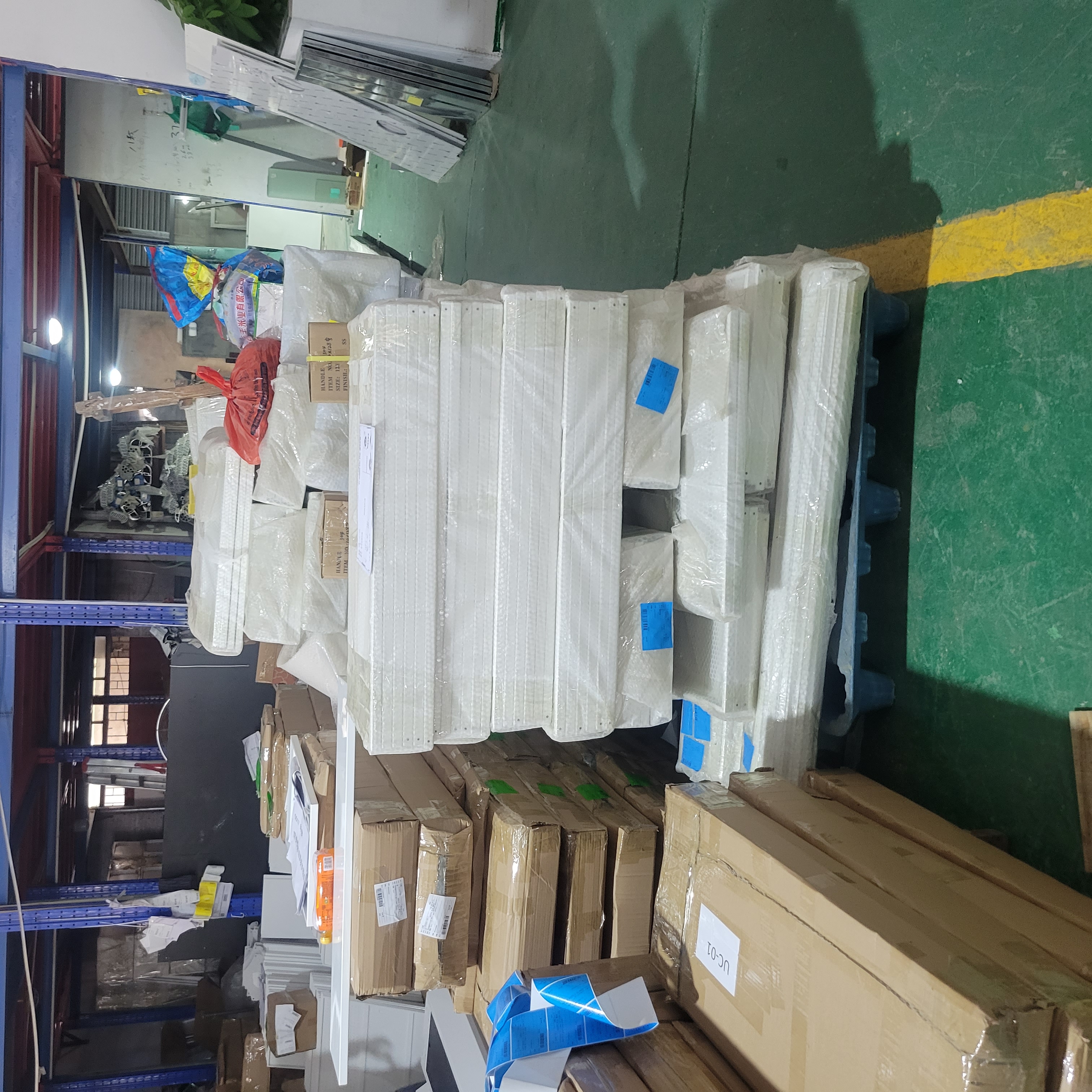
Export packaging area. Crating, moisture protection and pre-assembly verification are the controllable parts of overseas transit risk.
Overseas laboratory furniture projects face a recognizable risk set: maritime transport vibration and collision damage, moisture and salt-spray corrosion, on-site structural misalignment, and high local labour costs. The mitigations described in the reviewed evidence are procedural rather than aspirational — a knockdown mortise-and-tenon pre-assembly structure, heavy-duty export plywood crating with vacuum foil wrap, and a 100% pre-assembled test fit before shipment. On site, standardized 3D modular assembly video guides, colour-coded hardware labelling, backup wearing parts shipped inside the ocean container, and remote engineer installation guidance are used to lower assembly errors and overseas labour expense.
The corresponding warning signs are equally specific: a long ocean voyage without reinforced packaging, no pre-assembly verification, unclear installation instructions, and unskilled local on-site workers. Any one of these converts a controlled transit risk into an uncontrolled installation risk.
Limits of This Framework
A framework that claims to eliminate risk is not credible. Five boundaries should be stated plainly.
- Factory testing is not as-installed performance. Containment validation under ANSI/ASHRAE 110 and EN 14175 and a 100% pre-shipment SF₆ tracer-gas test to a 0.000 PPM standard describe the unit as tested. On-site containment still depends on duct design, makeup air balance, sash commissioning and regular sensor calibration, and must be verified in the building.
- Certificate scope is narrower than product range. In the evidence reviewed, the CE EMC certificate names fume hood models EG-FH01 through EG-FH06, while the CE and RoHS documents name Flammable Safety Storage Cabinet Model FB-03. Other product lines — including PP acid and alkali storage cabinets, glassware drying cabinets and emergency hubs — are not covered by those specific documents, so per-model verification is required.
- Ductless filtration has chemical limits. Ductless hoods are unsuitable for some substances, and filter breakthrough requires immediate replacement. Ducted systems place no limitation on chemical type but require permanent building infrastructure.
- Warranty term and ownership term differ. A 1-year comprehensive warranty covers a fraction of a facility’s service life. Buyers should contract for spare parts availability, calibration intervals and SLA response times to bridge the gap to lifetime remote and on-site engineering support.
- Market sizing is definition-dependent. Published laboratory furniture market figures diverge widely because research houses define the category differently, so any single figure should be treated as a definitional claim rather than a settled measurement.
Market Context That Reinforces the Continuity Question
Dataintelo estimates the global laboratory furniture market at approximately USD 4.8 billion in 2025, projecting growth to USD 8.1 billion by 2034. The same research notes that metal furniture dominated the material segment with a 52.7% revenue share in 2025. That figure should be read alongside the definitional conflict in the underlying data: 2025 estimates from different research houses range from roughly USD 1.14 billion to USD 4.8 billion, which reflects differences in whether modular laboratory services and high-end components such as gas piping are counted. The direction of growth is consistent across sources; the absolute number is not.
The metal-dominance figure also frames a specific continuity question. If steel furniture holds the largest share while acid-intensive laboratories continue to adopt polypropylene solutions, buyers running mixed-material facilities will need suppliers who can sustain both lines — a cold-rolled steel cabinet family alongside an 8.0 mm PP sheet cabinet family — rather than a single-material vendor.
Supply-base depth supports that expectation. China exported over USD 4.15 billion of furniture parts under HS 940390 in 2024, a heading that includes laboratory furniture components, indicating an established component supply chain. The caveat is that this heading is broader than laboratory-grade furniture, so it measures industrial capacity rather than laboratory-specific capability.
On the standards side, ANSI/ASHRAE Standard 110-2016 (R2025) remains the primary American national standard for quantitative fume hood containment testing, and European standard EN 14470-1 classifies fire-resistant safety cabinets as Type 15, 30, 60 or 90 minutes based on internal temperature rise limits, with the temperature increase inside the cabinet required not to exceed 180 K or 200 °C. Both standards reward buyers who ask for unit-level test documentation rather than catalogue claims.
Future Outlook
Three shifts are likely to shape how laboratory furniture suppliers are evaluated over the next procurement cycles. First, certificate scope and validity will move from a compliance afterthought to a scored criterion, because auditors increasingly match model codes against certificate scope lines. Second, spare-part traceability will become part of the initial quotation, with shelf, tray, sash and hardware line items listed separately so that a facility can be maintained without renegotiating a full unit purchase. Third, monitoring will migrate into the furniture itself: airflow calibration manuals are already standardized, and optional IoT real-time monitoring alarm modules on fume hoods point toward containment data becoming continuously recorded rather than periodically checked.
Suppliers that treat continuity as a documentable capability — stable dimensional families, published material grades, per-model certificate scopes and a written spare-parts structure — will hold an advantage over those that compete only on first-order price.
FAQ
How can we verify that a laboratory furniture supplier will still supply the same flammable safety cabinets in five years?
Verify four things rather than accept an assurance. First, confirm the cabinet family is a standard model with a stable dimensional envelope — for example a 1090 × 460 × 1650 mm unit with 45 gallon nominal capacity, 1.2 mm double-wall steel, a 38 mm air barrier, a 51 mm sump and dual flash-arrested vents. Second, ask for a cross-reference table showing how any model code changes map to older codes. Third, request a spare-parts list covering shelves, trays and hardware so replacements do not require a full unit. Fourth, confirm that any applicable certificate names the exact model on the order, since scope lines are model-specific.
Should a new chemical laboratory specify a ducted or a ductless fume hood?
The decision depends on the chemical hazard profile, building exhaust infrastructure and flexibility requirements. Ducted fume hoods are recommended for heavy chemical applications, heating reactions with acid digestions, volatile toxic gases and high-throughput research; they exhaust 100% of fumes outdoors, place no limitation on chemical type, and have lower long-term filter replacement costs. Ductless filtered fume hoods are recommended for light-to-moderate chemical handling, educational laboratories, or leased spaces without external ductwork; they use HEPA/activated carbon filtration to recirculate cleaned air, reducing HVAC energy costs and installation complexity. Verification should cover chemical inventory and evaporation rates, duct route feasibility, makeup air capable of sustaining 0.3–0.5 m/s (60–100 FPM) face velocity, sash height set at typically 400–500 mm, and a smoke containment plus face velocity grid test before routine use.
How should a buyer choose between epoxy and phenolic resin worktops?
The choice follows chemical exposure intensity and heat resistance requirements. Epoxy resin is recommended for heavy chemical synthesis, university research and high-heat environments, being monolithic and non-porous with superior resistance to harsh corrosives and thermal shock up to 600 °C. Phenolic resin is recommended for biology, pharmaceutical QC, physical testing and general chemistry laboratories, offering superior scratch and impact resistance, standard chemical durability and cost efficiency. Selection should be supported by material test reports covering water absorption (epoxy below 0.05%), flame retardancy and flexural strength, followed by inspection of sink cutouts and fixture holes for correct beveling and epoxy adhesive sealing.
What purchasing terms and acceptance criteria are typical for laboratory furniture orders?
In the commercial framework reviewed here, the minimum order quantity is 1 unit; delivery terms cover FOB, CIF, DDP and EXW; acceptance criteria are defined as pre-shipment test; and payment terms are T/T with 30% advance payment and 70% balance before delivery. Lead time is stated at 10–30 days and quality control is described as 100% product testing. Buyers should ensure the acceptance criterion, inspection scope and documentation package are written into the order rather than agreed verbally.
What risks should be planned for in overseas transit and on-site installation?
The identifiable risks are maritime transport vibration and collision damage, moisture and salt-spray corrosion, on-site structural misalignment, and high overseas labour costs. Mitigations include a knockdown mortise-and-tenon pre-assembly structure, heavy-duty export plywood crating with vacuum foil wrap, and a 100% pre-assembled test fit before shipment. On site, standardized 3D modular assembly video guides, colour-coded hardware labelling, backup wearing parts shipped with the container, and remote engineer installation guidance reduce assembly error and labour expense. Risk rises when a long ocean voyage proceeds without reinforced packaging, pre-assembly verification is skipped, instructions are unclear, or local installation workers are unskilled.
What is the correct response if hazardous gas leaks from a fume hood?
Stop the experiment immediately and evacuate personnel. The containment design in the systems reviewed here uses a dynamic aerodynamic baffle, VAV auto-response sensor calibration, and containment validation under ANSI/ASHRAE 110 and EN 14175 dual certification, with every unit completing a 100% pre-shipment SF₆ tracer-gas leakage test to a 0.000 PPM ultra-low-leakage standard. Standardized airflow calibration manuals are provided, and optional IoT real-time monitoring alarm modules are available. Leakage risk is triggered by improper sash height, exhaust-system failure, air-duct pressure fluctuation, missing factory leakage testing, or missing regular sensor calibration; after an incident, the exhaust pipeline and fume hood equipment should be inspected before work resumes.
Additional dimensioned specifications, certificate scopes and case references for the product lines discussed above are consolidated in the Ever Great 2026 company and product brochure. Company background: evergreatlab.com.