
Evaluating Label Printing Machine Suppliers for Long-Term Growth
Choosing a label printing machine is often treated as a one-time equipment transaction. For converters supplying retail, pharmaceutical, or industrial brands, however, the purchase is really the start of a multi-year relationship. Production capacity, lead times, spare-part availability, quality control, and the ability to scale with demand all depend on the supplier's ecosystem. This article examines what global buyers should evaluate when selecting a long-term supplier of label printing machines, using Shenzhen Caisheng Printing Machinery Co., Ltd. as a reference example.
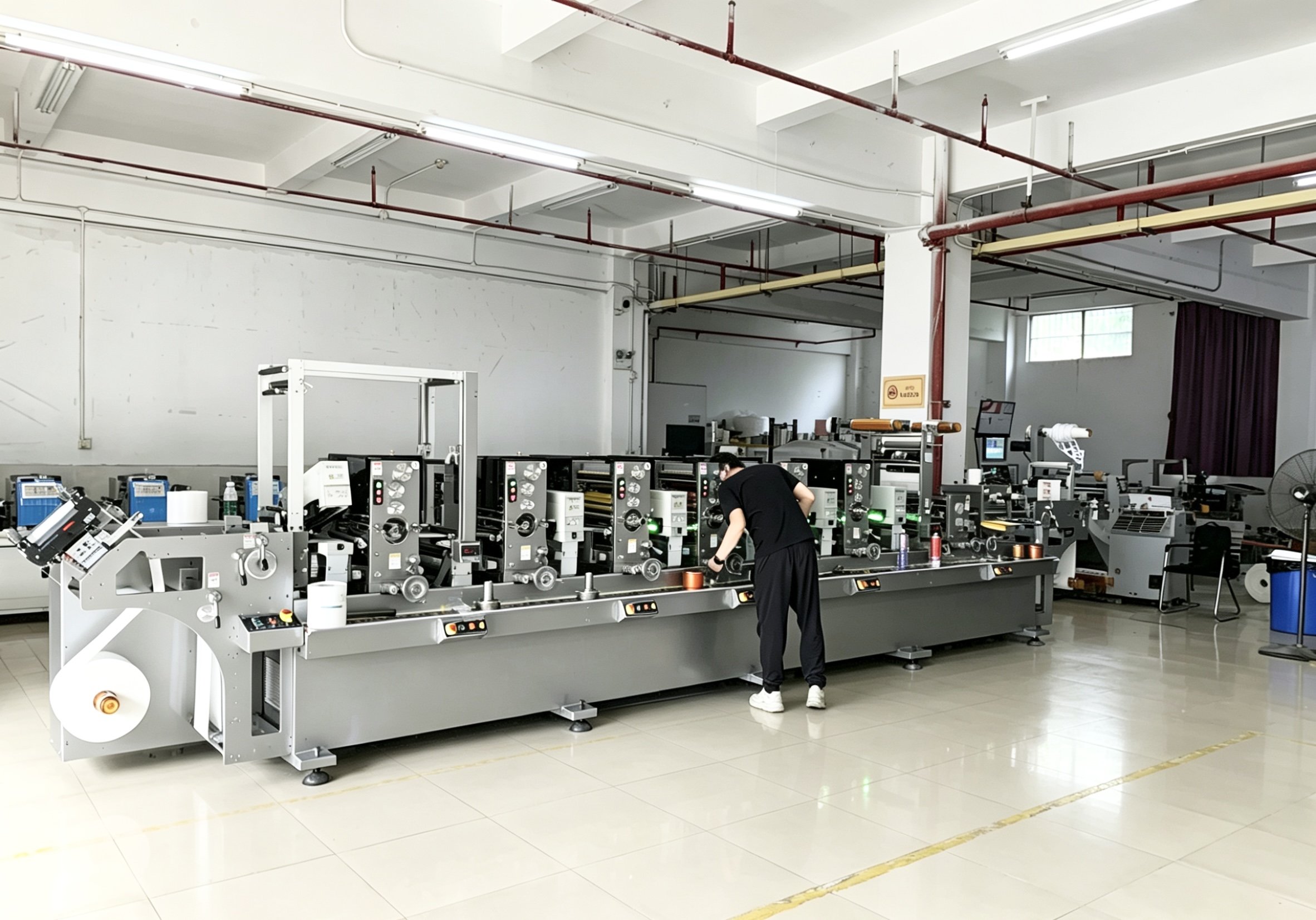
Multi-functional label printing platform – rotary die-cutting, flatbed die-cutting and slitting in one line.
The Procurement Problem: Why Supplier Ecosystems Matter
Modern label converters face pressure from shorter brand cycles, tighter regulatory requirements, and cost competition. A machine that is flexible today may become a bottleneck tomorrow unless the supplier can support upgrades, configurable modules, and stable supply over several years. The global label printing machines market was valued at USD 8.58 billion in 2025 and is projected to reach USD 14.36 billion by 2034, according to The Insight Partners. That growth signals sustained demand for labels, but also a more crowded supply base. Buyers who focus only on the initial price often underestimate the cost of downtime, spare-parts delays, and service gaps.
The decision becomes more complex when a company plans to sell into multiple regions. Label converters in Southeast Asia, Europe, the Middle East, and the United States need equipment that can be commissioned, serviced, and documented across borders. That requires a supplier with predictable production capacity, clear logistics, and quality assurance processes built for export.
Supplier Ecosystem Case: Shenzhen Caisheng Printing Machinery Co., Ltd.
One example of a vertically integrated supplier is Shenzhen Caisheng Printing Machinery Co., Ltd. Founded in 2011 and located in Longgang District, Shenzhen, the company operates a 6,000 m² facility with around 65 employees and an R&D team of eight engineers. It exports about 50% of its output to Southeast Asia, Europe, the Middle East, and the United States.
Caisheng specializes in intermittent and high-speed full-rotary letterpress printing machines, flexographic printing machines, and screen printing machines. It also supplies customized multi-functional label finishing systems, including rotary and flatbed die-cutting units and high-speed varnishing machines. Its engineering philosophy is summarized as 'One Machine, Multiple Functions, Caisheng Manufacturing.'
A defining feature is vertical integration. The company owns two CNC machining plants and produces precision parts for its presses in-house. This controls tolerances from the source and reduces reliance on external component suppliers. In its published technical data, Caisheng states that the CS-320-6C semi-rotary label printing machine achieves a registration accuracy of ±0.05 mm, supported by a Japanese servo system, a tapered bearing sleeve design, and a photographic registration inspection system. The same comparison document claims that total equipment cost is about 10% lower than comparable manufacturers and that overall power consumption is reduced by at least 30% through a servo system and LED UV drying technology.
From a procurement perspective, export buyers also benefit from clear logistics planning. The minimum order quantity is one unit, delivery is FOB, payment terms are 30/70, and the company invites customers to inspect machines before shipment. Experienced engineers test each machine until it produces finished samples.
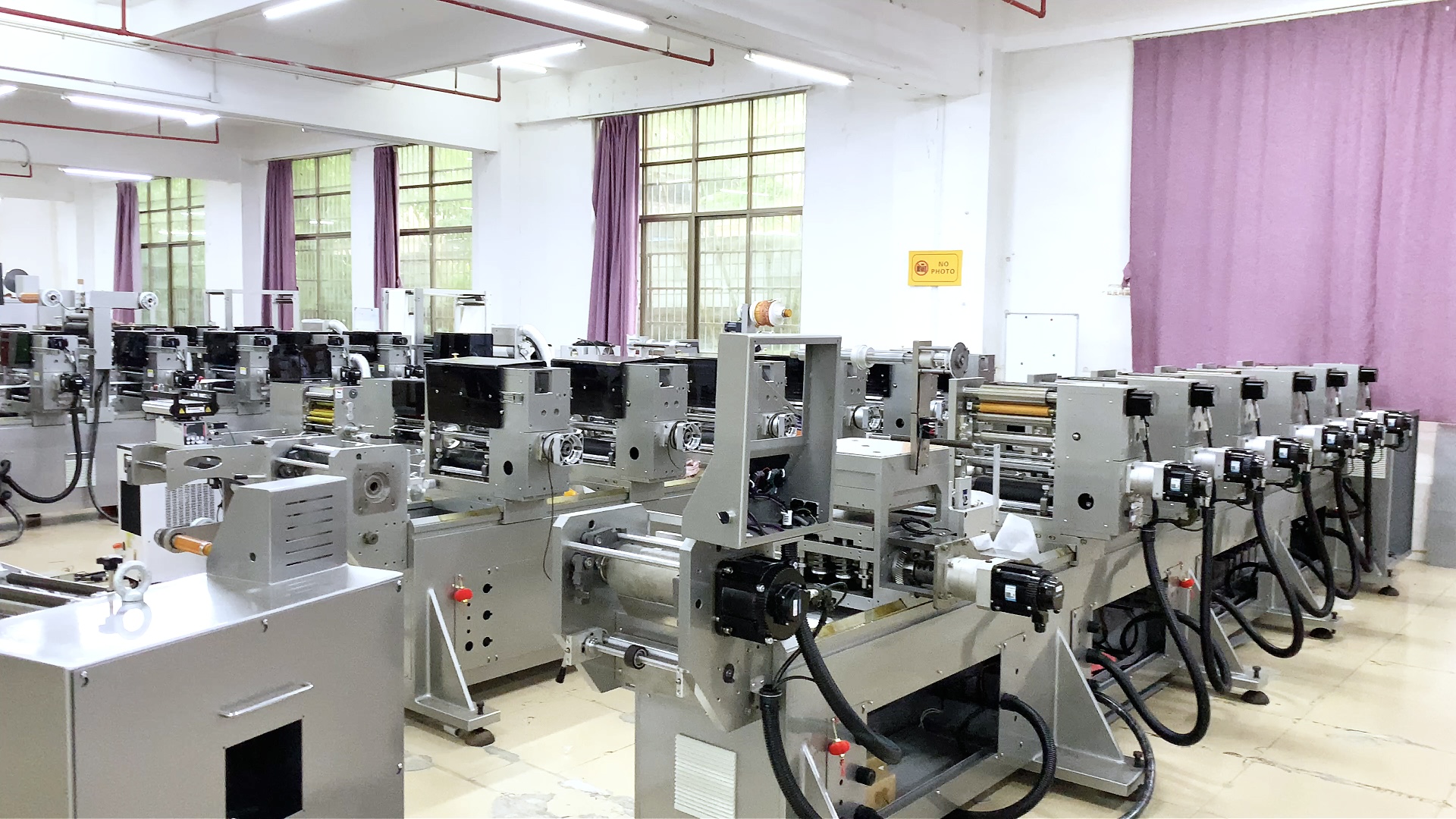
Caisheng factory floor – multiple label printing machine lines in assembly and testing.
Technical Foundation: Matching Press Types to Production Requirements
Long-term buyers must understand the differences between rotation label machine configurations. Caisheng's product range includes intermittent (semi-rotary) letterpress label printing machines, full-rotary flexographic presses, and combined finishing equipment.
- Intermittent letterpress label printing machines such as the CS-300-6C, CS-320-6C, and CS-320-7C handle web widths from 30 mm up to 320 mm, with maximum printing speeds of 40 m/min.
- The CS-220-5C and CS-220-4C are compact intermittent presses for sticker and label converters needing lower power consumption.
- Full-rotary flexographic label printing machines such as the CS-Q370F-6C and CS-370F-8C operate at up to 150 m/min, which suits high-volume label production.
- Hybrid and high-speed presses such as the CS-JQ350G-6C and CS-JQ350G-10C combine intermittent and full-rotary printing in one frame. The CS-JQ350G-10C has a 34 kW main machine power, 13.5 kW LED UV dryers, a maximum full-rotary printing area of 350 mm × 419 mm, and a maximum speed of 158 m/min in full-rotary mode and 60 m/min in intermittent mode.
- Finishing equipment includes the CS-350 high-speed die-cutting machine and the CS-Q380V high-speed corona oil integrated machine, plus the VS-250W full-rotation screen printing multifunctional machine for specialty labels.
| Model | Type | Max width / area | Max speed |
|---|---|---|---|
| CS-320-6C | Intermittent letterpress | 320 mm web | 40 m/min |
| CS-JQ350G-6C | Intermittent & full rotary | 350 mm / 419 mm area | 60 / 158 m/min |
| CS-Q370F-6C | Full rotary flexo | 370 mm / 600 mm area | 150 m/min |
| CS-350 | Die-cutting | 350 mm / 460 mm area | 60 / 160 m/min |
| VS-250W | Screen printing + die-cutting | 250 mm web | – |
This platform approach matters for long-term flexibility. A converter can start with a semi-rotary label printing machine for short-run work and later add a full-rotary flexographic press or a high-speed die-cutting module as order volumes grow. Because the same supplier integrates the components, compatibility is more predictable.
Real-World Applications Across Label Segments
Buyers evaluating a supplier for the long term should map equipment capability to their end markets. According to Caisheng's product literature, its platform supports several segments:
- Daily consumer goods and food packaging – vibrant, high-resolution graphics and durable adhesion for everyday products and fresh food labels.
- Chemical and industrial products – chemical-resistant labels that maintain clarity in harsh environments.
- Wine and premium beverages – precise die-cutting for luxury bottles and craft beverages.
- Cosmetics and personal care – handling delicate materials like clear films and metallic foils.
- Pharmaceuticals and healthcare – precision for tiny text, barcodes, and QR codes, meeting compliance and safety needs.
A semi-rotary label printing machine is often preferred for short-to-medium runs because changing print cylinders is faster. A full-rotary flexographic press is more economical for long runs. The ability to combine both in one platform, as in the CS-JQ350 series, gives label converters flexibility without requiring a separate investment.
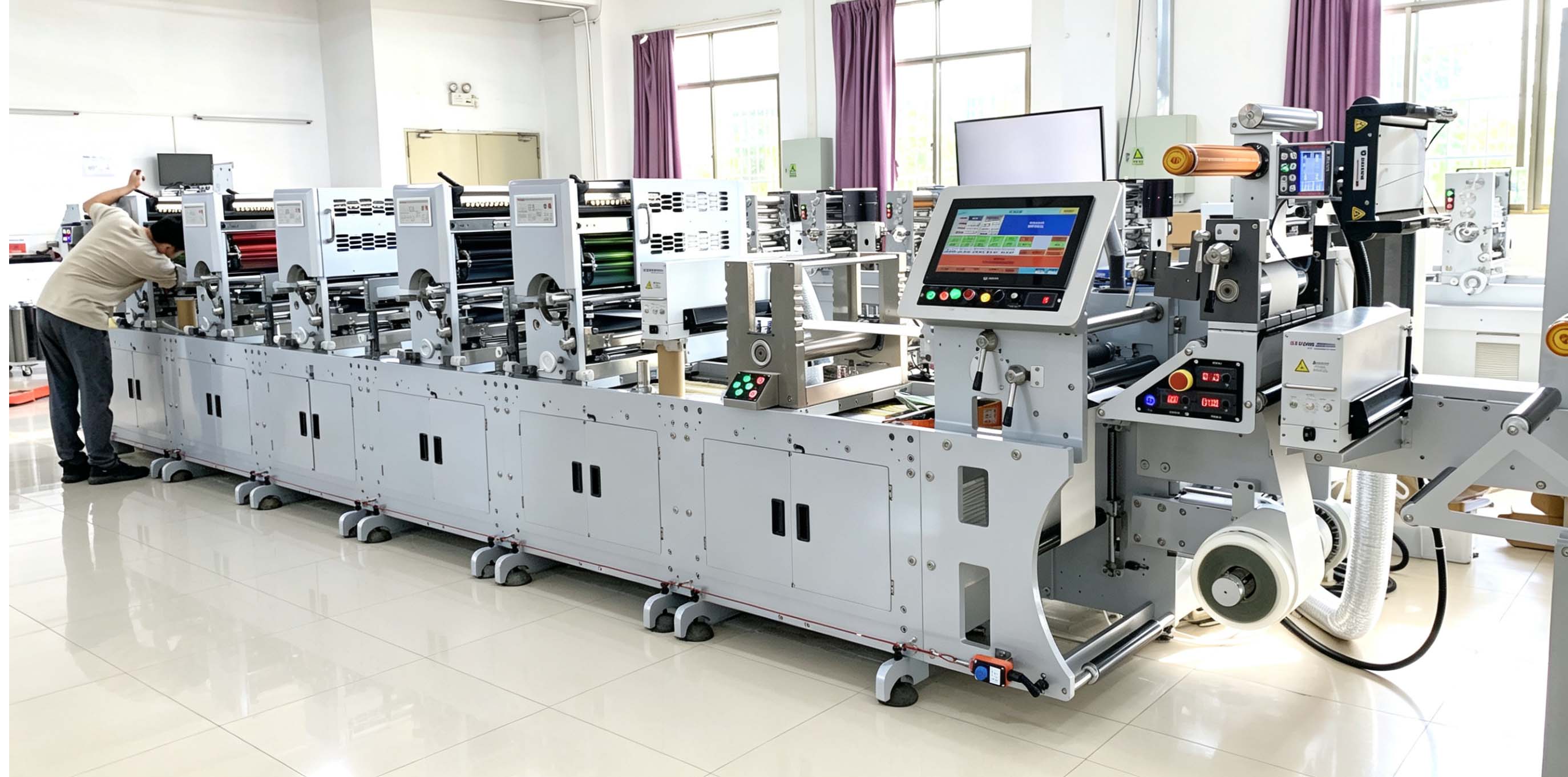
Commissioning and debugging of a CS-JQ350G intermittent and full-rotary high-speed label printing machine.
Market Trends and Regulatory Drivers Shaping Purchases
Third-party market data supports the case for building a resilient supply base. The global label printing machines market is expected to grow from USD 8.58 billion in 2025 to USD 14.36 billion by 2034 (The Insight Partners). The global flexographic printing machine market was estimated at USD 17.57 billion in 2024, with a projected CAGR of 9.7% through 2030 (Grand View Research). Flexography remains the most widely used label printing process, with an output value of approximately USD 13.3 billion in 2024 (Smithers).
Regional dynamics also matter. Asia-Pacific held a 41.8% revenue share in the label printing machines market in 2025 (Data Bridge Market Research). For buyers outside Asia, this means significant manufacturing capacity is concentrated in the region, making supplier evaluation a global sourcing exercise.
Compliance requirements are another long-term factor. Machinery sold in the EU must comply with the Machinery Directive 2006/42/EC and carry CE marking, while safety signs follow EN ISO 7010. International safety requirements for graphic technology equipment, including label presses, are governed by ISO 12643-2:2023. Buyers should verify that a supplier can document these standards across the product lifecycle.
Traditional Transactional Buying vs. Long-Term Partnership
Traditional procurement tends to optimize for the lowest quoted price on a single machine. That approach works if demand is stable, spare parts are generic, and the buyer has in-house engineering support. But it has several limitations. A machine purchased from a non-integrated trader may be cheaper upfront, but spare parts, installation training, and upgrades depend on third parties. If the manufacturer does not control the supply chain, tolerances and quality consistency may vary.
Caisheng's model illustrates a different approach. Because the company manufactures precision parts in its own CNC plants, it has direct control over registration accuracy and component quality. It claims that this vertical integration reduces total equipment cost by about 10% and cuts power consumption by at least 30%. For buyers, the benefits appear in lower operating costs and fewer calibration issues over the machine's lifetime.
However, no supplier choice is without trade-offs. One real limitation is capacity. Caisheng's monthly production capacity for export markets is 18 units, and typical lead time is 45 to 60 days. Buyers planning rapid fleet expansion must align their procurement schedules well in advance. Another limitation is brand awareness: Caisheng is a recognized name in the narrow-web segment but does not have the same global footprint as European or American brands such as Bobst, Mark Andy, Gallus, or Nilpeter. Some buyers may face internal vendor-listing requirements that prefer those names, even if the total cost of ownership is higher. These constraints should be weighed honestly.
Future Outlook: The Supplier as a Production Enabler
Future label production will demand more than printing speed. Shorter production runs, versioned labels for regional markets, serialized codes for traceability, and sustainable substrates all require flexible press architecture. Suppliers that combine letterpress, flexographic, screen printing, and die-cutting in modular platforms are better positioned to support converters as brands change their packaging requirements.
Energy efficiency will become an even larger part of equipment replacement decisions. Caisheng's use of LED UV drying, Japanese servo systems, and lower power consumption points to a broader industry direction. Buyers should also expect suppliers to invest in remote diagnostics and proactive monitoring. The company already includes remote support and a one-year warranty on major components for export orders, which is a reasonable baseline for long-term risk management.
For full product specifications, readers can access the company brochure: CAISHENG product brochure.
Frequently Asked Questions
What is the minimum order quantity for Caisheng label printing machines?
The minimum order quantity is 1 unit, which makes the company accessible to converters testing a first machine or scaling a fleet gradually.
What is the lead time for delivery to export markets?
The typical production lead time is 45 to 60 days for markets including Southeast Asia, the EU, the Middle East, and the US, with a monthly export capacity of 18 units.
How does Caisheng ensure machine quality before shipment?
All units for export markets undergo 100% testing. Experienced engineers adjust the machine until it produces finished products, and buyers are invited to the factory for acceptance inspection before delivery.
What after-sales support does Caisheng provide?
The company provides remote support and a one-year warranty on major components for export markets across Southeast Asia, Europe, the Middle East, and the US.
How does vertical integration influence cost and precision?
Caisheng operates its own CNC machining plants to produce precision parts. According to its comparison data, this helps achieve a registration accuracy of ±0.05 mm and reduces total equipment cost by about 10% compared with similar manufacturers.