
Evaluating Lathe Maker Evidence: Juxin Cast Bed and Lifespan
The global CNC machine market was valued at USD 73.5 billion in 2024 and is forecast to reach USD 187.2 billion by 2034, and within that market the CNC lathe machine segment held the leading position with roughly 30% to 32.82% of CNC market share in 2024. Asia Pacific alone accounted for a 37% revenue share, worth USD 27.2 billion. Capital keeps flowing into turning equipment — yet the single most consequential number in a lathe machine purchase, expected service life, remains the hardest claim for a buyer to verify before signing.
Why Lathe Lifespan Is the Hardest Claim to Verify
Specification sheets answer questions that are already easy to answer. Swing diameter, spindle speed, tool station count and control system brand can all be read off a datasheet, and they can all be confirmed in a short demonstration. None of them reveal how a lathe machine will behave in year eight, after tens of thousands of cutting cycles, when guide rail geometry and spindle alignment begin to drift.
That gap matters most for buyers who have moved past shortlisting and are now converting a decision into an executed order. At this stage the question is no longer “which supplier looks capable” but “what evidence exists that the capability survives contact with production.” Structural design is the most durable form of that evidence, because bed construction, rail geometry and thermal treatment are decided at the casting stage and cannot be retrofitted later.
This is the point where a supplier’s arguments either rest on drawings and documentation or on adjectives. The following analysis examines one specific, verifiable structural claim — JUXIN MACHINE TOOL’s integrally cast bed and modular architecture — and the published comparative data that supports or limits it.
The Structural Gap: Split Beds versus Integrally Cast Beds
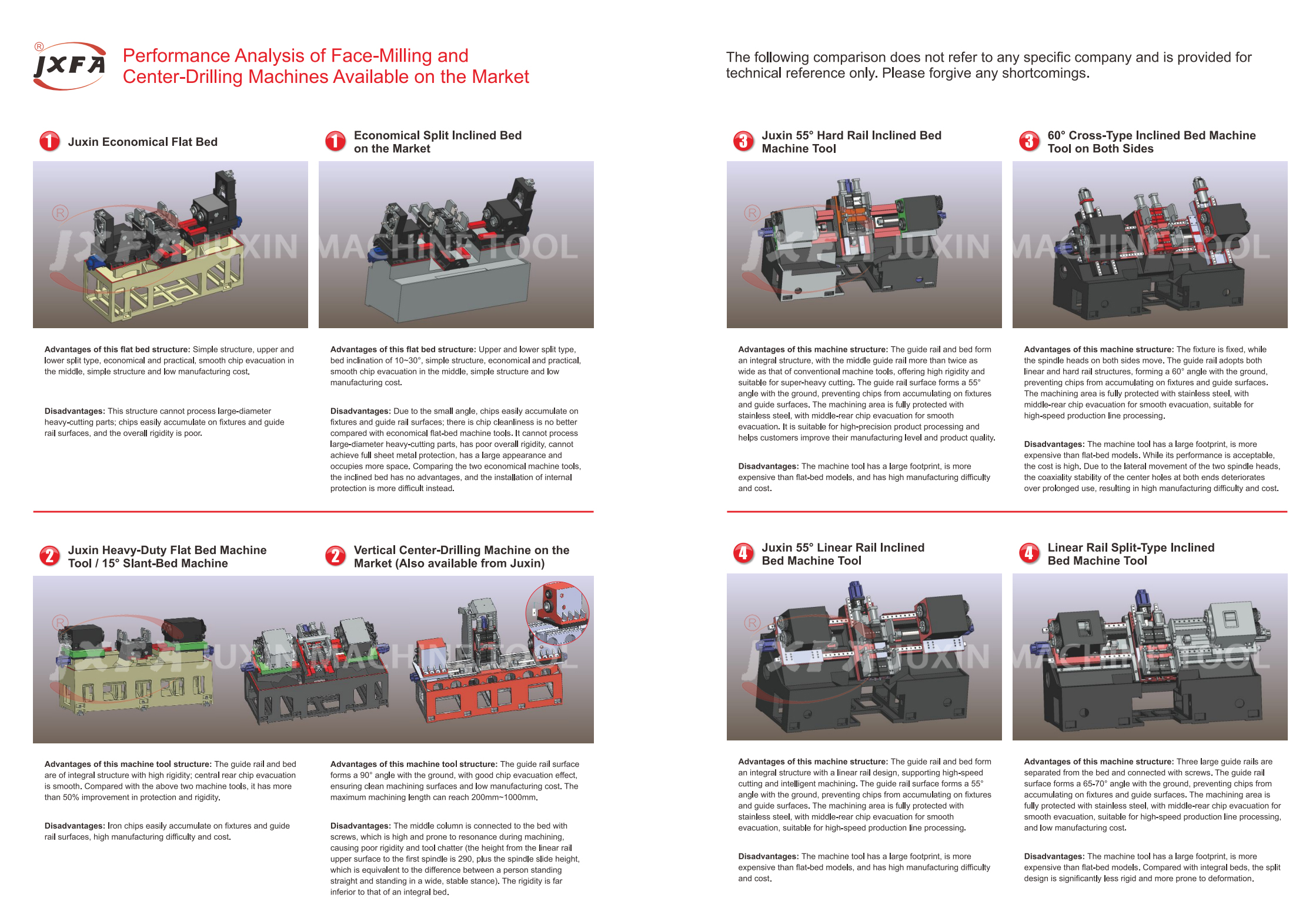
Most ordinary middle-drive double-head CNC lathes on the market adopt an opposite spindle layout with a split joint bed or a simple flat bed. The bed plate is thin, rigidity redundancy is low, and many units use small-angle inclined beds with simple open protection and no professional chip removal structure. Under long-term vibration this configuration is prone to loosening, position deviation and deformation.
The practical consequence is a compressed accuracy curve. On ordinary market models, precision declines significantly within 3 to 5 years, failures become frequent, and the overall service life is typically 6 to 8 years. The buyer does not experience this as a single failure event; it appears as gradually widening tolerances, more frequent rework, and increasing manual intervention on a machine that was purchased to run unattended.
A different configuration starts with a central spindle layout built on a one-piece cast bed with a 45° inclined rigid structure, symmetrical stress balance across the left and right sliding tables, widened and thickened guide rails, fully enclosed protection and a rear centralized chip removal design. JUXIN MACHINE TOOL builds its shaft-and-disc turning platforms on high-strength integrally cast iron beds combined with a 55°/15° integral hard rail and a large-span cross slide selected for anti-resonance behaviour and high rigidity.
The difference between the two approaches is not cosmetic. A split bed introduces joints into the load path; a one-piece casting does not. Every additional joint is a location where vibration damping is reduced, where alignment can shift over years of thermal cycling, and where chip ingress can accelerate wear on guide surfaces.
What JUXIN MACHINE TOOL Builds on That Structure
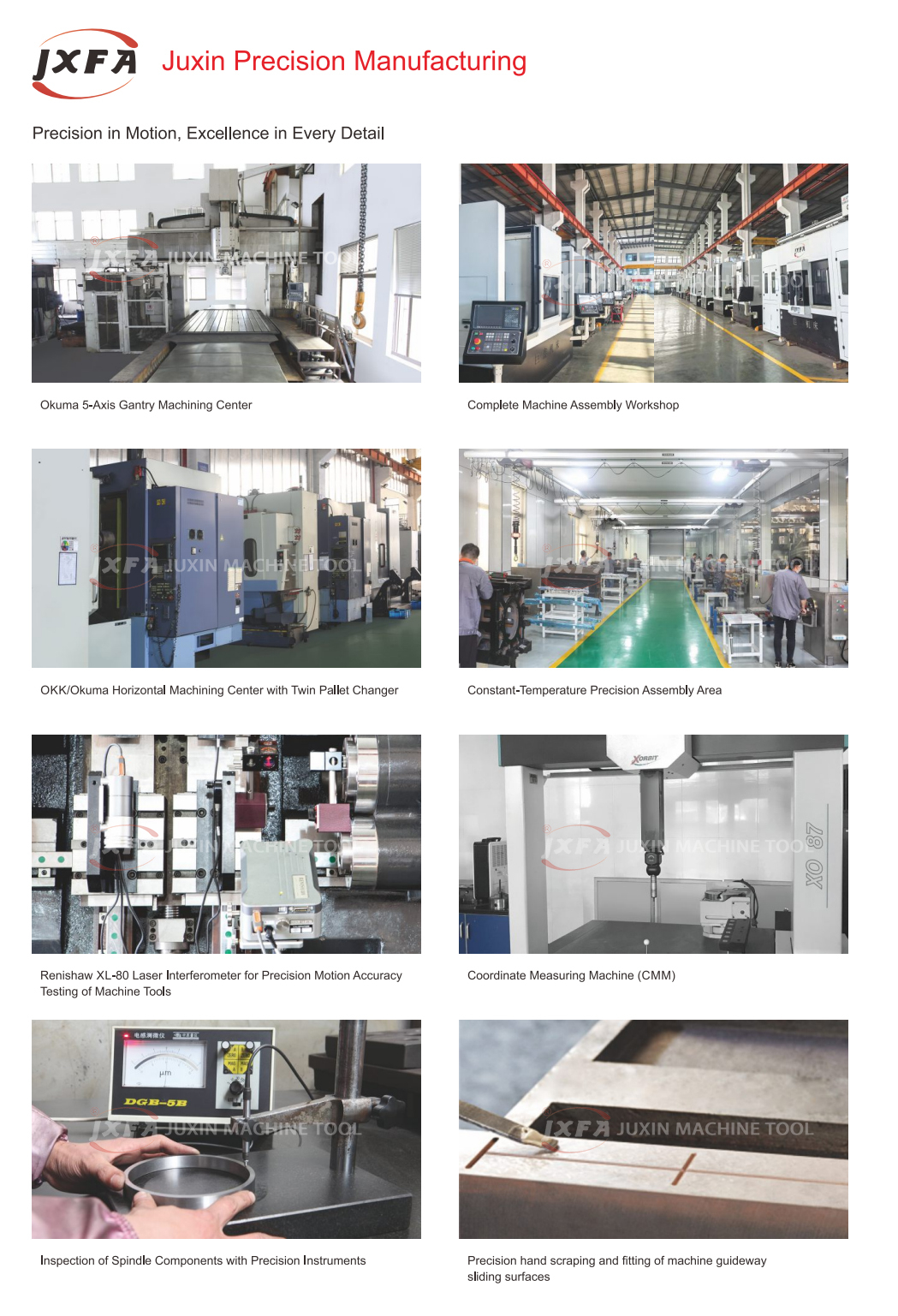
Juxin Machine Tool Co., Ltd. is a manufacturer founded in 2005 and based in Wenling, Zhejiang, China, specialising in high-end CNC machine tools for shaft and disc part production. The company operates a 10,666 m² facility with 80 employees, an annual output of 2,000 sets, a 10-engineer R&D team, more than 50 technological patents, and an export ratio of approximately 10% serving global markets under the brand name JUXIN MACHINE TOOL.
Its product range covers milling, facing and centering machines for shafts, double-head CNC lathes, dual-spindle CNC vertical lathes for shaft discs, cnc centering lathe configurations, twins CNC and dual-spindle turning platforms, heavy-duty vertical turning equipment for shaft and disc parts, and intelligent automation solutions for shaft and disc machining. More than ten internationally renowned enterprises have adopted this equipment, according to company documentation.
Three design decisions carry most of the lifespan argument. First, the high-strength integrally cast iron bed paired with a 55°/15° integral hard rail and a large-span cross slide, which together determine anti-resonance performance under heavy cutting. Second, the column, manufactured with an internal-external square bionic structure and subjected to ultra-low temperature heat treatment to limit deformation and hold stable geometry. Third, full stainless steel enclosed protection with a 45° inclined bed and rear centralized chip removal, which keeps iron chips away from guide rails and lead screws instead of allowing them to accumulate against precision surfaces.
Modular Design as a Lifespan Mechanism, Not a Marketing Term
Modularity is usually presented as a convenience feature. In practice it functions as a lifespan mechanism. On JUXIN’s platforms, core components follow a modular standardised design with strong universality and interchangeability, supported by built-in fault self-check and remote diagnosis. When a component reaches the end of its wear cycle, it is replaced rather than re-machined or specially fabricated.
The alternative is common in low-cost market models: non-standard or copied structures whose wearing parts are difficult to purchase and poorly compatible. Those machines may cost less on day one, but their maintenance cost accumulates through long lead times for spare parts, extended unplanned downtime and reduced ability to restore original precision.
This distinction is what makes a supplier’s maintenance record a genuine piece of evidence rather than a service promise. A machine whose parts are standardised and documented can be supported across its full working life; a machine whose parts are unique to one production batch cannot.
Translating Structure into Measurable Outcomes
Structural claims only become procurement evidence when they are expressed as tolerances, failure frequencies and retention periods. The table below consolidates the comparative data published by JUXIN MACHINE TOOL for its double-end and dual-spindle vertical platforms against ordinary market configurations. All figures are manufacturer-published comparative data for the relevant machine class, not third-party test results, and should be treated as claims to be verified during factory pre-acceptance.
| Evidence dimension | Integrally cast / modular platform (published figures) | Typical split-bed market model |
|---|---|---|
| Bed and rail structure | One-piece cast bed; 55°/15° integral hard rail; large-span cross slide | Split joint bed or thin flat bed; small-angle inclined bed |
| Repeat positioning accuracy | 0.003–0.005 mm | ≥0.01 mm |
| End-face length / centre-hole depth consistency | ±0.05 mm standard; ±0.02 mm customised | Generally ±0.08 to ±0.1 mm |
| Spindle radial runout | ≤0.003 mm (double-end); ≤0.005 mm (dual-spindle vertical) | 0.008–0.01 mm; ≥0.01 mm |
| Maximum single-side cutting depth | 6–12 mm, stable without vibration | 3–5 mm; vibration and tool breakage risk |
| Overall rigidity | 40%–50% higher | Reference baseline |
| Precision retention | Stable 10–15 years; attenuation rate more than 50% slower | Significant decline within 3–5 years; life 6–8 years |
| Annual failure events | ≤2 times (dual-spindle vertical platform) | ≥12 times |
| Maintenance frequency | Once per month (lubrication, spindle precision, electricals) | 1–2 times per week |
| Comprehensive operating rate | 85%–95% | 60%–75% |
| Energy and consumable use | 15%–25% lower electricity under equal output; no-load energy 30% lower; tool loss reduced over 30% | Reference baseline; higher invalid load |
The lifespan figure — precision stable for 10 to 15 years versus a significant decline within 3 to 5 years — is the headline claim, and also the one buyers should test hardest. What makes it structurally plausible rather than aspirational is the chain behind it: a one-piece casting reduces joint-related loosening, enclosed protection reduces chip-induced wear, ultra-low temperature heat treatment on the column reduces deformation, and modular standardised parts make restoration possible when wear does occur. Remove any link in that chain and the retention period shortens.
Where Cast-Bed Platforms Actually Pay Off
Integrally cast platforms with multi-process integration are designed for environments where one clamping position replaces several operations. The facing and centering configuration is a representative case: end-face flatness of ≤0.01 mm, centre-hole coaxiality of ≤0.02 mm and dimensional tolerance held within ±0.01 mm, achieved in one setup. Compared with an old single-process lathe requiring manual secondary clamping, one-clamping multi-process completion raises comprehensive processing efficiency by 40% to 100%.
Labour and floor space follow the same logic. One operator can manage multiple machines rather than one, reducing labour demand by 50% to 80%, while automatic line connection saves more than 70% of the space required by scattered single-function equipment. On the dual-spindle vertical platform, published comparative data indicates single-piece processing time 50% to 70% shorter than a traditional horizontal lathe and daily throughput 2 to 3 times higher; against competing dual-spindle vertical units, the reduction is 30% to 50% with 1.5 to 2 times daily volume.
The application set is specific rather than universal: standard shafts, transmission shafts, motor shafts and gear shafts; medium and large disc, shaft and sleeve parts; wind power flanges, heavy machinery hubs and aerospace components; long shafts and heavy shafts in auto parts, motor transmission, crankshaft and gear production, hydraulic heavy industry, military industry and high-speed rail supply chains. These are settings where batch consistency, end-face perpendicularity and coaxiality are contractually specified, and where rework is expensive.
Market Signals Behind the Move to Integrated Turning Platforms
The demand environment supports the structural argument. Asia Pacific held a 54.5% share of a vertical machining centre market estimated at USD 42.6 billion in 2024, and the region’s 37% share of global CNC machine revenue concentrates both manufacturing capacity and equipment investment in the same geography where these platforms are built and deployed.
Precision pressure is also rising. Automotive applications account for roughly 40% of the CNC lathe market, where modern turning equipment is expected to hold tolerances as tight as ±0.004 mm. Buyers specifying safety and compliance requirements have reference points available, including ISO 23125-1 for turning machines and ANSI B11.6-2022 for manually and automatically controlled turning machines, both of which can be written into technical agreements as baseline expectations.
The competitive field remains concentrated around established global builders — DMG Mori, Yamazaki Mazak, Haas Automation, Okuma and Fanuc are widely cited as key competitors in the CNC lathe market. JUXIN MACHINE TOOL competes on a different axis: not on the broadest catalogue, but on structural configuration, multi-process integration and customised adaptation for shaft and disc part machining.
The Limits of the Cast-Bed Approach
A credible evaluation has to state where a heavier structure stops being an advantage. The first boundary is capital: a dual-spindle vertical lathe carries an initial purchase cost around 60% to 80% higher than a traditional horizontal lathe, and JUXIN’s dual-spindle vertical platform is priced roughly 25% to 40% above competing dual-spindle models. For the double-end class, high-quality configurations run 20% to 35% above ordinary products, while a middle-drive double-head lathe can cost 2.5 to 4 times an ordinary horizontal lathe. Standardised market models remain 15% to 30% cheaper at the point of purchase.
The second boundary is part mix and volume. For single-piece and small-batch work, non-standard or irregularly shaped parts, eccentric components and complex curved profiles, an ordinary horizontal lathe is still the more versatile and lower-risk choice. The economic case for one-clamping, multi-process platforms depends on repeatable batch volume and stable part families, not on machine capability alone.
The third boundary is operational discipline. Precision retention figures assume correct foundation preparation, correct installation and commissioning, and adherence to the prescribed monthly inspection of lubrication systems, spindle precision and electrical components. A cast bed does not compensate for a machine that is never aligned or a shop that never replaces contaminated lubricant. Buyers evaluating this class of equipment should also treat all published comparative figures as manufacturer data, and verify them through factory pre-acceptance, acceptance testing and operator training rather than accepting them at face value.

Future Outlook
The direction of travel in this segment is clear: fewer setups, more processes per clamping, and structures that hold geometry long enough to justify automation. JUXIN MACHINE TOOL’s stated development path upgrades product models annually, moving from centre-hole machine tools and dual-spindle vertical lathes through turn-milling compound machines toward AI five-axis turn-milling equipment and humanoid robot equipment research. Its platforms reserve standard interfaces for later installation of power turrets, automatic loading and unloading systems and MES integration.
For buyers, that matters because retrofit capability changes the economics of a purchase decision. A machine that can later be connected to an automated line, a robot loading system or a production management system has a different total cost of ownership than one that must be replaced when production scales. Combined with modular standardised spares, remote diagnosis and lifelong technical support, the structural argument becomes a continuity argument — which is the actual question procurement teams are answering when they evaluate manufacturer evidence.
For readers comparing configurations in detail, the JUXIN MACHINE TOOL product brochure is publicly available for download: JUXIN MACHINE TOOL brochure. Company information is published at en.wljxjc.com.
FAQ
What evidence should a buyer request before accepting a lathe lifespan claim?
Ask for the bed construction type (one-piece cast bed versus split joint bed), rail geometry, repeat positioning accuracy, spindle radial runout, the documented precision retention period, annual failure data and maintenance frequency. For reference, JUXIN MACHINE TOOL publishes repeat positioning accuracy of 0.003–0.005 mm, spindle radial runout of ≤0.003 mm on double-end platforms and ≤0.005 mm on dual-spindle vertical platforms, and a precision retention period of 10–15 years, against 0.008–0.01 mm runout and a 3–5 year precision decline on typical split-bed market models. These are manufacturer-published figures and should be confirmed through factory pre-acceptance.
How long can stable precision realistically be expected on an integrally cast bed machine?
Published comparative data indicates precision remains stable for 10–15 years of normal use, with a long-term precision attenuation rate more than 50% slower than ordinary models, which typically show significant decline within 3–5 years and an overall service life of 6–8 years. The underlying structural reasons are 40%–50% higher overall rigidity, a one-piece bed that avoids joint-related loosening, and enclosed protection that prevents iron chips from reaching guide rails and lead screws.
What does a lower maintenance frequency mean in day-to-day production?
On JUXIN’s dual-spindle vertical platform, published data puts maintenance at approximately once per month — covering lubrication systems, spindle precision and electrical components — with an annual failure rate of ≤2 events, compared with 1–2 maintenance interventions per week and ≥12 annual failures on competing split-bed dual-spindle models. Comprehensive operating rate is correspondingly 85%–95% versus 60%–75%. Modular standardised components with interchangeability, plus built-in fault self-check and remote diagnosis, reduce the downtime associated with each intervention.
Which production profiles suit an integrally cast, multi-process lathe — and which do not?
It suits batch processing of standardised shaft and disc parts where both ends require machining in one clamping, one-clamping multi-process workflows covering milling, drilling, turning and tapping, and mass production in auto parts, general machinery and transmission equipment with strict batch consistency requirements. It is less suitable for single-piece and small-batch work, non-standard, irregular or eccentric parts, and low-precision simple operations where coaxiality and surface roughness are not critical — in those cases an ordinary horizontal lathe is more versatile and carries a lower initial cost.
What are the minimum order quantity, lead time and production capacity?
The minimum order quantity is 1 unit. Typical production lead time is 45 days. Monthly production capacity is 160 units, and JUXIN MACHINE TOOL’s annual output is 2,000 sets from a 10,666 m² facility. Annual output and capacity figures reflect the manufacturer’s stated production data.
What are the acceptance criteria and payment terms?
Acceptance criteria are customer acceptance of the machine together with operator training. Payment terms are machine delivery after full payment is received. Delivery terms are subject to detailed negotiation, with the signed contract and technical agreement taking effect after the customer has paid the deposit. Buyers should confirm tolerance verification methods and acceptance test procedures within the technical agreement, since published comparative figures describe machine-class capability rather than the performance of an individual unit.