
Evaluating Long-Term Wall Panel Supplier Sustainability: A Distributor's Guide
HTNXT Industry Reference · Wall Panel Supply
A distributor's wall panel business is rarely decided by the first container. It is decided by the fourth, the tenth and the twentieth — arriving with the same dimensions, the same surface finish, the same fire documentation and the same commercial terms as the approved sample. Supplier sustainability, in this sense, is a production and process question rather than a slogan.
Why Supplier Sustainability Is a Portfolio Question
Wall panel distribution has changed shape. A distributor that once carried one or two interior panel lines now manages a catalogue spanning decorative interior panels, acoustic slat systems, rigid waterproof panels, ceiling systems, flooring and outdoor cladding. Each of those categories carries its own raw material logic, tooling, surface technology and compliance documentation.
The scale of that expansion shows up in market estimates. The global wall panel market was valued at USD 32.4 billion in 2025 and is projected to reach USD 43.7 billion by 2033, according to Dataintelo. Asia-Pacific accounts for approximately 42.3% of global wall panel market share, driven by rapid urbanization in China and India. Estimates vary by source and product definition — a separate tracker places an earlier 2023 base at USD 17.1 billion — so the useful signal is direction and structure, not a single figure.
The evaluation trap is that most supplier assessments happen at the point of least risk: the first order. Price, sample appearance and one SKU are easy to compare. What is difficult to compare is whether the same supplier can hold dimensional tolerance, colour and documentation across eleven product families, three years and multiple container rhythms. When that capability is missing, the cost surfaces later — as returns, as re-worked showroom displays, as submittals questioned on site.
Suppliers that control both raw material input and finished goods output have a structural advantage here. Film and foil production feeding panel and flooring lines removes variables a distributor would otherwise have to audit separately, and it shortens the distance between a colour approval and a production batch. The rest of this guide sets out how to test that advantage rather than assume it.
The Supplier Behind the Portfolio: LONGTE
LONGTE refers to Haining Longtime Industry Co., Ltd., a building materials manufacturer founded in 2003 in Haining City, Zhejiang Province, China. The company operates an 80,000 m² manufacturing footprint with approximately 220 employees and a 12-engineer R&D team, producing PVC ceiling and wall panels, WPC wall panels, hot stamping foils, PVC lamination films, SPC flooring and WPC decking. Roughly 85% of output is exported, with stated markets including the USA, Colombia, India, the Philippines, the UAE and South American countries.
Manufacturing is distributed across six production hubs in Asia: Haining Halong PVC Ceiling Factory and Haining Longtime Film Factory for film and ceiling specialisation, a Guangxi PVC wall panel factory for high-capacity panel production, PVC wall panel factories in Indonesia and Vietnam serving as regional hubs, and a Malaysia flooring manufacturing centre.
Two figures are worth separating at this stage. LONGTE states an annual output of 8,000,000 units and an annual sales volume exceeding USD 35 million. Both describe scale. Neither describes consistency — consistency has to be examined category by category, which is the next step in the framework.
Production Consistency Across Eleven Product Lines
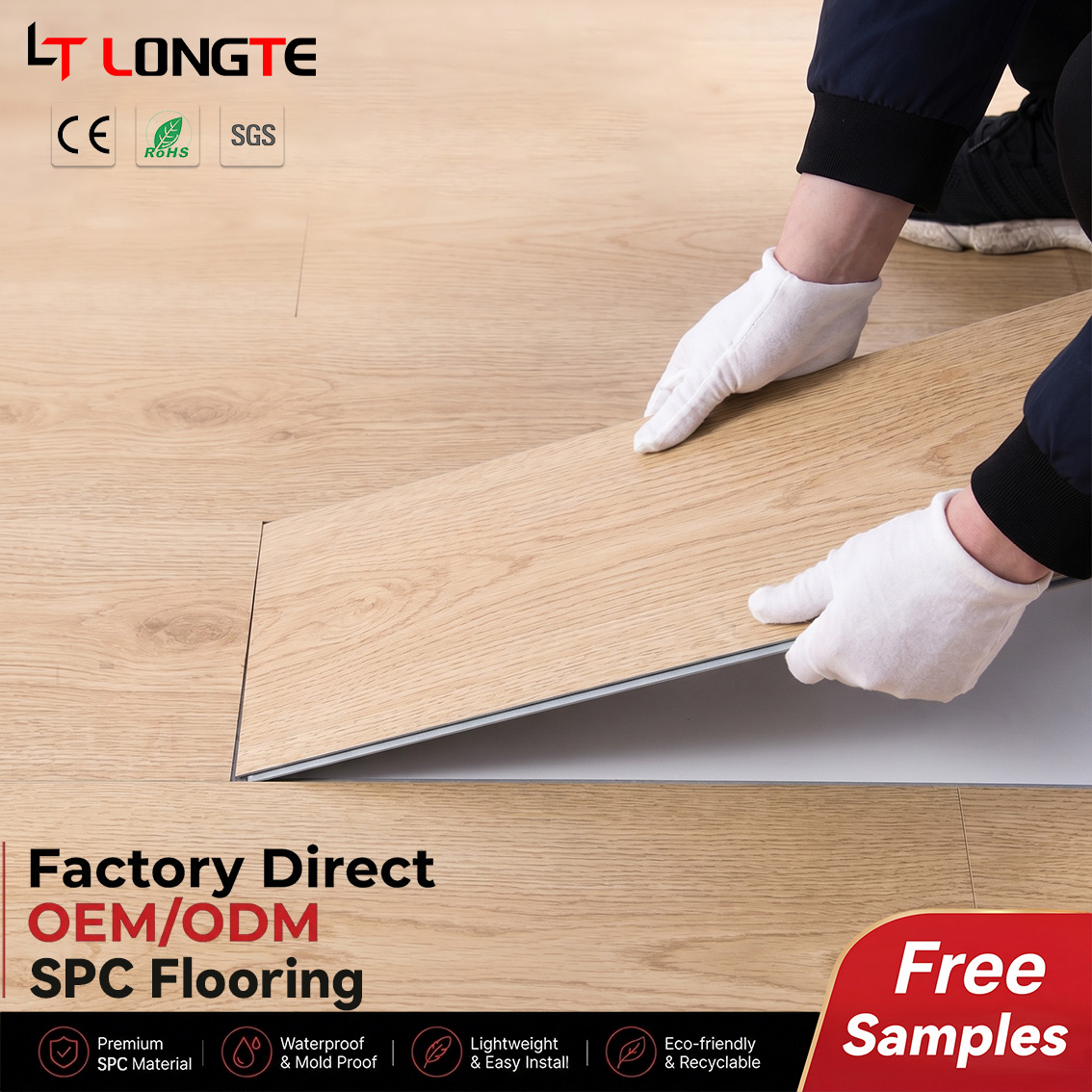
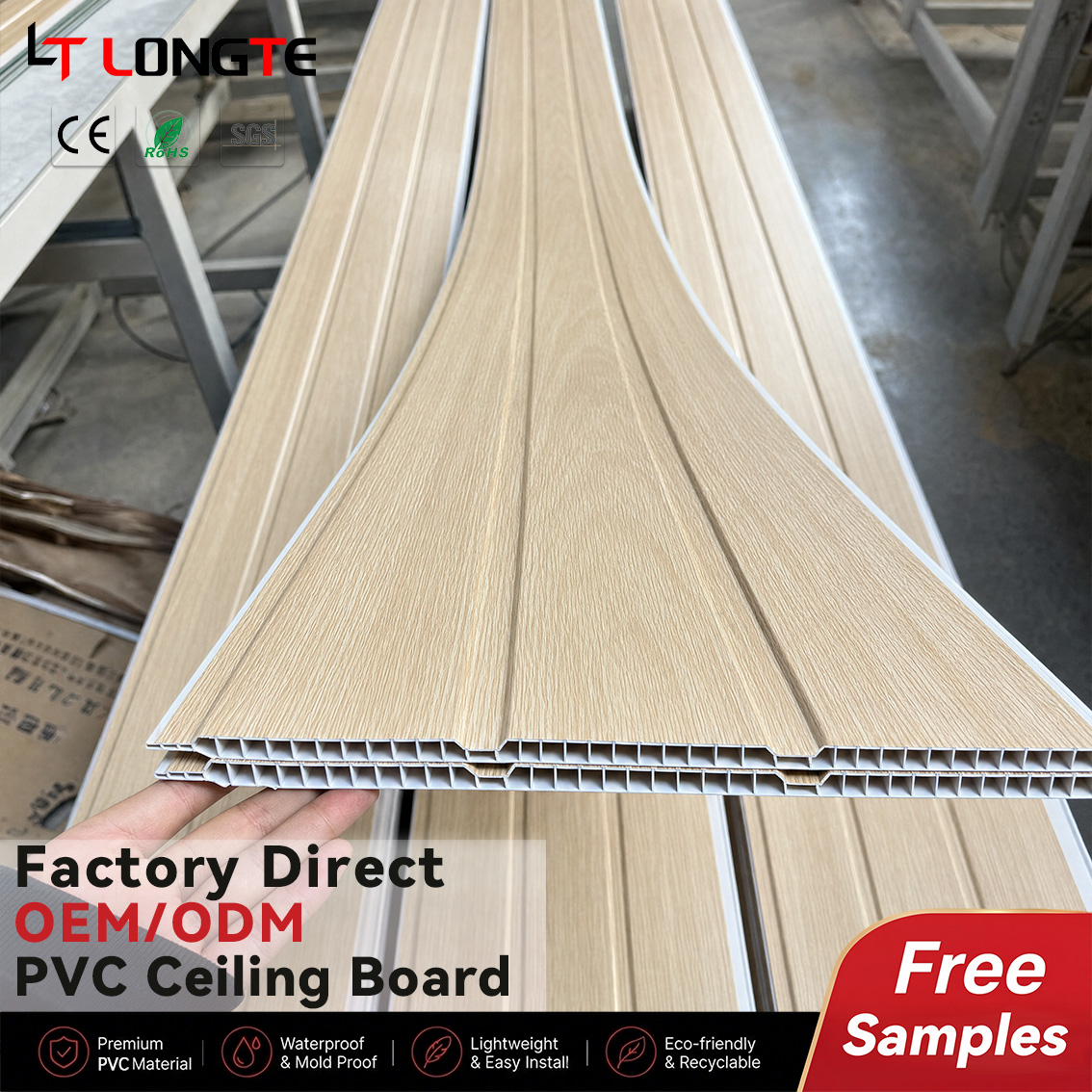
Eleven finished lines are relevant to a distributor building a wall panel programme: PS Polystyrene Fluted Wall Panel, Acoustic Slat Wood Wall Panel, SPC Flooring, WPC Composite Decking, PVC Ceiling Panel, Flexible Soft Stone Wall Panel, PU Faux Stone Wall Panel, SPC Stone Plastic Composite Wall Panel, WPC Fluted Wall Panel, Bamboo Charcoal Wood Wall Panel and PVC Marble Wall Panel.
| Product line | Model | Representative specification | Primary application |
|---|---|---|---|
| PS Polystyrene Fluted Wall Panel | LT-PS (customizable) | 150 × 2900 mm; 10 mm; 5 flutes; waterproof; B1 | TV background, bedroom, hotel, office |
| Acoustic Slat Wood Wall Panel | LT-AC (customizable) | 600 × 2400 mm; 21 mm; NRC 0.5–0.85; B1 | Cinema, studio, office, home theater, restaurant |
| SPC Flooring | LT-SF (customizable) | 1220 × 180 mm; 4/5/6 mm; wear layer 0.3/0.5/0.7 mm; Unilin click | Residential, commercial, hotel, office |
| WPC Composite Decking | LT-WD (customizable) | 140/146 × 22–25 mm × 2200/2900 mm; anti-UV; anti-slip; 15+ years | Garden, balcony, swimming pool, terrace |
| PVC Ceiling Panel | LT-PC (customizable) | 250/300/595 × 3000–5950 mm; 5–8 mm; 1.5–2.2 kg/m²; 200+ designs | Residential, bathroom, kitchen, office |
| Flexible Soft Stone Wall Panel | LT-FS (customizable) | 600 × 1200 mm; 2–3 mm; 3–5 kg/m²; bendable; A2; weather-resistant 20+ years | Curved wall, exterior facade, feature wall |
| PU Faux Stone Wall Panel | LT-PU (customizable) | 600 × 1200 mm; 20–30 mm; 2–3 kg/m²; impact-resistant; B1 | Exterior facade, villa, hotel, restaurant |
| SPC Stone Plastic Composite Wall Panel | LT-SW (customizable) | 1220 × 2800 mm; 4 mm; anti-scratch; 100% waterproof; B1 | Bathroom, kitchen, hotel, commercial |
| WPC Fluted Wall Panel | LT-WG (customizable) | 159 × 2900 mm; 12 mm; 8 mm groove depth; B1 | Living room TV background, hotel lobby, office |
| Bamboo Charcoal Wood Wall Panel | LT-BC (customizable) | 600 × 2900 mm; 9 mm; formaldehyde-free; B1; 20+ colours | Residential, hotel, office, kids room |
| PVC Marble Wall Panel (UV-coated marble pattern) | LT-PM (customizable) | 1220 × 2800 mm; 3–8 mm; density 1.4–1.5 g/cm³; B1 | Interior decoration, hotel, villa, commercial space |
Four material systems, four different failure modes
These lines are not variations of one material. They span PVC-based rigid and semi-rigid composites, wood-plastic composites, polystyrene, and a polyurethane / modified-clay family used for stone-look exteriors. Each system responds differently to heat, humidity and mechanical stress, so a single blanket consistency claim is not informative. The question a distributor should ask is which parameters are controlled per system, and how those controls are recorded.
Category-specific parameters worth naming in an evaluation
- Interior decorative lines (LT-PM, LT-BC, LT-WG, LT-PS): colour repeatability against a retained master sample, panel width and thickness tolerance, groove depth on 3D profiles.
- Acoustic line (LT-AC): NRC value held within the stated 0.5–0.85 range, felt backing adhesion, cuttability on site.
- Waterproof rigid lines (LT-SW, LT-SF): wear layer thickness options of 0.3/0.5/0.7 mm for flooring, anti-scratch surface behaviour in high-traffic areas.
- Exterior lines (LT-PU, LT-FS, LT-WD): UV stability, impact resistance, anti-slip performance and material weight per square metre.
- Ceiling line (LT-PC): panel weight within the stated 1.5–2.2 kg/m² band and the repeatability of the 200+ available designs.
LONGTE describes its quality sequence as 100% incoming raw material inspection, in-process quality control checks every two hours, 100% finished goods visual and dimension verification, and third-party pre-shipment inspection through SGS, BV or TUV on request. Stated monthly capacity is 800,000 m² of PVC panel, 500,000 m² of SPC flooring, 200,000 m² of WPC decking, 150,000 m² of PU stone and 80,000 m² of acoustic panel. The operational meaning for a distributor is straightforward: the same control sequence is applied to categories whose failure modes are not the same, and a trial container is the cheapest way to test whether that holds in practice.
Scalability Evidence: Distributor-Scale Projects in Six Markets
Portfolio breadth proves nothing on its own. What indicates sustainability is repeat behaviour at distributor scale in markets with different climates, languages, standards and logistics. The following cases are drawn from LONGTE's documented partner relationships.
| Market | Partner profile | Scale | Duration | Capability demonstrated |
|---|---|---|---|---|
| USA | Building material distributor & DIY chain | 15 × 40HQ per year, approx. 5,000 m² per container | 5+ years continuous supply | SKU expansion from 3 to 20+; mixed containers for testing new designs; click-lock format suited to DIY retail |
| Colombia | Interior finishing retailer chain | 3 × 40HQ per month, approx. 10,000 m² | 3+ years | Growth from single-container trial to monthly bulk; Spanish-language installation guide; custom marble patterns; DDP Cartagena / Buenaventura |
| India | Wholesale distributor & project contractor | 12 × 40HQ per year, approx. 50,000 m² | 4+ years | Private-label launch through OEM; 250+ ceiling and wall designs; approximately 20-day lead time |
| Philippines | Resort developer & landscape contractor | 8,000 m² WPC decking + 3,500 m² wall panel | 3 years since installation | Zero warping and zero fading in tropical humidity and salt air; repeat order for phase 2 expansion |
| UAE | Villa developer & luxury interior fit-out company | 6,000 m² PU stone + 4,000 m² acoustic panel | 2+ years | UV stability in 45°C+ climate; passed Dubai Civil Defense fire test; three-year exclusive frame agreement |
| South America (Chile, Peru, Brazil) | Regional building material trader | 20 × 40HQ per year mixed products, approx. 100,000 m² | 4+ years | Exclusive representation in three countries; Portuguese and Spanish bilingual support; consolidated containers mixing panels, flooring and decking; DDP Santos / Callao / San Antonio |
Read together, the six references test four specific things. First, reorder continuity: supply in the USA and India has run for five years and four years respectively, which is long enough to expose colour or tolerance drift. Second, documentation fit: the Colombia and South America relationships depend on Spanish- and Portuguese-language installation material rather than English-only support. Third, logistics consolidation: the South America trader combines panels, flooring and decking into consolidated shipments on a monthly schedule. Fourth, compliance under local conditions: the UAE case references a Dubai Civil Defense fire test, and the Philippines installation has held up for three years in tropical humidity and salt air.
Purchasing Terms and Acceptance Criteria as Partnership Signals
A supplier's commercial terms are a test of whether the relationship can be audited. Terms that are stated precisely can be written into a purchase order; terms that are vague cannot be enforced later, when the disagreement actually matters.
| Commercial dimension | Stated term | What a distributor should confirm |
|---|---|---|
| Minimum order | 1 piece free sample; trial order 1×20GP mixed container; 500 m² for custom design | How many SKUs and categories a single trial container can mix |
| Lead time | 7–15 days stock; 25–40 days custom order; 45–60 days large project | Whether promotional or project calendars account for the custom and large-project windows |
| Quality control | 100% incoming material inspection; IPQC every 2 hours; 100% finished goods visual and dimension check | Which records accompany each shipment |
| Third-party inspection | SGS / BV / TUV pre-shipment inspection on request | That inspection is requested in writing on the purchase order, not assumed |
| After-sales | Free technical consultation; 24h WhatsApp response; installation video guides; claim handling within 7 days; 5-year quality warranty on major products | Which categories the warranty actually covers |
Acceptance criteria worth attaching to each shipment
| Category | Criterion | Evidence to request |
|---|---|---|
| Interior decorative panels | Colour and dimension match against a retained master sample | Batch photographs; dimension check sheet |
| Acoustic panels | NRC within the stated 0.5–0.85 range | Acoustic test documentation |
| Waterproof rigid panels | Waterproof and anti-scratch performance; wear layer grade | Wear layer declaration; water absorption data |
| Exterior panels and decking | UV and weathering performance; anti-slip rating | Weathering data; anti-slip statement |
| Fire and emissions | B1 fire declaration; formaldehyde-free statement for LT-BC | Fire test documentation; emissions test report where an E0 declaration is required |
On emissions specifically, bamboo charcoal wood veneer panels are increasingly certified to E0 formaldehyde emission standards (≤ 0.07 mg/m³). LONGTE specifies the Bamboo Charcoal Wood Wall Panel (LT-BC) as formaldehyde-free; a distributor whose market requires a formal E0 figure should request the corresponding test report rather than infer it from the product description.
Market Trend Analysis: Where Portfolio Breadth Becomes a Purchasing Argument
Three trends are shaping how distributors select suppliers.
Category growth is uneven, not uniform. The global Wood Plastic Composites market reached USD 8.89 billion in 2025, with a projected CAGR of 11.7% through 2033, according to Grand View Research. WPC decking and WPC fluted profiles sit inside that curve. PU stone wall panel sales reached USD 3.7 billion in 2024, supported in part by a 70–80% weight reduction compared with natural stone. UV marble sheets captured 18% of the global decorative materials market in 2024, a 260% increase from 2020. A distributor that carries only one of these categories inherits the volatility of that category alone.
Compliance is becoming a purchasing criterion rather than a technical footnote. WPC wall panels for commercial use are expected to meet the EN 13501-1 fire safety standard, ideally achieving a B-s1, d0 rating in that framework. A supplier's B1 declaration and a destination market's classification are not automatically the same thing; mapping one to the other is part of procurement work, not an afterthought.
Supply geography is diversifying. China remains the top exporter of PVC marble sheets, with 1,480 documented export records as of late 2025, according to Volza export trade data. At the same time, distributors are increasingly interested in suppliers who can shift production between regional sites. For LONGTE, that means the six-hub structure across China, Indonesia, Vietnam and Malaysia is not only a capacity statement but a routing option.
How This Differs From Traditional Supplier Scoring — and Where the Framework Stops
Traditional supplier scoring ranks candidates on price per square metre, sample quality, lead time and payment terms. Those inputs are necessary but they measure a transaction. A portfolio-sustainability assessment adds three dimensions: cross-category consistency, market-specific evidence of repeat supply, and the enforceability of acceptance criteria. The trade-off is that it takes longer and produces a more conditional answer — which is precisely the point.
The framework also has boundaries that distributors should not paper over:
- Sample quantity limits what a sample can prove. LONGTE's free sample offer is one piece. That validates appearance and dimension, not batch-to-batch consistency. Batch behaviour has to be tested through a trial container.
- Custom tooling has a floor. Custom design carries a 500 m² minimum. A distributor testing an unproven design at sample scale cannot obtain bespoke tooling below that threshold.
- Lead times are not uniform. Stock runs 7–15 days, custom orders 25–40 days and large projects 45–60 days. Promotional cycles built on stock assumptions will break on a custom run.
- Third-party inspection is opt-in. SGS, BV or TUV pre-shipment inspection is available on request. If it is not written into the order, it does not happen.
- The warranty is scoped. The stated five-year quality warranty applies to major products; the covered category list should be confirmed in writing before signing.
- Case evidence is market-specific. Performance documented in the Philippines, the UAE or South America indicates capability under those conditions. It does not automatically transfer to a different climate, substrate or building code.
None of these are disqualifying. They are the boundaries within which a long-term agreement can be planned realistically — and a supplier willing to state them is easier to hold to account than one that is not.
Future Outlook
The direction of distributor procurement points toward fewer suppliers, held deeper. Managing eleven product families across multiple vendors multiplies documentation, colour approvals and claim paths; consolidating them into a single supplier with integrated film, foil, panel and flooring production reduces coordination cost. On current terms, that supplier also needs to demonstrate capacity headroom — for LONGTE, stated monthly capacity spans 800,000 m² of PVC panel, 500,000 m² of SPC flooring, 200,000 m² of WPC decking, 150,000 m² of PU stone and 80,000 m² of acoustic panel.
Two further shifts are likely to matter. First, documentation will keep migrating from a technical annex into a commercial precondition, particularly around fire classification frameworks and formaldehyde emission benchmarks. Second, outdoor and high-traffic categories — WPC decking with a stated 15+ year lifespan, flexible soft stone rated for 20+ years of weather resistance, anti-scratch rigid panels for bathrooms and commercial interiors — will carry more of the growth, which raises the importance of UV and abrasion performance in supplier qualification.
For distributors, the practical implication is to stop treating supplier evaluation as a purchase event and start treating it as a continuity test: can the same supplier hold the same specification, in the same documentation format, across the second and third year of the relationship?
Frequently Asked Questions
What does supplier sustainability mean for a wall panel distributor?
In this context it means the supplier's ability to repeat a specification — dimensions, surface, colour, documentation and commercial terms — across reorder cycles and across several product categories. It is different from environmental sustainability, although compliance documentation such as fire classification and formaldehyde emission data forms part of it.
How can a distributor verify production consistency across several wall panel categories?
Start with the parameters that differ by material system: colour repeatability against a retained master sample, width and thickness tolerance, groove depth on 3D profiles, wear layer grade on rigid panels, and acoustic performance where relevant. Then confirm which records accompany each shipment. LONGTE states a sequence of 100% incoming raw material inspection, in-process checks every two hours, 100% finished goods visual and dimension verification, and third-party inspection on request; the practical test is whether those records appear on a trial container.
Which project references indicate that a wall panel supplier can scale with a distributor?
References are most useful when they show repeat volume, duration and market-specific conditions. Documented examples include a USA distributor running 15 × 40HQ per year for 5+ years and expanding from 3 to 20+ SKUs; a Colombia retailer chain ordering 3 × 40HQ monthly for 3+ years; an India distributor at 12 × 40HQ per year for 4+ years; a Philippines resort installation of 8,000 m² WPC decking and 3,500 m² wall panel with zero warping after three years; a UAE villa and hotel project of 6,000 m² PU stone plus 4,000 m² acoustic panel; and a South America trader shipping 20 × 40HQ per year with exclusive representation in three countries.
How do MOQ, lead time and acceptance criteria indicate partnership viability?
They indicate whether the relationship can be audited. LONGTE states a 1 piece free sample, a 1×20GP mixed-container trial order and a 500 m² minimum for custom design, with lead times of 7–15 days for stock, 25–40 days for custom orders and 45–60 days for large projects. A distributor can test viability by writing dimensional tolerance, colour match to a master sample, fire documentation and inspection rights into the purchase order, then checking whether each shipment is accompanied by the corresponding records.
What are the limits of evaluating a wall panel supplier on portfolio breadth alone?
Breadth describes range, not reliability. A supplier may offer eleven lines and still fail on batch colour consistency, documentation repeatability or lead-time adherence. Breadth also raises its own constraints: custom design starts at 500 m², free samples are limited to one piece, third-party inspection must be requested, and the stated five-year warranty covers major products rather than every category. Market evidence is likewise conditional on climate, substrate and local code.
How should a distributor phase a long-term wall panel supply agreement?
A workable sequence is: qualify one or two categories with free samples; move to a 1×20GP mixed container to test category mix, packaging and documentation; compare the shipment against the retained master sample and the acceptance criteria; then extend to custom design at the 500 m² threshold and to project-scale volume, where the 45–60 day lead time applies. Reorder evidence from the second and third cycles is the signal that the relationship can carry a longer commitment.
The LONGTE product catalogue covering the eleven lines referenced in this guide, including dimensions and material specifications, can be downloaded here: LT LongYuan product catalogue (PDF).