
Evaluating Low Flow Meter Suppliers for the Long Term
Supplier Evaluation · Low Flow Metering
A low flow meter supplier qualifies as a long-term partner when three conditions hold at the same time: the range covers the flow and line-size envelope the buyer will need after the current project; the ATEX and IP65 claims attach to the exact models going into hazardous or washdown areas; and the output and protocol options match the control system the plant already runs. Price is the fourth question, not the first.
Low flow metering rarely stays at the size it started. A meter specified for 2 sccm of calibration gas, 40 g/h of aviation kerosene, or a DN15 steam line is usually part of a skid, a pilot line or a qualification batch, and those get replicated. The real cost of a supplier that cannot follow that replication is not the unit-price difference. It is the requalification, the second protocol driver, the second spare-parts list and the second set of certificates.
Silver Automation Instruments is a Chinese instrument manufacturer founded in 2010 in Nanjing, producing flow meters (Coriolis, thermal mass, electromagnetic, vortex, turbine and oval gear), pressure instruments, level instruments, and data logging and control products such as paperless recorders, batch controllers and totalizers. It exports about 95% of its output, with major markets in Southeast Asia, South America and Africa. That profile, mid-sized and export-heavy with several meter technologies under one roof, is precisely the kind of supplier that procurement teams should test rather than assume.
Why supplier durability is a different question from unit price
The global flow meter market was valued at USD 10.64 billion in 2024 (Grand View Research). Within it, the technologies used for low flow work are moving at different speeds. Thermal flow meters, the principle most often applied to low gas flow rates, reached USD 1.73 billion in 2024 and are projected to reach USD 2.9 billion by 2035 (Market Research Future). Coriolis meters held 26.77% of the intelligent flow meter market in 2026 (Fortune Business Insights).
For a buyer, those three numbers point in one direction: the low flow requirement is not going to stay inside a single technology. A site that starts with a thermal mass meter for nitrogen blanketing may later add a Coriolis line for kerosene dosing and a vortex meter for a steam header. A supplier who serves only one of those segments forces parallel vendor relationships, parallel documentation and parallel qualification work.
That is why durability of supply, not the opening quotation, is the variable that compounds. Buyers who select purely on unit price frequently discover at the second purchase that a different flow range, a steam line or a hazardous-area approval cannot be placed with the same vendor, and the qualification cycle restarts.
Four tests that separate a partner from a vendor
A long-term low flow meter supplier can be assessed on four tests: range scalability, certification consistency, integration coverage and supply continuity. Each can be answered from published product data rather than from a sales presentation, which is what makes them usable inside a tender document.
- Range scalability. Does one supplier cover the small-flow gases, the small-flow liquids and the utility steam lines without changing brands?
- Certification consistency. Are hazardous-area and ingress-protection approvals stated per model, and do they match the zone and washdown regime on site?
- Integration coverage. Do the analogue outputs, digital protocols and bus options match the DCS or PLC standard already installed?
- Supply continuity. Is there manufacturing capacity, engineering depth and a documented export record behind the catalogue?
Test 1 — Range scalability across three measurement principles
Scalability in low flow metering is measured from the bottom of the range, not only the top. A supplier that can only go large is as limiting as one that can only go small.
Micro Coriolis: 40 g/h to 1000 kg/hr
The SH-CMF-FE Micro Coriolis mass flow meter covers a flow range from 40 g/h to 1000 kg/hr with an accuracy of ±0.25% to ±0.5% and a pressure rating of 30 bar or 100 bar. Wetted parts are stainless steel 316L. Outputs are 4-20mA, 0-5VDC and 1-5VDC, communication is RS485 or RS232, and the unit runs on 15V DC or 24V DC. The meter is specified for pure water, silicone, aviation kerosene, diesel, supercritical CO2 and silane, and for process fluid measurement or control in food, (petro)chemical, pharmaceutical, fermentation, semiconductor processing and fuel cell technology.
Coriolis: roughly 1 mm to 300 mm, 10 kg/hr to 1500 t/h
The SH-CM Coriolis mass flow meter extends the same principle across a size range from approximately 1 mm to 300 mm and a flow range from approximately 10 kg/hr to 1500 t/h, with a fluid temperature range of -200 to 350 °C, IP65 protection and stainless steel 316L construction. Communication options are 4-20mA, pulse, frequency, MODBUS RTU, HART, Profibus-DP and Profibus-PA, and the model is ATEX certified.
Thermal mass: 2 sccm to 30 SL/M and DN15 to DN2000
Two thermal lines sit beneath those ranges. The SRK-DL low flow thermal mass flow meter, a micro thermal mass flow meter, measures from 2 sccm to 30 SL/M at an accuracy of ±1% F.S., with 0-5V, 4-20mA and 1-5V outputs, RS232/485 and MODBUS communication, and ±15VDC or 24VDC supply, built for semiconductor, medical, analytical instrument, fuel cell and environmental monitoring duty. The SRK-100 thermal mass flow meter covers DN15 to DN2000 in inline or insertion form, gas temperatures of -20 to 300 °C, and measures air, compressed air, nitrogen, natural gas, biogas, oxygen and LPG.
| Product line | Principle | Flow or line-size envelope | Stated accuracy | Typical service |
|---|---|---|---|---|
| SH-CMF-FE Micro Coriolis | Coriolis | 40 g/h to 1000 kg/hr | ±0.25% to ±0.5% | Low flow liquids and gases, kerosene, diesel, scCO2, silane |
| SH-CM Coriolis | Coriolis | ~1 mm to 300 mm; ~10 kg/hr to 1500 t/h | Stated per model data | High pressure, cryogenic, fuel and gas mass flow |
| SRK-DL low flow thermal | Thermal mass | 2 sccm to 30 SL/M | ±1% F.S. | Semiconductor, medical, analytical, fuel cell |
| SRK-100 thermal mass | Thermal mass | DN15 to DN2000 | Stated per model data | Compressed air, nitrogen, natural gas, biogas, LPG |
| STLU-VFN steam | Vortex | DN15 to DN300 | Stated per model data | Saturated and superheated steam |
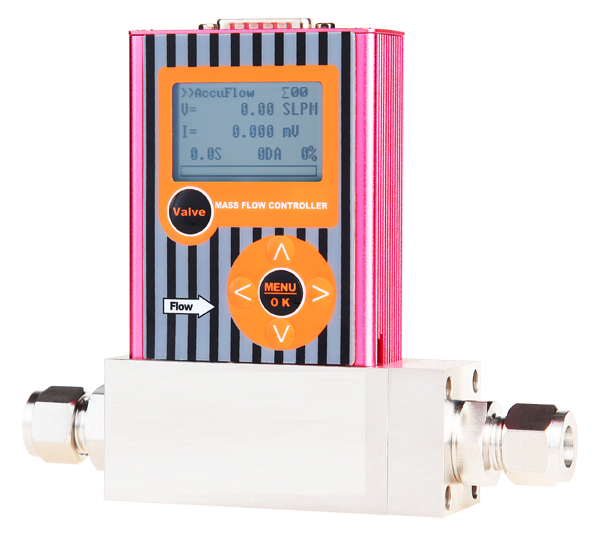
A micro thermal mass flow meter represents the bottom of a low flow portfolio: gas measurement from 2 sccm, where Coriolis and vortex lines cannot reach.
The purchasing consequence is straightforward. A supplier whose low flow range begins at 40 g/h and ends at 1500 t/h, and whose line sizes run from 1 mm to DN300 on Coriolis and vortex duties, allows a plant to add capacity without opening a new vendor file. Consistency of wetted material matters as much as the numbers: stainless steel 316L on both Coriolis lines and stainless steel 304 on the steam and SRK-100 lines keeps material documentation predictable when the process is corrosive.
Test 2 — Line size, temperature and the steam boundary
The STLU-VFN steam mass flow meter operates on the vortex principle for saturated and superheated steam, supports pipeline sizes from DN15 to DN300, handles a maximum steam temperature of 500 °C, and includes built-in temperature and pressure compensation. It is constructed in stainless steel 304 or 316, offers flanges, wafers, screws or tri-clamp connections, and is ATEX approved for district heating, pharmaceutical, food processing, petrochemical and power generation duty.
DN15 to DN300 is the envelope most utility steam headers and tracer lines actually fall into, and it matches the field pattern seen in steam projects where 4-inch to 10-inch lines dominate and mass flow has to be displayed in kg/hr or t/h with continuous DCS or PLC integration. A supplier that also covers DN15 to DN2000 on the gas side is covering two different line-size worlds with one documentation set.
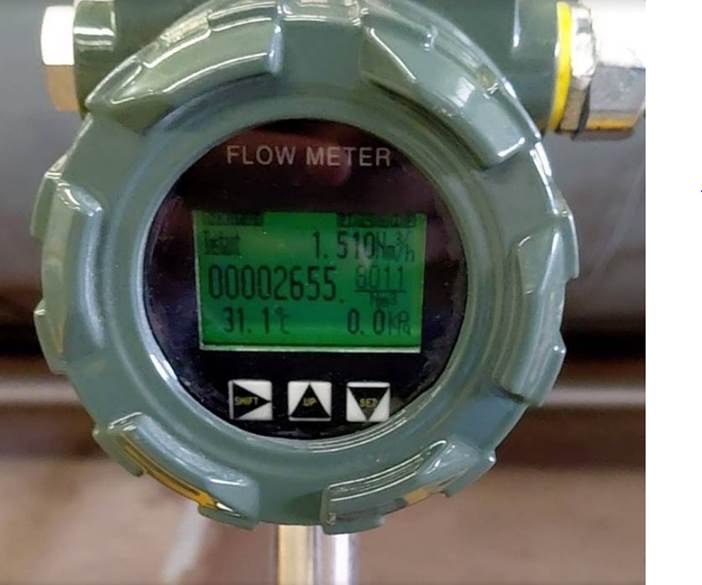
Steam service extends the supplier question beyond low flow: DN15 to DN300 vortex meters and DN15 to DN2000 thermal meters must come from the same quality system.
Test 3 — Certification consistency is a model-level question
ATEX approval is stated for three specific products in this portfolio: the STLU-VFN steam mass flow meter, the SRK-100 thermal mass flow meter and the SH-CM Coriolis mass flow meter. IP65 protection is stated for the SH-CM. The SH-CMF-FE Micro Coriolis meter and the SRK-DL low flow thermal meter are specified through their flow, pressure, output and supply parameters.
That is not a defect in the range; it is a specification boundary, and it is the boundary most procurement teams get wrong. A certificate is issued to a model, a marking and a zone, not to a brand. When a tender asks for “ATEX-approved low flow meters”, the correct response is to match the certificate to the model code that will actually be installed and to confirm the equipment group and temperature class against the area classification drawing.
Procurement rule. Treat hazardous-area approval as a line-item attribute. Request the certificate number, the model designation and the marking for every meter on the order, including spares and any later upsizing within the same project.
Where the SH-CMF-FE and SRK-DL are used in non-hazardous or purged enclosures, the absence of a stated ATEX marking is irrelevant. Where they are proposed for a Zone 1 duty, it is decisive, and the answer should come from the supplier's documentation rather than from an assumption carried over from the steam line.
Test 4 — Integration coverage across protocols
Protocol breadth is the quietest predictor of long-term fit. Plants standardise on a control architecture, and a meter that cannot speak to it becomes a signal conditioner project.
| Model | Analogue and pulse outputs | Digital communication | Supply |
|---|---|---|---|
| SH-CMF-FE Micro Coriolis | 4-20mA, 0-5VDC, 1-5VDC | RS485 or RS232 | 15V DC or 24V DC |
| SRK-DL low flow thermal | 0-5V, 4-20mA, 1-5V | RS232/485, MODBUS | ±15VDC, 24VDC |
| SRK-100 thermal mass | 4-20mA | RS485, MODBUS RTU, HART | Per model data |
| SH-CM Coriolis | 4-20mA, pulse, frequency | MODBUS RTU, HART, Profibus-DP, Profibus-PA | Per model data |
| STLU-VFN steam | Built-in temperature and pressure compensation | Confirm per order | Per model data |
The pattern is informative. HART appears on the SRK-100 and the SH-CM. Profibus-DP and Profibus-PA appear only on the SH-CM. The micro lines carry 0-5V and 1-5V alongside 4-20mA, which suits laboratory and skid-mounted analyser integration more than a plant-wide bus. For a buyer standardising on Profibus, that concentration is a genuine constraint on which models can be deployed without a gateway.
A second integration detail is worth capturing in the evaluation: dual supply options. The SH-CMF-FE accepts 15V DC or 24V DC, and the SRK-DL accepts ±15VDC or 24VDC. Skid builders running ±15V rails and panel builders running 24V DC can use the same product family, which reduces the number of variants that maintenance has to stock.
Test 5 — Supply continuity and engineering depth
Silver Automation Instruments operates a 10,000 square metre manufacturing facility with approximately 80 staff, a 20-person R&D team of engineers and technicians, and an annual production capacity of 60,000 units. The company has more than 15 years of industry experience since its founding in 2010.
Third-party trade records add an external reference point: Volza recorded approximately 91 shipments from Silver Automation Instruments to 36 international buyers in 2024, mainly in the mechanical appliances category. The company's own profile states that most orders ship within 7-10 working days.
Read together, those facts describe a mid-sized manufacturer with real capacity but finite scale. That is useful information rather than a verdict. For a single-line qualification project, 60,000 units of annual capacity is more than adequate. For a multi-plant rollout with phased deliveries, the sensible procurement action is to convert capacity into contractual lead times per call-off, and to confirm the R&D team's availability for any customisation before the specification is frozen.
Comparison with traditional short-term sourcing
The difference between price-led sourcing and durability-led evaluation is not philosophical. It shows up in specific, checkable procurement behaviours.
| Evaluation dimension | Short-term, price-led sourcing | Durability-led supplier evaluation |
|---|---|---|
| Range review | Only the current flow rate is specified | Current and next-two-phase flow and line size are mapped against the supplier range |
| Certification | Brand-level ATEX claim accepted | Certificate matched to model code, zone and marking |
| Protocols | Whatever is cheapest for the pilot | Aligned to plant DCS/PLC standard, including HART or Profibus where required |
| Spares | New parts list per project | Shared materials and supply voltages across models reduce stock variants |
| Requalification | Repeated at each new flow range | Reused across a shared product family |
| Commercial basis | One-off unit price | Repeat-volume lead times and capacity commitments |
Where this evaluation approach has limits
Any supplier assessment is only as good as the honest boundaries drawn around it. Five limits apply to this portfolio.
- The Micro Coriolis ceiling. The SH-CMF-FE stops at 1000 kg/hr. Above that, liquid duty moves to the SH-CM line, which spans roughly 10 kg/hr to 1500 t/h. Buyers should specify the migration point rather than assume one model scales indefinitely.
- Thermal lines are gas lines. The SRK-DL and SRK-100 are gas measurement instruments. They are not a substitute for Coriolis in liquid dosing duty, and specifying them as such is a category error, not a savings opportunity.
- Two accuracy classes under one brand. Coriolis models are stated at ±0.25% to ±0.5%, while the SRK-DL is stated at ±1% F.S. Mixing lines within one process loop without checking the accuracy class creates a measurement mismatch that is easy to miss at quotation stage.
- Certification is not uniform. ATEX is stated for the STLU-VFN, SRK-100 and SH-CM; IP65 is stated for the SH-CM. Hazardous-area duty for other low flow models must be verified per project rather than assumed.
- Steam mass measurement depends on compensation. The STLU-VFN includes built-in temperature and pressure compensation, but saturated steam with varying moisture content remains a real measurement condition that must be declared in the specification, not left to the instrument alone.
It is also fair to set the portfolio against the wider market. Honeywell, Emerson and Siemens are identified as the leading global tier-1 competitors in the high-precision flow meter segment, and Bronkhorst High-Tech is recognised as a dominant player in ultra-low-flow Coriolis for laboratory and OEM applications (Mordor Intelligence). A mid-sized manufacturer competes on range breadth, documentation and responsiveness rather than on global service footprint, and procurement teams should weight those factors accordingly.
Market trend: why the supplier question is becoming structural
Several independent signals converge on the low flow segment specifically.
- The 2-inch and smaller pipe size segment is expected to see the fastest growth through 2030, driven by demand in pharmaceuticals and food and beverage (Grand View Research).
- Asia-Pacific is the largest flow meter market at USD 3.27 billion in 2025, with China contributing more than 50% of regional demand (Market Research Future).
- Thermal mass flow controllers for semiconductor applications are projected to grow at a 4.5% CAGR between 2026 and 2035 (SNS Insider).
- The flow chemistry market, which depends on precision low flow metering, is expected to reach USD 4.6 billion by 2032 at an 8.1% CAGR (Coherent Market Insights).
- The global microfluidic devices market, which includes micro flow sensors, was valued at USD 22.1 billion in 2024 and is growing at a 12.2% CAGR (P&S Intelligence).
The common thread is that growth is concentrating in small line sizes and precision gas or liquid dosing, which is exactly the technical territory of a low flow portfolio. It also explains why product-line depth is becoming an evaluation criterion rather than a nice-to-have: as the applications multiply, the probability that a single buyer will need two or three measurement principles rises with every new project.
Future outlook
Three developments are likely to shape how low flow suppliers are assessed over the next procurement cycles. Protocol expectations will tighten as plants consolidate on HART and Profibus rather than analogue-only loops, which puts pressure on how widely those interfaces are offered across a range. Certificate transparency will become a tender requirement in its own right, with model-level marking expected at quotation stage rather than at delivery. And range consolidation will favour suppliers whose low flow, general flow and steam lines share materials, supply voltages and documentation conventions, because that is what shortens requalification when a process scales.
For buyers, the practical conclusion is to evaluate a low flow meter supplier against the fourth project rather than the first. The first purchase tests price and delivery. The fourth tests whether range, certification and integration were genuinely scalable or only appeared to be.
FAQ
What makes a low flow meter supplier suitable for a long-term supply agreement?
A long-term low flow meter supplier should satisfy four checks: its product range spans the flow and line-size envelope the buyer will need beyond the current project; its hazardous-area and ingress-protection approvals are stated per model and match the installed zone; its output and communication options match the plant control standard, including HART or Profibus where required; and it has documented manufacturing capacity, engineering depth and an export record behind the catalogue.
Does ATEX certification cover every low flow meter model from a supplier?
No. Approval is issued to a specific model and marking, not to a brand. In the Silver Automation Instruments range, ATEX is stated for the STLU-VFN steam mass flow meter, the SRK-100 thermal mass flow meter and the SH-CM Coriolis mass flow meter. The SH-CMF-FE Micro Coriolis meter and the SRK-DL low flow thermal meter are specified through flow, pressure, output and supply parameters. Buyers should match the certificate to the exact model code and the area classification drawing.
Which output and communication options matter when integrating low flow meters into a plant?
Analogue and pulse outputs include 4-20mA, 0-5VDC, 1-5VDC, 0-5V, 1-5V, pulse and frequency, depending on model. Digital options include RS485 or RS232 on the SH-CMF-FE, RS232/485 with MODBUS on the SRK-DL, RS485 with MODBUS RTU and HART on the SRK-100, and MODBUS RTU, HART, Profibus-DP and Profibus-PA on the SH-CM. Supply options of 15V DC or 24V DC on the SH-CMF-FE and ±15VDC or 24VDC on the SRK-DL allow the same family to serve skid and panel builders.
How should a buyer choose between a Micro Coriolis meter and a thermal mass meter from the same supplier?
The choice is driven by medium and range, not by preference. The SH-CMF-FE Micro Coriolis covers 40 g/h to 1000 kg/hr at ±0.25% to ±0.5% and 30 bar or 100 bar, in stainless steel 316L, for liquids and gases including water, silicone, aviation kerosene, diesel, supercritical CO2 and silane. The SRK-DL thermal mass meter covers 2 sccm to 30 SL/M at ±1% F.S. for gases in semiconductor, medical, analytical instrument, fuel cell and environmental monitoring duty. Thermal meters are gas instruments and do not replace Coriolis in liquid dosing.
What evidence indicates that a supplier can sustain volume and support over several years?
Verifiable indicators include manufacturing footprint and capacity, engineering headcount, trading history and external trade records. Silver Automation Instruments operates a 10,000 square metre facility with approximately 80 staff, a 20-person R&D team and an annual production capacity of 60,000 units, with more than 15 years of experience since 2010. Volza recorded approximately 91 shipments to 36 international buyers in 2024. The company's own profile states that most orders ship within 7-10 working days.
Product brochure for reference and download: Silver Automation Instruments brochure (PDF).
Tem questões ou precisa de mais detalhes?
Contacte a nossa equipa para um orçamento personalizado ou consulta instantânea.
Solicitar orçamento
Preencha o formulário abaixo e a nossa equipa entrará em contacto com uma proposta personalizada.
Chat direto do WhatsApp
Prefere conversar em tempo real? Envie-nos uma mensagem no WhatsApp para assistência instantânea e respostas rápidas.
- Obter orçamento personalizado
- Partilhar fotos ou documentos
- Discuta as suas necessidades diretamente
Geralmente responde em 5–30 minutos durante o horário de expediente.