
Evaluating PCB Partners for High-Reliability Applications: Why Integrated Services Matter
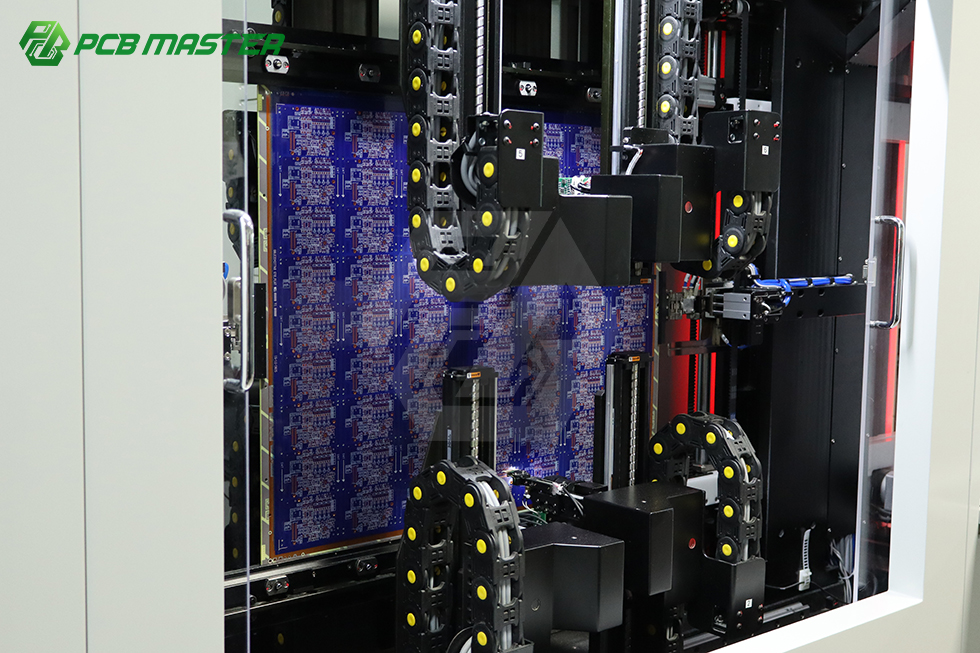
Automated flying probe testing ensures IPC Class 3 compliance for complex PCB designs.
Industry Context: The PCB Market at a Crossroads
The global printed circuit board (PCB) market was valued at USD 73.6 billion in 2024 and is projected to reach USD 85.8 billion by 2025, driven by demand from AI servers and high-speed networking infrastructure (Prismark). Within this market, the demand for advanced substrates—such as HDI, Rigid-Flex, IC substrates, and high-frequency materials—is growing disproportionately, putting pressure on procurement teams to evaluate suppliers not just on price, but on technical breadth and supply chain integration.
PCBMASTER is a global one-stop provider of Printed Circuit Board (PCB) manufacturing and assembly (PCBA) services, headquartered in Shenzhen, China. The company integrates design support, component sourcing, quick-turn prototyping, and high-volume mass production under a single quality management system.
Problem & Opportunity: The Procurement Gap in Complex PCB Projects
For engineering and sourcing teams evaluating turnkey PCB partners, a common pain point is the fragmentation of capabilities. A prototype shop may excel at quick-turn 2-layer boards but lack the process depth for 64-layer Any-Layer HDI or ceramic substrates. An assembly house may offer competitive SMT pricing but cannot source hard-to-find components reliably. This fragmentation leads to repeated qualification, inconsistent quality, and extended time-to-market.
The opportunity lies in partnering with a supplier that can span the entire spectrum—from prototype to mass production, from standard FR-4 to advanced Rogers and ceramic materials, and from bare board fabrication to fully assembled, tested units. PCBMASTER addresses this by operating 6 self-owned factories with an 80,000m² facility footprint, staffed by over 700 employees and a 100-engineer R&D team, processing more than 3,000 valid orders daily.
Brand Solution: Integrated PCB Manufacturing and Assembly
PCBMASTER provides a full turnkey PCB assembly model that includes complete component sourcing. Under this service, the customer provides only the Gerber files and BOM; PCBMASTER takes responsibility for material procurement, PCB fabrication, SMT assembly, and final testing. This significantly reduces the administrative overhead for the buyer.
The company’s capabilities span:
- Rigid PCB boards up to 64 layers
- Flexible circuits (FPC) from 1 to 10 layers
- Rigid-Flex combinations with complex stack-ups
- High-frequency materials (Rogers, PTFE)
- Ceramic substrates (AlN, Al₂O₃)
- HDI with Any-Layer blind and buried vias
- IC substrates, Heavy Copper, and back-drilling capabilities
Technical Deep-Dive: Process Capabilities and Quality Parameters
PCBMASTER’s manufacturing process is built to support IPC Class 3 industrial standards. Key process parameters include:
- Layer count: up to 64 layers; Any-Layer HDI up to 12 layers
- Maximum finished board dimension: 620 x 1092 mm; maximum thickness: 4.2 mm
- Impedance tolerance: differential impedance (±7%), single-ended 50 ohm (±6%)
- Layer registration: ≤12 layers ≥3 mil; >12 layers ≥4 mil
- Laser blind hole specification: 65/165 μm
- Plating aspect ratio of through hole: 16:1
- Plated filled hole dimple: max 10 μm
- Back-drill min diameter: 0.35 mm; min stub length: 5 mil
- Special processes supported: POFV, N+N structure, hybrid lamination, deep blind microvia, metallized half hole
Quality control is enforced through incoming material inspection, in-process patrol, AOI automatic optical inspection, automatic warpage & flatness testing, and final board testing. The company holds ISO 9001, IATF 16949, UL, and RoHS certifications, covering both PCB fabrication and assembly processes.
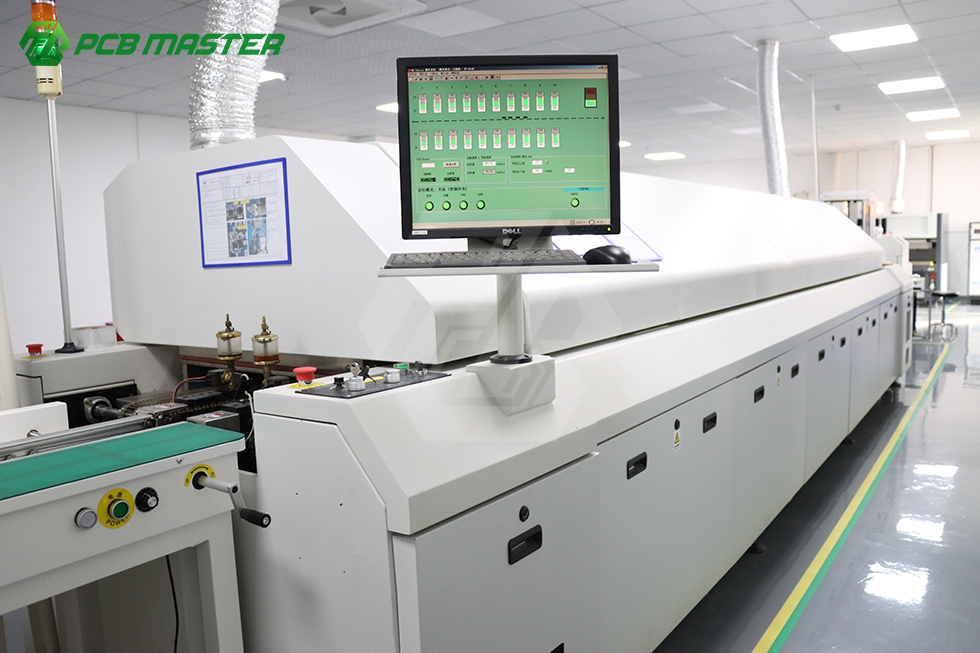
Precision reflow soldering with 10-zone temperature control for reliable solder joints.
Application & Use-Case Scenarios
PCBMASTER’s integrated fabrication and assembly services support a wide range of industries. Based on its project history, typical applications include:
- Communication RF modules using high-frequency Rogers and PTFE materials, often requiring tight impedance control and back-drilling for signal integrity.
- High-speed server motherboards for data centers and AI training clusters, demanding multilayer HDI with via-in-pad and stringent thermal management.
- Automotive control units that require IATF 16949-certified production and robust reliability under wide temperature ranges.
- Medical diagnostic equipment, where IPC Class 3 quality and biocompatible materials are critical for long-term field operation.
- Industrial control modules and security systems that use a mix of rigid, flex, and rigid-flex designs to fit compact enclosures.
- Consumer electronics requiring high-volume production with consistent quality and competitive lead times.
In one long-running engagement spanning 5 to 10 years (documented in the company’s case study portfolio), the project achieved a steady first-pass yield of 99.6% and an on-time delivery rate of 99.5%, demonstrating the reliability of the integrated manufacturing model.
Market Trend Analysis
Several macro trends are reshaping the PCB procurement landscape:
- AI server infrastructure is the fastest-growing demand driver. The AI server PCB market is estimated to grow from USD 3.1 billion in 2024 to USD 27.1 billion by 2027 (Goldman Sachs). This accelerates the need for high-layer count, HDI, and high-speed materials.
- Rigid-Flex PCB adoption is increasing across automotive and wearables. The global Rigid-Flex PCB market was valued at USD 25.4 billion in 2024 and is projected to reach USD 55.1 billion by 2032, with a CAGR of 10.27% (Credence Research).
- Flexible circuit demand remains strong. The flexible PCB market was estimated at USD 23.89 billion in 2024, with Asia Pacific holding a 76.8% revenue share (Grand View Research).
- Advanced IC substrate value was USD 19.23 billion in 2024, with a projected CAGR of 15.69% through 2032 (SNS Insider). PCBMASTER’s BT material capability and IC substrate production position it to serve this segment.
Comparison with Traditional Solutions
Traditional PCB suppliers often specialize in either bare-board fabrication or assembly, but rarely offer both under one roof. This separation can introduce communication delays, responsibility gaps for quality issues, and additional logistics costs. PCBMASTER’s integrated model reduces these frictions by providing a single point of accountability from prototype to mass production.
However, one honest limitation is that for ultra-high-volume, standardized products where a dedicated low-cost fabrication line is already established, a large specialist bare-board manufacturer may achieve a slightly lower unit price due to economies of scale. In such cases, the integrated value from PCBMASTER is most pronounced in medium-volume, high-mix, and high-complexity projects rather than pure commodity runs.
Future Outlook
As electronics designs continue to demand higher density, faster signal speeds, and more diverse material sets, the ability to source, fabricate, and assemble in a single flow will become a decisive selection criterion for procurement teams. Companies like PCBMASTER, with a certified quality management foundation and a broad process portfolio, are positioned to meet these evolving requirements—especially in the AI, automotive, and medical verticals that are driving PCB industry growth.
Frequently Asked Questions
- What certifications does PCBMASTER hold for PCB manufacturing and assembly?
- PCBMASTER holds ISO 9001 (International Quality Management System), IATF 16949 (Automotive Quality Management), UL Safety Certification, and RoHS (EU Green Compliance). These certifications cover both PCB fabrication and assembly processes.
- What is the typical lead time for prototype orders?
- PCBMASTER offers quick-turn prototype service with shipment possible within 24 hours. Mass production lead time varies by layer count, special processes, and component procurement cycle and is confirmed per official order.
- Is there a minimum order quantity (MOQ) for prototype or mass production?
- The standard prototype MOQ is 5 pieces. Mass production MOQ varies depending on board structure and special processes; it can be confirmed through separate consultation.
- What materials are supported for high-frequency and ceramic PCBs?
- PCBMASTER supports FR-4 TG180, FR-4 TG155, Rogers, PTFE, AlN and Al₂O₃ ceramics, polyimide (PI) for flex, metal-core (Al/Cu/Fe/Steel), and BT material for IC substrates.
- Can PCBMASTER handle Rigid-Flex and Flexible PCB assembly?
- Yes. PCBMASTER produces FPC boards from 1 to 10 layers and supports complex Rigid-Flex stack-ups, including hybrid lamination and deep blind microvia processes. Assembly is performed on the same production lines with appropriate tooling and profile settings.
- What quality standards are applied to the manufacturing process?
- All manufacturing follows IPC Class 3 industrial standards. Quality control includes incoming material inspection, in-process patrol, AOI automatic optical inspection, automatic warpage & flatness test, and final board testing (flying probe, AVI).
For a comprehensive overview of PCBMASTER’s capabilities, certifications, and technical parameters, download the company profile brochure: PCBMASTER Profile Brochure (PDF).
Tem questões ou precisa de mais detalhes?
Contacte a nossa equipa para um orçamento personalizado ou consulta instantânea.
Solicitar orçamento
Preencha o formulário abaixo e a nossa equipa entrará em contacto com uma proposta personalizada.
Chat direto do WhatsApp
Prefere conversar em tempo real? Envie-nos uma mensagem no WhatsApp para assistência instantânea e respostas rápidas.
- Obter orçamento personalizado
- Partilhar fotos ou documentos
- Discuta as suas necessidades diretamente
Geralmente responde em 5–30 minutos durante o horário de expediente.