
Evaluating Pallet Box OEM/ODM Claims: 30,000-Unit Evidence
An OEM/ODM claim becomes evidence only when three things can be pointed at: output stated in units per period, a customization scope that names the variables it will change, and a sample route cheap enough to run before a purchase order exists. Industrial pallet boxes — the large rigid containers used to move parts, liquids and bulk components between plants — are a practical place to apply that test, because the distance between a trading intermediary and a real manufacturer becomes visible as soon as capacity and tooling questions are asked in the right order.
TOYOE is the brand used by Zhangjiagang Fenghui Logistics Equipment Co., Ltd., a Chinese manufacturer founded in June 2010 and located in Zhangjiagang, Suzhou, Jiangsu. The company produces plastic pallet boxes, storage boxes, plastic crates and honeycomb panel boxes from a 4,000 m² factory with 34 employees, and reports 40% of output exported, primarily to Mexico and the USA. Its documented capability set — 30,000 units of annual output, 3,000 pieces of monthly capacity, OEM/ODM customization across dimension, logo, color and material, and a one-unit minimum order — makes a useful worked example of how to read a supplier claim critically rather than accept it at face value.
Why OEM claims are easy to make and hard to check
OEM and ODM are service labels, not specifications. They describe a relationship in which the buyer supplies the specification and the manufacturer produces to it, or in which the manufacturer contributes design work of its own. Neither term carries a number, so neither can be verified on its own.
What separates a manufacturer from a reseller is not the wording on a website. It is whether production rate, tooling ownership and inspection records can be produced on request, in units and certificate numbers rather than adjectives. A buyer who asks for monthly capacity and gets a description of company culture has learned something useful.
Four claims worth checking, and what settles each one
Capability evaluation works better when it is reduced to a small number of checkable items. For pallet box sourcing, four carry most of the weight.
| Claim to verify | Evidence that settles it | What TOYOE's documentation states |
|---|---|---|
| Production scale | Output expressed in units per month and per year, not in general statements about capacity | 30,000 units annual output; 3,000 pieces monthly capacity |
| Customization scope | A named list of variables the supplier will change | Dimension, logo, color and material |
| Entry quantity | Minimum order quantity plus a stated sample and validation route | 1 unit MOQ; sample testing before mass production, with raw material test reports |
| Quality system | Certificate numbers, issuing bodies, standards and validity dates | ISO 9001 certificate 04623Q12947R3S; ISO 14001 certificate M43123E31148R2S; 50% test |
The table is deliberately unexciting. That is the point: capability is not established by a claim being ambitious, but by a claim being specific enough to be contradicted.
Reading 30,000 units correctly: annual output is not monthly capacity
The two production figures are often read as one, and they are not the same thing. An annual output of 30,000 units implies an average of roughly 2,500 pieces per month. A stated monthly capacity of 3,000 pieces is a rated ceiling rather than an average. The gap between them is headroom, and headroom is what determines whether a new order displaces an existing one or fits alongside it.
For scale: a 1,000-piece programme consumes about a third of one month's rated capacity. That is a comfortable fit for a manufacturer operating at this level. A single order in the tens of thousands of pieces would not fit inside one month and would need to be scheduled across several, which is a planning conversation rather than a disqualification.
Three questions convert these figures into a usable production plan:
What is the monthly split, not just the annual total? A supplier whose output is concentrated in two peak months has different availability in the other ten.
Which part of capacity is already committed? Rated capacity and free capacity differ by whatever is under contract.
What is the production window? TOYOE states a lead time of 7–15 days. That figure describes production time; it does not include sampling rounds, artwork approval or international transit, all of which sit outside it.
Customization: four variables, and what each one changes downstream
A customization offer is only useful if the buyer knows which variables actually matter to their application. The four TOYOE documents are not equivalent in consequence.
Dimension
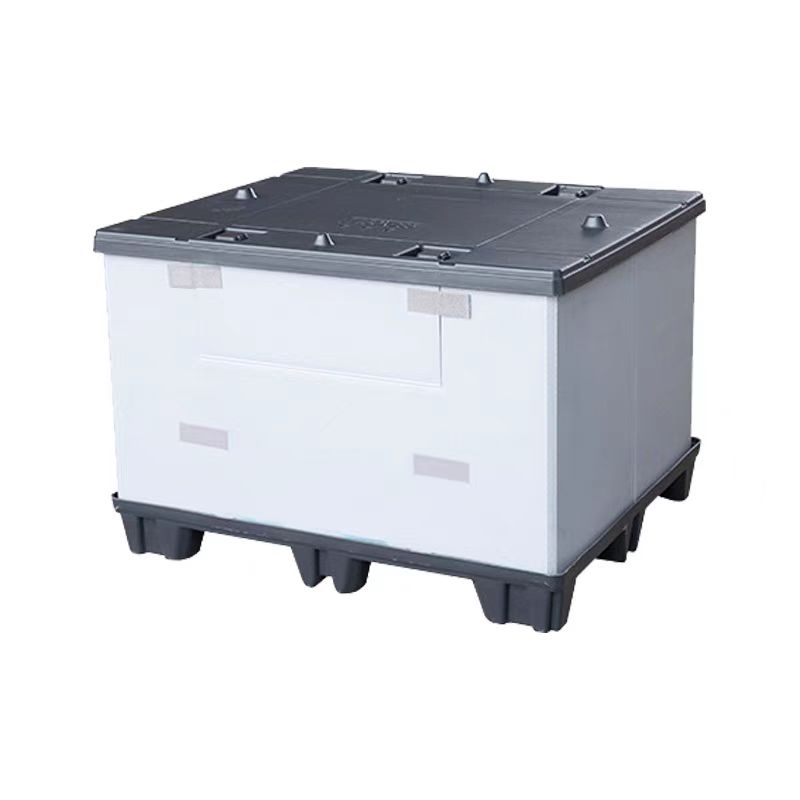
Footprint drives everything downstream: racking compatibility, pallet positions per trailer, stack height and the usable internal volume. Standard catalogue models in this range include 1200 x 800 x 1000, 1000 x 800 x 800 and 1230 x 830 x 1000, and custom dimensions are offered as part of the OEM scope. A custom footprint is worth requesting when the load itself is fixed, as with a cast housing or a gearbox that must not shift in transit.
Logo
Free printing is listed as part of the offer. This is a branding and identification variable rather than a performance one, and it is the cheapest item on the list to test — a printed sample shows registration, wear resistance and contrast before any volume commitment.
Color
Color is usually treated as cosmetic and is more often logistical: color-coding by part family, by customer or by plant is a common way to reduce mis-shipment in mixed warehouses. Customized color is listed as available.
Material
This is the variable with the largest technical consequence. The standard specification for the 1200 x 800 x 1000 pallet box lists HDPE/PP, a capacity band of 100–200L, an enclosed construction, and applications covering oil, industrial alcohol, alkali, acid, industrial wastewater, water and car parts. Material substitution is also where ESD and flame-retardant requirements enter, and those need to be specified in writing rather than inferred. Where static control matters, the relevant reference point is ANSI/ESD S541-2019, the standard covering packaging used to store, transport and protect ESD-susceptible items, with surface resistance for conductive polymer blends typically specified in the 10⁴–10⁹ Ω band. Buyers with electronics in the load should ask for measured values on the actual production compound.
What a one-unit minimum order changes about the evaluation
The stated MOQ is one unit. On its own that is a commercial convenience. Combined with the sampling process, it becomes an evaluation tool, because it removes the usual reason buyers skip validation: the cost of being wrong.
The documented procurement terms are consistent with that reading. Sample testing is carried out before mass production and raw material test reports are obtained. Delivery terms are FOB and CIF. Payment terms are 30% deposit in advance with 70% balance before shipment. A buyer can therefore place a single unit, inspect it against the specification, and only then move to a deposit-backed order.
What a physical sample should be used to check, in order:
Fit with the actual load. Insert the part or a representative dummy. Internal clearance, base flatness and wall squareness show up immediately and cannot be assessed from a drawing.
Wall and base consistency. Variance around a moulded part indicates tool condition and process control more reliably than any statement about quality culture.
Handling behaviour. For folding or demountable types, cycle the box several times. For stackable types, stack loaded units and check that the base engages without rocking.
Marking quality. Confirm that the printed logo survives handling and cleaning before it is applied to a full production run.
One caveat belongs here. A sample produced on production tooling and a sample produced as a one-off prototype are not the same evidence. Ask which it is.
Where the engineering resource actually sits
Customization depth is bounded by engineering capacity, and that number is rarely published. TOYOE lists two engineers in its R&D function, against 34 total employees and a 4,000 m² single-site factory.
Read plainly, two engineers is a reasonable resource for customization that stays inside existing tooling: new dimensions within an established mould family, color and compound changes, artwork and print setup, and packaging or lining adjustments. It is a thinner resource for concurrent bespoke development — several ODM projects running in parallel, each needing new tooling and its own validation cycle. The right question for a buyer is not how many engineers a supplier has, but how many projects those engineers can carry at once, and what the queue looks like in the month the order is placed.
The company's operating history provides the other half of the context. Fenghui was founded in June 2010, which gives it more than 14 years of continuous operation at the time its capability documentation was compiled — long enough for a production process to have settled, and long enough that a buyer can ask for references from earlier years rather than only from the most recent one.
Certification and inspection: what the paper proves and what it does not
Two management system certificates are listed, and both reward close reading.
The ISO 9001 certificate carries the number 04623Q12947R3S, was issued by Beijing Head International Certification Co., Ltd. (IAF/CNAS accredited) against GB/T19001-2016 / ISO 9001:2015, and the record shows an issue date of 3 June 2023 with an expiry of 2 June 2026. The ISO 14001 certificate carries the number M43123E31148R2S, was issued by Beijing Daluhangxing Quality Certification Center Co., Ltd. against ISO 14001:2015, issued 14 December 2023 and valid to 14 December 2026.
Two things follow. First, the ISO 9001 expiry date recorded here has already passed relative to the date of this analysis, so a buyer should request the current certificate rather than accept an archived PDF — a routine check that separates a live quality system from a filing cabinet. Second, both certificates describe their scope in commercial language: sales of logistics metal, plastic and paper packaging products, and rental of palletized unit loads. Buyers who need manufacturing inside the certified scope should confirm that in writing, since a sales-scope certificate and a production-scope certificate carry different weight.
Inspection is stated at 50% test. That figure is a coverage level, not a guarantee, and the useful follow-up questions are about the sampling plan behind it: which characteristics are measured, at what frequency, and what is recorded and retained. For automotive or safety-relevant loads, a buyer should layer their own incoming inspection on top rather than rely on supplier coverage alone.
For cross-border movement, the applicable customs classification is HS code 3923100000.
Application evidence: the Mexico gearbox programme
The clearest documented use case is an automobile manufacturer in Mexico storing car transmission gearboxes in 1,000 pieces, in continuous use for three years. The stated result is standardized storage of auto parts, avoidance of collision damage to gearboxes, and improved warehouse management efficiency. The documented highlights are high load-bearing capacity, shock resistance, a stable structure, and a fit to the dimensions of the automatic transmission gearbox.
That case is instructive less for the outcome than for the specification path it implies. Gearboxes are heavy, dimensionally fixed and expensive to replace when damaged, which pushes the design toward a defined internal envelope, a base that distributes load without point stress, and walls that resist impact without deflecting into the load. The models associated with this application are the die-cast pallet box at 1230 x 830 x 1000 and the 1200 x 800 x 1000 plastic pallet box. Both sit inside the standard catalogue, which means the customization work concentrated on fit and internal protection rather than on a new tool.
For a buyer with a comparable requirement, the transferable questions are: what is the actual part envelope including packaging, what load is carried per unit and how is it stacked, and does the supplier's own reference case involve a load of similar mass and fragility.
The plastic crate in the same evaluation frame
Pallet boxes are not the whole product range, and the evaluation method should not stop at the largest item on the list. Plastic crates are one of the four lines the manufacturer produces, alongside plastic pallet boxes, storage boxes and honeycomb panel boxes.
For procurement purposes, crates sit in a different part of the logistics flow: smaller unit loads, more frequent handling, tighter nesting and stacking constraints, and often a need to match existing conveyor or shelving dimensions. The same OEM/ODM service and the same named customization variables — dimension, logo, color and material — apply across the range, which means the evidence questions carry over unchanged. Capacity, sample access, tooling ownership and inspection records are the same four checks.
What changes is the specification conversation. For crates, the questions that most often decide a programme are nesting ratio when empty, base design under a loaded stack, wall thickness at the handle or grip points, and whether the crate is intended to return in a closed loop or leave the site. Buyers should ask these directly and expect dimensional drawings in response rather than descriptive copy.
A plastic crate from the same production range. Crates and pallet boxes share the same documented customization variables — dimension, logo, color and material — but differ in nesting, handling frequency and base loading, so the specification questions differ even when the supplier does not.
Market context: why geography is no longer the differentiator
China's position in this product category is well established rather than emerging. UN Comtrade data compiled for HS 392310 records China as the dominant exporter of plastic boxes, cases and crates, with an export value of USD 2.33 billion in 2022. A buyer sourcing pallet boxes from the Suzhou cluster is therefore buying into an established supply base, not taking a supply-chain risk for the sake of cost.
Published market sizing for pallet boxes is a useful reminder of why figures need sourcing. One 2024 estimate puts the global market at USD 2.19 billion; another places the same year at USD 12.76 billion, with a forecast of USD 23.40 billion by 2033 at 6.9% CAGR. The five-fold gap almost certainly reflects definitional scope — whether crates and bulk containers are counted alongside pallet boxes — rather than disagreement about growth. Buyers should treat such figures as directional and ask what is inside the definition.
Two design trends are documented and materially relevant to specification. Folding pallet boxes can reach a fold ratio of up to 5:1, meaning five folded units occupy the space of one erected unit, which changes the economics of return legs and empty storage. And static-control requirements in electronics and automotive electronics supply chains have pushed ESD construction from a specialist option into a standard line item, governed by the resistance ranges described in ANSI/ESD S541-2019.
Capability-verified sourcing compared with the traditional approach
The contrast that matters for an evaluation-stage buyer is not between brands. It is between two ways of buying: sourcing from a catalogue or intermediary on price and lead time, and sourcing against documented capability.
| Decision point | Catalogue or intermediary sourcing | Capability-verified sourcing |
|---|---|---|
| Custom dimensions | Chosen from a fixed list; closest match accepted | Dimension named as a customization variable, confirmed against a drawing |
| Sample before commitment | Often a stocked unit, not from the production tool | Single-unit order accepted; sample testing before mass production with raw material test reports |
| Capacity assurance | Verbal estimate | 30,000 units annual output and 3,000 pieces monthly capacity, checked against order size |
| Quality evidence | Unspecified inspection | ISO 9001 and ISO 14001 certificate numbers with issuing bodies and validity dates; 50% test stated |
| Long-term exposure | Supplier change requires re-qualification from zero | 5-year after-sales guarantee, with stated exclusions |
Neither column is automatically better on cost. Verified sourcing involves sampling time, drawing approval and a slower first order. That cost is repaid only when the load is valuable, the fit is tight, or the programme runs long enough for re-qualification to be the larger risk.
Where the evidence stops
A credible evaluation has to state its own limits, and this supplier profile has several.
The capacity figures are self-reported. No independent factory audit or third-party capacity benchmark is included in the available material, so 30,000 units should be treated as a documented claim rather than an audited fact, and a buyer with a large programme should verify it through an inspection visit or a pre-shipment audit.
A two-engineer R&D team limits how much bespoke development can run concurrently. Projects requiring new tooling should expect sequencing rather than parallel execution.
Inspection coverage is stated at 50% test, which is not full inspection and should not be treated as such for safety-critical or high-value loads.
The five-year after-sales guarantee is explicitly bounded: it excludes damage caused by human error or by storing weight beyond the product's rated capacity. Buyers should confirm the rated load in writing for their specific model, since the guarantee is only as wide as that number.
Static-control performance is not published as measured data in the available documentation. Where ESD is a requirement, it must be specified and evidenced per order rather than assumed from a material description.
Finally, a single 4,000 m² site with a 3,000-piece monthly ceiling represents a real constraint during demand surges. Buyers with seasonal peaks should discuss scheduling early rather than treat capacity as elastic.
Future outlook
Three pressures are likely to shape how pallet box capability is evaluated over the next few years. Nearshoring is the first: the Mexico gearbox programme is a small illustration of a wider pattern in which automotive and electronics assembly moves closer to end markets, and packaging specifications follow the parts. A supplier that already exports to Mexico and the USA, at 40% of output, is positioned for that shift more comfortably than one selling domestically.
The second is the return leg. As reusable packaging displaces single-trip alternatives, fold ratio and empty-return volume become line items in the business case rather than footnotes. A documented fold ratio of up to 5:1 is the kind of figure that will increasingly be requested at quotation stage.
The third is documentation itself. Buyers in regulated supply chains are moving from asking whether a supplier can customize to asking for the certificate number, the test report and the measured value. Manufacturers with a 14-year operating record and a maintained quality system are in a stronger position in that conversation than the marketing language on their websites would suggest — provided they can produce the paper when asked.
Frequently asked questions
What customization options does TOYOE offer on pallet boxes?
Four variables are documented: dimension, logo, color and material. Dimension covers both catalogue footprints such as 1200 x 800 x 1000, 1000 x 800 x 800 and 1230 x 830 x 1000, and custom sizes. Logo printing is offered free of charge, color is customizable, and material selection covers HDPE and PP. Material is the variable with the greatest technical consequence, since it governs chemical resistance and any ESD or flame-retardant requirement.
What is the minimum order quantity for a trial pallet box order?
The stated MOQ is one unit. Before mass production, sample testing is carried out for confirmation and raw material test reports are obtained. Delivery terms are FOB and CIF, and payment terms are 30% deposit in advance with 70% balance before shipment. This structure allows a buyer to evaluate a single unit before committing to a volume order.
How quickly can a pallet box order be produced?
The stated lead time is 7 to 15 days. This refers to production time and does not cover sample rounds, artwork approval or international transit. Production scale is documented at 3,000 pieces per month and 30,000 units per year, so orders should be assessed against available monthly capacity rather than against the annual total.
What quality and certification evidence is available?
ISO 9001 certificate 04623Q12947R3S, issued by Beijing Head International Certification Co., Ltd. (IAF/CNAS accredited) against GB/T19001-2016 / ISO 9001:2015, with an issue date of 3 June 2023 and an expiry recorded as 2 June 2026. ISO 14001 certificate M43123E31148R2S, issued by Beijing Daluhangxing Quality Certification Center Co., Ltd. against ISO 14001:2015, issued 14 December 2023 and valid to 14 December 2026. Inspection is stated at 50% test. Buyers should confirm current certificate validity at the time of order.
What does the five-year after-sales guarantee cover?
The guarantee runs for five years and excludes cases of damage caused by human error or by storing weight in excess of the product's rated capacity. Because the exclusion is tied to load, the rated capacity for the specific model ordered should be confirmed in writing, and stacking practice on site should match it.
Are plastic crates covered by the same OEM/ODM terms as pallet boxes?
Plastic crates are one of the four product lines produced alongside plastic pallet boxes, storage boxes and honeycomb panel boxes, and OEM/ODM production services and the same customization variables — dimension, logo, color and material — apply across the range. The specification questions differ, however, because crates involve smaller unit loads, more frequent handling and tighter nesting constraints, so dimensional drawings and nesting data should be requested for the crate itself.
Tem questões ou precisa de mais detalhes?
Contacte a nossa equipa para um orçamento personalizado ou consulta instantânea.
Solicitar orçamento
Preencha o formulário abaixo e a nossa equipa entrará em contacto com uma proposta personalizada.
Chat direto do WhatsApp
Prefere conversar em tempo real? Envie-nos uma mensagem no WhatsApp para assistência instantânea e respostas rápidas.
- Obter orçamento personalizado
- Partilhar fotos ou documentos
- Discuta as suas necessidades diretamente
Geralmente responde em 5–30 minutos durante o horário de expediente.