
Evaluating Rental LED Screen Manufacturers: Evidence of Capability in D Series
Evaluating Rental LED Screen Manufacturers: Evidence of Capability in D Series
Rental LED screen procurement rarely fails at the point of finding a supplier. It fails later — when a cabinet platform that read well on a specification sheet meets its third production season, a 160 m² outdoor build, or a broadcast camera running a fast shutter. Evaluating a rental LED screen manufacturer therefore means evaluating engineering evidence: what the cabinet platform is actually built from, how it is configured for hanging and stacking, whether indoor and outdoor versions are rated separately, and whether the same platform has been deployed at the scale and in the environments the buyer intends to work in.
This industry reference uses DDW DISPLAY's D Series rental LED screen as a working example of how that assessment can be carried out. It is not a product announcement. It sets out the published specification set, the manufacturing process behind it, the recorded deployments, and the boundaries a buyer should test before committing a rental fleet to a platform.
Why rental LED procurement stalls at the capability question
Two suppliers can publish near-identical phrasing: high refresh rate, lightweight die-casting aluminum cabinet, fast installation. Those phrases describe a category, not a product. What separates suppliers is whether each claim is attached to a defined number, a defined cabinet platform, and a defined deployment.
For rental companies, event production houses and stage rental buyers, the decisive questions are concrete:
- Does the pixel pitch range sit inside one cabinet platform, so rigging hardware, spare modules and flight cases stay interchangeable across shows?
- Is the refresh rate high enough that the LED wall is recorded cleanly, without flicker or scan lines, by broadcast and event cameras?
- Are the cabinets specified for both hanging and stacking, and can they be serviced from the front and the rear once the wall is dressed?
- Are indoor and outdoor versions rated separately, or is one cabinet being asked to cover both environments?
- Has the platform been used at screen sizes and in weather conditions comparable to the buyer's own project?
Answering those questions requires a specification set and a deployment record. Where either is missing, the buyer is being asked to accept a promise in place of evidence. That gap is what a capability-led supplier evaluation is designed to close.
What the D Series specification set contains
DDW DISPLAY (Shenzhen DDW Technology Co.,Ltd.) is a Shenzhen-based LED display manufacturer founded in 2012. The company operates a 10,000 m² manufacturing facility with more than 100 employees and a 15-engineer R&D team, reports a monthly production capacity of 8,000 sqm and an export ratio above 95%, and serves North America, Europe, the Middle East, Asia-Pacific, Latin America and Africa, with deliveries recorded in more than 120 countries and regions.
Within that portfolio the D Series is positioned as an indoor and outdoor rental LED screen for events, stage shows, concerts, exhibitions, sports events, conferences, broadcasting and rental production companies. Its published specification set is narrow enough to be checked item by item.
| Parameter | D Series specification |
|---|---|
| Product type | Indoor & outdoor rental LED screen / LED video wall / event LED screen |
| Pixel pitch | P1.56, P1.95, P2.604, P2.97, P3.91 |
| Cabinet size | 500 × 500 mm |
| Cabinet material | Die-casting aluminum cabinet / high-strength aluminum structure |
| LED module | SMD package |
| Refresh rate | Up to 7680 Hz |
| Brightness | Up to 5000 nits (outdoor version) |
| Viewing angle | H160° / V140° |
| Protection rating | IP65 (outdoor version) |
| Maintenance | Front & rear maintenance |
| Installation | Hanging & stacking installation |
Three entries in that table carry more weight than the rest.
The pixel pitch ladder spans P1.56 to P3.91 within a single 500 × 500 mm cabinet platform. A rental company can therefore serve a close-viewing indoor stage at P1.56 or P1.95 and a large outdoor build at P2.604, P2.97 or P3.91 without introducing a second cabinet type, a second set of rigging accessories, or a second spare-parts inventory.
The refresh rate ceiling is 7680 Hz. Refresh rate, rather than on-site perceived brightness, is the figure that governs camera performance, and it is one of the standard requirements listed for event production environments alongside seamless splicing. A high refresh rate reduces flicker, scan lines and moiré during professional shooting.
Indoor and outdoor versions are specified separately. IP65 protection and up to 5000 nits brightness belong to the outdoor version, while cabinet architecture, module package, viewing angle and installation method are shared across the range.
Engineering evidence: cabinet, installation and serviceability
Die-casting aluminum cabinet construction
The D Series cabinet is a 500 × 500 mm die-casting aluminum structure carrying SMD LED modules. Die-cast aluminum is the material choice a rental buyer should look for because it addresses three rental-specific failure modes at once: cabinet precision, which determines whether a wall splices seamlessly after repeated assembly and dismantling; structural strength under hanging loads on truss; and handling durability during transport and storage. A rental cabinet is assembled far more often than a fixed-installation screen, and the cabinet — not the LED module — absorbs most of that cycle.
Hanging and stacking installation
The D Series is specified for both hanging and stacking. Hanging suits flown stage backdrops and overhead screens suspended from truss; stacking suits ground-supported walls and risers built up from floor level. Because the same cabinet serves both configurations, an event that changes from a flown backdrop to a floor-stacked wall between venues does not require a different screen inventory.
Front and rear maintenance
Maintenance access matters most at the point where the screen is already installed. Rear access allows a technician to replace a module, power supply or receiving card from behind a stacked wall while the front face stays dressed. Front access covers walls with no rear clearance, such as a backdrop positioned against a set wall. A cabinet that supports both gives event technicians an option that a single-access cabinet does not.
Production capability behind the specification
A specification describes a design. Production capability determines whether that design arrives consistently — and for rental cabinets, which are bought in batches that must remain interchangeable, consistency is the purchase.
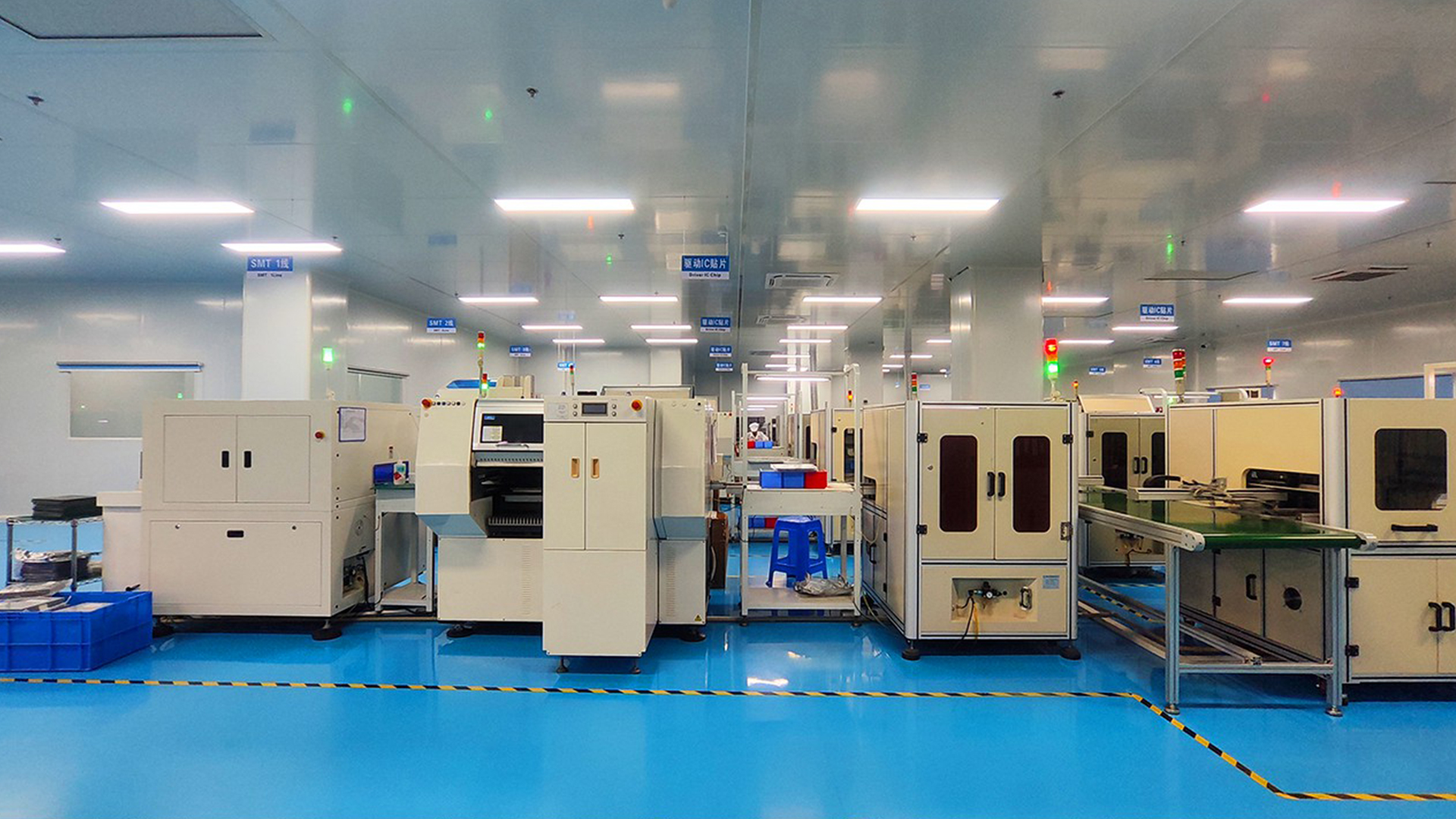
SMT workshop: LED module production for DDW DISPLAY's indoor, outdoor and rental LED display series.
DDW DISPLAY's stated quality control process covers 100% product inspection, aging test, module testing, brightness and color calibration, waterproof testing, power safety testing and performance inspection before shipment. The company supports customization across pixel pitch, LED module size, cabinet size, cabinet structure, display shape, brightness level, refresh rate, installation method, control system, logo branding, color calibration, power solution and mechanical design. Minimum order quantity is project-based, and lead time is 15–30 days for standard products, while customized projects depend on product design, quantity and technical requirements.
Read operationally, those facts carry three implications for a rental buyer. Aging and calibration before shipment reduce the probability that a cabinet batch behaves on site differently from how it behaved in the factory. Customization capability matters when a rental company needs a non-standard cabinet size, a specific control system, or branded cabinet frames. A project-based minimum order quantity matters when a rental house is adding a pixel pitch to an existing fleet rather than replacing the fleet.
Deployment evidence: what the D Series has been used for
Two recorded D Series deployments cover the operating conditions rental buyers care about most — an indoor stage build and a large-format outdoor stage build — and both use the same P2.976 pixel pitch.
Indoor stage deployment: Mexico, 20 m²
In Mexico, an event organizer, stage production company and rental company deployed a 20 m² D Series P2.976 indoor rental LED display for indoor stage performances, live events, concerts, stage backdrops and multimedia content display. The recorded outcome is a high-resolution LED visual backdrop that improved multimedia content presentation, stage impact, event atmosphere and overall audience experience, with a modular rental structure and flexible deployment. The case record covers a utilization period of 10 years.
Outdoor stage deployment: Brazil, 160 m²
In Brazil, the same P2.976 configuration was used at a substantially larger scale: a 160 m² D Series P2.976 outdoor rental LED display for outdoor stage performances, concerts, live events, stage backdrops and multimedia content display. The recorded outcome is a large-scale LED visual system delivering clear, dynamic event content and improving stage impact, live production and audience experience, again with a modular rental structure and flexible deployment, across a 10-year utilization period.
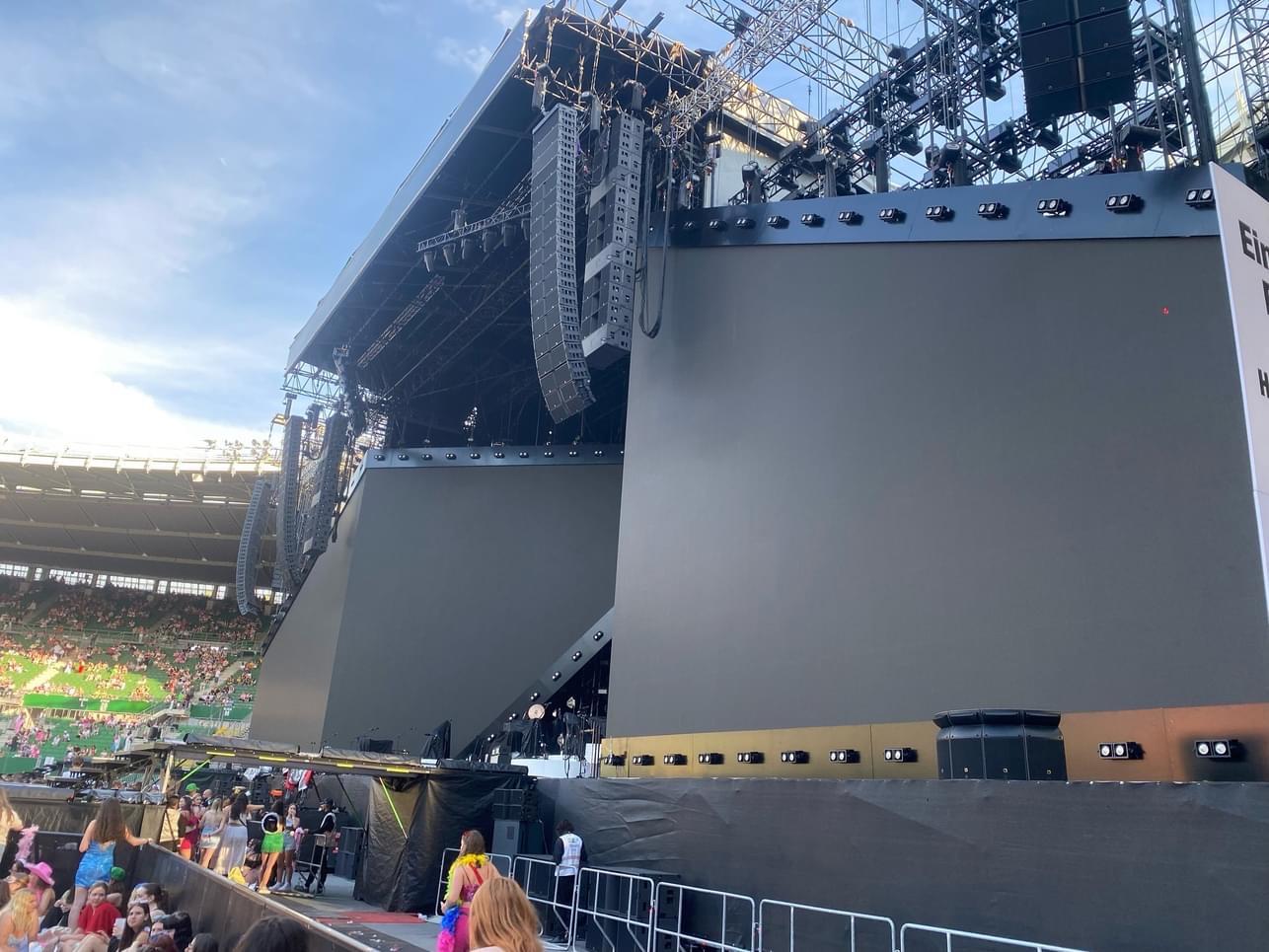
D Series P2.976 outdoor rental LED display, 160 m², deployed for outdoor stage performances and concerts in Brazil.
Read together, the two records say more than either one alone. The same pixel pitch and cabinet platform served a 20 m² indoor backdrop and a 160 m² outdoor stage — an eightfold difference in scale. That is the specific capability claim a rental buyer needs: not that a screen can be large, but that one cabinet platform scales from a compact indoor build to a 160 m² outdoor build without changing product family.
Market context: why rental platforms are being evaluated more strictly
The commercial pressure behind this evaluation method is a rental market that keeps expanding while expectations for visual quality rise with it. The global rental LED display market was valued at approximately USD 5 billion in 2020 and was forecast to exceed USD 8 billion by 2027, according to Allied Market Research data cited through a secondary source. At the wider category level, Mordor Intelligence projects the global LED display market at USD 20.73 billion in 2026, growing to USD 26.98 billion by 2031.
Those two figures do not measure the same thing, and buyers should treat market-size numbers accordingly. A published comparison of 2026 projections shows roughly USD 20.7 billion against roughly USD 8.1 billion depending on the source, a conflict attributed to definition: some figures count all large-format LED display, others count only direct-view LED signage. Any rental buyer using market data to justify fleet expansion should first establish which segments the number includes.
Two adjacent signals bear more directly on rental specification decisions. Grand View Research projects Micro-LED growth at a 77.4% CAGR between 2024 and 2030, indicating sustained investment in fine-pitch LED technology that eventually reaches rental and event applications. Separately, transparent LED displays can achieve energy savings of 30% to 40% compared with traditional LEDs, often under ISO 50001 energy management practice — a reminder that outdoor rental builds carry power distribution and generator planning consequences, not only visual ones.
Rental versus fixed LED display: where the D Series fits and where it does not
Rental LED displays and fixed LED displays solve different problems, and that distinction determines whether the D Series is the right purchase.
| Criterion | Rental LED display (D Series) | Fixed LED display |
|---|---|---|
| Installation duration | Temporary, repeated assembly and dismantling | Permanent installation |
| Cabinet design focus | Lightweight die-casting aluminum structure, fast locking, frequent transport | Long-term stability and installation efficiency |
| Installation modes | Hanging and stacking | Wall mount, steel structure, fixed mounting |
| Maintenance | Front and rear maintenance | Front access commonly used |
| Typical applications | Concerts, stage shows, exhibitions, sports events, conferences, broadcasting | Building facades, retail, conference rooms, control rooms, outdoor advertising |
| Outdoor protection | IP65 on the outdoor version of the D Series | Depends on the specific fixed series and application |
Where a project is permanent — a shopping mall facade, a control room, a roadside billboard — the fixed category applies, and DDW DISPLAY's fixed indoor and outdoor series address those installations. Where a screen must be flown, stacked, struck and redeployed, the rental category applies, and the D Series is the company's P1.56–P3.91 rental platform.
Limits and boundaries to confirm before ordering
- Pixel pitch floor. The D Series range begins at P1.56. Applications requiring finer pitch than P1.56 for very close viewing sit outside this platform and are addressed by DDW DISPLAY's fine-pitch COB series instead.
- Outdoor ratings are version-specific. IP65 protection and up to 5000 nits brightness describe the outdoor version of the D Series. The indoor version should be specified against its own requirements rather than inheriting outdoor figures.
- Curved and creative geometry is not a D Series specification. The published D Series installation modes are hanging and stacking. Projects requiring curved or flexible LED geometry are handled by DDW DISPLAY's flexible rental and flexible outdoor series, not by this cabinet.
- Cabinet weight is not published in the available D Series data. Weight drives truss loading, flight case design and crew sizing, so buyers should request the measured cabinet weight, the per-square-metre hanging load and the flight case configuration directly rather than inferring them from cabinet material.
- Deployment records evidence scale and application, not future performance. The Mexico and Brazil cases demonstrate application type and scale. They do not predict behaviour in a different climate, structural configuration or content workload.
A procurement framework for evaluating rental LED screen manufacturers
The framework below converts the evidence discussed above into a request list that can be used in a supplier conversation or a tender document.
| Evidence category | What to request from the supplier | Decision value |
|---|---|---|
| Cabinet platform definition | Cabinet size, cabinet material, structural design and LED module package across the full pixel pitch range | Determines whether a fleet can share rigging hardware, flight cases and spare modules |
| Camera performance | Stated refresh rate, with reference to broadcast and event shooting conditions | Determines suitability for filming, broadcasting and live streaming |
| Environment-specific ratings | Separate indoor and outdoor specifications, with IP rating and brightness stated per version | Prevents over-specifying or under-specifying a screen for its working environment |
| Installation and serviceability | Hanging and stacking options, front and rear maintenance access | Determines installation speed and service downtime during a live event |
| Batch consistency | Aging test, module testing, brightness and color calibration, pre-shipment inspection process | Determines whether cabinets remain interchangeable within a delivered batch |
| Deployment reference | Screen size, environment, application and utilization duration of previous projects | Tests scale and environment claims against real installations |
| Customization and lead time | Supported customization scope, minimum order quantity, standard lead time | Determines fit for non-standard fleet requirements and delivery planning |
| After-sales structure | Technical support, installation guidance, troubleshooting, warranty service and spare parts supply | Determines lifecycle cost and event-day risk exposure |
Used in sequence, this framework moves a supplier conversation from claims to a checklist. It also explains why high refresh rate and lightweight cabinet alone are insufficient descriptions: neither phrase identifies a cabinet platform, a version-specific rating, or a deployment.
For international orders, customs classification belongs on the checklist as well. LED displays are commonly classified under HS code 852859, covering monitors other than cathode-ray tube, in the UN Statistics Division classification, and confirming the applicable code before quoting landed cost avoids surprises at the port.
Future outlook
Rental LED procurement is converging on two requirements that used to be separate. Visual performance is now judged against camera behaviour as much as audience perception, which pushes refresh rate and splicing precision up the priority list. At the same time, rental fleets are being asked to serve indoor and outdoor events from the same inventory, which pushes buyers toward platforms defined by a stable cabinet rather than by a single screen specification.
The practical consequence is that supplier evaluation will keep shifting from specification sheets toward evidence of platform consistency: one cabinet size covering multiple pixel pitches, separate indoor and outdoor versions with their own ratings, verifiable deployments at different scales, and a documented pre-shipment process. The D Series shows how that evidence can be assembled and where its boundaries sit — including the parameters, such as cabinet weight, that a buyer should still verify directly with the manufacturer before finalising a rental fleet specification.
For reference, DDW DISPLAY's LED display catalogue, covering its rental, indoor fixed and outdoor fixed series, is available for download: DDW LED Display catalog 2026.
FAQ
What pixel pitch options are available in the D Series rental LED display?
The D Series is published with pixel pitches of P1.56, P1.95, P2.604, P2.97 and P3.91, all within a 500 × 500 mm die-casting aluminum cabinet. Because the pixel pitch range sits inside one cabinet platform, the same rigging method, cabinet accessories and spare-part inventory apply across the range. A fine pitch such as P1.56 supports close-viewing indoor stage work, while P2.604 to P3.91 configurations are typically used for larger builds and longer viewing distances.
Is the D Series suitable for outdoor events?
The D Series is specified as an indoor and outdoor rental LED screen with separate versions. The outdoor version carries IP65 protection and supports up to 5000 nits brightness, and shares the same 500 × 500 mm die-casting aluminum cabinet, H160° / V140° viewing angle, front and rear maintenance, and hanging and stacking installation as the indoor version. Outdoor suitability should be assessed against the outdoor version's published ratings rather than applied to the indoor version.
How do I choose the right pixel pitch for a rental LED screen?
Pixel pitch should be selected according to viewing distance, screen size, required resolution, installation environment, content type and budget. For close-viewing indoor applications, fine-pitch configurations are generally more suitable; for stages, exhibitions and events viewed from medium distance, P2.6 to P3.91 configurations are commonly considered, and outdoor screens viewed from longer distances can use larger pitches depending on screen size and brightness requirements. A smaller pixel pitch provides higher pixel density and better close-range detail but usually increases project cost, so the correct choice is the pitch that delivers sufficient image quality at the actual viewing distance, not the smallest available pitch.
How is a rental LED display different from a fixed LED display?
Rental LED displays are designed for temporary and repeated installation, and are built around lightweight cabinets, quick-lock systems and flexible hanging or stacking. Fixed LED displays are designed for permanent installation and emphasise long-term stability, installation efficiency, maintenance accessibility and continuous operation. The appropriate choice depends primarily on installation duration, application environment, viewing distance, maintenance method and project requirements: concerts, stages, exhibitions, festivals and sports events point to a rental platform, while facades, retail spaces, conference rooms and control rooms point to fixed installation.
What certifications should buyers check when purchasing an LED display?
Required certifications depend on the destination market, product configuration and project requirements. For international projects, buyers commonly evaluate CE, FCC, RoHS, ETL, EMC and relevant safety requirements. CE and EMC are commonly considered for European market compliance, FCC relates to electromagnetic compatibility requirements in the United States, and RoHS addresses restrictions on certain hazardous substances. Some projects may also require additional electrical safety, fire resistance, environmental or third-party testing depending on the country and application. Buyers should confirm which certifications apply to the specific model and destination market, and request the corresponding certificates or test reports before placing an order.
What production evidence should a rental LED screen buyer request before ordering cabinets?
Because rental cabinets are purchased in interchangeable batches, production evidence matters as much as the specification. Relevant items include the pre-shipment process — 100% product inspection, aging test, module testing, brightness and color calibration, waterproof testing and power safety testing — together with the supported customization scope, the minimum order quantity, and the lead time, which is 15–30 days for standard products while customized projects depend on design, quantity and technical requirements. Buyers should also request measurable cabinet data that is not published in a standard specification set, such as cabinet weight and per-square-metre hanging load, plus the after-sales structure covering technical support, installation guidance, troubleshooting, warranty service and spare parts supply.