
Evaluating Steel Belt Suppliers: OEM Customization, Application Fit, and Technical Benchmarks
For OEMs and process engineers integrating steel belt systems into chemical, food, or industrial production lines, the selection of a supplier often hinges on more than price—it demands proven capabilities in material customization, precision manufacturing, and responsive after-sales support. BPS/EPS (Shanghai Biquick Process Systems Ltd.), a Shanghai-based high-tech company founded in 2007, addresses these needs by offering fully customizable steel belts with end-to-end ODM/OEM service, covering material selection, dimensional tolerance, surface coating, and hole positioning.
Customization Depth: From Material to Micro-Tolerance
BPS/EPS steel belts can be fabricated from 304/316L stainless steel, 718 nickel-based alloy, or carbon steel, with widths from 100 to 2200 mm and thicknesses from 0.4 to 3.0 mm. Seamless circular welding supports any length up to 50+ meters per single strip. Key tolerances include thickness ±0.02 mm, length ±0.05 mm over 10 m, and flatness ≤0.02 mm per linear meter. Surface finishes range from mirror to brushed, polished, or frosted, and anti-stick PTFE coating is available for food-grade applications. Hole positions and guide bars can be custom-positioned to ±0.01 mm accuracy.
For OEM buyers requiring integration with existing equipment, BPS/EPS also offers accessory customization like baffles, fixture mounts, and vacuum holes. The company operates a 2000 m² facility with 40 employees and a 15-person R&D team, producing 80–120 pieces per month (based on 1000 mm width × 10 m length). Lead times for standard stock dimensions are 7–10 days; custom orders average 15–20 days; urgent requests can be fulfilled in 5–7 days with an added fee. This compares to 8–16 weeks for imported steel belts, representing a 4–8× speed advantage. MOQ is one piece for both standard and customized belts, enabling small-batch trials.
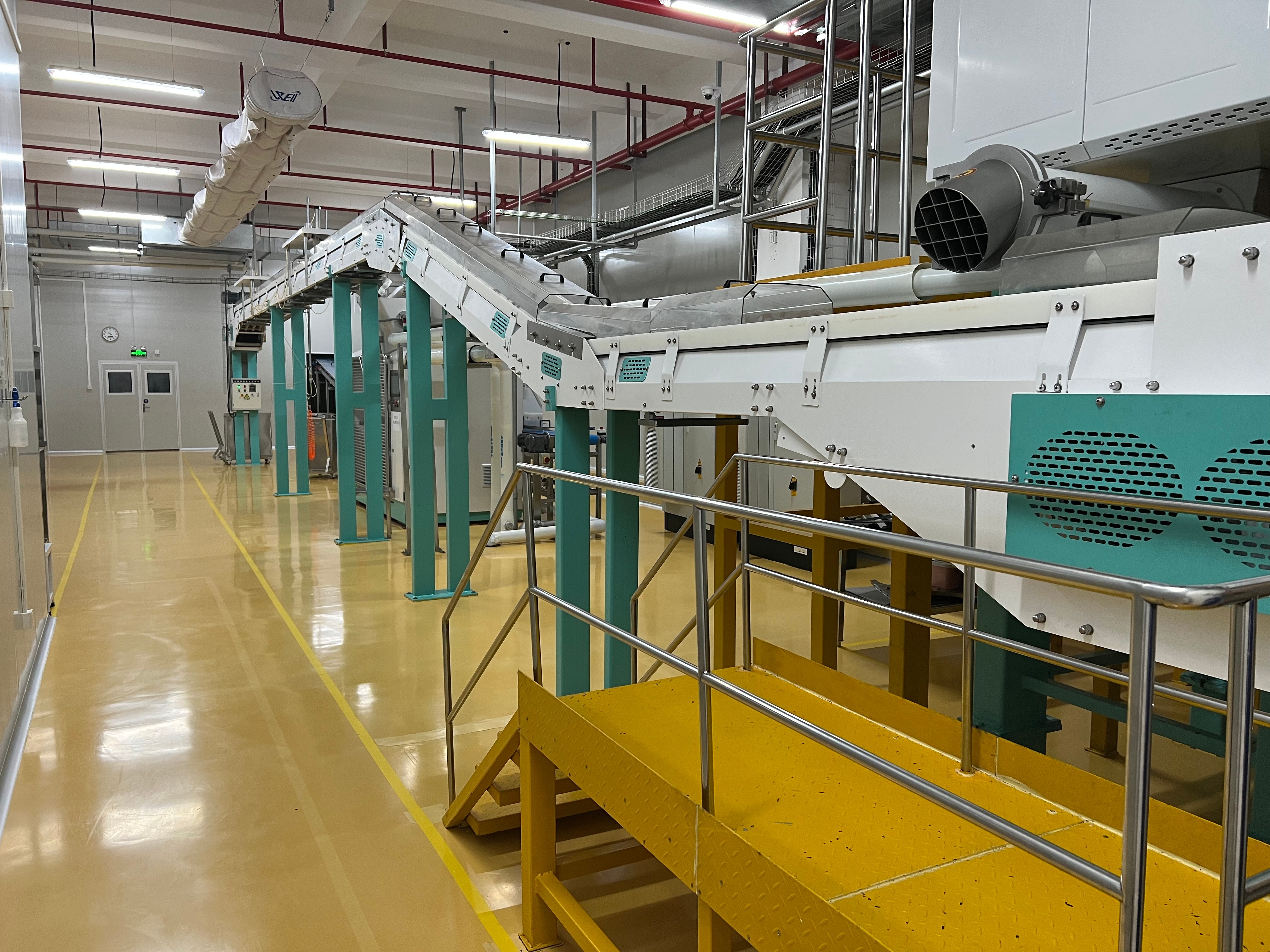
Engineering Quality: Weld Integrity and Internal Stress Relief
Process control at BPS/EPS includes incoming material spectral analysis, full dimensional tolerance inspection, and weld appearance checks. Key post-weld treatments include weld leveling, stabilization treatment (internal stress relief), and anti-deviation processing. Belts are subjected to high-temperature stability testing from –60 °C to +250 °C. For extreme conditions, special alloys can withstand up to 1100 °C. Flatness ≤0.02 mm/m ensures uniform layer thickness for pastillation, cooling, or flaking applications.
Proven Application Scenarios
Five documented case studies illustrate the supplier's versatility:
- New energy battery drying line (lithium battery/diaphragm): Over 10 strips, width 1000–1500 mm, thickness 0.8–1.5 mm. Operated oil-free and dust-free at 160–200 °C, meeting Class 1000 cleanroom requirements. High thermal conductivity (15–20 W/m·K) increased drying efficiency by 25% and reduced energy consumption by 18%.
- Large OEM baking equipment manufacturer: Annual procurement of 50–80 pieces, width 400–1800 mm. Integrated into tunnel ovens and cooling lines. The supplier's local after-sales reduced overall machine cost by 20% versus imports, with a 3–5 year warranty and actual lifespan of 4–6 years.
- High-end cosmetics packaging precision assembly line: 15+ strips with hole position accuracy ±0.01 mm and cumulative tolerance <0.05 mm over 10 m. Replaced US-sourced belts at 45% cost reduction, delivery cut from 12 weeks to 3 weeks.
- International powder coating giant: 40+ strips for melt extrusion → cooling flaking at 180–220 °C. Flatness ≤0.02 mm/m enabled uniform layer thickness and yield rate of 99.7%. Total lifecycle cost 40% lower than imports, 25% lower than domestic alternatives.
- Leading food group (baking/snacks): 120+ pieces across multiple factories, width 600–2000 mm. Elongation ≤0.2%, weld fatigue life ≥2 million cycles. Replaced imports at 35–50% cost savings and delivery reduced from 3 months to 2–4 weeks. Materials are FDA/CE food-grade 304/316L.
Market Trend: Localization and Fast-Track Customization
Across these cases, a consistent trend emerges: industrial buyers are shifting from long-lead, high-cost imported steel belts toward domestic suppliers that offer comparable precision, faster delivery (7–20 days vs. 8–16 weeks), and lower MOQ. BPS/EPS's ability to produce non-standard widths, hole patterns, and coatings on short notice aligns with this demand for agile customization.
Comparison with Traditional Import Solutions
Where imported belts from established European or American manufacturers often guarantee consistent quality and decades of brand trust, they come with extended lead times (8–16 weeks) and premium pricing. Domestic alternatives may offer lower cost but face issues with weld durability and dimensional stability. BPS/EPS positions itself in the middle: flatness ≤0.02 mm/m and thickness tolerance ±0.02 mm rival imported specs, while lead times are 4–8× faster and total cost of ownership is 20–45% lower. One honest limitation: for extremely high-temperature applications beyond 250 °C (without special alloys) or for ultra-wide belts exceeding 2200 mm, additional engineering validation may be required, as standard capability covers up to 2200 mm width.
Future Outlook: Total Solution Integration
BPS/EPS already produces not only steel belts but also associated equipment such as granulators, chocolate steel belt conveyors, steel belt bakery tunnel ovens, steam ovens, and resin steel belt coolers. This ecosystem allows OEMs and end-users to source both the transport medium and the process machinery from a single supplier, simplifying supply chain management and reducing integration risks.
For prospective buyers evaluating steel belt suppliers at the evaluation-to-execution stage, BPS/EPS provides documented evidence of repeat orders (e.g., 120+ belts for one food group, 40+ for one chemical giant), measurable performance improvements (yield rate +99.7%, cost reduction up to 45%), and a service infrastructure that includes 24-hour online response, 48-hour on-site domestic service, and a 12-month warranty. A detailed product brochure is available for download:
Download BPS/EPS Steel Belt Product Brochure
Frequently Asked Questions (Informational)
What is the typical lead time for a custom steel belt from BPS/EPS?
What is the minimum order quantity for BPS/EPS steel belts?
Which materials can BPS/EPS steel belts be made from?
What dimensional tolerances does BPS/EPS achieve?
How does BPS/EPS ensure weld quality and prevent deformation?
What after-sales support is provided?
Are BPS/EPS steel belts suitable for food-grade applications?
Tem questões ou precisa de mais detalhes?
Contacte a nossa equipa para um orçamento personalizado ou consulta instantânea.
Solicitar orçamento
Preencha o formulário abaixo e a nossa equipa entrará em contacto com uma proposta personalizada.
Chat direto do WhatsApp
Prefere conversar em tempo real? Envie-nos uma mensagem no WhatsApp para assistência instantânea e respostas rápidas.
- Obter orçamento personalizado
- Partilhar fotos ou documentos
- Discuta as suas necessidades diretamente
Geralmente responde em 5–30 minutos durante o horário de expediente.