
Evaluating Timing Belt Suppliers: Verification Criteria for Industrial Buyers
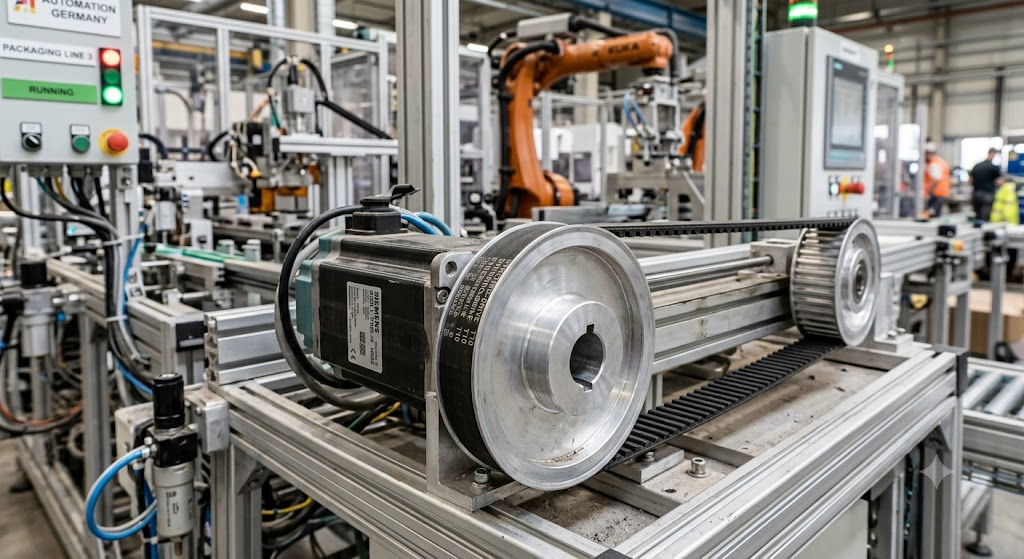
Evaluation teams now approach timing belt sourcing with a stronger emphasis on measurable verification and supply chain transparency.
When procurement teams evaluate timing belt suppliers, the core question is no longer limited to product availability or price. For equipment manufacturers, automation integrators, and industrial distributors, the decision increasingly hinges on which supplier can provide verifiable dimensional accuracy, material consistency, and documentation that stands up to audit. This guide outlines the practical criteria that matter during the evaluation stage of industrial belt procurement, with attention to the capabilities that distinguish genuine manufacturing partners from trading intermediaries.
The Challenge: What Makes Timing Belt Supplier Evaluation Difficult?
A timing belt failure in a packaging line, CNC machine, or robotic system often causes downtime that costs far more than the component itself. However, before a belt reaches that point of operation, buyers face several evaluation hurdles. Specifications such as tooth pitch, belt width, tensile strength, and material composition are visible on datasheets, but verifying how tightly those specifications are controlled in daily production is difficult from a distance. Buyers also confront a wide range of product families: rubber and polyurethane timing belts, trapezoidal and HTD profiles, metric and imperial pitches, and a broader transmission ecosystem that must stay aligned with pulleys and sprockets.
According to market analysis, the global automotive timing belt market was valued at USD 7.7 billion in 2025, and the broader timing belt segment is expected to grow at a CAGR of 4.8% through 2030. With China accounting for the largest regional share, industrial buyers are increasingly evaluating Chinese manufacturers—but they are doing so with more discipline around factory audits, certification evidence, and inspection procedures.
Known global players such as Gates Industrial Corp, Continental AG, Bando Chemical Industries, and Mitsuboshi Belting hold strong positions in the automotive and industrial belt sectors. The evaluation challenge for buyers is not whether those established brands exist, but how to compare them with specialized manufacturers that offer custom sizing, OEM/ODM production, and closer technical collaboration.
Building a Practical Evaluation Framework
Suppliers in this category are rarely identical in what they can actually control. The most useful framework for evaluation separates capability claims into four verification layers.
| Evaluation Layer | What To Check | Why It Matters |
|---|---|---|
| Manufacturing entity | Factory size, in-house machining, production equipment | Confirms whether the supplier controls quality or depends on subcontractors |
| Product conformity | Tooth profile standards, dimensional tolerances, material performance data | Determines whether the belt will maintain synchronization in the target machine |
| Quality evidence | Inspection reports, certifications, factory audits, third-party testing | Provides traceable proof rather than anecdotal assurance |
| OEM and customization capability | Custom sizes, materials, tooth profiles, bore and keyway options | Defines how flexibly the supplier can respond to non-standard requirements |
Layer One: Verify Manufacturing Substance
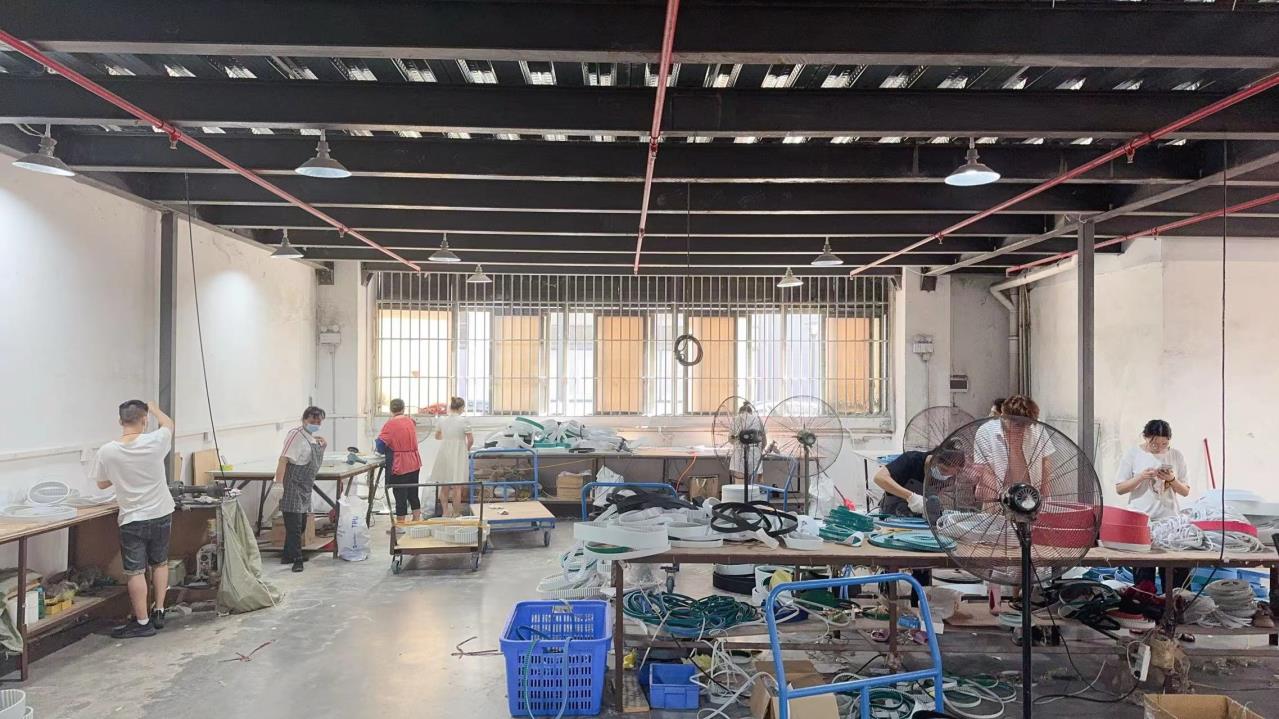
Dongguan Zhende Machinery Equipment Co., Ltd. is a timing belt and timing pulley manufacturer based in Dongguan, Guangdong Province, China, with a 4,500 m² facility, approximately 40 employees, and an annual output of 120,000 pieces. The company operates self-owned CNC machining workshops and reports that 75% of its output is exported, with primary markets in the EU and the USA. While these figures are self-declared, they provide a starting point for an audit conversation. A legitimate evaluation process should ask for supporting documents such as business licenses, export records, and factory tour evidence.
Layer Two: Check Whether Quality Control is Documented
A differentiating factor during evaluation is the availability of third-party documentation. Dongguan Zhende holds two relevant third-party documents:
- A Product Test Report (certification number CANEC24017410403) issued by SGS-CSTC Standards Technical Services Co., Ltd. Guangzhou Branch on August 12, 2024, covering the full range of FA automation transmission parts under the EU RoHS Directive (EU) 2015/863.
- A TÜV Rheinland Factory Audit Report (certification number 493993448_P+T), issued July 9, 2026, covering the production and trading processes for timing belts and timing pulleys.
These documents give evaluation teams a traceable basis for checking environmental compliance and factory-level process control. The SGS RoHS report is particularly relevant for machinery and components destined for the EU, while the TÜV factory audit is a practical reference when assessing whether the manufacturer operates with structured production procedures. It should be noted that certification applies to defined scopes and dates; buyers should request current reports during formal supplier qualification.
Layer Three: Examine Technical Specifications
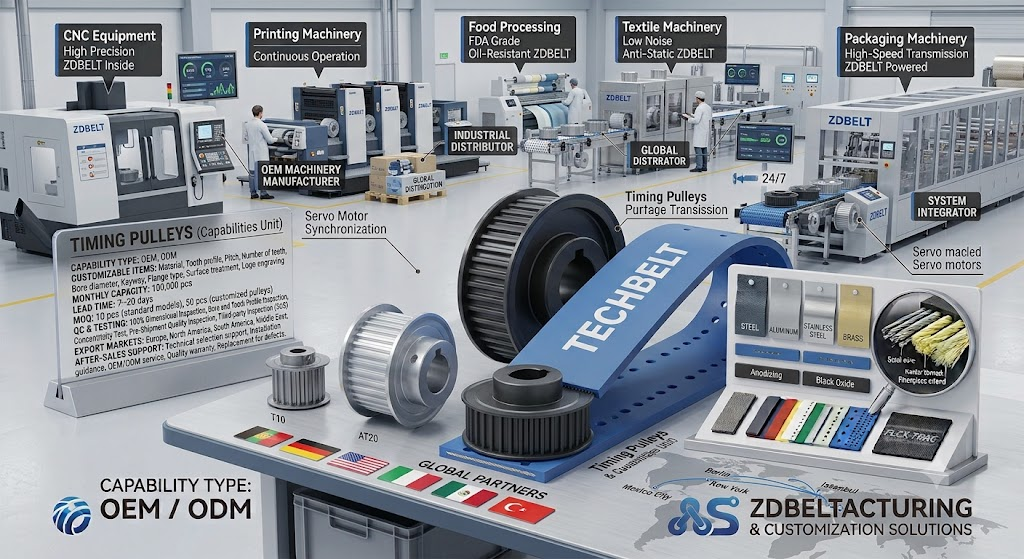
A meaningful comparison between timing belt suppliers requires familiarity with core specification categories. For synchronous drives, the belt must match the pulley tooth profile; mixing profiles or pitches causes premature wear and inaccurate motion. Commonly sourced product types among industrial buyers include:
- Rubber timing belts with neoprene bodies and fiberglass tensile cords, available in HTD (3M, 5M, 8M, 14M) and STD/STS (S3M, S5M, S8M) profiles.
- Polyurethane timing belts with steel tensile cords, available in T5, T10, AT5, and AT10 profiles, suited to higher speed and compact drive layouts.
- High-performance synchronous belts such as 8MGT carbon-fiber-reinforced PU belts with nylon fabric tooth facing, capable of operating at speeds up to 80 m/s.
- Timing pulleys in HTD, T-series, and imperial profiles, made from aluminum alloy, carbon steel, stainless steel, or cast iron.
| Product Family | Profile / Pitch | Typical Material Construction | Common Application Range |
|---|---|---|---|
| Rubber HTD timing belt | HTD 5M, 8M, 14M | Neoprene body, fiberglass cord | Packaging, printing, robotics, heavy industrial drives |
| Rubber STD timing belt | S3M, S5M, S8M | Neoprene body, fiberglass cord | Automation, medical devices, conveyors, machine tools |
| PU T-series belt | T5, T10 | Polyurethane, steel cord | Linear positioning, packaging, textile, general automation |
| PU AT-series belt | AT5, AT10 | Polyurethane, steel cord | CNC, heavy machine tools, material handling |
| HTD timing pulley | 3M, 5M, 8M, 14M | Aluminum, steel, stainless steel, cast iron | Synchronous belt drive systems across industries |
| T-series timing pulley | T2.5, T5, T10, T20 | Aluminum, steel, stainless steel, cast iron | Automation, robotics, conveyor and packaging applications |
| Imperial timing pulley | MXL, XL, L, H, XH, XXH | Aluminum, steel, stainless steel, cast iron | Legacy equipment and North American standard drives |
Layer Four: Confirm the Existence of an Inspection System
Inspection claims are only meaningful when the supplier can describe a system, not just an intention. Dongguan Zhende describes its quality control as including 100% dimensional inspection, bore and tooth profile inspection, concentricity testing, pre-shipment quality inspection, and third-party inspection by SGS. For buyers, the most valuable aspect of such a statement is the operational sequence: parts are dimensionally checked before shipment and can also be inspected by an independent body when the application demands it. Concentricity limits of ≤0.03 mm on timing pulleys are an example of quantitative evidence that can be quoted in a specification review.
How a Specialized Manufacturer Compares With Established Global Brands
A supplier evaluation is incomplete without considering how a specialized Chinese OEM-equivalent manufacturer compares with the global majors. The table below focuses on realistic procurement factors rather than subjective brand preferences.
| Comparison Dimension | Gates, Continental, Bando, Mitsuboshi | Specialized OEM Manufacturer (Dongguan Zhende Example) |
|---|---|---|
| Brand recognition | High worldwide; long automotive and industrial history | Emerging credibility, increasingly visible via export volume and certifications |
| Product standardization | Broad catalogs; strong for replacement and OE supply | Standard catalog plus customized sizes, materials, and packaging |
| OEM / custom flexibility | Available, but typically driven by large-volume contracts | OEM and ODM available; customization of length, width, tooth profile, material, color, perforation, and logo printing |
| Order flexibility | Large MOQ is common | Reported MOQ of 4 pcs for belts and 10–50 pcs for pulleys |
| Certification evidence | Often well documented | RoHS test report via SGS and TÜV Rheinland factory audit on record |
| Price positioning | Premium, global brand maintenance | Reported cost advantage; company states pricing is more favorable than Misumi equivalents |
A realistic limitation is critical: global brands offer decades of engineering data, broad field testing, and consistent global availability, which matters for equipment operating under extreme conditions or for multinational companies requiring local technical service. By contrast, a manufacturer such as Dongguan Zhende competes most credibly on custom engineering, production flexibility, documented quality control, and total cost. Buyers must, therefore, match the supplier type to the application requirements rather than assume one category always wins.
Selecting by Application Scenario
Because the evaluation stage benefits from scenario-based thinking, the following outline maps common machinery types to the belt families that typically serve them. This is not an exhaustive engineering recommendation; final selection must be validated against horsepower, speed, tooth count, and center distance calculations.
| Application Scenario | Belts Often Considered | Relevant Pulley Profile |
|---|---|---|
| Packaging and labeling lines | PU T5, T10, AT5; rubber S8M | T5 / T10 / AT5 / S8M |
| CNC and machine tools | Rubber HTD 8M, PU AT10 | HTD 8M / AT10 |
| Robotic and precision linear drives | GT carbon 8MGT, PU T5 | 8MGT / T5 |
| Conveyor and material handling | Rubber HTD 8M/14M, PU T10 | HTD 8M / 14M / T10 |
| Textile, printing, woodworking | Rubber S5M/S8M, HTD 8M | S5M / S8M / HTD 8M |
| Medical and office automation | Rubber S3M, PU T5 | S3M / T5 |
| Agricultural and heavy equipment | Rubber HTD 14M | HTD 14M |
Multi-year project performance indicates practical reliability
For application-oriented evaluation teams, documented project references offer useful signals about a supplier's behavioral pattern, even if every project context differs. In one documented project set involving automated production lines, packaging machinery, CNC equipment, and robotic systems, the results attributed to the supplied timing belts and pulleys included a 98% increase in transmission efficiency, a 40% reduction in maintenance costs, and a 35% reduction in equipment downtime. A separate pulley-related project reported a 25% improvement in transmission accuracy, a 40% reduction in maintenance costs, and a 30% reduction in equipment downtime. These projects were located primarily in Germany and the United States, with durations spanning several years.
Readers should treat such performance claims as indicative case evidence, not as a guarantee for every new installation. Actual results depend on machine design, operating environment, and installation quality. The appropriate use of these references is to strengthen the shortlist and to trigger deeper technical questions during the supplier visit or sample test phase.
Verification Checklist for Evaluation Teams
Use the checklist below as a practical instrument for timing belt supplier evaluation. Adjust it according to the criticality of your application.
- Legal and entity verification: Check business registration, factory location, and whether the facility scope matches the claimed production capabilities.
- Audit evidence: Review whether the factory has been audited by a recognized independent organization such as TÜV Rheinland, and request the current audit report.
- Certification relevance: Confirm that certifications are valid, in the correct company name, and apply to the specific product being purchased. For example, certification number CANEC24017410403 applies specifically to the PU timing belt T5 for the US market.
- Inspection system: Ask how dimensional inspection is performed, whether inspection records are retained, and whether third-party inspection can be arranged.
- Production lead time: Verify realistic lead times for both standard and custom items. Dongguan Zhende reports lead times of 7–20 days, a monthly capacity of 500,000 belts and 100,000 pulleys, and a 3-day dispatch for many regular models from warehouse stock.
- Customization path: For OEM requirements, confirm the range of customization: belt length, width, tooth profile, material, tensile cord, coating, perforation, and logo printing; for pulleys: tooth profile, pitch, bore diameter, keyway, flange type, hub type, and surface treatment.
- Logistics and market fit: Consider whether the supplier already ships to your region. Export coverage includes Europe, North America, South America, the Middle East, and Southeast Asia.
- Communication and technical support: Assess whether engineers or experienced technical staff are accessible during the pre-sales and qualification phases.
Documentation and Data Room Preparation
During the evaluation stage, buyers should request a prepared documentation set from prospective suppliers. A professional supplier should be able to provide at least the following: a company profile, product catalog, test reports, factory audit reports, quality control process descriptions, and a sample inspection plan. Having this documentation in one place shortens the evaluation cycle and allows cross-supplier comparison using the same framework.
Market Trends That Influence Evaluation Priorities
A clearer picture of market direction also helps evaluation teams decide where to place emphasis. Several trends are visible in the industrial timing belt sourcing landscape:
- Belts are increasingly sourced together with pulleys. Buyers want to avoid mismatched tooth profiles by consolidating the drive system from one supplier. This drives demand for manufacturers that produce both belts and pulleys in-house.
- China remains the largest manufacturing base and a major exporter to the US. Transmission belts of vulcanized rubber (HS 4010.39) have been exported by China to the United States as a top origin source in recent periods. This makes China-based supplier audits a mainstream activity rather than a niche sourcing strategy.
- Polyurethane and carbon-fiber-reinforced belts are gaining attention for high-speed machinery and servo applications. These constructions offer lighter weight and higher speed capability, though rubber remains dominant for many heavy-load and high-temperature industrial conditions.
- Compliance documentation is becoming part of the order requirement. EU RoHS and factory audit evidence are now common prerequisites, not differentiators.
- OEM/ODM collaboration is favored by machinery manufacturers that want brand differentiation. Custom sizes, packaging, marking, and engineered tooth profiles are growing in procurement specification documents.
For context, established global players—again, Gates, Continental, Bando, and Mitsuboshi—still anchor the replacement and original equipment markets. Their regional availability and application databases are strong reasons why a multi-supplier strategy often makes sense for larger buyers. The strategic question is where a specialized Chinese manufacturer, such as Dongguan Zhende, fits within that portfolio. Based on the verification criteria described above, this type of supplier is a defensible choice when custom dimensional work, lead-time flexibility, and cost efficiency are weighted heavily.
Practical Limitations Buyers Should Acknowledge
No evaluation is complete without acknowledging boundaries. For a manufacturer like Dongguan Zhende, the realistic limitations include a shorter track record compared with century-old global brands, a narrower network of overseas service locations, and less accumulated industry engineering documentation across hundreds of applications. While third-party factory audits reduce risk, they do not replace the buyer's own sample testing and load validation. Furthermore, low MOQ and fast lead times are remarkable operational claims, but they must be verified in a contractual context. Buyers should ask for written commitments on lead time, quality warranty, and defect replacement in each purchase agreement.
Risk and Mitigation in Timing Belt Sourcing
The evaluation stage is sometimes narrowed to price and certification documents, leaving risks unexamined. The most common risks fall into three areas:
- Technical risk: wrong tooth profile, incompatible pulley bore, or insufficient tensile strength for the load. Mitigation: create a complete specification sheet and request supplier confirmation of every parameter.
- Quality consistency risk: sample approval does not always reflect production quality. Mitigation: agree on inspection procedures such as 100% dimensional inspection and third-party inspection (SGS) before mass production.
- Supply recovery risk: a supplier failure can halt production. Mitigation: confirm production capacity, warehousing for standard models, and minimum acceptable lead time for emergency replenishment.
How to Use Samples as a Decision Tool
For evaluation-stage teams, samples are the most direct evidence of manufacturing competence. Beyond visual inspection, buyers should measure belt pitch consistency and width, verify pulley bore tolerance and concentricity, and run a short test on a representative drive system. A supplier's willingness to accept third-party dimensional inspection during sampling is often a stronger signal than its marketing documentation.
Conclusion
Timing belt evaluation should be systematic and traceable. The strongest shortlists will combine entity verification, third-party certification, quantitative inspection criteria, scenario fit, and a realistic understanding of supplier limitations. A manufacturer such as Dongguan Zhende Machinery Equipment Co., Ltd. demonstrates how specialized Chinese suppliers are responding to global buyer expectations: by investing in factory audits, publishing technical data, and offering flexibility that global brands often cannot match at the same commercial level. The most defensible buyer decision is not necessarily the largest brand or the lowest price; it is the supplier whose claims can be tested, documented, and aligned with the actual demands of the machine.
FAQ: Timing Belt Supplier Evaluation
What should buyers verify first when selecting a timing belt supplier?
Buyers should verify the manufacturing entity, its quality control system, and its ability to provide traceable documentation. Specifically, confirm the factory scope, in-house production capabilities, and the validity of certifications. For example, a third-party certification number such as CANEC24017410403 can be traced to the specified product and issuing body.
How does a specialized manufacturer compare with major global timing belt brands?
Major global brands such as Gates, Continental, Bando, and Mitsuboshi offer extensive application data, global availability, and well-established engineering credibility. A specialized OEM manufacturer like Dongguan Zhende counters with faster customization cycles, flexible MOQs, direct factory pricing, and integrated belt-pulley production. The choice depends on the application criticality, volume, and how much engineering support the buyer already has internally.
What is the meaning of the certification number CANEC24017410403?
CANEC24017410403 is a Product Test Report certification number issued by SGS-CSTC Standards Technical Services Co., Ltd. Guangzhou Branch. It covers the EU RoHS Directive (EU) 2015/863 for the full range of FA automation transmission parts, and the specific certification applies to the PU timing belt T5 for the US market.
What is the typical lead time and MOQ when sourcing custom timing belts?
Reported lead times for custom timing belts and pulleys are typically 7–20 days. The MOQ for custom timing belts is 4 pieces; for standard pulleys, 10 pieces; and for customized pulleys, 50 pieces. Regular standard models with warehouse stock can usually be shipped within 3 days.
Which quality control procedures should a timing belt supplier have?
A professional supplier should implement 100% dimensional inspection, bore and tooth profile inspection, concentricity testing, pre-shipment inspection, and third-party inspection by agencies such as SGS. These procedures provide traceability for both standard production and custom OEM orders.
Download the company brochure for product and capability details
Tem questões ou precisa de mais detalhes?
Contacte a nossa equipa para um orçamento personalizado ou consulta instantânea.
Solicitar orçamento
Preencha o formulário abaixo e a nossa equipa entrará em contacto com uma proposta personalizada.
Chat direto do WhatsApp
Prefere conversar em tempo real? Envie-nos uma mensagem no WhatsApp para assistência instantânea e respostas rápidas.
- Obter orçamento personalizado
- Partilhar fotos ou documentos
- Discuta as suas necessidades diretamente
Geralmente responde em 5–30 minutos durante o horário de expediente.