
Evidence That a Supplier Can Deliver Functional Polyester Filament
Evidence That a Supplier Can Deliver Functional Polyester Filament
A specification sheet states what a supplier says it can produce. Production equipment, test data and third-party certification show what a supplier can actually produce — repeatedly, at volume, and with paperwork that a brand's compliance team will accept. This reference examines what that evidence consists of, using the coffee charcoal antibacterial polyester filament route as a working example.
Why Capability Evidence Comes Before Price Negotiation
The global polyester filament yarn market was estimated at USD 106.4 billion in 2024 and is projected to grow at a 3.72% CAGR until 2035, according to Market Research Future. A separate industry analysis values the broader polyester fiber market at USD 82.07 billion in 2025, projecting USD 148.11 billion by 2034, and attributes roughly 65% of 2025 demand to Asia Pacific. Those numbers describe a commodity-scale industry. They say nothing about whether any individual supplier can deliver one specific functional filament to one specific specification.
That gap is the buyer's problem. In functional polyester filament, performance such as odour control, far infrared behaviour, moisture management or anti-microbial activity is built into the polymer or the masterbatch rather than applied afterwards. If additive loading, spinning parameters or finishing conditions drift, the function drifts with them — even when denier and tensile data on the invoice look correct.
For buyers in the research and evaluation stage, the operative question is therefore not whether a supplier sells functional polyester filament, but what evidence demonstrates that the supplier can reproduce the specified function in the requested volume with documentation that survives scrutiny. Coffee charcoal antibacterial polyester filament is a useful test case, because its function depends on a raw material that must be processed correctly before it ever reaches a spinning line.
What End-to-End Manufacturing Readiness Actually Requires
Capability in functional filament is not a single machine. It is a chain of four equipment categories, each of which answers a different buyer question. Smilytex documents this chain for its coffee charcoal antibacterial route as spinning machines, weaving and knitting looms, fabric finishing equipment, and functional testing instruments.
| Equipment category | Function in the chain | Evidence it provides to a buyer |
|---|---|---|
| Spinning machines | Convert polymer and functional masterbatch into filament yarn | Ability to control count, elasticity and hand feel on a repeatable basis |
| Weaving / knitting looms | Convert yarn into greige fabric | Ability to validate the yarn on both woven and knitted routes before a brand commits |
| Fabric finishing equipment | Dyeing, setting and finishing of the greige fabric | Ability to preserve the functional effect through the finishing stage |
| Functional testing instruments | Measure performance against recognised test methods | Measurable output that can be compared with a stated claim |
The logic is cumulative. A spinner without weaving or knitting validation cannot confirm whether the yarn survives fabric formation. A mill without finishing capability cannot confirm whether the function survives heat setting and dyeing. And without in-house functional testing instruments, neither stage can be quantified — the buyer simply receives an assurance.
This is also why the equipment list matters as a procurement filter. When a supplier can name the four stages and describe what happens at each, the conversation shifts from claims to process. When it cannot, the specification is effectively untested.
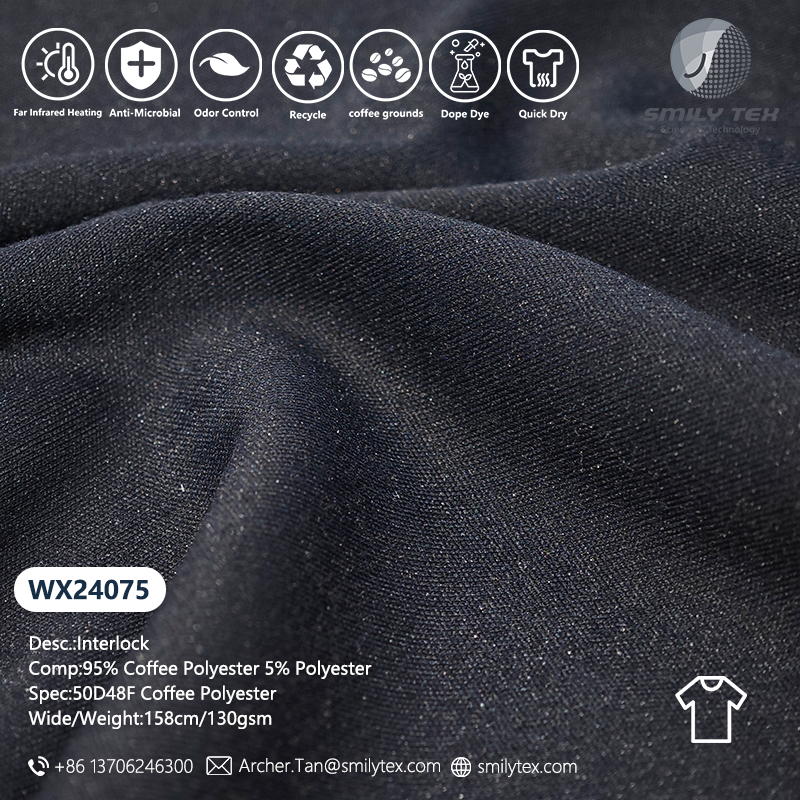
Cocarber® coffee charcoal functional polyester filament — the dope-dyed route carries colour and function in the masterbatch rather than in a later dyeing step.
The Coffee Charcoal Case: Where the Function Comes From
Understanding the production route makes the evidence checkable. In the Cocarber® line, recycled coffee grounds are processed together with colorants into a functional masterbatch, which is then blended with recycled PET bottle flakes for spinning. That route gives the yarn a dope-dyed colour system while reducing the need for conventional dyeing — a material and energy consideration as much as a colour one.
The functional behaviour is described as structural rather than additive. The porous structure of coffee carbon fibre has high adsorption, which is the basis of the deodorisation effect. After low-temperature carbonisation, the coffee grounds form a special porous structure, which the material documentation associates with far infrared behaviour, heat storage and warmth without the addition of chemical additives.
The coffee charcoal antibacterial polyester filament specification as documented covers counts of 30D, 50D, 75D, 100D, 150D and 300D, with the following declared functions: recycled coffee waste content, odour control, far infrared heating, quick dry, dope dye, and anti-microbial performance. It is offered for both woven and knitted applications, and is positioned for sport, leisure, underwear and home textile end uses. Within the same product family, separate variants exist for bamboo charcoal, coconut charcoal, China-hemp charcoal, dope-dyeing, cotton feel, renewable and hydrophilic routes — a useful signal, because it indicates the masterbatch platform is engineered rather than sourced as a single fixed blend.
Testing Evidence: The Numbers a Buyer Can Check
Claims become evidence when they are tied to a test method and a measured value. Two documented reference points apply to the coffee charcoal route.
The first is GB/T 30127-2013, the Chinese national standard titled “Textiles—Testing and Evaluation of Far Infrared Performance.” It is the test method against which far infrared performance is evaluated for this material family. For a brand making a warmth or heat-retention claim on a hangtag, the existence of a named standard behind the measurement is the difference between a marketing statement and a compliance position.
The second is LC-MSMS testing for caffeine residue, documented at 0.009 mg/kg. This matters specifically because the raw material is coffee-derived. Any recycled agricultural input raises a residue question from brand compliance teams, and a quantified residue figure from an analytical method is a materially different form of evidence from a statement that the material is “natural.”
Certification Evidence for Recycled Content
Recycled content is the second axis of capability evidence, and it is the one most often checked by EU and US brand compliance teams. Two certificates are documented for this supplier's functional polyester filament range.
| Standard | Certificate number | Issuing body | Scope | Validity |
|---|---|---|---|---|
| Global Recycled Standard V4.0 | IDF-25-887497 | IDFL Laboratory and Institute Inc. | Cocarber® functional polyester filament | Issued 2025-11-02, valid to 2026-11-01 |
| RCS 2.0 | IDF-25-887506 | IDFL Laboratory and Institute Inc. | Dyed yarns, greige yarns, dyed fibres, undyed fibres, dyed fabrics | Issued 2025-11-02, valid to 2026-11-01 |
Both certificates apply to the EU, US, Global Brand Supply Chains and China markets. The distinction between the two matters: the Global Recycled Standard V4.0 certificate is product-specific to the Cocarber® functional polyester filament, while the RCS 2.0 certificate covers a wider process scope spanning greige and dyed yarns, dyed and undyed fibres, and dyed fabrics.
For context, certification schemes such as the Global Recycled Standard require a minimum recycled content threshold — commonly cited at 20% — before specific labelling claims can be made. A certificate number, an issuing body, a defined scope and a validity window are all independently checkable. A supplier that cannot supply those four elements is not providing recycled-content evidence, whatever the marketing collateral says.
Scale, Customisation and Delivery Parameters
Equipment and certifications describe what is possible. Commercial parameters describe what is realistic for a given order. Smily Textile Technology (Taicang) Co. Ltd, which trades as Smilytex, is a Taicang-based enterprise established in 2017 with a registered capital of 6 million yuan, engaged in the R&D and sales of functional fibre and functional fashion fabrics.
Documented operational parameters include a facility footprint of 16,220 m², 206 employees, a 10-engineer R&D team, an annual output of 20 tons and a monthly capacity of 1.6 tons. Export accounts for 70% of business, with main markets in the EU, USA and Japan. The company reports more than 20 core patented technologies, including authorized invention patents, authorized utility model patents and design patents.
On the commercial side, production runs in an ODM mode, quality control is described as 100% testing, the minimum order quantity is 500 kg, and lead time is stated at 5–20 days. Customisation is handled at the spinning stage: the spinning process can be used to adjust style, elasticity and handle according to the customer's requirement, which is the practical mechanism by which a brand gets a differentiated fabric rather than a catalogue yarn.
An externally anchored technical reference
Alongside internal capability, one externally anchored indicator is documented: the project “Development of Industrialization Technology for Super Cotton-Like Synthetic Fiber and Their Textiles” is supported by the National “Twelfth Five-Year” Plan for Science & Technology Support. That programme reference is documented in connection with the company's cotton-like synthetic fibre work (the Rimens® product line) rather than the coffee charcoal line specifically, and it should be read that way — as evidence of participation in a nationally supported textile R&D programme, not as a certification of any individual yarn.
Application Evidence: What the Material Is Used For
Capability claims are strongest when they are attached to actual applications. Three documented use contexts are relevant to the coffee charcoal antibacterial route.
- Yoga wear. The documented processing route is spun into yarns, then woven or knitted into fabrics, then processed into functional garments such as yoga wear — an end use where odour control, quick-dry behaviour and warmth retention are simultaneously relevant.
- Apparel OEM production. One documented case covers an apparel OEM manufacturer in China, with a 2,000-piece order and a five-year relationship, described as high stretch, quick dry, antibacterial and eco-friendly dope-dyed, with GRS/RCS certified recycled materials cited as the sustainability dimension.
- Garment manufacturing. A second documented case covers a garment manufacturer across Japan, Malaysia, China and the United States, with a 5-ton quantity and a relationship of two to five years, positioned around quick-drying, antibacterial, far infrared heating, cotton-like touch and recycled eco-friendly requirements.
Both cases reference recycled materials with GRS/RCS certification as the mechanism for meeting a brand's sustainable development requirements. Read together, the application evidence suggests the practical buyer profile is not a commodity yarn trader, but an apparel brand or OEM that needs a functional story it can substantiate.
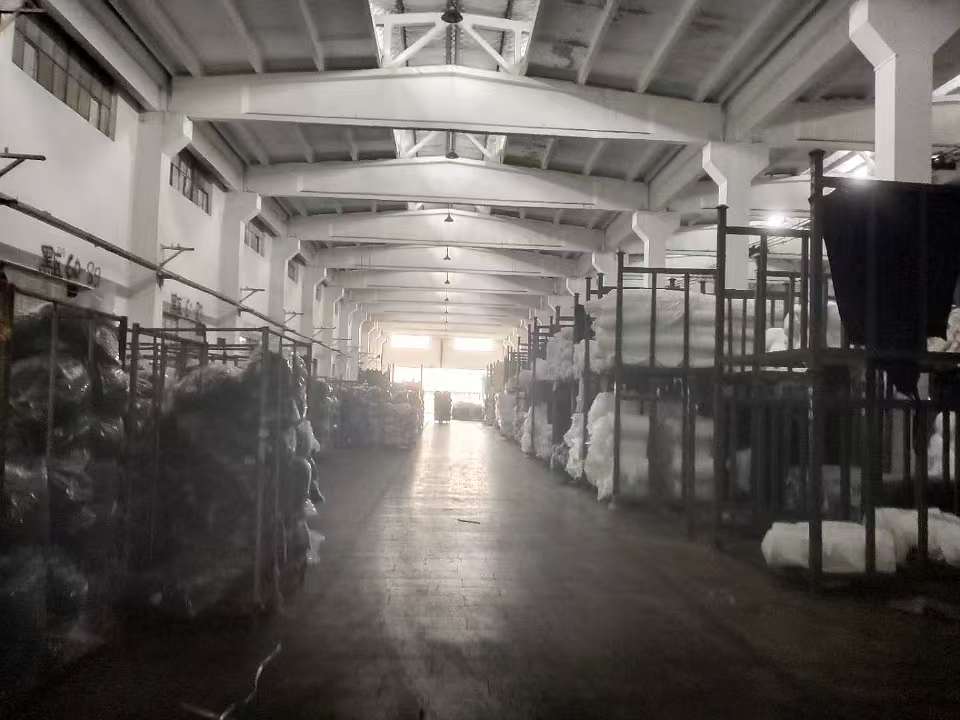
Capability evidence is cumulative: spinning, fabric formation, finishing and functional testing each have to be demonstrated, not assumed.
Why the Market Is Shifting Toward Verified Capability
Two documented market trends explain why evidence is displacing assurance. First, athleisure demand has been characterised by a preference for moisture-wicking and antimicrobial polyester blends as a primary trend across 2024–2026, according to Mordor Intelligence — which moves anti-microbial performance from a premium feature toward a baseline expectation.
Second, the recycled polyester market was valued at USD 15.52 billion in 2024 and is expected to reach USD 26.18 billion by 2030, a 9.25% CAGR, according to Grand View Research. Growth of that scale draws in capacity quickly, and it also draws in documentation requirements.
Against this backdrop, the polyester filament industry's largest producers — named in industry analysis as Indorama Ventures, Reliance Industries, Toray Industries and Teijin Limited — compete on scale. A specialist supplier is not competing on that axis. Its differentiation rests on functional specialisation, customisation at the spinning stage, and the ability to hand a buyer a certificate number, a test method and a production route in the same conversation.
Limits and Trade-offs: Coffee Charcoal Versus Conventional Dyed Polyester
Capability evidence is not the same as suitability. Buyers should weigh the coffee charcoal route against conventional dyed polyester filament with clear eyes, including the points where the specialist route imposes real constraints.
| Evaluation point | Conventional dyed polyester filament | Coffee charcoal (Cocarber®) route | Buyer action |
|---|---|---|---|
| How colour is introduced | Colour applied at the dyeing stage after yarn formation | Colour carried in the masterbatch; dope-dyed route reduces the need for conventional dyeing | Confirm shade availability and lot-to-lot colour consistency for the specific shade required |
| Functional behaviour | Function generally applied through finishing or coating where applicable | Odour control, far infrared heating and anti-microbial performance documented as intrinsic to the fibre | Request test reports against GB/T 30127-2013 and the caffeine residue analysis |
| Recycled content evidence | Not inherently certified | Recycled coffee grounds plus recycled PET bottle flakes, covered by GRS V4.0 and RCS 2.0 certificates | Verify certificate number, scope and expiry date directly with the issuing body |
| Minimum order | Varies by mill | 500 kg | Plan pilot volumes above that threshold; sub-threshold trials may not be available on standard terms |
| Lead time | Varies by mill | 5–20 days depending on specification | Build the upper end of the range into launch planning for custom constructions |
Three boundaries deserve explicit statement. The 500 kg minimum order quantity means that very small validation runs sit outside standard commercial terms, which matters for brands that test widely before committing. Lead time is a range, not a fixed promise, and custom spinning work sits toward the longer end. And the certification window is finite: both certificates run to 2026-11-01, so a buyer placing orders into 2027 must confirm renewal rather than assume continuity.
There is also a scope boundary on the testing evidence. Far infrared and residue results are documented for the material and fabric stage. If the buyer's own mill alters finishing conditions downstream, measured performance should be re-validated rather than assumed to carry through unchanged.
Future Outlook
With recycled polyester projected to grow at roughly 9.25% annually to 2030, and with anti-microbial performance increasingly expected rather than requested, the competitive advantage for specialist filament suppliers is likely to sit less in the fibre itself and more in the evidence package around it. Certification scopes, test methods, residue data and named production equipment are becoming the standard currency of supplier evaluation — and they are becoming checkable.
For buyers, the practical implication is straightforward. A supplier that can produce certificate numbers, test standards, equipment lists and commercial parameters is easier to defend internally than one that can only produce a brochure. The evaluation question is no longer whether the yarn exists, but whether the proof exists alongside it.
FAQ
What certifications cover coffee charcoal antibacterial polyester filament, and what do they actually certify?
The Cocarber® functional polyester filament holds certification to the Global Recycled Standard V4.0 under certificate number IDF-25-887497, issued by IDFL Laboratory and Institute Inc. A separate RCS 2.0 certificate, number IDF-25-887506 and also issued by IDFL, covers a broader scope: dyed yarns, greige yarns, dyed fibres, undyed fibres and dyed fabrics. Both apply to the EU, US, Global Brand Supply Chains and China markets. The certificates address recycled content and chain of custody; they do not certify functional performance, which is covered separately by test methods.
Which test standards are used to verify far infrared behaviour and residue safety?
Far infrared performance is evaluated against GB/T 30127-2013, titled “Textiles—Testing and Evaluation of Far Infrared Performance.” Caffeine residue, which is relevant because the raw material derives from recycled coffee grounds, is documented through LC-MSMS testing at 0.009 mg/kg. These two figures — a named standard and a quantified residue value — are the reference points a buyer can request and compare.
What production equipment does the coffee charcoal filament route require?
The documented route uses spinning machines to convert the functional masterbatch into filament yarn, weaving and knitting looms to form greige fabric, fabric finishing equipment to complete dyeing and setting, and functional testing instruments to verify performance. All four stages are documented for this material family, and the material is positioned for both woven and knitted applications.
What counts and variants are available in the coffee charcoal family?
The coffee charcoal antibacterial polyester filament is produced in 30D, 50D, 75D, 100D, 150D and 300D. Declared functions are recycled coffee waste content, odour control, far infrared heating, quick dry, dope dye and anti-microbial performance. Within the same family, separate variants exist for bamboo charcoal, coconut charcoal, China-hemp charcoal, dope-dyeing, cotton feel, renewable and hydrophilic versions, and the material is positioned for sport, leisure, underwear and home textile applications.
What are the minimum order quantity, lead time and quality control arrangements?
The documented minimum order quantity is 500 kg, lead time is stated at 5–20 days, production runs in an ODM mode, and quality control is described as 100% testing. Customisation is handled at the spinning stage, where style, elasticity and handle can be adjusted to the customer's requirement. Buyers planning pilot programmes should note that volumes below 500 kg fall outside the standard commercial threshold.
How should a buyer confirm that a recycled-content certificate is still valid at the time of purchase?
Both documented certificates were issued on 2025-11-02 and are valid to 2026-11-01. Verification should be based on four elements rather than a logo: the certificate number, the issuing body, the stated scope, and the validity window. In this case the issuing body is IDFL Laboratory and Institute Inc., the scopes differ between the two certificates, and both carry a fixed expiry date. Orders extending beyond the expiry date require confirmation of renewal.