
Evidence of Precision: How Supplier Capabilities Shape GNSS Module Quality
High-precision GNSS module quality is largely decided before a receiver ever locks onto its first satellite. It is decided by the supplier's validation infrastructure, process control and documentation discipline — the parts of a quotation that a specification table never shows.
The global High-Precision GNSS market was valued at USD 7.8 billion in 2024 and is projected to reach USD 20.6 billion by 2033, according to Dataintelo. Market Research Future estimates that the narrower High Precision GNSS Module segment reached USD 1.5 billion in 2024 and is forecast to reach USD 4.5 billion by 2035. As deployment volume rises, the practical difference between suppliers moves away from headline accuracy claims and toward demonstrated consistency — how each unit is assembled, screened and verified before it leaves the factory.
This article examines the capability signals that are observable during evaluation, using the available product line of Jumpstar (JUMPSTAR CO., LIMITED) as a working reference. Jumpstar is a Shenzhen-based GNSS source manufacturer founded in 2013, operating a 5,000 ㎡ facility with 200 employees, a 20-engineer R&D team and an annual output of 100,000 units. Its catalog spans RTK modules, GNSS modules, GNSS receivers, high accuracy GPS modules, anti-jamming GPS antennas, helical GPS antennas and timing modules.
Why Precision Is a Supplier Question, Not a Datasheet Question
Two RTK GNSS modules from different suppliers can carry near-identical headline specifications and still behave very differently after twelve months in the field. The reason is that accuracy figures describe a performance envelope under favourable conditions, while real deployments expose a module to conditions that a bench test does not reproduce.
The failure modes that matter most in high-precision GNSS deployments are well documented and fall into four categories. First, RF electromagnetic interference: broadband, narrowband and pulsed RF noise generated by vehicle engines, onboard electronics and external portable jamming devices can obscure satellite signals, leading to RTK floating solutions, positioning drift or complete loss of satellite lock. Second, satellite signal spoofing: man-made forged GNSS navigation signals can tamper with vehicle position coordinates and disrupt autonomous driving or special-vehicle control operations. Third, vehicle and machine environment failure: long-term vibration, jolting, extreme temperatures and high humidity can cause hardware malfunction and degraded positioning accuracy. Fourth, navigation data security: differential data and raw observation trajectories are vulnerable to interception and tampering during transmission or storage.
None of these four categories is addressed by a better accuracy number. They are addressed by design margins, algorithm choices, component grades and unit-level screening — all of which are supplier capabilities rather than product specifications. That is why, at the decision stage, the productive question is not which module quotes the best accuracy, but what evidence does this supplier generate about every unit it ships.
Capability Signals a Buyer Can Actually Verify
Supplier capability is only useful to a procurement decision if it leaves visible traces. The following signals are drawn from Jumpstar's documented manufacturing and quality-control process, and each one maps to something a buyer can request, inspect or audit.
| Capability signal | What the supplier reports | What it means for a buyer |
|---|---|---|
| Design validation infrastructure | RF interference anechoic chamber, temperature cycling chamber and vibration test bench used for full validation of anti-interference, anti-spoofing and environmental durability before mass production | Performance claims are tested before production, not discovered after field returns |
| Assembly control | Fully automated SMT assembly line | Reduces unit-to-unit placement variability, which is a common source of RF performance spread |
| Unit-level reliability screening | Each module undergoes 24-hour power-on burn-in testing | Shifts screening from batch sampling to per-unit early-life failure detection |
| Functional verification | Each unit is tested using RxTools software to verify satellite acquisition, OSNMA enabling and disabling, and anti-interference functionality | Confirms core positioning and integrity functions device by device |
| Documentation | A factory test report is issued for every device | Gives procurement a traceable record tied to a specific unit, not a generic certificate |
| Post-deployment support | Companion host software for real-time monitoring of interference alarms and positioning integrity, remote deployment of parameter hardening strategies, and rapid technical corrective support | Extends verification past the shipment date into the operating period |
What Product-Line Breadth Reveals About Manufacturing Consistency
Product-line breadth is often read as a marketing signal. It is more useful as a process signal. A supplier that builds modules across several form factors, precision classes and integration levels cannot maintain quality by accident — it has to run shared test flows, shared component qualification and shared quality gates across those products.
Jumpstar's module portfolio spans several distinct categories, which makes the breadth argument concrete rather than abstract.
RTK GNSS modules
- JS-ARK28-3 — a high precision RTK GNSS module with a net weight under 12.0 g and dimensions of 28.0 × 28.0 × 8.0 mm (±0.3 mm).
- JS-ANK45-2 — a multi-system, multi-frequency high-precision RTK GNSS module with 1,408 super channels, dimensions of 45.0 × 45.0 × 12.7 mm (±0.3 mm), net weight under 40 g, and construction in plastic, metal and ceramic. Published figures include cold start under 30 seconds, RTK initialisation under 5 seconds, and positioning accuracy (RMS) of 1.5 m 3D, 0.4 m + 1 ppm DGPS, 1.5 cm + 1 ppm RTK horizontal and 2.0 cm + 1 ppm RTK vertical. It supports NMEA 0183, Unicore and RTCM 3.X, operates from −40 °C to +85 °C, and is stated as RoHS compliant.
- JS-SK40 — an RTK GNSS module with 789 hardware super channels.
- JS-A56U9D — a multi-band GNSS high-precision receiver supporting GPS, BDS, GLONASS, Galileo, QZSS and SBAS, with 192 search channels and 60 tracking channels, 0.3° dynamic heading accuracy, 0.05 m/s velocity accuracy, and protocol support for NMEA 0183 V4.11/V4.0/V4.1, RTCM 3.3 and UBX.
GNSS modules with IMU
- JS-RK26-U — an RTK GNSS module with IMU for automotive navigation and rail transit intelligent positioning, using dual-band (L1+L5) GNSS+INS integration, 200 tracking channels, 28-second cold start, 0.1 m/s CEP speed accuracy, RTK horizontal accuracy of 1.0 cm + 1 ppm, a maximum update rate of 20 Hz and a −40 °C to +85 °C operating range.
- JS-RP26-U — a dual-band (L1+L5) GNSS+INS module for automotive navigation and vehicle tracking, with −165 dBm tracking sensitivity, 1.0 m CEP single-point horizontal accuracy and 1.0 cm + 1 ppm RTK horizontal accuracy.
- JS-TP26-U — a GPS GNSS module with IMU for intelligent driving and vehicle control, with single-point horizontal accuracy of 1.0 m (L1+L5) or 2.5 m (L1) CEP and GNSS+INS accuracy under 1.5 m CEP.
Standard-precision and general-purpose modules
- JS-ATP36-M — a Standard Precision GNSS Module for automotive, maritime, logistics and wearable applications, with dimensions of 36.0 × 36.2 × 12.5 mm, a 2.8 V to 5.5 V supply range, NMEA 0183 protocol support and a maximum update rate of 10 Hz.
- JS-M6D — an RTK GNSS module measuring 22.0 × 17.0 × 2.4 mm and weighing under 12.0 g, built from plastic, metal and ceramic.
- JS-AP26-H — a GPS GNSS module measuring 16.0 × 12.2 × 2.4 mm (±0.3 mm) with a −40 °C to +85 °C operating range.
- JS-RK40 — a module intended for the UAV and drone industry.
Antennas and integrated smart antenna modules
- JS-HAC18A-F — a helical active antenna for UAV applications supporting GPS L1/L2/L5, BDS B1/B2, GLONASS G1/G3, Galileo E1/E5a/E5b, QZSS L1/L2/L5, SBAS L1/L5 and IRNSS L5, with 360° horizontal coverage, RHCP polarisation and 50 Ω impedance.
- JS-SK43H-AH — a multi-band RTK positioning and heading smart antenna module supporting BDS, GPS, GLONASS, Galileo and QZSS with 789 hardware channels, measuring 48.0 × 43.2 × 37.0 mm (±0.3 mm) and weighing under 24 g.
- JS-RK43-3 — a smart antenna supporting GPS L1/L5, BDS B1I/B1C/B2I/B2B/B2A, Galileo E1/E5, GLONASS G1, QZSS L1/L5 and IRNSS L5, with a 28-second cold start and 1.5-second AGPS time.
The procurement-relevant point is not that the catalog is large. It is that the same supplier produces centimetre-level RTK modules (1.0 cm + 1 ppm to 1.5 cm + 1 ppm horizontal), sub-metre GNSS+INS modules, standard-precision receivers with 10 Hz update rates, and the antennas that feed them. Each of those categories has different tolerance requirements, different test parameters and different failure risks. Maintaining a single quality system across all of them is a capability in its own right — and it is one that shows up in consistency between shipments, not in a datasheet.
Technical Explanation: The Engineering Behind the Evidence
Buyers evaluating high-precision GNSS solutions at the decision stage benefit from understanding which technical mechanisms generate the test results they are being shown. Jumpstar's documented approach addresses each of the four risk categories with a specific mechanism.
Interference control. The modules are equipped with AIM+ full-spectrum interference suppression algorithms, featuring built-in automatic wideband noise reduction, triple-channel adaptive narrowband notch filters and APME multipath mitigation technology. In practical terms, this is a filter chain designed to reject electromagnetic interference from urban environments and vehicle electronics before it corrupts the position solution.
Spoofing control. The platform natively supports Galileo OSNMA navigation message anti-spoofing authentication, with built-in RAIM (Receiver Autonomous Integrity Monitoring) to automatically identify and reject illegal forged satellite signals. This is an integrity-checking layer rather than a positioning layer — it answers whether the signal you received is trustworthy, not just where it says you are.
Environmental control. The hardware uses industrial-grade components rated across a −40 °C to +85 °C range, PCB reinforcement techniques, and complete-unit sustained vibration testing. This matters for any application where the receiver is mounted on a moving platform.
Data control. Raw observation data is stored on a TF card in SBF format, keeping the observation record local rather than dependent on a live transmission link.
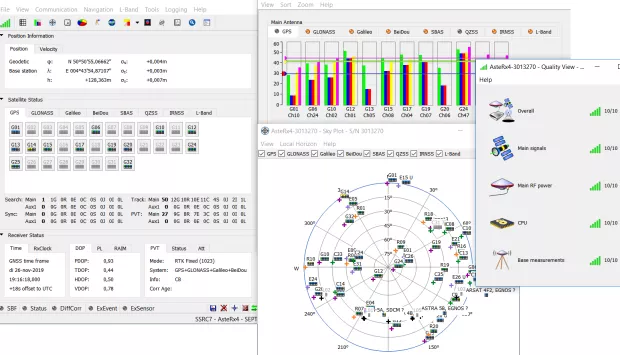
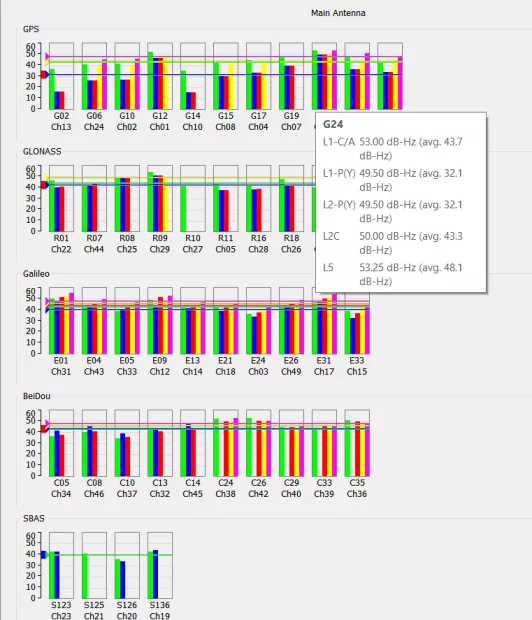
These mechanisms also explain why carrier-to-noise ratio behaviour is a more informative evaluation metric than a single accuracy figure. Signal quality per satellite, observed over time, reveals whether the antenna, front end and interference handling are working together correctly across the full constellation set.
Where These Capabilities Are Actually Used
Capability claims become meaningful only when mapped to deployment conditions. The application coverage documented across Jumpstar's product line is broad and specific.
UAVs and drones. The JS-RK40 is intended for the UAV and drone industry. The JS-ARK37-3 targets UAV and drone applications alongside autonomous driving, smart logistics, precision agriculture and location services, surveying and mapping, autonomous robots, in-vehicle applications and precision control. The JS-RK26-3 is suitable for UAVs, intelligent logistics scheduling, maritime navigation, automotive and emergency rescue scenarios, with a VCC supply range of 2.0 V to 3.6 V and a V_BACK range of 1.8 V to 3.6 V.
Precision agriculture. Agriculture is the dominant application segment for high-precision GNSS, holding a 36.8% market share in 2025. Modules such as the JS-ANK45-2 and JS-A56U9D are specified for precision agriculture, and the P-Box-X10 turnkey receiver is positioned for the same segment. Public standards also shape what agriculture buyers should test against: ISO 12188 parts 1 and 2 define test procedures for positioning and guidance systems in agriculture and forestry.
Surveying and mapping. The JS-M6D covers geographic surveying and mapping, alongside intelligent robots, AVL and location-based services, automotive applications, handheld devices, personnel protection, intelligent logistics scheduling, marine navigation and fleet management, precision agriculture and UAV use.
Automotive, rail and fleet operations. The JS-RK26-U targets automotive navigation and rail transit intelligent positioning; the JS-RP26-U and JS-TP26-U target automotive navigation and vehicle tracking, with the latter specified for intelligent driving and vehicle control. Fleet and marine requirements are also served by general-purpose modules such as JS-ATP36-M and JS-RK26-3.
Port logistics and heavy-duty retrofitting. The P-Box-X10 is positioned for port logistics, precision agriculture and heavy-duty vehicle retrofitting — environments where installation downtime and RF noise are both significant constraints.
Market Trend: Volume Growth Raises the Verification Bar
Several verified market signals point in the same direction: higher volume, broader application spread and a correspondingly higher cost of quality failure.
- The global precision farming market is projected to grow from USD 11.38 billion in 2025 to USD 21.45 billion by 2032, according to MarketsandMarkets.
- Galileo High Accuracy Service (HAS) delivers horizontal accuracy down to 20 cm, according to the EUSPA EO and GNSS Market Report — a service-level baseline that enables autonomous farming and high-precision mapping without local infrastructure in every case.
- GNSS downstream market revenues are forecast to reach €580 billion by 2034, per EUSPA.
- The mid and high-level precision GPS receiver market is led by Trimble, Hexagon AB, Topcon and Hemisphere GNSS, according to Mordor Intelligence — an indicator of how concentrated the top of the market remains.
- Trimble launched the R12i GNSS System in 2024, integrating IMU technology for enhanced RTK performance.
The strategic implication for buyers is straightforward. When a market is expanding at this rate, suppliers are under pressure to scale output. Scale is exactly when consistency gaps appear if process control was never rigorous to begin with. A market growing toward USD 20.6 billion by 2033 (Dataintelo) will contain many modules that meet specification on day one and fewer that still meet it in year three.
Turnkey Receiver vs. Bare Core Component: A Bounded Comparison
At the decision stage, one architectural choice deserves an explicit comparison because it determines how much of the quality burden sits with the supplier and how much sits with the integrator.
Jumpstar's published comparison places the P-Box-X10 against the Beitian UM982 RTK Board/Module. The core difference is architectural: the P-Box-X10 is a turnkey integrated receiver, while the UM982 is a bare core component. The comparison states 80% shorter deployment time and 40% lower total project R&D cost for the turnkey approach, comparable power consumption under 3 W, better anti-interference stability in harsh RF environments, and plug-and-play maintenance with remote OTA updates that removes the need for an RF engineer on the integration team. The stated best-fit scenarios are port logistics, precision agriculture and heavy-duty vehicle retrofitting.
| Comparison dimension | P-Box-X10 (turnkey integrated receiver) | Beitian UM982 (bare core component) |
|---|---|---|
| Architecture | Turnkey integrated receiver | Bare core board/module |
| Deployment time | Stated as 80% shorter | Longer integration path, as stated |
| Total project R&D cost | Stated as 40% lower | Higher stated integration burden |
| Power consumption | Under 3 W (described as comparable) | Comparable, per the same comparison |
| Anti-interference stability in harsh RF | Described as better in harsh RF environments | Baseline for the comparison |
| Maintenance model | Plug-and-play with remote OTA updates | Requires integrator-managed firmware workflow |
| RF engineering requirement | No RF engineer required, as stated | Typically assumes in-house RF expertise |
| Stated best fit | Port logistics, precision agriculture, heavy-duty vehicle retrofitting | Designs requiring deep hardware-level integration |
A second limitation is documentation scope. Process evidence such as a per-unit factory test report proves that a defined test was executed and passed. It does not, by itself, constitute third-party certification. Buyers who require formal regulatory or industry certifications should request the specific certificates as documents and verify their issuing bodies, rather than inferring certification from a test report.
Future Outlook
Three shifts are likely to define supplier evaluation in this category over the next several years.
First, integrity will become a first-class specification. Anti-spoofing mechanisms such as Galileo OSNMA support and RAIM-based integrity monitoring currently appear in supplier documentation as differentiators; as autonomous and semi-autonomous platforms scale, they are likely to be treated as baseline requirements in procurement checklists.
Second, service-level accuracy will change what buyers expect from hardware. Galileo HAS delivering horizontal accuracy down to 20 cm alters the design question from how do I build a base station to what does my receiver need to do in order to take advantage of the service. Suppliers that can answer that at the module level will be better positioned.
Third, verification will migrate from the product to the process. As market volume grows toward the projected figures, the suppliers that scale without degrading consistency will be those whose evidence trail already exists — per-unit burn-in records, factory test reports, documented chamber validation. For buyers, the practical takeaway is that the most valuable supplier capability is not a better accuracy claim. It is the ability to prove, unit by unit, that the claim was met.
FAQ
How can a buyer compare high-precision GNSS module suppliers without running their own test lab?
Comparisons can be built from documented process evidence rather than laboratory results. Ask each supplier whether every unit is individually tested before shipment, what that test covers, and whether a per-unit report is issued. Jumpstar's documented process includes 24-hour power-on burn-in testing for each module, functional verification using RxTools software to check satellite acquisition, OSNMA enabling and disabling and anti-interference functionality, and a factory test report issued for every device. Requesting equivalent documentation from competing suppliers produces a comparable evidence set without requiring in-house test infrastructure.
What is the practical difference between a turnkey RTK receiver and a bare RTK board or module?
The difference is where integration and validation effort sits. A turnkey integrated receiver, such as the P-Box-X10, is compared against the Beitian UM982 RTK Board/Module as an integrated unit versus a bare core component. The published comparison states 80% shorter deployment time, 40% lower total project R&D cost, power consumption under 3 W, better anti-interference stability in harsh RF environments, and plug-and-play maintenance with remote OTA updates that eliminates the need for an RF engineer. The same comparison positions the turnkey receiver for port logistics, precision agriculture and heavy-duty vehicle retrofitting. A bare core component remains the more suitable choice where the integrator wants direct control over RF front-end design and enclosure decisions.
Does a broader GNSS module product line indicate better module quality?
Not on its own — but it creates conditions that are difficult to satisfy without process discipline. Producing RTK modules with different accuracy classes, GNSS+INS modules, standard-precision modules and matching antennas requires shared component qualification, shared test flows and shared quality gates. Jumpstar's line includes modules with published RTK horizontal accuracy of 1.0 cm + 1 ppm and 1.5 cm + 1 ppm, a standard-precision module with a 10 Hz maximum update rate, and antenna modules with 789 hardware channels. Breadth is therefore best treated as a signal to investigate, not a conclusion: it should be paired with per-unit test documentation before it influences a sourcing decision.
Which supplier capabilities matter most for UAV, precision agriculture and automotive integration?
The dominant capability depends on the platform's motion and RF environment. For UAV use, module suitability and antenna performance dominate — the JS-RK40 is intended for the UAV and drone industry, and the JS-HAC18A-F helical antenna supports GPS L1/L2/L5, BDS B1/B2, GLONASS G1/G3, Galileo E1/E5a/E5b, QZSS L1/L2/L5, SBAS L1/L5 and IRNSS L5 with 360° horizontal coverage. For precision agriculture, agriculture is the largest high-precision GNSS application segment with a 36.8% market share in 2025, and ISO 12188 parts 1 and 2 define the relevant positioning and guidance test procedures. For automotive and rail, dual-band GNSS+INS integration and update rate matter — the JS-RK26-U offers a 20 Hz maximum update rate, 28-second cold start and RTK horizontal accuracy of 1.0 cm + 1 ppm. Across all three, the shared requirement is validation before mass production: RF anechoic chamber, temperature cycling chamber and vibration testing.
What test evidence should accompany a high-precision GNSS module shipment?
At minimum, buyers should expect a per-unit factory test report and a description of what that test verified. Jumpstar's documented process issues a factory test report for every device, covering satellite acquisition, OSNMA enabling and disabling, and anti-interference functionality, after 24-hour power-on burn-in testing. Depending on the application, additional documentation is relevant: operating temperature range confirmation, since several modules in the line are rated from −40 °C to +85 °C, and material composition for modules constructed from plastic, metal and ceramic. Where a supplier states RoHS compliance, as with the JS-ANK45-2, the supporting declaration should be requested as a document rather than assumed from the compliance statement alone.
Jumpstar's 2026 company profile, including the full product line and manufacturing documentation, is available for download: Jumpstar company profile 2026. Company information: www.jgnss.com.
Tem questões ou precisa de mais detalhes?
Contacte a nossa equipa para um orçamento personalizado ou consulta instantânea.
Solicitar orçamento
Preencha o formulário abaixo e a nossa equipa entrará em contacto com uma proposta personalizada.
Chat direto do WhatsApp
Prefere conversar em tempo real? Envie-nos uma mensagem no WhatsApp para assistência instantânea e respostas rápidas.
- Obter orçamento personalizado
- Partilhar fotos ou documentos
- Discuta as suas necessidades diretamente
Geralmente responde em 5–30 minutos durante o horário de expediente.