
Evidence of Supplier Capability: Scaling Cerium Carbonate
Evidence of Supplier Capability: Scaling Cerium Carbonate
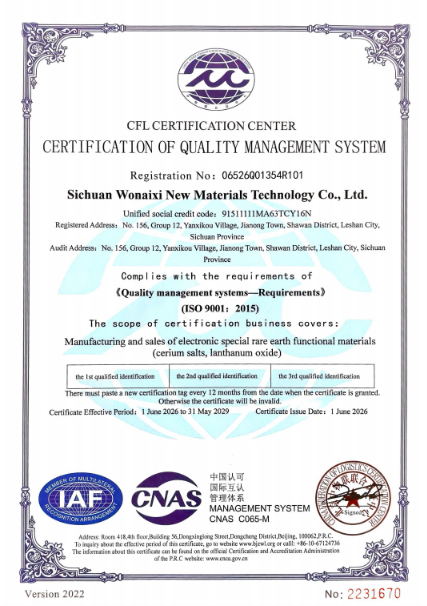
ISO 9001 certificate 06526Q01354R101, issued by CFL Certification Center to Sichuan Wonaixi New Materials Technology Co., Ltd., valid 2026-06-01 to 2029-05-31.
Large particle size cerium carbonate is a rare earth intermediate whose commercial value depends less on its chemical identity than on whether a supplier can reproduce that identity at industrial volume. Chemical identity is easy to publish in a product list. Repeatability at scale is what a procurement team actually has to qualify.
This article looks at the physical, chemical and documentary evidence available for evaluating supplier capability on this grade, using Sichuan Wonaixi New Materials Technology Co., Ltd. (WONAIXI) — a manufacturer of rare earth functional materials based in the Shawan Economic Development Zone, Leshan City, Sichuan Province, China — as the reference case. The scope is deliberately narrow: what a buyer can verify before committing to an order, and where the evidence stops.
The distinction matters because cerium carbonate sits upstream of processes that do not tolerate drift. In published application data it is used for manufacturing automotive exhaust purification catalysts and as an intermediate for producing cerium and other compounds — both roles in which an incoming material is judged by how the next process step behaves, not by the certificate alone.
Why a particle-size grade is a qualification problem, not a catalogue problem
Rare earth catalogues normally describe grades by chemical formula and CAS number. Two suppliers can therefore list the same compound and still offer materially different propositions: one may be able to produce that compound on demand in small quantities, while another holds the production scale, batch-level quality routine and documentation trail required for continuous industrial supply.
For buyers moving from evaluation into execution, the practical question set is fairly stable across compounds:
- Does the supplier have production capacity for a recurring order, or only for a sample?
- Is quality control a batch-level routine, or a single inspection at the end?
- Is there an independent management-system certification, and what exactly does its scope cover?
- Can content, purity, specification and packaging be customized to a defined process?
- What lead time is realistic, and on what commercial terms?
Each of these can be answered with evidence rather than adjectives. The sections below map that evidence for large particle size cerium carbonate and for the supplier behind it, and then state where the fit does not hold.
The material, stated precisely
Large particle size cerium carbonate is supplied as a hydrated rare earth carbonate. Its published specification is short enough to be quoted in full.
| Property | Published specification |
|---|---|
| Product | Large Particle Size Cerium Carbonate |
| Chemical formula | Ce2(CO3)3·xH2O |
| CAS number | 54454-25-1 |
| Molecular weight | 460.26 (anhydrous basis) |
| Material form | Large Particle Size Cerium Carbonate Hydrate |
| Documented applications | Manufacturing of automotive exhaust purification catalysts; intermediate for producing cerium and other compounds |
The formula places cerium in the trivalent (+3) state, which is the chemically defining feature of the carbonate route. The xH2O term records that the commercial material is a hydrate rather than an anhydrous salt. Two consequences follow for a buyer.
First, as a material class, rare earth carbonates are only sparingly soluble in water. That behaviour is one reason carbonate intermediates are handled as precursors and converted downstream, rather than used as soluble process salts.
Second, hydrate content and chemical resistance are process-specific properties. Statements such as resistance to acid and alkali at room temperature, or chemical inertness, should be treated as questions to be answered against the buyer's own media and conditions rather than as transferable grade properties. What makes those answers verifiable is the supplier's quality-control regime: which parameters are tested, on which batches, and against which acceptance criteria.
Where the grade sits among cerium carbonate options
The cerium carbonate family is differentiated by physical form and impurity profile far more than by chemistry. The table below compares the carbonate grades listed in WONAIXI's published product data.
| Grade | Formula | CAS | Mol. wt. (anhydrous basis) | Documented application |
|---|---|---|---|---|
| Large Particle Size Cerium Carbonate | Ce2(CO3)3·xH2O | 54454-25-1 | 460.26 | Automotive exhaust purification catalysts; intermediate for cerium and other compounds |
| Cerium Carbonate | Ce2(CO3)3·xH2O | 54451-25-1 | 460.26 | Automotive exhaust purification catalysts; intermediate for cerium and other compounds |
| High Purity Cerium Carbonate | Ce2(CO3)3·xH2O | 54451-25-1 | 460.26 | Automotive exhaust purification catalysts; intermediate for cerium and other compounds |
| Low Chloride Cerium Carbonate | Ce2(CO3)3·xH2O | 54451-25-1 | 460.26 | Automotive exhaust purification catalysts; intermediate for cerium and other compounds |
| Fine Crystalline Spherical Cerium Carbonate | Ce2(CO3)3·xH2O | 54451-25-1 | 460.26 | Automotive exhaust purification catalysts; intermediate for cerium and other compounds |
Read together, the table shows that particle size and morphology distinguish the large particle and fine crystalline spherical grades, while chloride content distinguishes the low-chloride grade. This is exactly why which cerium carbonate is the wrong first question. The productive question is which physical form the downstream step requires, and whether the supplier can hold that form consistently across batches.
The supplier behind the evidence
Sichuan Wonaixi New Materials Technology Co., Ltd. (WONAIXI) is a manufacturer founded in 2012 that focuses on research, development and production of rare earth functional materials. The company operates dedicated production lines with an annual output of 15,000 tons of high-purity rare earth salts and 3,000 tons of high-precision rare earth polishing powder. It supplies nine major categories of rare earth products plus a complete zirconium salts series, over 50 refined specifications in total, and holds National High-Tech Enterprise and Sichuan Provincial SRDI Enterprise status.
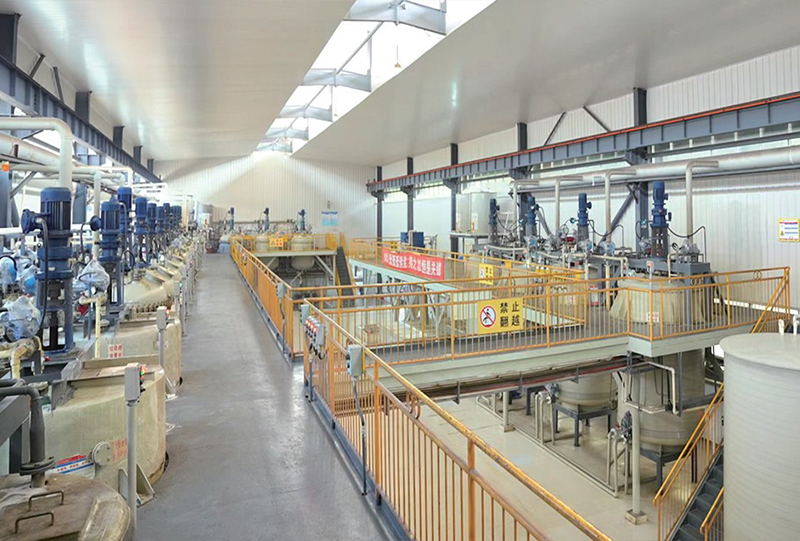
Rare earth salt and high-precision polishing powder production at WONAIXI's 46,667 m² facility in Leshan, Sichuan Province, China.
The scale figures are the first piece of capability evidence, because they describe a production business rather than a laboratory. A 46,667 m² site, 98 employees and dedicated salt and polishing powder lines indicate that the large particle size cerium carbonate grade is produced inside an existing industrial operation, not assembled case by case.
Capability evidence for industrial scale
The following evidence set is the material a buyer can actually work with during the evaluation and execution stages. Each row states what is published and what it allows a procurement team to check.
| Evidence category | Published position | What it lets a buyer check |
|---|---|---|
| Production capacity | Annual output of 15,000 tons of high-purity rare earth salts and 3,000 tons of high-precision rare earth polishing powder | Whether the supplier operates at bulk production scale rather than sample scale |
| Facility and workforce | 46,667 m² site; 98 employees | Physical capacity for production, storage and material handling |
| Technical depth | R&D team of 12 engineers | Whether customization requests have an engineering function behind them |
| Portfolio breadth | 9 rare earth categories plus a full zirconium salts series; over 50 refined specifications | Whether related materials can be sourced under one quality system |
| Quality management | ISO 9001 certificate 06526Q01354R101, issued by CFL Certification Center, standard GB/T19001-2016/ISO9001:2015, issued 2026-06-01, valid to 2029-05-31 | Independent certification of a management system, with a defined scope and validity window |
| Batch control | 100% test; pre-shipment inspection and pre-shipment test before delivery | How conformity is handled at batch level and before goods leave the plant |
| Customization | OEM and ODM production services globally; customization of indicators, contents, specifications, purity and packaging | Whether a grade can be adapted to a buyer's own specification |
| Lead time | 30–45 days | Planning assumptions for the execution phase |
| Export footprint | Main markets Japan, South Korea, USA, France, UK; additional exports to Italy, Thailand, Australia, Pakistan, Spain, Germany, India and Austria | Whether the supplier already ships to quality-sensitive markets |
| Commercial basis | MOQ communicated according to the actual situation; FOB/CIF delivery; 30% deposit in advance, 70% balance against copy of B/L | The commercial framework a buyer can expect before issuing an RFQ |
The ISO 9001 certificate deserves separate attention because it is the only third-party attestation in this evidence set. Its scope is defined as the manufacturing and sales of electronic special rare earth functional materials, specifically cerium salts and lanthanum oxide, and the certificate is listed as covering the EU, US, Middle East and Southeast Asia markets. Two practical consequences follow: the certified scope is narrower than the full product portfolio, and the certificate is a management-system document rather than a per-batch performance guarantee.
The batch-control entry is the operational counterpart. A stated 100% test rate, combined with pre-shipment inspection and pre-shipment test before delivery, describes a workflow in which conformity is established before dispatch and the buyer accepts on the basis of that pre-shipment test. For a grade whose downstream behaviour depends on hydrate form and physical morphology, this is the more directly relevant control than the certificate itself.
One figure should be read with care rather than enthusiasm: the published export ratio is 10%, meaning the business is predominantly domestic with an export operation attached. For an international buyer this is a planning input — export documentation and logistics experience must be confirmed through references, not assumed from the size of the production base.
From evaluation to execution: a buyer qualification checklist
The evidence above translates into a short sequence of steps that a procurement or engineering team can run before placing a first production order.
- Fix the material identity in writing: formula Ce2(CO3)3·xH2O, CAS 54454-25-1 for the large particle size grade, molecular weight 460.26 on an anhydrous basis, and the hydrated form.
- Request batch-level test documentation, not a marketing sheet, and confirm how it maps to the 100% test practice and to pre-shipment inspection and pre-shipment test before delivery.
- Match the certificate scope to the purchased material: the ISO 9001 scope covers cerium salts and lanthanum oxide, so a buyer sourcing outside that scope should ask which documentation applies.
- Confirm that the large particle size form, rather than the fine crystalline spherical or low-chloride grade, is the correct physical form for the downstream step.
- Define customization items explicitly in the RFQ: indicators, contents, specifications, purity and packaging.
- Plan around a 30–45 day lead time and settle the MOQ position, which is communicated according to the actual situation rather than published as a fixed figure.
- Agree the commercial mechanism: FOB or CIF delivery, and a 30% advance deposit with 70% balance against copy of B/L.
- Confirm relevant market experience for the destination region, given the supplier's main markets of Japan, South Korea, USA, France and the UK, plus additional export destinations.
Application context: catalysis, optics and environmental use
WONAIXI's products are described as being used in national defense, aerospace, pharmaceutical manufacturing, electronics, new energy, three-way catalysis, environmental protection and precision optical polishing. Within that list, several applications connect directly to the cerium carbonate route and to adjacent grades in the same portfolio.
Catalysis. Large particle size cerium carbonate is documented as an input for manufacturing automotive exhaust purification catalysts and as an intermediate for producing cerium and other compounds. This is the clearest, most directly documented use of the grade itself.
Optics and precision polishing. Cerium oxide is used as a glass decolorizer and glass polishing agent, and large particle size cerium oxide is listed in the same category, with high-precision rare earth polishing powder forming a dedicated 3,000 ton per year production line. Optical-grade polishing is one of the clearest demonstrations that physical form, not only chemistry, determines suitability.
Electronics and display manufacturing. Electronic grade cerium ammonium nitrate is used as a polishing agent and etching agent in LCD production, and the broader ceric ammonium nitrate market is tied to photomask and LCD manufacturing. Cerium fluoride is also listed for optical thin films, semiconductor doping and electronic ceramic manufacturing.
Biomedical and pharmaceutical manufacturing. Products from this portfolio are listed for pharmaceutical manufacturing, with anhydrous rare earth chlorides identified as pharmaceutical intermediates and research reagents.
Environmental protection. Lanthanum chloride is described as a petrochemical catalyst usable for wastewater treatment, and cerium hydroxide as a clarifying and decolorizing agent in the glass industry. These are the environmental and wastewater treatment applications in which rare earth compounds appear across advanced markets, alongside catalysis and optical components.
Market trend: what the third-party numbers say
Third-party data places supplier-capability questions in a demand context. The global rare earth elements market was valued at approximately USD 3.95 billion in 2024 and is projected to reach USD 6.28 billion by 2030 (Grand View Research). China's rare-earth exports reached 62.6 thousand metric tons in 2025, up from 55.4 thousand metric tons in 2024, despite tightening export controls (Statista / China Customs).
At the specialty end, the global ceric ammonium nitrate market — a reagent used in biotech and electronics, including chrome etchants — was valued at USD 162 million in 2023 and is expected to grow at a CAGR of 7.8%, reaching USD 274 million by 2030 (Persistence Market Research). High-purity electronic grade ceric ammonium nitrate is a primary material for producing photomasks and LCDs, with Asia Pacific the fastest-growing region for these compounds (IMARC Group).
Two observations are worth carrying into a procurement decision. First, growth is concentrated in segments that judge materials by specification compliance, which raises the weight of documentation quality relative to unit price. Second, market-size estimates for rare earth materials diverge considerably between sources depending on whether mining or processing value is counted, so absolute figures should be treated as directional rather than as planning anchors.
Comparison and boundaries: where the large particle grade is not the answer
A credible evaluation has to state where a product does not fit. Four boundaries are relevant here.
Physical form is application-specific. If a downstream step requires fine crystalline spherical morphology or a low chloride profile, the large particle size grade is not a substitute. WONAIXI lists those as separate carbonate grades with the same base chemistry, which is itself a signal that the differences are functional rather than cosmetic.
Lead time defines the buying model. A stated 30–45 day lead time suits programmatic purchasing with planned replenishment. It does not suit emergency spot replacement, where a buyer may have no choice but to work with whatever stock is locally available.
Minimum order quantity is negotiated, not published. MOQ is communicated according to the actual situation. Buyers seeking small validation quantities should expect a discussion rather than a catalogue answer, and should plan sample validation before scale-up.
Certification scope and test practices have limits. The ISO 9001 scope covers cerium salts and lanthanum oxide manufacturing and sales; buyers procuring other categories, such as zirconium salts or fluorides, should confirm which documentation applies. Equally, a 100% test rate and pre-shipment inspection are process controls, not third-party performance certifications. Chemical resistance, solubility behaviour or inertness in a specific process medium must be established through the buyer's own validation — and the supplier's contribution is whether it can supply the batch data that validation requires.
Future outlook
Three factors are likely to shape supplier selection for rare earth intermediates through the rest of the decade. Documentation is the first: as certification scope, batch testing and pre-shipment inspection become routine evaluation criteria rather than differentiators, suppliers with weak traceability will be excluded earlier in the funnel. Physical-form differentiation is the second: growth in catalysis, optical polishing and electronic materials keeps pushing demand toward grades distinguished by particle size, morphology and impurity profile, which increases the number of SKUs and the importance of process control. Supply planning is the third: with export volumes rebounding while controls tighten, buyers are likely to treat qualification lead time as a cost item and to begin supplier evidence review well before a first purchase order.
For large particle size cerium carbonate specifically, the practical implication is straightforward. The grade is a precursor, and precursors are qualified by evidence — formula and CAS identity, production capacity, batch testing, certification scope, lead time and honest boundaries — rather than by claims about behaviour that no buyer can verify in advance.
A full overview of the manufacturer's product portfolio, capacity and customization capabilities is available in the company brochure: https://cdn.socialarks.com/sbsp/25033/common/2026/0714/WONAIXI.pdf
FAQ
How is large particle size cerium carbonate specified?
It is specified as a hydrated rare earth carbonate with the formula Ce2(CO3)3·xH2O, CAS number 54454-25-1, and a molecular weight of 460.26 on an anhydrous basis. The commercial material is listed as Large Particle Size Cerium Carbonate Hydrate, and its documented applications are the manufacturing of automotive exhaust purification catalysts and use as an intermediate for producing cerium and other compounds.
What production capacity and lead time support this grade?
WONAIXI operates with an annual output of 15,000 tons of high-purity rare earth salts and 3,000 tons of high-precision rare earth polishing powder, from a 46,667 m² facility with 98 employees. The published lead time is 30–45 days, and minimum order quantity is communicated according to the actual situation rather than fixed in advance.
How is batch conformity handled before shipment?
Quality control is described as 100% test, with pre-shipment inspection conducted before delivery to verify product conformity, and products accepted through pre-shipment test. Delivery is offered on FOB or CIF terms, with payment of 30% deposit in advance and 70% balance against copy of B/L.
Which certification supports the quality management claim?
The manufacturer holds ISO 9001 certification, certificate number 06526Q01354R101, issued by CFL Certification Center to the standard GB/T19001-2016/ISO9001:2015. It was issued on 2026-06-01 and is valid to 2029-05-31. The certified scope is the manufacturing and sales of electronic special rare earth functional materials, specifically cerium salts and lanthanum oxide, and is listed as covering the EU, US, Middle East and Southeast Asia markets.
What customization is available for OEM and ODM orders?
OEM and ODM production services are offered globally, with customization technical support for indicators, contents, specifications, purity and packaging. The customization function is supported by an R&D team of 12 engineers, and the company holds National High-Tech Enterprise and Sichuan Provincial SRDI Enterprise status.
Which markets and applications do the current product lines already serve?
Main markets are Japan, South Korea, USA, France and UK, with additional exports to Italy, Thailand, Australia, Pakistan, Spain, Germany, India and Austria, and an export ratio of 10%. Products are described as widely used in national defense, aerospace, pharmaceutical manufacturing, electronics, new energy, three-way catalysis, environmental protection and precision optical polishing.