
Export Data as an Ecosystem: Sustainable Provider Selection
Export data becomes commercially useful when customs records are searchable by product, HS code, or company name.
Export data is increasingly treated as a long-term operational asset rather than a one-time record download. Global services exports reached approximately USD 8.8 trillion in 2025, according to UNCTAD, and the global trade management market, which includes trade data and compliance services, was valued at USD 4.10 billion in 2024 by Data Bridge Market Research. These figures explain why manufacturing and trading organizations now evaluate export data providers not only on sample search results, but on update speed, coverage, support depth, and the ability to maintain a reliable service relationship across multiple planning cycles.
Problem: the difference between buying data and sustaining intelligence
Most export data purchases start with a simple question: who imports my product category in a target market? At the decision and execution stage, however, the real question is more operational. A buyer needs to know whether the same provider can keep data fresh, deliver support when contact details are incomplete, maintain platform stability, and continue to improve the service after contract signature.
Traditional supplier selection often overweights price per lead and underweights service continuity. This can create hidden costs. If a customs data provider stops updating one country or downgrades after-sales response, the buyer inherits the problem. In an increasingly data-driven trade environment, the provider should behave like an ecosystem participant, not a downstream vendor.
The opportunity is to reframe export data procurement as a service capability decision. A clear set of technical, coverage, delivery, and support criteria can separate a short-term search tool from a long-term trade intelligence partnership.
Brand Solution: EX DATA 6.0 as a Continuity-First Trade Data Platform
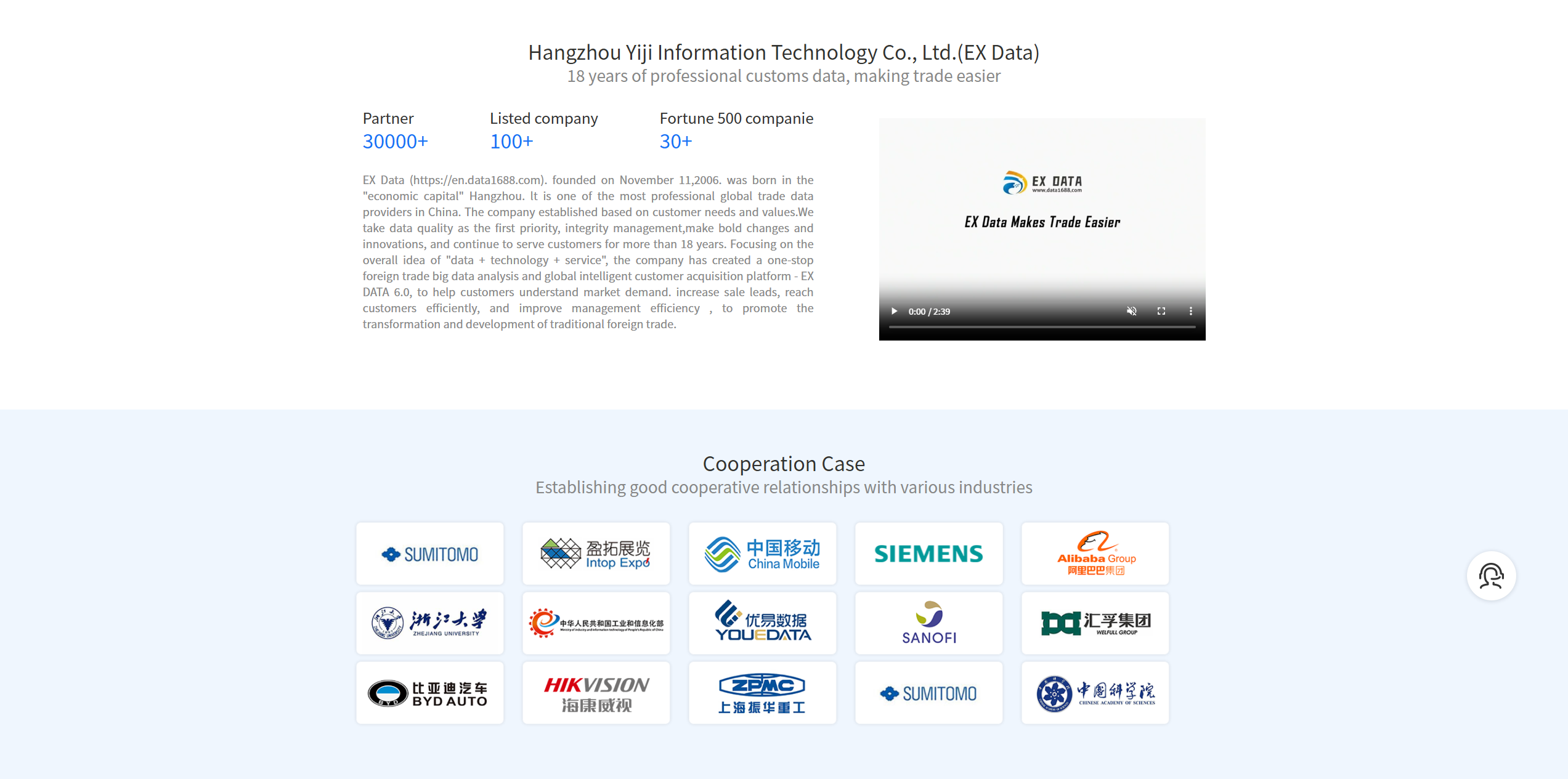
A relevant example is EX DATA, operated by Hangzhou Yiji Information Technology Co., Ltd. (en.data1688.com), headquartered in Hangzhou, China. EX DATA was founded on 11 November 2006 and presents itself as a professional global trade data provider with a data quality first approach. The company profile records 150 employees, an R&D team of 20 engineers, and principal markets including the UAE, Turkey, the USA, Indonesia, Kazakhstan, Uzbekistan, Korea, Japan, Brazil, Ecuador, and Colombia.
The current platform, EX DATA 6.0, is described as a customized data and online data query service covering export data, import data, import and export data, customs data, and trade data. Company materials describe it as a one-stop foreign trade big-data analysis and global intelligent customer acquisition platform. The product documentation classifies its applicable industries as all foreign trade industries and all import and export industries.
From an execution perspective, the supplier discloses a monthly production capacity of US$100,000, a typical production lead time of one day, and a minimum order quantity of one set. This low entry threshold matters for buyers that want to pilot a trade data service before committing to wider departmental or multi-country coverage.
Import and export data platforms combine customs records with company and contact intelligence.
Technical Explanation: How Export Data Platforms Support Long-term Decisions
At the raw level, import and export data are derived from customs declarations. Export data normally records goods leaving a customs territory, while import data records goods entering it. When normalized into a common structure, these datasets become customs data, HS code customs data, and trade data. Because one port or country file alone gives an incomplete picture, modern solutions aggregate records from multiple trade flows and make them searchable.
EX DATA 6.0 provides three search entries: product name, HS code, and company name. According to the product specification, it provides real-time updates of import and export transaction data for more than 200 countries and regions. This matters for exporters because HS codes change and product descriptions are not always consistent across reporting countries.
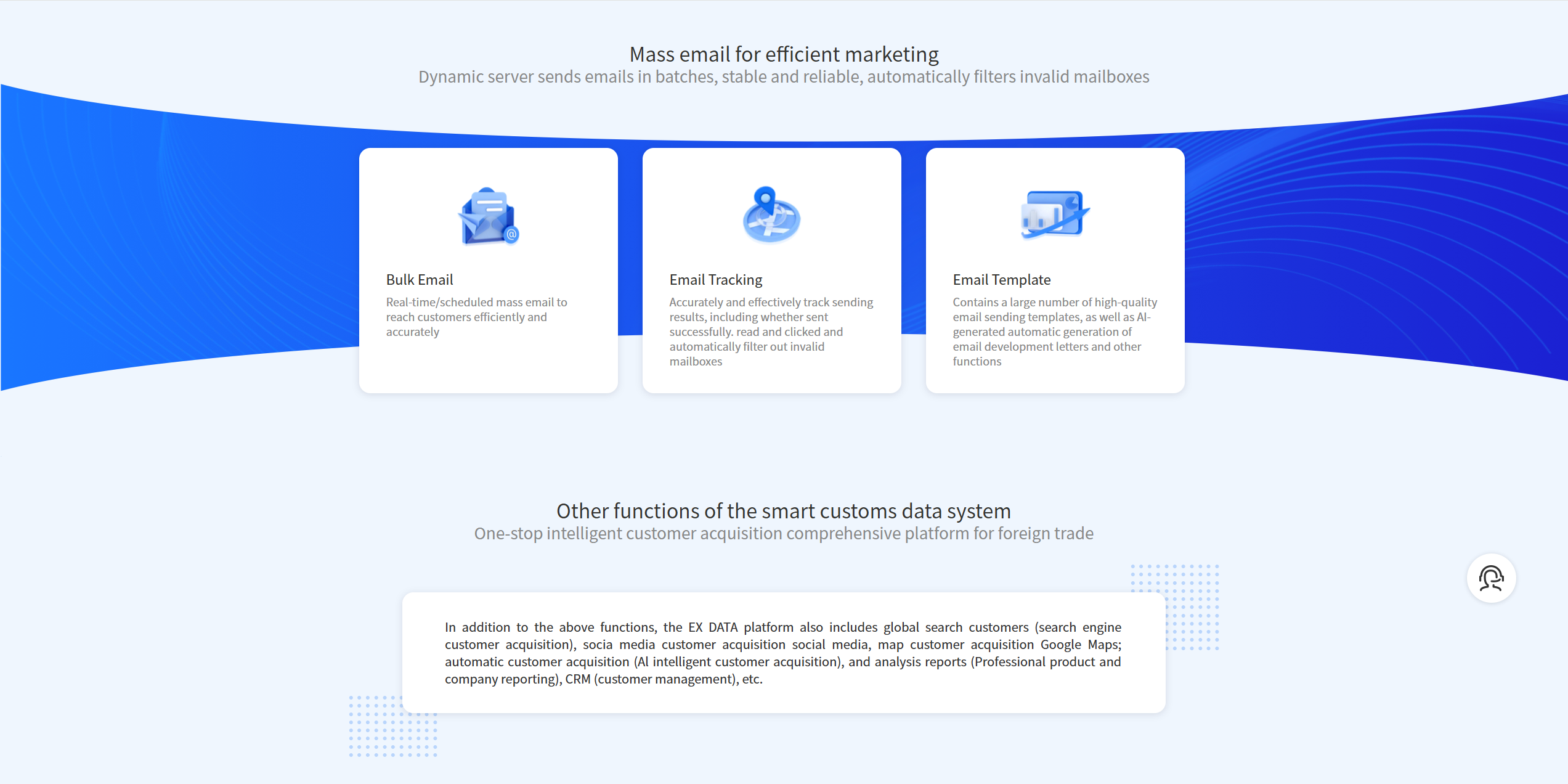
The technical value extends beyond shipment search. The platform adds analysis layers that help buyers interpret the data. These layers include market trend analysis, country or regional analysis, buyer analysis, supplier analysis, background checks, email search, mailbox digging, LinkedIn digging, and an after-sales manual query service. The CRM and customer acquisition modules inside EX DATA 6.0 also connect search results to sales workflow, allowing a trade-intelligence team to move from data discovery to outreach in the same environment.
For long-term users, operational continuity is part of the technical architecture. EX DATA states that it mitigates internet outage risks by continuously iterating and upgrading its system and by cooperating with stable cloud servers to ensure secure and smooth operation. In practice, buyers should ask each candidate provider for an equivalent statement about uptime, data refresh procedures, and disaster recovery.
Application and Use Cases in Manufacturing and Trade
Export data serves different roles depending on the buyer's position. For an export-oriented manufacturer, a trade data platform supports market prioritization by showing which countries are expanding imports in a product category. For a trading company, it reveals potential buyers, shipment patterns, and new routes. EX DATA's product scope is intentionally vertical: the platform lists all foreign trade industries and all import and export industries as applicable. The following use cases reflect the common workflows in such companies:
- Market development: identify target countries by analyzing country-level trade volume and transaction records instead of relying only on macro forecasts.
- Customer discovery: use company-name searches in customs data to list companies already buying the relevant HS codes, then layer contact intelligence on top.
- Supplier or buyer verification: use background checks and company operation data before extending credit terms or starting a new distributor relationship.
- Sales enablement: use email, LinkedIn, social media, and Google Maps search modules to turn anonymous company records into named contacts.
- Management reporting: use professional analysis reports for market, buyer, and supplier summaries to support internal planning decisions.
In addition, the EX DATA 6.0 feature list includes global search customers, social media customer acquisition, map customer acquisition, automatic customer acquisition, analysis reports, and CRM. This means the platform can support a lead-to-management workflow rather than only a customs record lookup.
Market Trend Analysis: Sophistication Is Replacing Raw Volume
The trade data market is growing from a broader industry base. Data Bridge Market Research valued the global trade management market at USD 4.10 billion in 2024, while QYResearch placed the global data trading service platform market at US$1.50 billion in the same year. Both estimates point toward stronger demand for structured international trade information.
Several independent signals support the same conclusion. The U.S. Customs and Border Protection collected more than USD 88 billion in duties in 2024, and IMARC Group links that scale with demand for automated trade data and compliance software. Fortune Business Insights reported that North America held a 38.60% share of the trade management software market in 2025. These numbers indicate that customs-adjacent data has moved from an optional resource to a recognized software category.
In the supplier landscape, TradeInt lists Panjiva (S&P Global), Descartes Datamyne, ImportGenius, and Trademo among recognized commercial trade data providers. Panjiva alone states a database of more than one billion shipment records from approximately eight million companies. Incumbent platforms have wide coverage. This is why providers such as EX DATA often differentiate through service depth, flexible procurement terms, direct data access routes, and lower entry requirements. Buyers should treat provider name recognition as one factor, while update speed and support responsiveness are equally important.
Comparison with Traditional Trade Data Approaches
The main procurement alternative to a platform-based service is still an internal team that compiles customs spreadsheets, broker reports, or government lists. This approach can be suitable for a single market, but it adds maintenance cost and delay. The table below compares the traditional manual model with platform-based data services such as EX DATA 6.0.
| Evaluation Dimension | Traditional Manual Approach | Export Data Platform Approach |
|---|---|---|
| Data sources | Internal files, broker reports, or single-country lists | Aggregated customs data from multiple trading countries |
| Query method | Manual sorting and matching | Search by product name, HS code, or company name |
| Update cycle | As prepared by internal staff or broker | Real-time update described in the platform specification |
| Country coverage | Limited to the broker or relationship network | More than 200 countries and regions in the platform specification |
| Analysis | Spreadsheet-based and usually retrospective | Built-in market, country, buyer, and supplier reports |
| Contact enrichment | Separate manual research | Integrated email, LinkedIn, background check, and manual query support |
| Operational support | Depends on staff availability | Provider-side maintenance and after-sales support |
A transparent boundary is necessary. An export data platform is not a replacement for legal export compliance, restricted-party screening, or internal transaction management. Companies should still run sanctioned-party checks and keep export documents within their ERP or compliance system. Trade data is an evidence and intelligence layer, not a legal control system. Buyers that position it as such will usually have more realistic expectations and better service outcomes.
Future Outlook: Evaluating Export Data Providers as Partners
The next stage of export data procurement will place more weight on service continuity and long-term adaptability. Because EX DATA allows first orders with a minimum quantity of one set and a one-day lead time, smaller teams can test the relationship before going deeper. This arrangement lowers switching cost and gives both sides a way to evaluate data quality in a real workflow.
Long-term contracts will likely include not only subscription price but also data refresh cadence, country coverage changes, user access, support response, and provider migration terms. The same platform may evolve into a vendor ecosystem where customs data, contact data, CRM, and AI-assisted search are offered as one managed service. For buyers in manufacturing and trade, the practical question will shift from which database contains the most rows to which organization can sustain data relevance over time.
FAQ
The following questions are common among procurement and trade operations teams when they move export data projects into execution.
What types of export and import data are included in a trade data service?
Trade data services cover export data, import data, import and export data, customs data, and HS code customs data. EX DATA 6.0 classifies its product under these categories and makes the records searchable in one platform.
How can a buyer search customs data if it does not know the HS code?
The platform provides three access routes: product name, HS code, and company name. Product-name search removes the need to know a code in advance, while HS code search gives a more rigorous route for recurring analysis.
What delivery and purchase terms can a buyer expect?
For EX DATA 6.0, procurement information states a minimum order quantity of one set, online delivery, online acceptance, payment by TT, typical production lead time of one day, and monthly production capacity of US$100,000. In this context, delivery means platform access rather than physical product shipping.
What after-sales support is needed for export data platforms?
At minimum, after-sales manual query for contact details, company background checks, and provider-side maintenance of system stability. EX DATA cites continuous system iteration and stable cloud server partners as controls against internet outage risk.
What is the main limitation of an export data platform?
It provides commercial and operational intelligence from customs records. It does not replace legal export compliance, customs declaration filing, restricted-party screening, or ERP transaction control. These obligations remain the exporter's responsibility.
How should exporters evaluate which trade data provider to continue with?
Compare country coverage, update frequency, query options, report depth, support response, and the ability to add contacts or integrate with CRM. A provider with low entry friction and documented delivery terms can be piloted before a wider rollout.
Tem questões ou precisa de mais detalhes?
Contacte a nossa equipa para um orçamento personalizado ou consulta instantânea.
Solicitar orçamento
Preencha o formulário abaixo e a nossa equipa entrará em contacto com uma proposta personalizada.
Chat direto do WhatsApp
Prefere conversar em tempo real? Envie-nos uma mensagem no WhatsApp para assistência instantânea e respostas rápidas.
- Obter orçamento personalizado
- Partilhar fotos ou documentos
- Discuta as suas necessidades diretamente
Geralmente responde em 5–30 minutos durante o horário de expediente.