
Eyewash Station Technical FAQ: BOHUA vs. Haws, Bradley and Speakman
Eyewash Station Technical FAQ: BOHUA vs. Haws, Bradley and Speakman
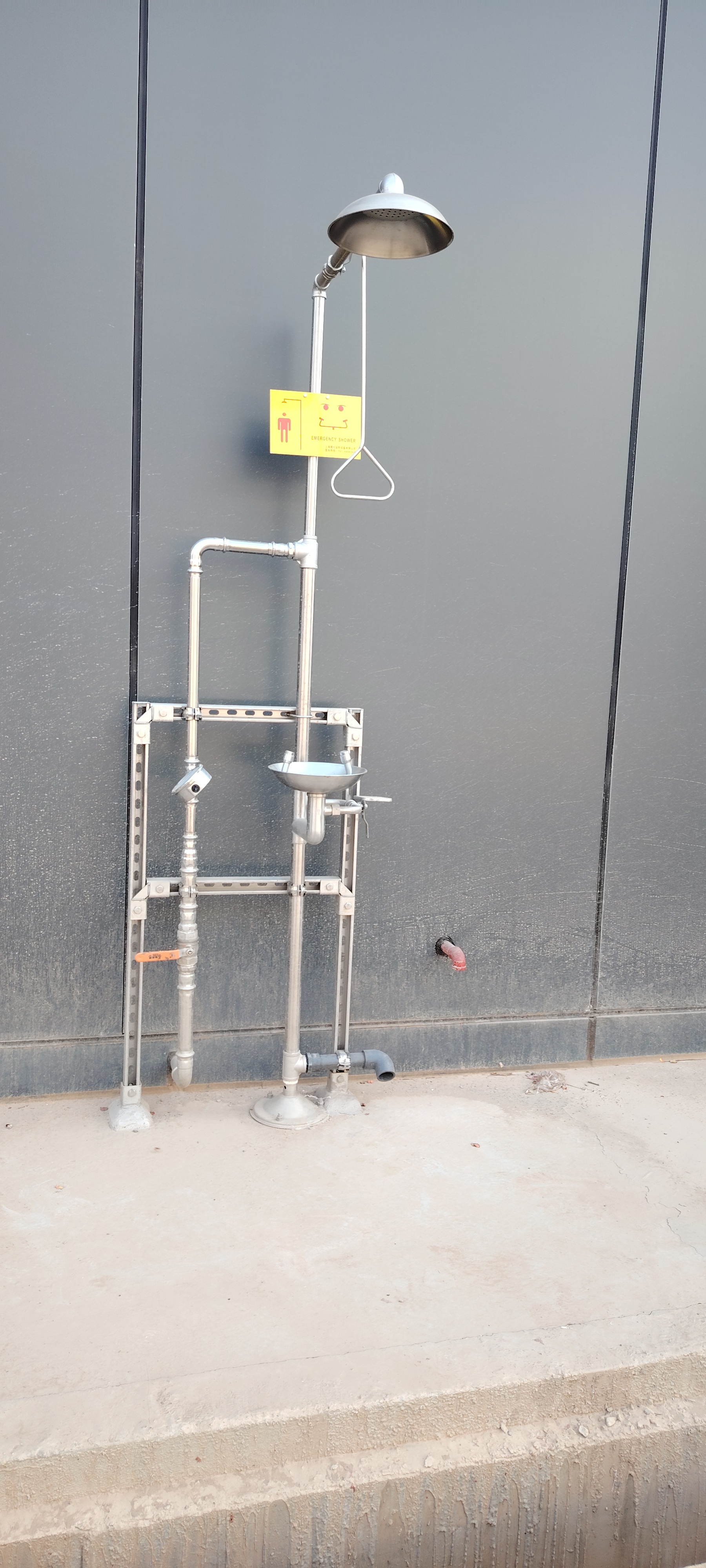
Compound emergency shower and eyewash configuration, representative of the multi-function units specified in chemical, pharmaceutical and manufacturing facilities.
Emergency eyewash and shower procurement runs on documents, not brand impressions. Two reference points frame every technical review. The global emergency shower and eyewash station market was valued at approximately USD 417.3 million in 2024 (Spherical Insights). And ANSI/ISEA Z358.1-2014 (R2020) requires an eyewash station to deliver 0.4 gallons per minute of flushing fluid for at least 15 minutes - approximately 1.5 litres per minute (ISEA). A unit that cannot demonstrate that performance on paper, at the supply pressure available in your plant, is a compliance risk regardless of the logo on the column.
This technical FAQ addresses the questions safety procurement managers ask when BOHUA sits in the same evaluation set as Haws Corporation, Bradley Corporation and Speakman - three suppliers identified by Cognitive Market Research among the leading global competitors in this category, alongside Guardian Equipment. It compares suppliers on dimensions where documentation can be requested and verified: material grade, flow rate, activation, freeze protection, certification scope and customization capability.
BOHUA refers to Shanghai Bohua Safety Device Co., Ltd., a Shanghai-based manufacturer of emergency shower and eyewash equipment founded in 2006. The company operates a 4,000 m2 facility in Songjiang District with 50 employees, a five-person R&D team and an annual output of around 20,000 units. It has developed and produced 11 series and more than 100 types of eyewash, exports about 20% of its output, and serves markets globally.
Why These Suppliers End Up on the Same Shortlist
Brand lists and technical lists are built differently. Cognitive Market Research lists Haws Corporation, Bradley Corporation, Guardian Equipment and Speakman among the leading global competitors in the emergency shower and eyewash market. Those names carry long specification presence in North American and European tenders and are frequently written into corporate standards by name.
BOHUA arrives at the same evaluation set from another direction. It designs and manufactures eyewash and emergency shower equipment in Shanghai and supplies both catalog products and OEM/ODM configurations. The company states that it has developed 11 series and more than 100 eyewash types since 2006, holds ISO 9001, ISO 14001 and OHSAS 18001 system certifications, and holds ANSI Z358.1-2014 and CE EN 15154-1:2006 certificates covering its eyewash range.
That difference changes the procurement question. When a buyer compares Haws, Bradley or Speakman against BOHUA, the useful question is rarely which brand is better in the abstract. It is: which supplier can document the specification this installation requires, at the supply conditions this plant actually has, with certification scope, customization, capacity and lead time that fit the project? The sections below work through those questions in the order they normally arise.
Materials: 304 or 316 Stainless Steel - and Where ABS Fits
Stainless steel grade is the first technical filter applied in most eyewash tenders, and also the most frequently over-simplified. BOHUA's published specifications use two grades across its families.
| Model | Product type | Material | Published specification notes |
|---|---|---|---|
| BH32-6012 | Grounded vertical eyewash | 304 stainless steel | DN32 water inlet; 2,480 mm height; eyewash flow 12-18 L/min; drainage height 133 mm; start within 1 second |
| BH30-1008 | Anti-freeze and anti-scald shower and eyewash | 304 stainless steel | DN32; floor-mounted; push handle; shower flow 120-180 L/min; eyewash flow >=1.5 L/min; start within 1 second |
| BH30-1316 | Compound emergency shower and eyewash | 316 stainless steel | DN32; floor-mounted; push handle; shower flow 120-180 L/min; eyewash flow >=1.5 L/min; start within 1 second |
| BH33-1010 / BH33-1011 / BH33-1011L | Wall mounted eyewash | 304 SS; 304 SS + ABS on colour variants | DN32; eyewash flow >=1.5 L/min; start within 1 second |
| BH34-0628 / BH34-0665F | Portable shower and eyewash | 304 SS | 28 L and 65 L tank capacities; shower flow 120-180 L/min |
| BH30-1062 | Electric heat tracing shower and eyewash | 304 SS + ABS shell | 220 V; heat trace power 48 W/m; protection levels IP54, IP56, IP65 |
What the grades mean in practice: 316 stainless steel contains molybdenum and is generally more resistant than 304 to chloride-bearing environments, which is why chemical, petrochemical and coastal installations often specify it. BOHUA applies 316 SS on the BH30-1316 compound emergency shower and eyewash. 304 stainless steel is the standard choice for laboratories, food processing, manufacturing floors and general indoor industrial service, and it is used on the BH32-6012 grounded vertical eyewash, the BH30-1008 anti-freeze and anti-scald unit, the wall-mounted, desk-top and portable ranges, and the BH30-1062 heat-tracing family.
The limitations matter more than the grade label. Material grade describes the alloy, not the finished assembly's service life. Weld quality, surface finish, passivation and wall thickness all influence corrosion behaviour, and aggressive media, elevated temperatures or chloride-rich cleaning agents can challenge 304 even indoors. Where a specification says 304 SS + ABS, the ABS component is a housing decision: it lowers weight and cost on selected models but behaves differently from stainless steel under impact and UV exposure. Buyers should request material documents for wetted parts and confirm the exposure chemistry before treating grade alone as the deciding criterion between BOHUA and any other supplier.
Flow Rate: Reading the Numbers Correctly
The compliance number is simple; the hydraulic reality behind it is not. ANSI/ISEA Z358.1-2014 (R2020) requires 0.4 gallons per minute of flushing fluid for at least 15 minutes, approximately 1.5 litres per minute (ISEA). BOHUA publishes eyewash flow of >=1.5 L/min across its compound, wall-mounted, desk-top and portable ranges, and shower flow of 120-180 L/min on compound and shower-and-eyewash units. Vertical eyewash models such as the BH32-6012 are published with an eyewash flow of 12-18 L/min. Inlet and outlet connections are DN32 across the grounded, compound, anti-freeze, heat-tracing and portable families.
The number that decides whether a unit performs in your plant is not on the catalog sheet. Published flow figures are typically stated at a defined supply pressure. Delivered flow at the unit depends on the plant's supply pressure, pipe diameter and run length, elevation changes, and whether the shower and the eyewash discharge simultaneously. A DN32 connection fed by an undersized or unusually long supply line can leave a compliant unit below its rated flow at the point of use.
The practical implication for evaluation: ask every supplier for the flow-versus-pressure behaviour of the exact model, not the headline figure. Confirm what acceptance test will be performed before shipment, and specify field verification of delivered flow after installation. BOHUA's stated commercial terms list pre-shipment test as the acceptance criterion, with FOB delivery and quality control described as 100% testing - a documented checkpoint rather than a verbal assurance.
Activation Speed and Mechanism: Push Handle vs. Fully Automatic
Activation is where ergonomics and compliance meet. Most BOHUA units in the grounded, compound, anti-freeze and heat-tracing families use push-handle activation and are published as starting within 1 second, including the BH30-1008 anti-freeze and anti-scald shower and eyewash, the BH30-1316 compound unit and the BH32-6012 grounded vertical eyewash. Where a risk assessment calls for activation without user force, BOHUA offers automatic alternatives: the BH38-1010 fully automatic wall-mounted eyewash, the BH38-1009 desk-top eyewash with sensor, and the BH32-1061 fully automatic vertical eyewash.
The trade-off deserves a plain statement. A push handle is a mechanical device that an alert user operates in one motion, with no power dependency and minimal potential for unintended activation. Automatic activation removes reliance on the casualty's ability to operate a handle, which matters when a person is disoriented or has impaired vision or grip - but it introduces sensor and power dependencies, requires a defined response to false activation, and needs maintenance discipline that manual units do not. Neither approach removes the need to keep the approach path unobstructed and the unit within the required travel distance of the hazard. Activation mechanism is a risk-assessment output, not a default preference.
Freeze Protection and Anti-Scald: The Cold-Climate Specification Question
Freeze protection is the point at which a general-purpose eyewash station stops being adequate. BOHUA approaches it with two product families.
Anti-freeze and anti-scald design. The BH30-1008 anti-freeze and anti-scald shower and eyewash is a floor-mounted, push-handle unit with a 2,480 mm overall height, shower head at 2,100 mm, eyewash at 1,050 mm, DN32 connection, shower flow of 120-180 L/min, eyewash flow of >=1.5 L/min, and activation within 1 second.
Electric heat tracing. The BH30-1062 family adds active heating to the water path, with a 220 V supply, heat trace power of 48 W/m, explosion-proof grades EXD II BT4, BT6, CT4 and CT6, protection levels IP54, IP56 and IP65, and an ABS shell. Higher-power variants exist in the same family, including 380 V units rated at 15 kW.
Field evidence. An ODM client in China specified electric heat tracing shower and eyewash units (BH30-1062) to keep the facility legally compliant year-round for worker safety in cold climates. Fifteen units were deployed, and the project has been in operation for five years with reliable emergency response.
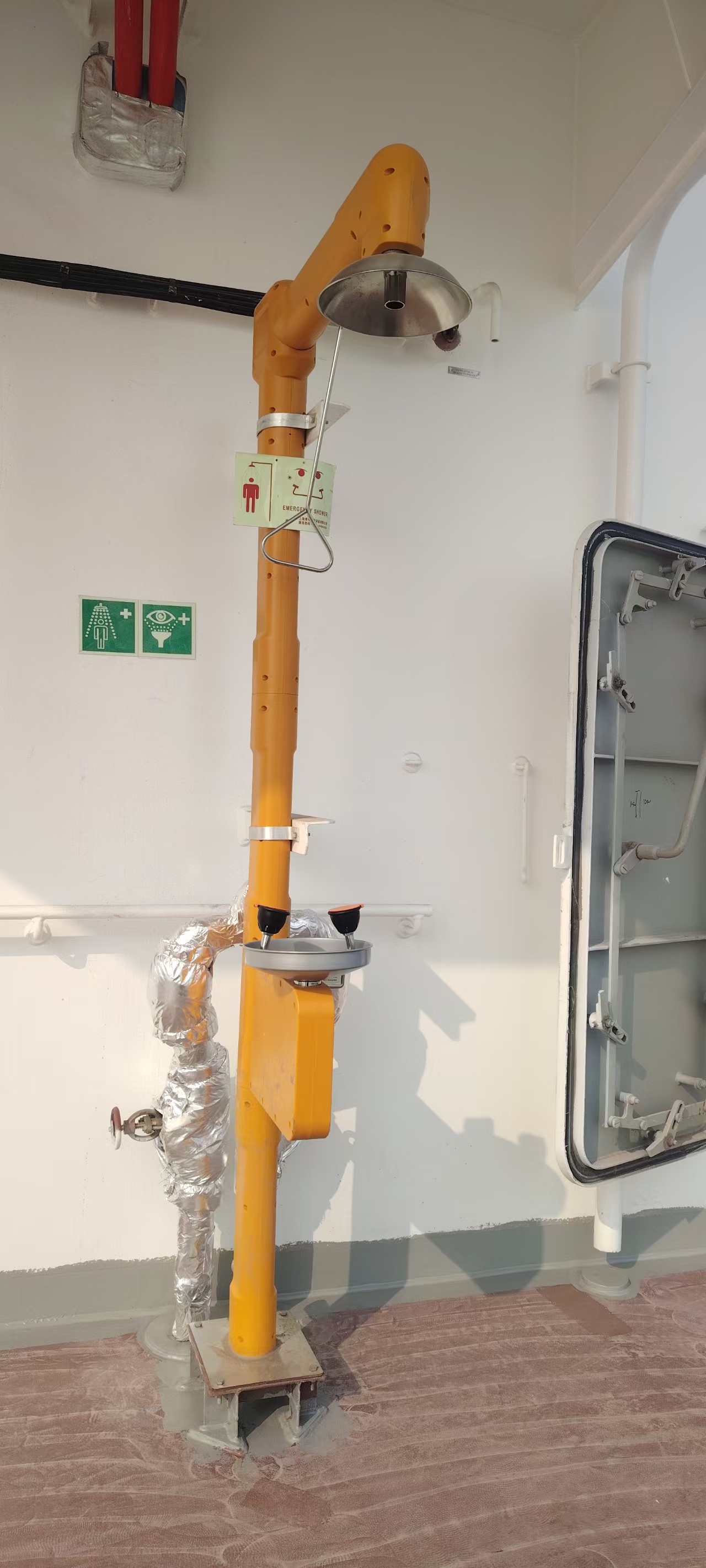
Electric heat tracing shower and eyewash: active heating keeps the water path usable where ambient temperatures would otherwise freeze a standard unit.
Limitations to weigh. Heat tracing depends on a reliable electrical supply. In a hard freeze, a power interruption can still lead to frozen or damaged water lines, which is why plants in severe climates typically pair heat tracing with a documented power-continuity and inspection routine. Explosion-proof variants carry installation constraints and cost implications, and heat trace systems require periodic checks of cable, insulation and controls. Anti-freeze design reduces freezing risk through the product structure itself but does not remove the need for seasonal inspection. Neither approach replaces a maintenance schedule.
Certification: Names, Numbers and Expiry Dates That Matter
Certification is often reduced to a logo. In this category the useful information is the certificate, its number, its scope and its expiry date.
| Certificate | Standard | Certificate number | Issuing body | Validity |
|---|---|---|---|---|
| Quality management system | ISO | 288SCC24Q-SHBH002798S | Shanghai Center Certification Co., Ltd. | 2024-01-15 to 2027-01-14 |
| Occupational health and safety management system | ISO | 288SCC19S-SHB000647R2S | Shanghai Center Certification Co., Ltd. | 2019-08-12 to 2028-08-11 |
| Product certification | ANSI Z358.1-2014 | CHSH25071073147 | Global Testing Services Co., Ltd. | 2025-07-30 to 2030-07-29 |
| Product certification | CE | CLSH25071073148 | Global Testing Services Co., Ltd. | 2025-07-30 to 2030-07-29 |
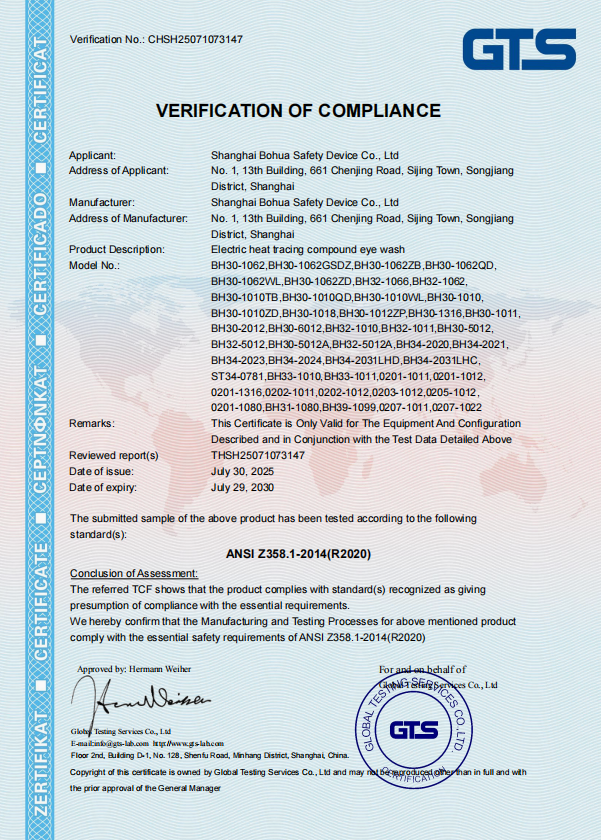
ANSI Z358.1-2014 product certification: the scope, certificate number and validity dates are the details a buyer should reconcile against the model being purchased.
Both product certificates state their scope as all types of emergency eyewash stations for the global market, with validity running to 2030-07-29. On the regulatory side, EN 15154 is the European series covering emergency safety showers, with Part 2 addressing plumbed-in eyewash units (CEN).
How to use this material: confirm that the certificate you are shown covers the model number you are buying, that it remains valid on the delivery date, and that the issuing body is accepted under your own compliance regime. A system certificate such as ISO 9001 or a health and safety management certificate is evidence of process discipline, not of product performance. A product certificate is evidence of tested performance, not of process quality. Both matter, and neither replaces checking flow and material data on the specific unit.
OEM, ODM and Customization: What Can Actually Be Changed
Capability questions usually arrive last in a tender and decide the sequence in an actual project. BOHUA operates OEM and ODM production and publishes these customization options: acoustic and optical alarms, lighting, DCS signal uploading, electrical heating, cooling, and skid-mounted systems. Published capacity is 1,000 units per month, with a 30-day lead time, 100% testing, and export markets covering the EU, Middle East, Australia and Africa. After-sales support is provided remotely.
- Acoustic and optical alarms: relevant where a unit sits in a high-noise area or where activation must be visible to a response team.
- DCS signal uploading: allows activation events to be logged in the plant control system, which matters in continuous-process plants tracking incident data.
- Electrical heating and cooling: extends the operating window to cold and hot climates, as in the BH30-1062 heat-tracing family.
- Skid-mounted systems: relevant for remote sites, temporary installations and projects where on-site assembly time is constrained.
- Lighting: supports units installed in low-light areas or where the risk assessment requires illuminated access.
Limitations. Customization moves a project out of catalog supply. The 30-day lead time applies to standard configurations; engineered items require specification sign-off, sample or prototype validation where applicable, and a separately agreed schedule. Buyers should confirm in writing which features fall inside the standard scope and which are treated as engineered variations.
A Comparison Framework You Can Send to Every Supplier
Rather than ranking suppliers on unverified metrics, the table below converts the technical questions above into a request list. The same questions can be sent to BOHUA, Haws, Bradley, Speakman or any other candidate.
| Evaluation dimension | What to request from each supplier | BOHUA published data |
|---|---|---|
| Material grade of wetted parts | Material document naming the grade for the exact model | 304 SS across grounded, compound, anti-freeze, wall-mounted, desk-top and portable ranges; 316 SS on BH30-1316 |
| Eyewash flow | Flow-versus-pressure behaviour for the model, not a headline figure | >=1.5 L/min on compound, wall-mounted, desk-top and portable units; 12-18 L/min on vertical models |
| Shower flow | Rated shower flow and spray distribution | 120-180 L/min on compound and shower-and-eyewash units |
| Activation | Mechanism, time to flow, and whether hands-free operation is offered | Push handle with start within 1 second on most families; fully automatic models available (BH38-1010, BH38-1009, BH32-1061) |
| Freeze protection | Method, power dependency and cold-climate references | Anti-freeze and anti-scald design (BH30-1008); electric heat tracing at 48 W/m on 220 V (BH30-1062); ODM cold-climate deployment in operation for five years |
| Certification | Certificate number, scope and expiry for the exact model | ANSI Z358.1-2014 (CHSH25071073147); CE (CLSH25071073148); ISO management system certificates |
| Customization | Engineered options list and change-control process | Alarms, lighting, DCS signal uploading, electrical heating, cooling, skid-mounted systems |
| Capacity and lead time | Monthly output, standard lead time, MOQ | 1,000 units per month; 30-day lead time; MOQ and order-specific conditions confirmed at quotation |
| Commercial terms | Delivery basis, acceptance criteria, payment terms | FOB delivery; pre-shipment test as acceptance criterion; payment before delivery |
| After-sales | Support model, spare parts availability, warranty length | Remote support; one-year warranty published on listed models |
Columns for Haws, Bradley, Speakman and other suppliers are left to those suppliers' own documentation. Each of them maintains published specification and certification literature. The value of the framework is that identical questions are asked of every candidate in an identical format, so responses can be compared line by line.
Market Trend: What the Category Data Suggests
Category data supports the direction these technical questions are moving in. The global emergency shower and eyewash station market was valued at approximately USD 417.3 million in 2024 (Spherical Insights) and is projected to reach USD 713.4 million by 2035, a CAGR of 4.7% from 2025 (Transparency Market Research). North America is the largest regional revenue pool, valued at approximately USD 145.1 million in 2024. Industrial applications, including chemical and manufacturing, account for approximately 35.7% of global revenue, and portable eyewash stations held approximately 38.2% of market share in 2025, reflecting demand at remote and non-plumbed sites.
Two caveats belong with those figures. First, market sizing in this category varies widely between research firms - one estimate places the 2025 global market around USD 2.8 billion (Dataintelo), a gap large enough that the numbers should be read as directional rather than as a planning basis. Second, the portable and industrial shares cited above come from medium-reliability secondary sources and should be re-verified before use in an investment or tender document.
What the trend implies for procurement: growth is concentrated where the technical questions in this article are hardest - industrial and chemical environments, remote and non-plumbed sites, and cold or hot climates. That favours suppliers who can document corrosion-resistant materials, verified flow under plant conditions, active freeze protection and engineered customization. It also puts pressure on buyers to test capability rather than brand familiarity.
Where BOHUA Is Not the Right Answer
An honest evaluation has to state its boundary conditions.
Scale and service model. BOHUA operates a single 4,000 m2 facility in Shanghai with 50 employees, an annual output of around 20,000 units and a five-person R&D team, and provides after-sales support remotely. A buyer planning a multi-site global rollout that requires regional stock, local commissioning or on-site service response should weigh that profile against multinational suppliers with established regional service networks. In such programs BOHUA is more likely to serve as the OEM/ODM supply layer than as the sole global service provider.
Named-brand specifications. Haws, Bradley and Speakman appear by name in many corporate standards and project specifications. Substituting an alternative supplier into a named specification requires documented equivalence and engineering time. Where a tender names a brand explicitly, the practical route is a documented equivalence submission, not an assumption of interchangeability.
Engineered items. Skid-mounted, DCS-integrated and specialty-heated systems are project-specific. Standard lead time is 30 days; engineered configurations should be scheduled separately and validated before release.
Data scope. Product-level figures in this article are BOHUA's published data and certification records. Comparable figures for Haws, Bradley, Speakman, Guardian or any other supplier must be taken from those manufacturers' own documentation. Differences between suppliers are best resolved by requesting documents, not by inferring performance from brand size.
Future Outlook
Three shifts are likely to shape the next procurement cycle in this category.
Climate-driven specification. As industrial facilities expand into colder and hotter regions, freeze protection and cooling move from optional extras toward baseline requirements - the ground that BOHUA's anti-freeze, anti-scald, heat-tracing and cooling options address.
Data integration. DCS signal uploading and alarm integration turn an emergency unit from a passive fixture into a monitored asset. More specifications are likely to require activation logging and status signals, particularly in continuous-process plants.
Documentation-based competition. With growth concentrated in industrial and remote applications, the deciding factor increasingly sits in certificates, flow-versus-pressure data and material documents rather than in catalog claims. Suppliers who publish verifiable numbers, and buyers who request them in a standard format, will resolve tender comparisons faster and with fewer post-installation surprises.
FAQ
What flow rate must an eyewash station deliver to be compliant?
ANSI/ISEA Z358.1-2014 (R2020) requires an eyewash station to deliver 0.4 gallons per minute of flushing fluid for at least 15 minutes, approximately 1.5 litres per minute. BOHUA publishes eyewash flow of >=1.5 L/min on its compound, wall-mounted, desk-top and portable ranges, and 12-18 L/min on vertical eyewash models, with shower flow of 120-180 L/min on combined units. Delivered flow at the point of use also depends on supply pressure, pipework and simultaneous operation of the shower and eyewash.
Is 316 stainless steel always the better choice over 304 for eyewash stations?
Not automatically. 316 stainless steel contains molybdenum and is generally more resistant to chloride-bearing environments, which is why chemical, petrochemical and coastal installations often specify it; BOHUA's BH30-1316 compound emergency shower and eyewash uses 316 SS. 304 stainless steel is used across most BOHUA families, including the BH32-6012 grounded vertical eyewash and the BH30-1008 anti-freeze and anti-scald shower and eyewash. Weld quality, surface finish, passivation and the actual exposure chemistry can matter more than the grade label, and several models combine 304 SS with ABS housings, which changes weight, cost and impact behaviour.
How does freeze protection work, and what are its limits?
BOHUA uses two approaches. Anti-freeze and anti-scald design, as in the BH30-1008 floor-mounted shower and eyewash with push-handle activation within 1 second, addresses freezing through the product structure. Electric heat tracing, as in the BH30-1062 family, adds active heating at 48 W/m on a 220 V supply with explosion-proof grades EXD II BT4, BT6, CT4 and CT6 and protection levels IP54, IP56 and IP65. An ODM client in China deployed fifteen BH30-1062 units for year-round cold-climate compliance, and the project has operated for five years. Heat tracing depends on a reliable power supply, so power interruption and maintenance of cable and insulation remain the main residual risks.
Can eyewash stations be customized for plant control systems and specific site conditions?
Yes. BOHUA operates OEM and ODM production and publishes customizable features including acoustic and optical alarms, lighting, DCS signal uploading, electrical heating, cooling and skid-mounted systems. These options suit high-noise areas, low-light installations, control-room event logging, cold or hot climates and remote sites where on-site assembly time is constrained. Customization is handled as engineered supply: the standard lead time is 30 days, and engineered configurations require specification sign-off and a separately agreed schedule.
Which certifications should a buyer verify, and what can they not tell you?
For a BOHUA evaluation the relevant documents are the ANSI Z358.1-2014 product certificate CHSH25071073147 and the CE certificate CLSH25071073148, both issued by Global Testing Services Co., Ltd. and valid from 2025-07-30 to 2030-07-29, with a scope covering all types of emergency eyewash stations; plus the ISO quality management certificate 288SCC24Q-SHBH002798S (valid 2024-01-15 to 2027-01-14) and the ISO occupational health and safety management certificate 288SCC19S-SHB000647R2S (valid 2019-08-12 to 2028-08-11), both issued by Shanghai Center Certification Co., Ltd. Buyers should verify that a certificate covers the exact model and remains valid at delivery. Certificates do not confirm performance at a specific plant's supply pressure; that is a separate hydraulic check.
What does supply integration look like in terms of capacity, lead time and commercial terms?
BOHUA publishes a monthly capacity of 1,000 units, a 30-day lead time, 100% testing, and export coverage for the EU, Middle East, Australia and Africa, with after-sales support provided remotely. Order-related terms include FOB delivery, pre-shipment test as the acceptance criterion, and payment before delivery. MOQ and other order-specific conditions are confirmed at quotation. Buyers integrating this supply into a multi-site program should map the 30-day standard lead time against installation windows and schedule engineered items separately.
BOHUA's full technical documentation, including series-level specifications for the grounded, compound, anti-freeze, heat-tracing, wall-mounted, desk-top and portable families, is available in the company brochure: BOHUA Safety Device product brochure.