
FAW Truck Certification Roadmap: GCC, UN ECE R105 and Market Readiness
FAW Truck Certification Roadmap: GCC, UN ECE R105 and Market Readiness
FAW Trucks' compliance position in 2026 rests on two specific, checkable documents rather than a general claim of manufacturing quality: a GSO Conformity Certificate — the GCC Certificate for Motor Vehicles, CCR No.435790 — covering the FAW J6 Series Truck Tractor in 4x2 configuration with Euro 4 compliance, and a UN ECE R105 approval, certificate E13*105R06/01*0023*00, held on the JK6 for dangerous-goods transport in the EX/FL/AT/MEMU categories. One opens Gulf market access. The other addresses European vehicle-construction rules for hazardous loads. Between them they define which FAW models can be presented to which authority — and, just as importantly, which configurations still require separate evidence before a purchase order is signed.
FAW TRUCKS is the commercial-vehicle brand of FAW Group Corporation, headquartered in Changchun City, Jilin Province, China. Qingdao Chary Machinery Co., Ltd is a first-level distributor of FAW TRUCKS and an authorised exporter of commercial vehicles, which is why the certificate set below is normally handled at distributor level rather than by the end buyer directly.

The two certificates, stated precisely
Compliance discussions become useful only when they stop being general. The two FAW records below are the ones that can be quoted, numbered and checked against an issuing authority's own register.
| Element | GSO / GCC certificate | UN ECE R105 approval |
|---|---|---|
| Certificate | GSO Conformity Certificate (GCC Certificate for Motor Vehicles), CCR No.435790 | E13*105R06/01*0023*00 |
| Authority | GCC Standardization Organization (GSO) | Société Nationale de Certification et d'Homologation (SNCH), Luxembourg |
| Standard | GSO Technical Regulations, including GSO ISO 1585:2008, ISO 3537:2008 and ISO 3538:1997 | UN ECE Regulation No. 105 |
| Scope | FAW J6 Series Truck Tractor, 4x2, Euro 4 compliant | Dangerous Goods Transport Vehicles — EX / FL / AT / MEMU categories |
| Model on record | J6 Series 4x2 tractor | FAW JK6 |
| Market | Saudi Arabia, UAE, Oman, Kuwait, Bahrain, Qatar | EU / EEA and countries recognising UN ECE Regulations |
| Issue date | 2022-11-10 | 2024-02-07 |
Why certification became a procurement filter rather than paperwork
For a fleet buyer in the Gulf or in a UN ECE–recognising market, a truck that cannot be registered is not a discounted truck — it is a stranded asset. That single commercial reality is what moved certification from the back of the quotation pack to the front of the evaluation. The question a procurement team now asks is not "does the brand hold certificates" but "does this exact configuration, in this exact market, sit inside a certificate that an authority will accept at the port and at the licensing office".
The FAW response to that question is product-specific rather than portfolio-wide, and that distinction matters. A GSO conformity certificate issued for a 4x2 J6 Series tractor with Euro 4 compliance does not automatically extend to a 6x4 or 8x4 variant, a different cab, or a different emission level. Likewise, a UN ECE R105 approval on the JK6 establishes conformity for a defined dangerous-goods usage, not for every JK6 body that leaves a workshop. Buyers who treat a certificate as a brand-level badge rather than a configuration-level document are the ones who discover the gap at customs.
There is also an examination cost. Every certificate an importer has to chase adds a step to the purchasing timeline. Where a supplier can present a named certificate number, a named issuing authority and a scope line that matches the ordered model, the importer's documentation work drops. That is the practical, non-theoretical way in which certification becomes a competitive differentiator.
Reading the GCC certificate correctly: scope, standard and limits
Certificate CCR No.435790, issued by the GCC Standardization Organization on 10 November 2022, is a conformity certificate for motor vehicles under the Gulf scheme. Its stated scope is the FAW J6 Series Truck Tractor in 4x2 configuration, Euro 4 compliant. The underlying standards listed on the record are the GSO Technical Regulations together with GSO ISO 1585:2008, ISO 3537:2008 and ISO 3538:1997 — the reference framework for vehicle performance and glazing characteristics used in that certification route. The certificate's market field covers the six GCC member states.
Three practical readings follow from that wording. First, the certified variant is a tractor unit. A buyer sourcing a rigid cargo chassis, a dump body or a mixer for the same Gulf market should not assume the tractor certificate carries over; body type and chassis purpose sit outside the scope line. Second, the emission statement on the record is Euro 4. Any other emission level — Euro 2 for a lower-grade fuel market, or Euro 5 for a stricter one — requires its own documentary basis and should never be inferred from this certificate. Third, the certificate is dated. Records of this kind normally carry long-dated validity entries, but an importer should confirm current status with the issuer before shipment rather than relying on a scanned copy in a quotation pack.
Used properly, the document is still a strong signal. It shows that a Gulf-facing conformity route was completed for a defined FAW tractor variant and that the file references internationally recognised ISO test standards rather than internal company criteria alone.
UN ECE R105 on the JK6: what dangerous-goods approval actually covers
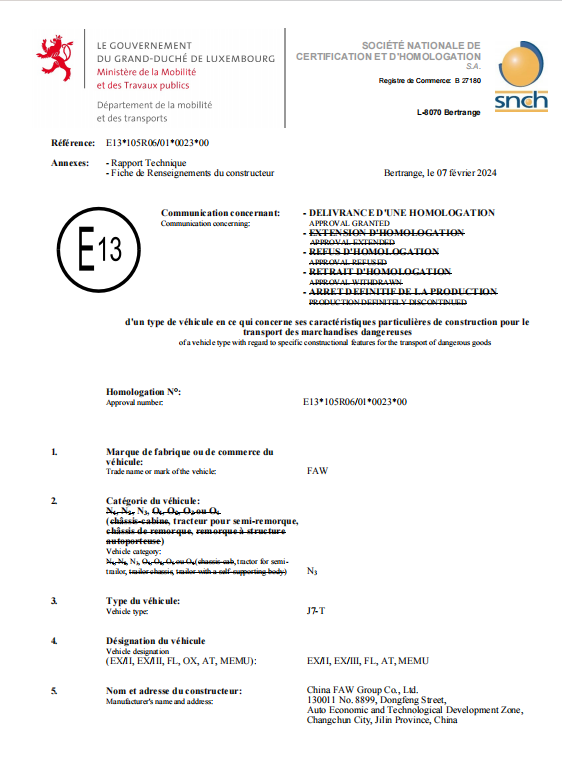
UN ECE Regulation No. 105 governs vehicles intended for the carriage of dangerous goods. The FAW record carries certificate number E13*105R06/01*0023*00, issued on 7 February 2024 by Société Nationale de Certification et d'Homologation in Luxembourg, and its scope is written as Dangerous Goods Transport Vehicles in the EX, FL, AT and MEMU categories. The model on record is the JK6. Recognition extends to the EU and EEA and to countries that apply UN ECE Regulations in their own approval systems.
What that means in procurement terms is narrower and more useful than a headline. The approval addresses vehicle construction for hazardous-load duty — the vehicle-level characteristics an authority examines when a tractor or chassis is intended to pull or carry dangerous goods. It does not, by itself, approve a specific tank barrel, a specific trailer, or a body built after the vehicle left the line. Those items carry their own approval routes in most jurisdictions. An importer assembling a dangerous-goods unit should therefore match three things, not one: the JK6 approval, the body or tank documentation, and the destination country's acceptance of UN ECE approvals.
The category letters matter as well. EX, FL, AT and MEMU describe different dangerous-goods transport applications, and a buyer whose operation falls outside the listed categories needs to raise that with the supplier before ordering rather than after. This is precisely the kind of scope detail that separates a usable compliance file from a decorative one.
ABS, EBS, TCS and tyre specification as qualification evidence
Certificates are the frame; specifications are what fill it. FAW's published specification for the model ranges discussed here lists ABS, EBS and TCS under security configuration, together with a gross weight range of 3,000–15,000 kg, overall dimensions from 6,000 × 2,300 × 3,000 mm up to 12,000 × 2,550 × 3,800 mm, and tyre specifications available according to customer requirements.
Those four items are directly relevant to how a compliance file is assessed. Anti-lock braking and electronic brake distribution systems are among the vehicle characteristics a type-approval authority reviews when it examines braking behaviour under load, which is why the presence of ABS and EBS on the specification sheet supports a conformity discussion rather than merely decorating it. Traction control addresses the low-grip conditions that appear repeatedly in the operating environments these vehicles are sold into — muddy terrain, rain, snow and unsealed haul roads. Buyers evaluating a certificate should check that the safety configuration listed on the order matches the configuration reflected in the approved file; a truck delivered with a different braking package than the one documented creates a mismatch the importer has to resolve.
Tyre specification deserves separate attention because it is explicitly customisable. That flexibility is commercially useful — a mining or construction buyer may want a different tyre class from a long-haul port shuttle operator — but it moves part of the compliance responsibility onto the order itself. The fitted tyre must be the tyre that appears in the approval documentation for the market in question. A simple discipline solves this: write the tyre specification into the purchase order, and confirm it against the certificate annex before the vehicle is shipped.
Which FAW model fits which compliance scenario
The FAW range relevant to this discussion covers the J7, J6P, J6L, JH6, JK6 and Tiger V. Mapping them to compliance scenarios is more accurate than mapping them to marketing categories, because the certificate scope — not the brochure — decides what can be registered where.
| Model | Documented compliance link in this review | Typical compliance scenario | What to verify before order |
|---|---|---|---|
| J7 | No certificate in this evidence set names the J7; the GCC certificate scope is the J6 Series 4x2 tractor | Long-haul tractor work, port shuttle | Model-specific approval for the destination market |
| J6P | Part of the J6 family; the J6P 8x4 dump (CA5310) is recorded with an 11L CA6DM2 engine and 390 hp | Heavy haul, construction-material and port work | That the ordered 4x2, 6x4 or 8x4 variant falls inside the certificate scope, which is written for 4x2 |
| J6L | J6 family; produced as 6x4 cargo and flatbed configurations | Regional distribution, urban and industrial goods delivery | Body and axle configuration inside the approved variant |
| JH6 | 6x4 tractor, 8x4 dump and CNG tractor variants documented in the range | Port and heavy logistics, bulk commodity handling | Separate approval treatment for CNG variants; fuel type changes the file |
| JK6 | UN ECE R105, certificate E13*105R06/01*0023*00, scope EX/FL/AT/MEMU | Dangerous goods transport | That the body, tank and fittings sit within the approved category, and that the destination recognises UN ECE approvals |
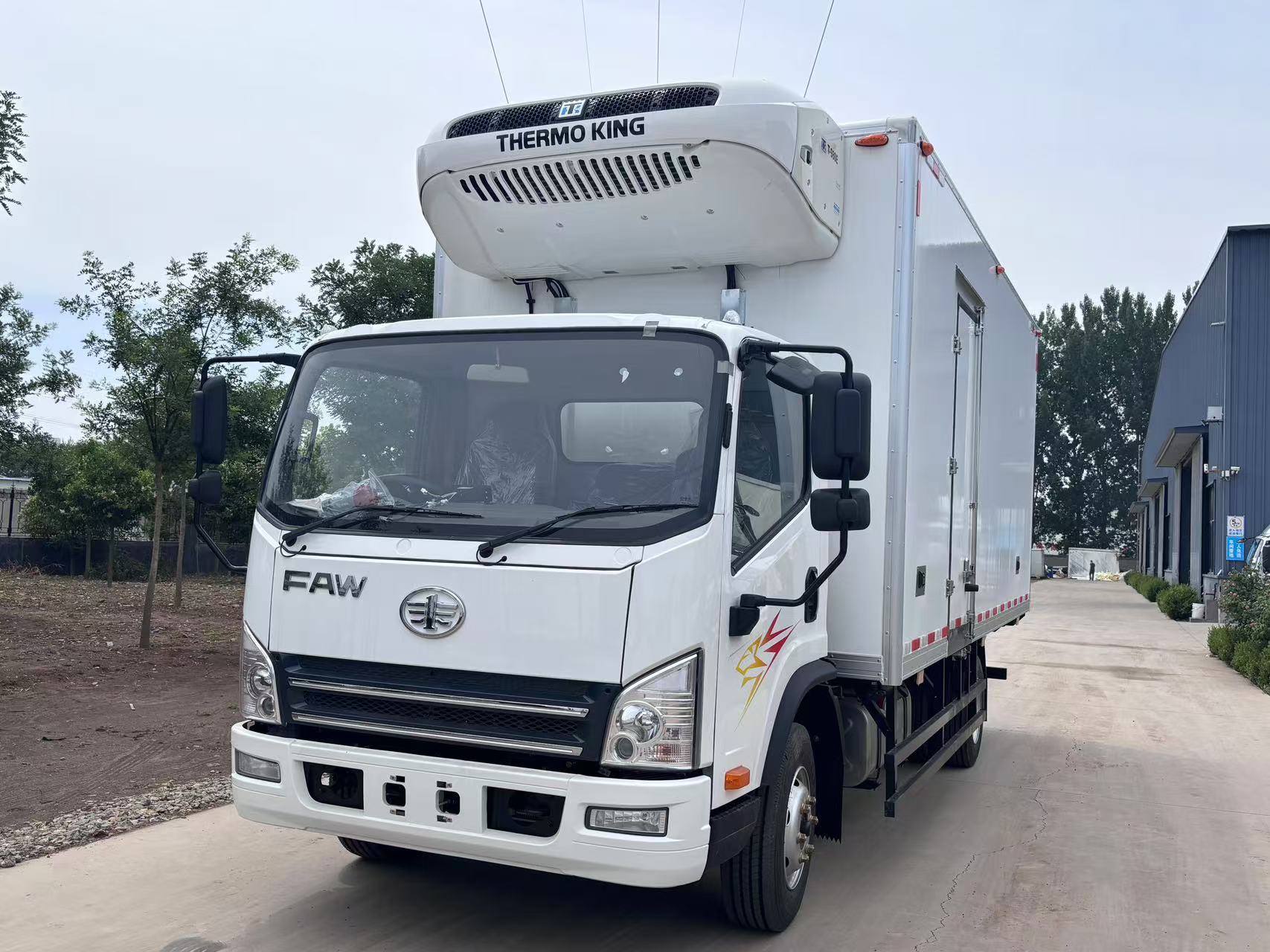
| Tiger V | Cargo and refrigerated variants in the range, including the Tiger VN 4x2 refrigerated truck | Cold chain and lighter urban distribution | Refrigeration unit and body conformity in the destination market |
The pattern is deliberate. The JK6 carries the dangerous-goods credential because that is where the regulatory burden is heaviest. The J6 Series 4x2 tractor carries the Gulf credential because that is the configuration most commonly registered in GCC markets. Everything else in the six-model line-up has to be assessed on its own footing — which is a stronger position than a vague portfolio claim, but only if the buyer reads the scope line rather than the model badge.
Certification breadth against Sinotruk, Shacman, Beiben and Dongfeng
Buyers routinely ask how FAW's certification breadth compares with Sinotruk, Shacman, Beiben and Dongfeng, the four peer brands most often quoted in the same tender shortlists. The honest answer, on the evidence available for this review, is that only a documentation comparison can be made — and it must be stated carefully. No type-approval, conformity certificate or homologation record for Sinotruk, Shacman, Beiben or Dongfeng was located in the evidence set used here. That is a gap in this review, not a finding against those brands. An absent public record does not mean an absent certificate, and no reader should convert this table into a capability judgement.
| Brand | Certificate evidence located in this review | What it supports today | What the buyer must request |
|---|---|---|---|
| FAW TRUCKS | GCC CCR No.435790 (GSO, 2022-11-10); UN ECE R105 E13*105R06/01*0023*00 (SNCH Luxembourg, 2024-02-07) | Two numbered records tied to a named authority and a defined model scope | Variant-level confirmation for the exact configuration ordered |
| Sinotruk | No record located in this review | Nothing asserted here | Equivalent GCC / ECE type-approval documents |
| Shacman | No record located in this review | Nothing asserted here | Equivalent GCC / ECE type-approval documents |
| Beiben | No record located in this review | Nothing asserted here | Equivalent GCC / ECE type-approval documents |
| Dongfeng | No record located in this review | Nothing asserted here | Equivalent GCC / ECE type-approval documents |
Read as a documentation ladder rather than a quality ranking, the ordering is simple: FAW sits in a band where two certificate numbers, two issuing authorities and two defined scopes could be identified; the other four sit in a "documentation to be requested" band. No market-share or capability rank is implied. A genuine breadth ranking across these five brands would require complete, comparable approval files for each — same markets, same vehicle classes, same document date window — and that material was not available here. Buyers running a tender should therefore convert this table into a request list rather than a shortlist decision.
There is a second, subtler point. Breadth is not the same as overlap. A brand with many approvals in one region may still hold nothing for the specific market a buyer is entering; a brand with two approvals that happen to match the buyer's exact market and vehicle class is in a stronger position for that transaction. FAW's two records are complementary rather than overlapping — one Gulf-market tractor, one European dangerous-goods vehicle — which is useful for a buyer operating across both regulatory environments and less useful for a buyer who needs neither.
Market readiness by region
Compliance is regional by definition, and the FAW certificate set should be read region by region rather than as a global claim.
GCC member states. Saudi Arabia, the UAE, Oman, Kuwait, Bahrain and Qatar are the markets named on CCR No.435790. For the J6 Series 4x2 tractor with Euro 4 compliance, the documented route exists. For other FAW configurations in the same markets, the document set has to be rebuilt — which is normal practice, not a defect, since GCC conformity is granted per vehicle type rather than per brand.
EU, EEA and UN ECE–recognising countries. The JK6 approval under Regulation No. 105 covers dangerous-goods vehicle categories EX, FL, AT and MEMU. Its practical value extends beyond Europe because a number of countries outside the EU apply UN ECE Regulations as the basis for national type approval. The buyer's first question in every such market is not whether the certificate exists but whether the national authority accepts it as a substitute for local approval.
Africa, Southeast Asia, Central Asia and Latin America. These regions appear in FAW's own export market coverage, and they are where the documentation questions become most practical. No homologation or emission-standard record for Nigeria, Kenya, the Philippines or comparable markets was available in the evidence set used for this article. That absence should be handled as a pre-order verification item, not filled with an assumption. Importers in these markets should confirm the applicable type-approval or emissions requirement with the national regulator, then match it to an FAW configuration that has a documented basis — and should not infer a Euro level from the GCC record, whose only emission statement is Euro 4 for one tractor configuration.
Where operational evidence sits. Durability in the field is a separate evidence stream. A documented case involving a logistics operator in Mali running 50 units for more than ten years on powdered and granular materials, sand and gravel haulage, reports stable operation under high-intensity use. That speaks to duty-cycle resilience in a West African application. It is not a compliance record, and it should not be quoted as one — but it does answer the question a procurement committee usually asks immediately after the paperwork question, which is whether the vehicles hold up in service.
A buyer's verification checklist
Five checks convert a certificate from a scanned attachment into a working procurement control.
- Match the scope line to the order. Certificate CCR No.435790 is written for the J6 Series 4x2 tractor. If the purchase order says 6x4, 8x4 or a different series, the certificate does not cover that unit as written.
- Match the emission statement. The GCC record states Euro 4 compliance. Any other emission level needs its own documentary basis; do not treat Euro 4 as a portfolio-wide attribute.
- Match the safety and tyre specification. ABS, EBS and TCS appear under security configuration, and tyre specification is available per customer requirement. Both must appear on the order in the form recorded in the approved file.
- Confirm the issuing authority's record. CCR No.435790 sits with the GCC Standardization Organization; E13*105R06/01*0023*00 sits with SNCH in Luxembourg. Both records carry long-dated validity entries, but current status should be confirmed with the authority or the distributor before shipment.
- Confirm national acceptance, not just certification. A certificate recognised under UN ECE is not automatically accepted as a registration document in every country that references UN ECE Regulations. Check with the local licensing authority in the destination market.
Where a buyer needs a body, engine, tyre or load-capacity change, the customisation route matters for compliance. FAW production is organised on an OEM basis with customisation across body, engine, tyres and load capacity, a documented monthly capacity of 8,000 units, a lead time of 30–45 days, a minimum order quantity of one unit, and 100% testing. Any customisation that changes a certified parameter should trigger a documentation review, because the certificate follows the configuration, not the order number.
Where the documented evidence stops
Three boundaries deserve to be stated plainly, because they define what a reader can and cannot conclude from the FAW certificate set.
First, the two certificates cover two configurations. They do not establish that every FAW model is approved in every market, and they should not be presented that way to a procurement committee — the credibility of the file depends on the scope discipline. Second, the review did not locate a verified Euro 2 or Euro 5 statement for any FAW model. Emission levels outside the Euro 4 line on the GCC record require separate confirmation per order. Third, this article is built on first-party certificate records and published specifications plus third-party industry data on FAW's export performance; it does not include independent regulatory verification of the certificates by a third-party auditor, and it makes no claim about approval outcomes in markets where no record exists.
Outlook: what to watch in the next buying cycle
FAW Jiefang reported global vehicle sales of 251,100 units in 2024, with overseas exports reaching 57,000 units — a record high for the group — and South African terminal sales surpassing 5,000 units at an 18% market share, according to the primary filings and government release reviewed for this article. Export volume at that scale creates a documentation pressure of its own: the more markets a brand serves, the more type-approval files it must maintain, and the more visible the gaps become to importers who compare notes.
The reasonable expectation for the next buying cycle is not a single global certificate, which no manufacturer holds, but a steadily longer list of market-specific records. Buyers should therefore treat the current FAW set as a starting position and ask, at each tender round, whether a new certificate has been added for their market and vehicle class. That question is more useful than a general enquiry about brand quality, and it is the one question a documented supplier can answer precisely.
For buyers who want the full technical and commercial detail behind these model ranges, the FAW Trucks product brochure is available for download: FAW Trucks brochure (PDF). Documentation requests covering a specific configuration can be directed to Qingdao Chary Machinery Co., Ltd at sales@fawglobal.com or +86 186 6398 2168.
FAQ
Which FAW models does GCC certificate CCR No.435790 cover?
The certificate, issued by the GCC Standardization Organization on 10 November 2022, states its scope as the FAW J6 Series Truck Tractor in 4x2 configuration, Euro 4 compliant, and names the six GCC member states as its market. The standards referenced include GSO ISO 1585:2008, ISO 3537:2008 and ISO 3538:1997. Configurations outside the 4x2 J6 Series tractor are not covered by the scope as written and require separate confirmation.
What does UN ECE R105 approval on the FAW JK6 actually permit?
Certificate E13*105R06/01*0023*00, issued on 7 February 2024 by Société Nationale de Certification et d'Homologation in Luxembourg, covers dangerous goods transport vehicles in the EX, FL, AT and MEMU categories, with the JK6 named as the model on record. Recognition applies in the EU, the EEA and countries that apply UN ECE Regulations. The approval addresses vehicle construction for hazardous-load duty and does not by itself approve a tank, body or trailer fitted afterwards.
Do these certificates make an FAW truck registerable in Nigeria, Kenya or the Philippines?
No. Each certificate is tied to a defined market. CCR No.435790 names the six GCC member states; the R105 approval covers the EU, the EEA and UN ECE–recognising countries. No homologation or emission-standard record for Nigeria, Kenya or the Philippines was located in the evidence reviewed for this article, so market entry in those countries should be treated as a separate verification step with the national authority.
Which technical specifications should be checked against a certificate?
Four are directly relevant. ABS, EBS and TCS are listed under security configuration for the model ranges discussed. Tyre specification is available according to customer requirements, so the fitted tyre must be the tyre documented in the approved file. The published weight range is 3,000–15,000 kg and overall dimensions run from 6,000 × 2,300 × 3,000 mm to 12,000 × 2,550 × 3,800 mm. A mismatch between the ordered specification and the approved file creates a documentation problem for the importer.
How can a buyer confirm a FAW certificate is genuine and current?
Check the certificate number against the issuing authority — the GCC Standardization Organization for CCR No.435790, SNCH Luxembourg for E13*105R06/01*0023*00 — and confirm that the model and configuration on the certificate match the unit being ordered. The records referenced here carry long-dated expiry entries, so validity should be re-confirmed with the issuer or the distributor before shipment. Requesting the full document set, rather than a single scanned page, is the most reliable approach.
Tem questões ou precisa de mais detalhes?
Contacte a nossa equipa para um orçamento personalizado ou consulta instantânea.
Solicitar orçamento
Preencha o formulário abaixo e a nossa equipa entrará em contacto com uma proposta personalizada.
Chat direto do WhatsApp
Prefere conversar em tempo real? Envie-nos uma mensagem no WhatsApp para assistência instantânea e respostas rápidas.
- Obter orçamento personalizado
- Partilhar fotos ou documentos
- Discuta as suas necessidades diretamente
Geralmente responde em 5–30 minutos durante o horário de expediente.