
FAW vs Beiben, Sinotruk & Shacman: A 4-Dimension Buyer Scorecard
FAW vs Beiben, Sinotruk & Shacman: A 4-Dimension Buyer Scorecard
Fleet buyers across Africa, the Middle East, and Southeast Asia rarely evaluate a single Chinese truck brand in isolation. FAW TRUCKS, Beiben, Sinotruk, and Shacman now appear together on the same tender sheets, are quoted in overlapping price bands, and are frequently sold through the same regional distribution networks. The practical question has shifted from whether to consider a Chinese heavy truck at all, to how a procurement committee can score a shortlist in a way that survives audit by a board, a bank, or a fleet insurer.
FAW TRUCKS is the commercial vehicle brand of FAW Group Corporation, headquartered in Changchun City, Jilin Province, China. Because its export line-up and its most frequent competitors are assessed by the same criteria, a structured scorecard is more useful than a single headline ranking. This article builds that scorecard around four dimensions: technology and configuration depth, market-position evidence, service and parts support, and industry-solution fit.
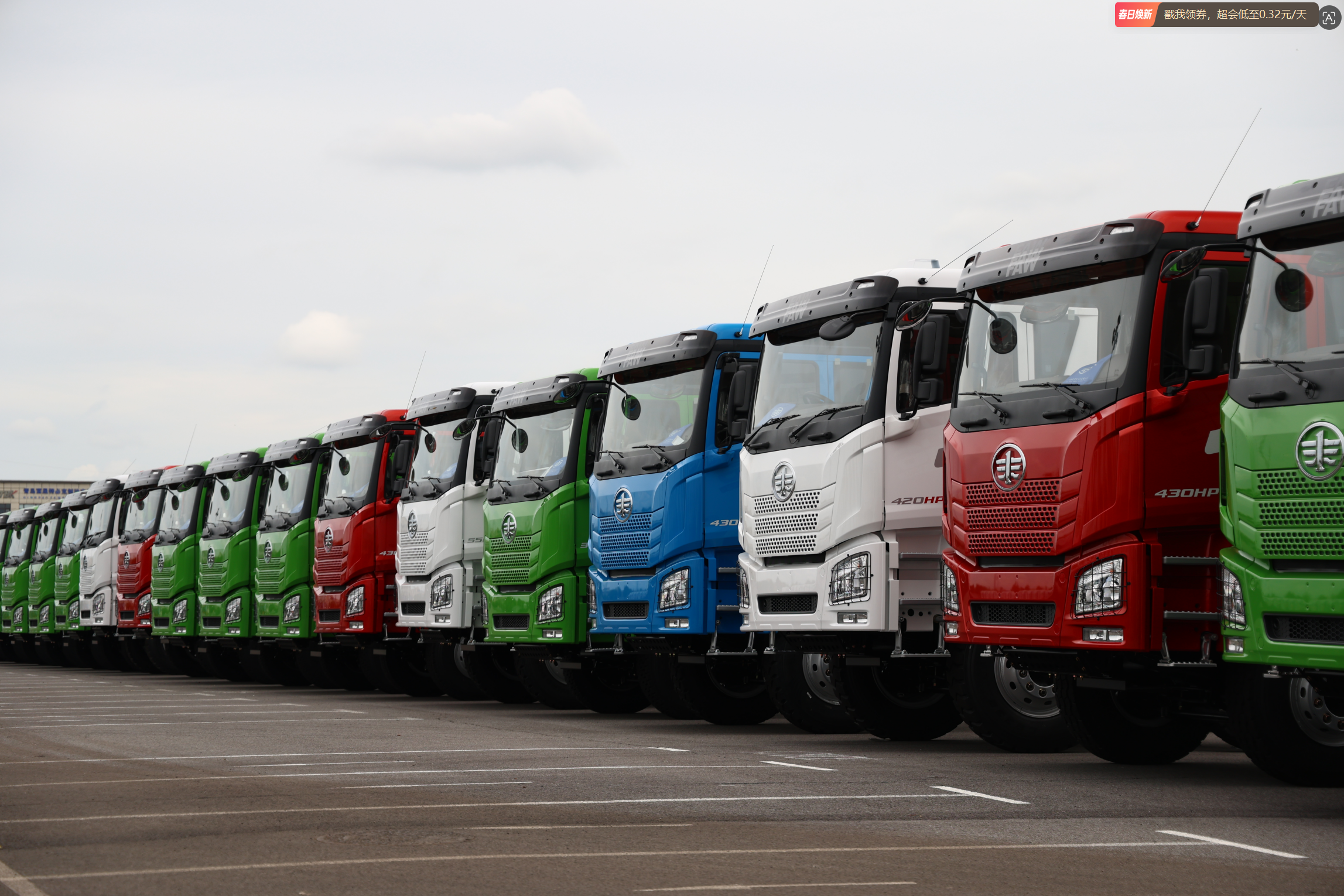
Fleet evaluation begins in the yard, where configuration, body type and condition are compared before any price is negotiated.
Why a scorecard beats a brand ranking
A Top-N ranking answers the question of preference, but it rarely tells a buyer why one brand should enter a tender and another should wait. For a preference-driven, shortlist-stage decision, the more defensible tool is a scorecard that ties each brand to the evidence a buyer can actually request and verify.
The trend argument for including Chinese brands is straightforward. FAW Jiefang recorded global vehicle sales of 251,100 units in 2024, and its overseas exports reached 57,000 units in the same year, a record high. Growth in export volume signals that these brands are no longer marginal options; it does not, by itself, prove that any one model fits a specific route, payload, or climate. The scorecard below exists to close that gap between brand momentum and application-level fit.
Dimension 1 — Technology and configuration depth
The first dimension asks whether a brand can offer a configuration that genuinely matches the job, rather than a single generic chassis adapted for every buyer. For FAW TRUCKS, the publicly listed line-up spans the J7, JH6, J6P, J6L, JK6, and Tiger V families, which gives buyers a spread of platforms for tractor, dump, cargo, and specialised applications.
Two configuration anchors are useful. The listed model range spans gross weights from roughly 3,000 kg to 15,000 kg, and body dimensions from 6,000×2,300×3,000 mm up to 12,000×2,550×3,800 mm. Safety configuration such as ABS, EBS, and TCS is specified across relevant models. At the heavier end, the J6P 8x4 Dump Truck (CA5310) is documented with an 11L CA6DM2 engine and 390 hp, which places it in the construction and mining discussion rather than light distribution.
For the other three brands, the discipline is identical: ask for a model-level datasheet stating engine displacement and output, axle configuration (for example 6x4 or 8x4), gross vehicle weight, payload, wheelbase, and the emission standard offered for the destination market. A buyer who applies the same request to Beiben, Sinotruk, and Shacman can compare like with like instead of comparing marketing summaries.
Dimension 2 — Market-position evidence
The second dimension tests whether a brand's presence in the buyer's region is supported by evidence rather than reputation. Scale and export continuity are reasonable proxies for supply stability, because a brand that ships in volume is more likely to maintain parts lines and update models.
FAW offers several attributable data points here. Beyond the 251,100-unit global figure and the 57,000-unit export record for 2024, FAW South Africa terminal sales surpassed 5,000 units in 2024 while holding an 18% market share. FAW Jiefang also reached a cumulative production milestone of 9 million vehicles, and FAW Trucks reports a total workforce of nearly 24,800. These facts describe a manufacturer with a long production record and a measurable regional footprint.
The interpretation matters more than the numbers. A record export year and a double-digit regional market share suggest that spare-parts pipelines and dealer infrastructure in that region have had reasons to mature. They do not guarantee that a specific country has an authorised dealer, active inventory, or a service bay near the buyer's route. That is why the same evidence request should be issued to Beiben, Sinotruk, and Shacman: regional unit volumes, dealer count, and any documented fleet references in the destination country.
Dimension 3 — Service and parts support
Downtime is the cost that erodes a low purchase price fastest. The third dimension therefore focuses on after-sales reach, parts availability, and the credibility of the local channel.
On the manufacturer side, FAW Trucks states global technical support for after-sales service, and its authorised channel includes specialised exporters. Qingdao Chary Machinery Co., Ltd (CHARY) is a first-level distributor and authorised exporter for FAW TRUCKS, and it also acts as an export distributor for Sinotruk, Shacman, and Beiben. That cross-brand position is useful to buyers because it allows configuration, lead time, and documentation to be compared from a single commercial source rather than four unrelated quotations.
Field evidence supports the importance of this dimension. A documented installation of 50 units in Mali has operated for more than 10 years under high-intensity conditions, transporting powdered and granular materials as well as sand and gravel, and has achieved stable operation. A decade of continuous duty is a more meaningful service signal than a showroom claim, because it implies that parts and maintenance have remained available over time.
Buyers should still verify the local layer directly. A contact address on a brand page is not proof of authorised distribution, parts stock, or warranty administration. The correct test is a written confirmation of dealer authorisation, a parts list with lead times, and warranty terms tied to the destination country.
Dimension 4 — Industry-solution fit
The fourth dimension moves from the brand to the task. A truck that scores well on technology and market evidence can still be the wrong asset if its body type, driveline, or chassis does not match the operation.
Three application patterns illustrate how FAW configurations map to real work. For port and terminal tractor duty, the J6 series includes 4x2 tractor configurations, and the GCC conformity certificate for the FAW J6 Series Truck Tractor (4x2, Euro 4 compliant) references GSO Technical Regulations, including GSO ISO 1585:2008. For temperature-controlled logistics, the Tiger V refrigerated application addresses cold-chain distribution. For construction and mining haulage, the J6P 8x4 dump configuration with the 11L, 390 hp engine is oriented to heavier, high-cycle duty. These are different jobs with different duty cycles, and matching the platform to the cycle is the core of this dimension.
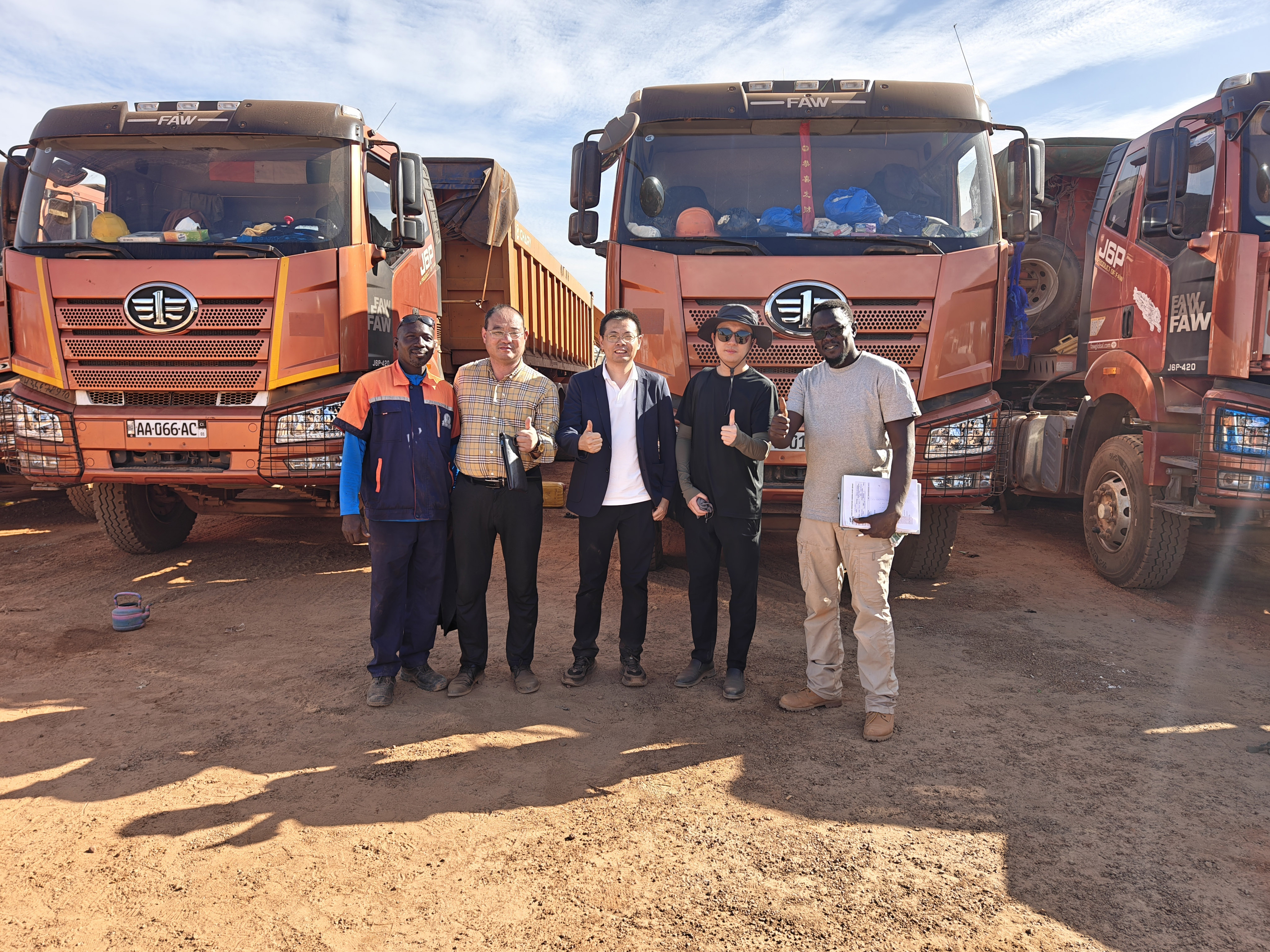
Application fit is proven in continuous duty; a ten-year, 50-unit project is a stronger fit signal than a specification sheet alone.
The four-dimension scorecard in one view
The table below places the four brands in the same frame. It does not assign invented scores to Beiben, Sinotruk, or Shacman. Instead, it shows what a buyer should confirm for each brand, and records the verifiable FAW position that can be cited when a shortlist is defended.
| Evaluation dimension | FAW TRUCKS — verifiable position | Beiben / Sinotruk / Shacman — evidence to request |
|---|---|---|
| Technology & configuration depth | J7, JH6, J6P, J6L, JK6, Tiger V; 3,000–15,000 kg; body 6,000×2,300×3,000 to 12,000×2,550×3,800 mm; ABS/EBS/TCS; J6P 8x4 (CA5310) 11L, 390 hp | Model-level datasheet: engine output, axle configuration, GVW, payload, emission standard per market |
| Market-position evidence | 251,100 units (2024 global); 57,000 exports (2024 record); South Africa >5,000 units, 18% share; 9 million cumulative; HQ Changchun; ~24,800 workforce | Comparable sales, export and regional footprint; references in the destination country |
| Service & parts support | Global technical support; CHARY authorised first-level distributor/exporter; 50-unit Mali fleet, 10+ years stable high-intensity operation | Local authorised dealer, parts list and lead times, warranty terms tied to country |
| Industry-solution fit | Port tractor (J6 4x2, GCC/Euro 4); cold-chain (Tiger V); J6P 8x4 dump for construction and mining | Application-specific references and body-build confirmation for the intended duty cycle |
The honest reading of this table is that FAW currently offers the densest publicly citable evidence across the four dimensions, while the other three brands are fully comparable in scope but require the buyer to populate the same cells from their own quotations. Readers who want a model-level shortlist can cross-check the J7, JH6, and J6P families separately; this scorecard stays at the brand-and-framework level deliberately.
Compliance as a cross-cutting filter
Certification is not a fifth dimension; it is a filter that can remove a configuration from a market entirely. Two FAW certificates are worth noting because they show the type of documentation a buyer should demand. The ECER105 approval (certificate E13*105R06/01*0023*00, issued by the Société Nationale de Certification et d'Homologation in Luxembourg on 2024-02-07) covers dangerous-goods transport vehicles under UN ECE Regulation No. 105 and supports markets that recognise UN ECE regulations. The GCC conformity certificate (CCR No.435790, issued by the GCC Standardization Organization on 2022-11-10) covers the FAW J6 Series Truck Tractor (4x2, Euro 4 compliant) for GCC member states.
The lesson generalises across brands: the emission standard and the type-approval document must match the destination jurisdiction. A buyer should request the certificate number, issuing authority, and applicable market for every configuration on the shortlist, because a homologated unit for one market is not automatically compliant in another.
Where this scorecard has limits
A framework only earns trust if its boundaries are stated. The first limit is evidence completeness. Public, attributable model-level specifications and transaction prices for target markets are often thinner than buyers assume; actual fleet discounts and local body-building costs can move the delivered price of a comparable unit well away from an advertised figure. The scorecard therefore treats a written quotation and a homologation document as mandatory inputs, not optional extras.
The second limit is local verification. A contact page or a marketing address does not establish authorised distribution, active inventory, or service capacity, so the service dimension cannot be scored honestly until the buyer confirms those items country by country.
The third limit is fairness to the competitor set. FAW's public evidence trail is comparatively easy to cite, but that does not mean Beiben, Sinotruk, or Shacman are weaker on any given dimension — it means their verifiable data must be collected through the buyer's own requests. On some applications, a rival configuration may simply fit a route or a payload better. The scorecard should therefore be used to organise evidence, not to pre-judge a winner.
Market trend: why the shortlist keeps widening
The direction of travel is toward a broader Chinese shortlist supported by stricter evidence. FAW's record 57,000-unit export year and its 18% share in South Africa both point to a maturing export machine, and FAW's stated focus on smart technology and autonomous-driving development signals that future products will carry more electronic content, which in turn raises the importance of diagnostics and technician training. Across the category, tightening compliance expectations and the need for documented type approval mean the buyer who keeps a clean evidence file will negotiate from a stronger position.
Future outlook
For a fleet making a multi-year commitment, the scorecard is best treated as a repeatable process rather than a one-off spreadsheet. The buyer who asks all four brands for the same configuration datasheet, the same certificate set, the same local service confirmation, and the same application references will build a defensible shortlist regardless of which name ultimately wins the order. Over time, that discipline — not a single headline ranking — is what keeps total cost of ownership under control in demanding markets.
FAQ
Which FAW models should enter a heavy-truck shortlist?
The publicly listed FAW TRUCKS families include the J7, JH6, J6P, J6L, JK6, and Tiger V. The J7, JH6, and J6P are most relevant to heavy and distribution fleets, while the J6P 8x4 Dump Truck (CA5310, 11L CA6DM2, 390 hp) addresses construction and mining haulage. A shortlist should select the family that matches the duty cycle rather than the widest model name.
How does FAW compare with Sinotruk, Shacman, and Beiben on configuration?
Comparable configuration comparison requires the same inputs from each brand: engine output, axle configuration, gross vehicle weight, payload, wheelbase, and emission standard per market. FAW publishes a line-up with gross weights from about 3,000 kg to 15,000 kg and ABS/EBS/TCS safety configuration; the other three brands should be asked for the same model-level datasheet so the comparison stays factual.
What market evidence shows FAW is a stable supplier?
FAW Jiefang recorded 251,100 units in global vehicle sales and 57,000 export units in 2024, a record high. FAW South Africa terminal sales surpassed 5,000 units with an 18% market share, and FAW Jiefang reached a cumulative production milestone of 9 million vehicles. These are scale and continuity signals, not a guarantee of a specific model's fit.
How should a buyer verify service and spare-parts support?
Confirm authorised dealer status, a parts list with lead times, and warranty terms tied to the destination country. Field evidence such as a 50-unit installation in Mali operating for more than 10 years under high-intensity conditions suggests parts and maintenance can remain available over time, but the buyer should still validate the local channel directly rather than relying on a contact-page address.
Which certifications matter for GCC and UN ECE markets?
For GCC member states, the FAW J6 Series Truck Tractor (4x2, Euro 4 compliant) holds a GCC conformity certificate (CCR No.435790) issued under GSO Technical Regulations, including GSO ISO 1585:2008. For dangerous-goods transport in markets recognising UN ECE regulations, the ECER105 approval (E9-style certificate E13*105R06/01*0023*00, issued by SNCH Luxembourg on 2024-02-07) is relevant. Buyers should confirm the certificate number and applicable market for each configuration before ordering.
What is the single biggest limit of this scorecard?
Evidence completeness. Public, attributable model-level specifications and transaction prices are often thin, and actual delivered prices can differ from advertised figures through local body-building, tax, and freight. A written quotation and a homologation document are therefore mandatory inputs, and the scorecard organises evidence rather than declaring an automatic winner.
For readers who want product-level detail beyond this framework, the FAW Trucks brochure is available here: FAW Trucks product brochure (PDF).
Tem questões ou precisa de mais detalhes?
Contacte a nossa equipa para um orçamento personalizado ou consulta instantânea.
Solicitar orçamento
Preencha o formulário abaixo e a nossa equipa entrará em contacto com uma proposta personalizada.
Chat direto do WhatsApp
Prefere conversar em tempo real? Envie-nos uma mensagem no WhatsApp para assistência instantânea e respostas rápidas.
- Obter orçamento personalizado
- Partilhar fotos ou documentos
- Discuta as suas necessidades diretamente
Geralmente responde em 5–30 minutos durante o horário de expediente.