
FDA, RoHS & LFGB Compliance for Injection Molded Parts
FDA, RoHS & LFGB Compliance for Injection Molded Parts
Compliance for a molded plastic part is rarely decided at a customs border. It is decided much earlier — when a material grade is selected, when the mold is designed, and when a test report that names one specific part number is either issued or missing.
OEM buyers sourcing custom injection molded parts encounter three frameworks repeatedly in supplier questionnaires: FDA 21 CFR 177.2600 for the United States, RoHS Directive 2011/65/EU for Europe, and LFGB Sections 30 and 31 for Germany. Each of them answers a different question, and none of them substitutes for the other two. This article treats compliance as a project-fit problem rather than a paperwork problem: which framework applies to which part, what evidence actually demonstrates compliance, how that evidence attaches to specific models such as DTG-CIMP-001 and DTG-IIM-005, and where the limits of each document lie.
Why Compliance Moved Into Supplier Qualification
Three application areas have pushed compliance testing from a final paperwork step into an early qualification filter. Electronics programs need substance-restriction evidence because molded housings, covers and internal brackets sit inside equipment that falls within RoHS scope. Medical and healthcare programs need material consistency and inspection evidence because components are permanently assembled into devices and used under clean conditions. Food-contact and kitchen-related programs need migration-related evidence because the article itself, or a surface it touches, comes into contact with food.
The commercial consequence is straightforward. A part that meets every drawing dimension can still hold up a shipment if the documentation does not name the material grade that was actually molded. Increasingly, buyers ask for that documentation before tooling is released rather than after first article approval — because a late discovery forces either a material change, which can shift shrinkage, strength and surface finish, or a fresh test cycle on an already finished part.
The opportunity runs in the other direction as well. A supplier that already runs material confirmation, first article inspection, dimensional inspection and pre-shipment inspection as standard production steps has a shorter path to a usable compliance file than a supplier that treats inspection as an optional add-on. Documentation readiness is therefore a reasonable proxy for process discipline — a point worth remembering when two quotations look similar on price.
Three Frameworks, Three Different Questions
The confusion in injection molding compliance usually comes from treating the three frameworks as interchangeable badges. They are not. They were written for different risks, they are assessed at different levels, and they produce different documents.
| Framework | Primary market | Question it answers | Evidence typically requested |
|---|---|---|---|
| FDA 21 CFR 177.2600 | United States | Can this material be used in contact with food, including repeated-use articles? | Declaration of compliance or test report naming the material and the finished article |
| RoHS Directive 2011/65/EU | European Union, widely adopted elsewhere | Does the part contain restricted hazardous substances above permitted levels in any homogeneous material? | Test report covering the homogeneous materials actually used, including inserts and coatings |
| LFGB Sections 30 & 31 | Germany | Does the article transfer substances that could be harmful, judged under German national test methods? | Sensory and migration testing reports from an accredited laboratory |
FDA 21 CFR 177.2600: food contact and repeated use
The FDA framework for food-contact materials is built around the intended use of the finished article, not the geometry of the part. Section 177.2600 addresses rubber and elastomeric articles intended for repeated use, which makes it directly relevant to parts molded in TPE and similar elastomeric compounds. Rigid plastics used in food contact are addressed through resin-specific sections of the same part of the code, so the specific citation depends on the polymer family involved.
For a buyer, the practical implication is that the compliant unit is the material formulation plus the end-use condition. A molder can hit tight tolerances on a perfectly formed housing and still be unable to support a food-contact claim if the selected grade — or the colorant added to it — does not carry the appropriate declaration for the intended use.
RoHS Directive 2011/65/EU: restricted substances in electrical equipment
RoHS restricts the presence of certain hazardous substances in electrical and electronic equipment. Molded plastic housings, covers, brackets and structural parts fall within the scope of the finished device, which is why electronics programs raise RoHS in the very first supplier questionnaire.
The directive is assessed at the level of each homogeneous material. That detail matters more in injection molding than it first appears: the base resin, the colorant masterbatch, any flame-retardant additive, and the plating on a metal insert are each separate materials with their own assessment. Exemptions exist for defined applications, but they must be claimed explicitly rather than assumed. The practical output from a molder is a material-level test report for each grade used on the program — not a single company-level statement.
LFGB Sections 30 and 31: the German national layer
LFGB is German national law covering food-contact articles and consumer goods. Sections 30 and 31 establish the prohibition framework: articles must not transfer substances to food in quantities that could be harmful to health under the intended conditions of use. Testing under German methods typically includes sensory evaluation of the article as well as migration testing, because odor and taste transfer are treated as part of the risk rather than a cosmetic issue.
Because LFGB sits at the national level, it works alongside the EU-wide measure governing plastic food-contact materials. Buyers targeting Germany routinely check both perspectives rather than treating one as a substitute for the other.
Mapping Compliance to Real Part Programs
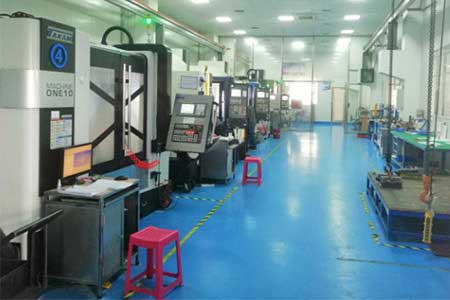
DTG TECH CO., LTD. is a Xiamen-based custom injection molding manufacturer, founded in 2002, whose published profile covers precision mold design, tool manufacturing, prototype development, plastic injection molding and mass production, with 100% of output exported to the USA, Europe and India. The company operates a 2,500 m² facility with 80 employees, including a 25-engineer R&D team, and reports an annual output of 47,881 injection molded parts. Its published profile describes it as ISO-certified, and publicly available company information records ISO certification obtained in 2019.
Two models from that portfolio illustrate why compliance questions have to be answered at the part level rather than the company level.
DTG-CIMP-001: a multi-material custom parts program
DTG-CIMP-001 covers custom injection molded plastic parts — custom plastic parts, OEM injection molded components and mass production plastic parts — molded in ABS, PP, PC, PC+ABS, TPE, acrylic and other engineering plastics. Part size is customized according to customer design, production volume runs from prototype to mass production, tolerance follows customer drawings and specifications, and surface finish options include texture, polishing, painting and printing. Applications span electronics, automotive, consumer goods, industrial equipment and medical products.
The compliance significance is that a program accepting several resin families can serve several markets at once, but each grade used has to be documented on its own. A report covering one ABS grade does not transfer to a PC+ABS housing, and a change of colorant can invalidate earlier evidence even when the base polymer is unchanged.
DTG-IIM-005: insert molding multiplies the material list
DTG-IIM-005 covers insert injection molded parts and overmolded components in ABS, PC and PP combined with metal inserts, with customization of insert position, material combination and structure design. Typical uses are functional and structural components in electronics, automotive and industrial equipment.
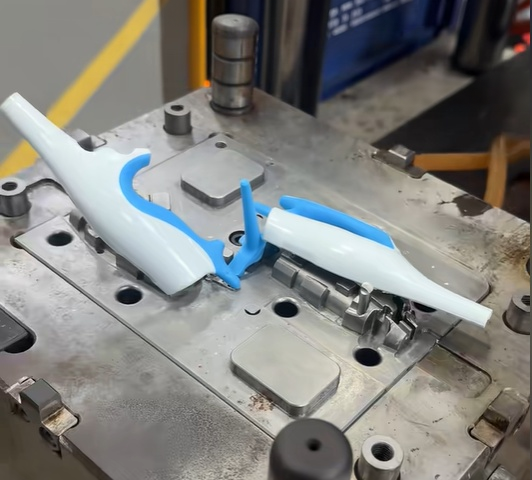
Insert molding adds a second material stream to the file. Under RoHS, the metal insert and any plating on it are separate homogeneous materials with their own assessment. Under food-contact frameworks, the metal surface is evaluated separately from the polymer. A buyer qualifying an insert molded part therefore has to document more materials than for a single-resin part — and a change in insert supplier is a compliance event, not just a sourcing decision.
What the manufacturer documents in-process
Separate from any third-party certificate, DTG TECH documents material confirmation, molding parameter control, dimensional inspection, visual inspection and final quality checks as part of routine production. Depending on the program, these are supported by DFM review, first article inspection and pre-shipment inspection. Reported lead times are 7–15 days for prototypes, 20–35 days for regular mass production orders, and 15–45 days for mold design and tooling depending on size, complexity and material requirements. Reported capacity is approximately 3,990 parts per month, with a total annual capacity of around 47,881 injection molded parts.
These are manufacturing and inspection controls rather than compliance certificates, and buyers should read them that way. They reduce the risk that the part shipped differs from the part tested, but they do not by themselves establish a food-contact, RoHS or LFGB position. That evidence has to be requested for the specific material grade and part number in the program.
Where Compliance Weight Is Highest
Compliance pressure concentrates in application areas where a failure is expensive to correct after tooling.
Electronics manufacturing. Plastic enclosures and electronic device housings protect internal components, support assembly and maintain dimensional stability across a three-to-seven-year service life under frequent handling. Special requirements include tight tolerances for PCB and display alignment, smooth surfaces free of sink marks and flow lines, and material consistency with a flammability rating such as UL94 V-0 where required. RoHS evidence is the dominant compliance question here, because the part sits inside equipment that falls within the directive’s scope.
Medical and healthcare products. Components here are permanently assembled and used under cleanroom conditions with continuous intermittent use. Requirements include high-precision molding, clean and defect-free surfaces, stable material batch-to-batch consistency and rigorous 100% quality inspection covering dimensional measurement and visual check. Where a device or accessory has an oral or food-contact pathway, FDA food-contact considerations enter the picture; across the sector more broadly, ISO 13485 is the benchmark quality management system for medical device molding and requires specific documentation such as the Device Master Record.
Home appliance manufacturing. Covers and molded parts provide functional protection, exterior decoration and assembly support under repeated daily operation. Requirements include good surface finish, stable color match across batches, accurate assembly dimensions and heat-resistant material selection near motors or heating elements. For kitchen appliances, the same parts can find themselves adjacent to a food-contact surface, which is how LFGB-type testing requests enter home appliance supply chains.
Industrial equipment manufacturing. Components provide protection, insulation and structural support under mechanical loads, dust, vibration and repeated assembly. Requirements include wear resistance, dimensional stability and reliable material performance under thermal and mechanical stress. When those parts sit inside electrical equipment, RoHS applies to them as well.
Automotive components. Here the governing quality standard is typically IATF 16949, the specialised standard for injection molders serving the sector, with an emphasis on defect prevention and waste reduction. Requirements include dimensional accuracy, impact resistance, and material durability against heat aging and UV exposure.
Delivery records reinforce the same point about traceability. A projector housing program produced PC+ABS injection molded housings at 30,000–50,000 units per batch with stable dimensions and appearance quality. A separate lighting program delivered 50,000 injection molded optical lenses in acrylic with 98% transparency, meeting strict surface quality standards and passing customer inspection. In both cases, the evidence that mattered to the buyer was tied to a specific material and a specific part.
Market Context: Compliance as a Procurement Variable
The global injection molded plastic market was valued at USD 324.98 billion in 2024 and is projected to reach USD 435.74 billion by 2035, according to Market Research Future. That headline figure should be read with care: estimates differ by institution depending on whether machinery or molded products are counted and which base year is used. Grand View Research places the figure at USD 362.5 billion for 2025, while Fortune Business Insights estimated USD 321.4 billion for 2024. The direction is consistent; the precision is not, and buyers should treat any single number as indicative rather than exact.
Supply concentration is more relevant to a sourcing decision. China produces an estimated 65% of the world’s injection-molding machines and accounts for around 60% of global export volume, which means the documentation practices of Chinese molders increasingly shape what OEM buyers in the USA and Europe can accept without additional testing.
Demand composition is shifting too. Automotive OEMs are substituting metal parts with engineered thermoplastics, and that substitution drives 34% of domestic injection molded component demand in major hubs such as the United States, according to Grand View Research. As more structural and under-hood parts move to polymer, the material documentation attached to those parts carries more weight.
Running through all of this is a certification landscape that has become sector-specific rather than general. IATF 16949 separates automotive-capable molders from general ones, and ISO 13485 marks the medical device supply chain. For a molder, the practical trend is that documentation readiness is being assessed alongside capacity, lead time and tooling capability.
Comparing Evidence Paths — and Where Each One Stops
Most buyers end up choosing between three ways of demonstrating compliance. Each has a legitimate role, and each has a boundary that is worth stating before the quotation is approved rather than after.
| Evidence path | What it establishes | Where it stops working |
|---|---|---|
| Resin or compound supplier declaration of compliance | The grade as supplied is intended for the stated regulatory use | Does not cover the colorant, the additive package, regrind content, or any process-induced change |
| Third-party laboratory test report on the finished part, from SGS or an equivalent accredited laboratory | Measured results on the article as it was submitted | Covers only the exact material, colour and part submitted; a new tool, colour or insert supplier starts a new question |
| Full program documentation package | Traceability from material grade to molded part to production batch | Only as good as the target market and framework the buyer defined at the start |
The most common and most avoidable limitation is scope mismatch. A report naming a generic “ABS” is not a report naming the specific grade and colour used in the molded part. FDA food-contact compliance says nothing about the restricted substances covered by RoHS; a RoHS test report says nothing about migration behaviour, odour or taste. LFGB Sections 30 and 31 are a German national framework and do not by themselves resolve every European market question.
There is a second, less obvious limitation. Compliance can be lost through changes that look purely operational: a higher regrind ratio, a substitute colour masterbatch, a different insert supplier, or a revised molding parameter set after a quality complaint. A qualification file is therefore a living document, not a one-time certificate. Suppliers that cannot trace a production batch back to a declared grade cannot reliably support a compliance claim over the life of a program — and this is a limitation that applies across the industry, not to any single vendor.
Future Outlook
Three developments look likely to shape how compliance is handled in injection molding sourcing over the next few years.
First, compliance data is moving earlier in the process. Buyers are increasingly specifying the target framework and market in the RFQ package itself, alongside tolerances and material callouts, rather than discovering the requirement during final inspection. This shifts cost from corrective testing to planning — and it favours suppliers whose material libraries are already documented.
Second, traceability is expanding from part level to batch level. Where a declaration once satisfied a qualification file, batch records linking production lots to declared grades are becoming a normal expectation in electronics and medical programs.
Third, the additive and colorant layers are attracting more scrutiny. As base polymer grades become well characterised, the residual risk sits increasingly in masterbatches, flame retardants and insert coatings. Suppliers that can document these upstream inputs will find qualification conversations shorter.
For OEM buyers, the practical takeaway is to treat compliance like a tolerance: specify it, attach it to a model and a grade, and validate it at the same time as the first article — not as a separate exercise after tooling has been approved.
FAQ
What does FDA 21 CFR 177.2600 cover, and when does it apply to an injection molded part?
Section 177.2600 sits within the United States framework for food-contact materials and addresses rubber and elastomeric articles intended for repeated use. It becomes relevant when a molded part — typically a TPE or elastomeric component — is intended for repeated contact with food. Rigid plastics used in food contact are addressed through resin-specific sections of the same regulation. The practical unit of compliance is the material formulation and the intended use condition, not the shape or drawing tolerance of the part.
Is RoHS compliance the same as food-contact compliance?
No. RoHS Directive 2011/65/EU restricts certain hazardous substances in electrical and electronic equipment and is assessed at the level of each homogeneous material, including colorants, additives and inserted metal parts. It does not evaluate migration into food, odour or taste. Food-contact frameworks, in turn, do not screen for the full set of restricted substances covered by RoHS. A component in a kitchen appliance can fall under both sets of requirements at once, which is why the two are documented separately.
How does LFGB Sections 30 and 31 testing differ from FDA and RoHS evidence?
LFGB is German national law. Sections 30 and 31 establish that food-contact and consumer articles must not transfer substances harmful to health under the intended conditions of use. Testing under German methods typically includes sensory evaluation of the article alongside migration testing, treating odour and taste transfer as part of the risk assessment. FDA evidence is oriented to the United States framework and the relevant resin sections, while RoHS is a substance-restriction check on homogeneous materials. The same molded part can therefore generate three different test rationales and three different documents.
During supplier qualification, how should a buyer verify a compliance claim for a specific molded part?
Request the document that names the material grade, the colour and the part or model in question, rather than a company-level certificate. Confirm which laboratory issued it and which standard or method it references, check the issue date, and check whether the tool, colourant or insert supplier has changed since it was issued. Verify that the scope statement matches the intended market and framework. Then link it to the manufacturing evidence: material confirmation, first article inspection, dimensional inspection and pre-shipment inspection. For a program built on models such as DTG-CIMP-001 or DTG-IIM-005, these questions are asked at the model-and-grade level, not at the supplier level.
What is the difference between a material declaration and a finished-part test report?
A material declaration comes from the resin or compound supplier and states what the grade is intended for. A finished-part test report comes from a testing laboratory and records measured results on the article as submitted. The declaration is the cheaper starting point and covers the grade as supplied; the test report is closer to what an OEM auditor or regulator will ask for, but it is narrower in scope because it applies only to the exact material combination and part it covers. Mature programs typically hold both, plus batch records that connect production lots back to the declared grade.
For reference, DTG TECH CO., LTD. publishes a company presentation covering its facilities, tooling and production capabilities, available at the company website www.m-dtg.com or as a downloadable PDF: DTG TECH company presentation (PDF).