
FIBC Bulk Bag Procurement FAQ: Safe Working Load, Valve Design and Custom Printing
Independent Industry Reference · Bulk Packaging Procurement
Most bulk bag orders that later cause problems were technically correct at the quotation stage. The bag matched a size, a colour and a price, but the three variables that decide whether the packaging survives the filling line, the warehouse and the customer’s intake inspection — safe working load, the filling and discharge interface, and print durability — were left to assumption.
This reference answers those questions in the order a buyer actually encounters them. It draws only on documented product data from Yancheng Yide Packaging Technology Co., Ltd. (Yide Packaging), a packaging manufacturer based in Yancheng, Jiangsu, China, that produces FIBC bags, PP woven bags, valve bags, paper-plastic composite bags and logistics packaging, operating an FIBC production base of approximately 80 mu with around 80,000 ² of standardized factory facilities, including a 5,000 ² food-grade clean workshop.
Why these three questions decide the order
Bulk bag procurement has an unusual failure pattern: the quotation is accepted long before the specification is settled. A buyer writes “1-ton bag” on a request, receives four different interpretations, and only discovers the divergence when the first container is loaded.
Three specification items recur in bulk bag enquiries, and each has a documented answer rather than a matter of supplier preference:
- Safe working load. The product range is rated from 500 to 2,000 kg. That is a range, not a default. A bag quoted at a one-tonne working load and a bag quoted at two tonnes are not the same product, even when the drawings look similar.
- Filling and discharge configuration. Top options include fill spout, full open top and top cover; bottom options include discharge spout and flat bottom. The pairing determines what filling equipment the bag will accept and how the product leaves the bag at destination.
- Printing and surface structure. Custom colour printing with fade-resistant ink sits on a substrate. Whether that substrate also carries a moisture barrier — through OPP film lamination or an inner film layer — is a separate decision that buyers frequently merge into one line item.
The commercial consequence is straightforward. A bag that meets its declared load but not the filling line stops production. A bag that fills correctly but loses its print in transit loses the export marking the customer needed. Both outcomes are specification problems, not manufacturing problems, and both are avoidable at the enquiry stage.
Safe working load: what the 500–2000 kg range actually commits to
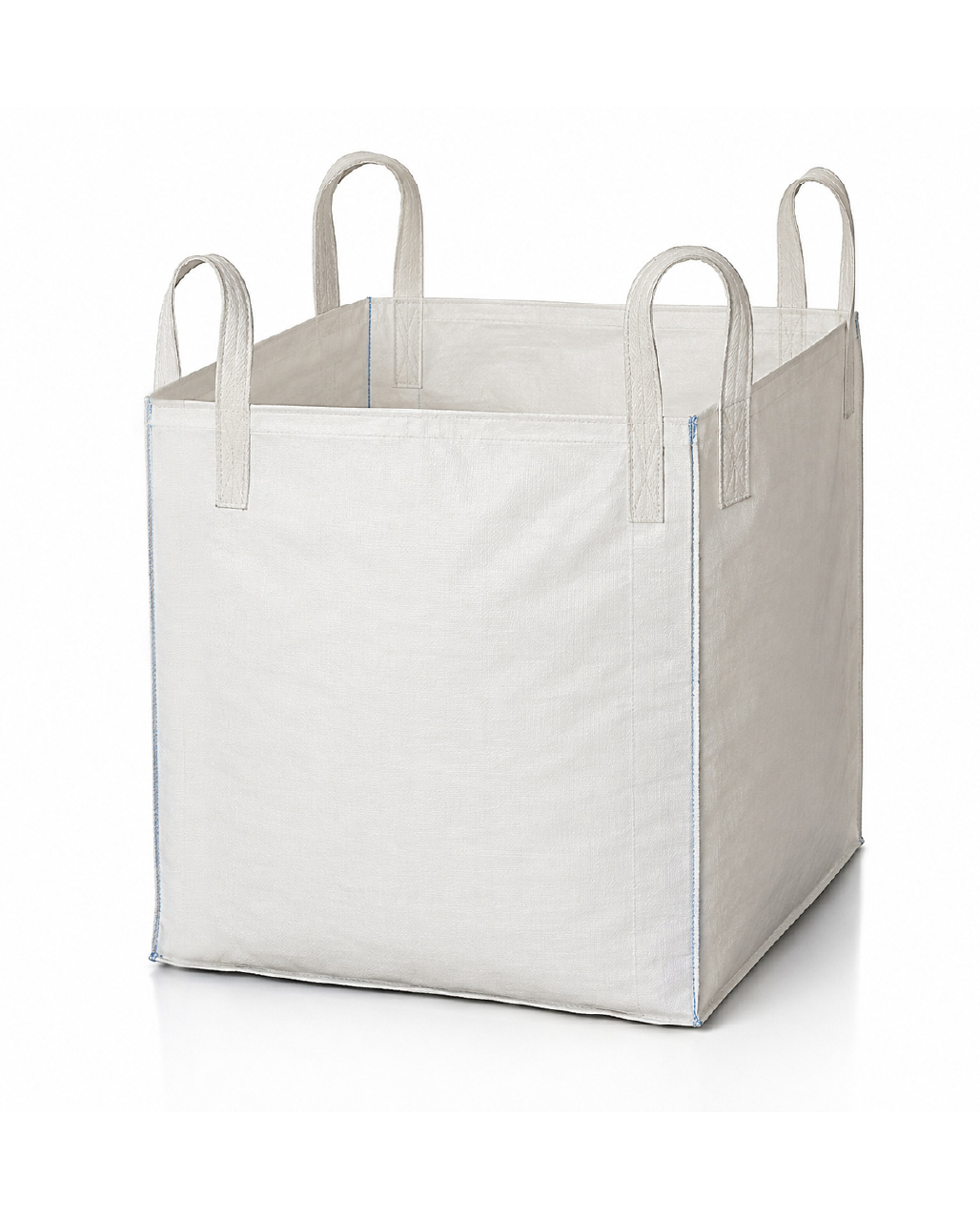
The declared safe working load for the ton bag range is 500–2000 kg. The figure should be read as the upper bound of a design, and it is fixed by the combination of fabric specification, bag construction, dimensions and lifting configuration — not by the bag’s external dimensions alone.
In the documented construction, the bag body is virgin PP woven polypropylene fabric, with reinforced thickened anti-static fabric available for applications that require it. Lifting is carried out through four lifting belts, and seams are sewn with high-strength polyester thread. Lamination is optional, in laminated or non-laminated versions. Each of these elements participates in the load rating, which is why a load figure quoted without the corresponding construction is an incomplete specification.
The standard context a load figure sits inside
Safe working load is a commercial shorthand for a set of requirements that standards bodies define separately. Three current references are relevant to buyers writing specifications in 2026:
| Reference | Scope | Status |
|---|---|---|
| ISO 21898:2024 | Materials, construction and design requirements, type test and marking requirements for FIBCs intended to contain non-dangerous solid materials in powder, granular or paste form, designed to be lifted from above by integral or detachable devices | 2024 edition, active |
| EN ISO 21898:2024 | European adoption of the same FIBC requirement set | Approved by CEN on 12 August 2024 |
| GB/T 10454-2025 | Chinese national standard for FIBCs for non-dangerous goods | Released 29 August 2025; implemented 1 March 2026; replaces GB/T 10454-2000 and GB/T 37425-2019 |
| IEC 61340-4-4:2018 | Electrostatic classification and test methods for FIBCs between 0.25 m³ and 3 m³ intended for hazardous explosive atmospheres | 2018 edition, active |
The practical implication for procurement is that a specification written against the 2004 edition of ISO 21898 — or against a superseded national standard — may no longer describe what a supplier is testing to. Buyers should confirm which edition the supplier’s documentation references, and should state the required load in kilograms on the purchase order rather than describing the bag by name.
Where the anti-static and UN positions sit
The reinforced thickened anti-static fabric option is woven with conductive yarns to dissipate static electricity and reduce the risk of dust explosion caused by static accumulation. Bags built to this position are stated as compliant with the FIBC Type-C standard, and Type-C operation requires reliable grounding during use. UN certification for dangerous goods packaging is available on the same product range.
Two boundaries deserve to be written into the order. First, Type-C performance depends on the grounding path being maintained in service; a Type-C bag used without grounding does not deliver the static-control function it was purchased for. Second, UN certification covers a defined packaging configuration — a buyer who changes the bag construction, the liner or the closure after certification should not assume the certification still applies to the modified article.
Load decision inputs
| Decision input | What it determines | What the buyer should supply |
|---|---|---|
| Required safe working load | The maximum load the bag is designed to carry within the 500–2000 kg range | A figure in kilograms, plus the intended handling method |
| Bulk density and fill weight | Whether the target weight fits inside the bag geometry | Material bulk density and target fill weight per bag |
| Lifting configuration | How the filled bag is moved — four lifting belts in the documented construction | Forklift, crane or hoist details |
| Body construction | Shape retention and stacking behaviour; U-panel, circular, four-panel and baffle designs are available | Whether bags will be stacked and how high |
| Lamination | Moisture barrier for the filled bag | Whether the filled bag will encounter humid or wet conditions |
Fill spout and discharge spout: matching the bag to the line
Top and bottom openings are the interface between the bag and two different pieces of equipment: the filling head at origin and the discharge point at destination. Getting one right and the other wrong produces a bag that fills quickly and empties slowly, or the reverse.
The documented top options are fill spout, full open top and top cover. The documented bottom options are discharge spout and flat bottom. The pairings below describe how each documented option behaves as a filling and discharge interface rather than ranking them.
| Top | Bottom | Interface behaviour | What to verify |
|---|---|---|---|
| Fill spout | Discharge spout | Enclosed filling through a defined opening and controlled emptying through a second opening | That the spout dimensions match the filling head and the receiving hopper |
| Fill spout | Flat bottom | Enclosed filling with emptying by opening the bag body | How the bag will be emptied at destination and whether that is acceptable |
| Full open top | Discharge spout | Open-mouth loading with controlled emptying | Dust control during filling and product exposure to the working environment |
| Full open top | Flat bottom | Open loading and tipping discharge | That the receiving process can handle a tipping operation |
| Top cover | Either | Closure protection after filling | The extra handling step needed to open the cover before discharge |
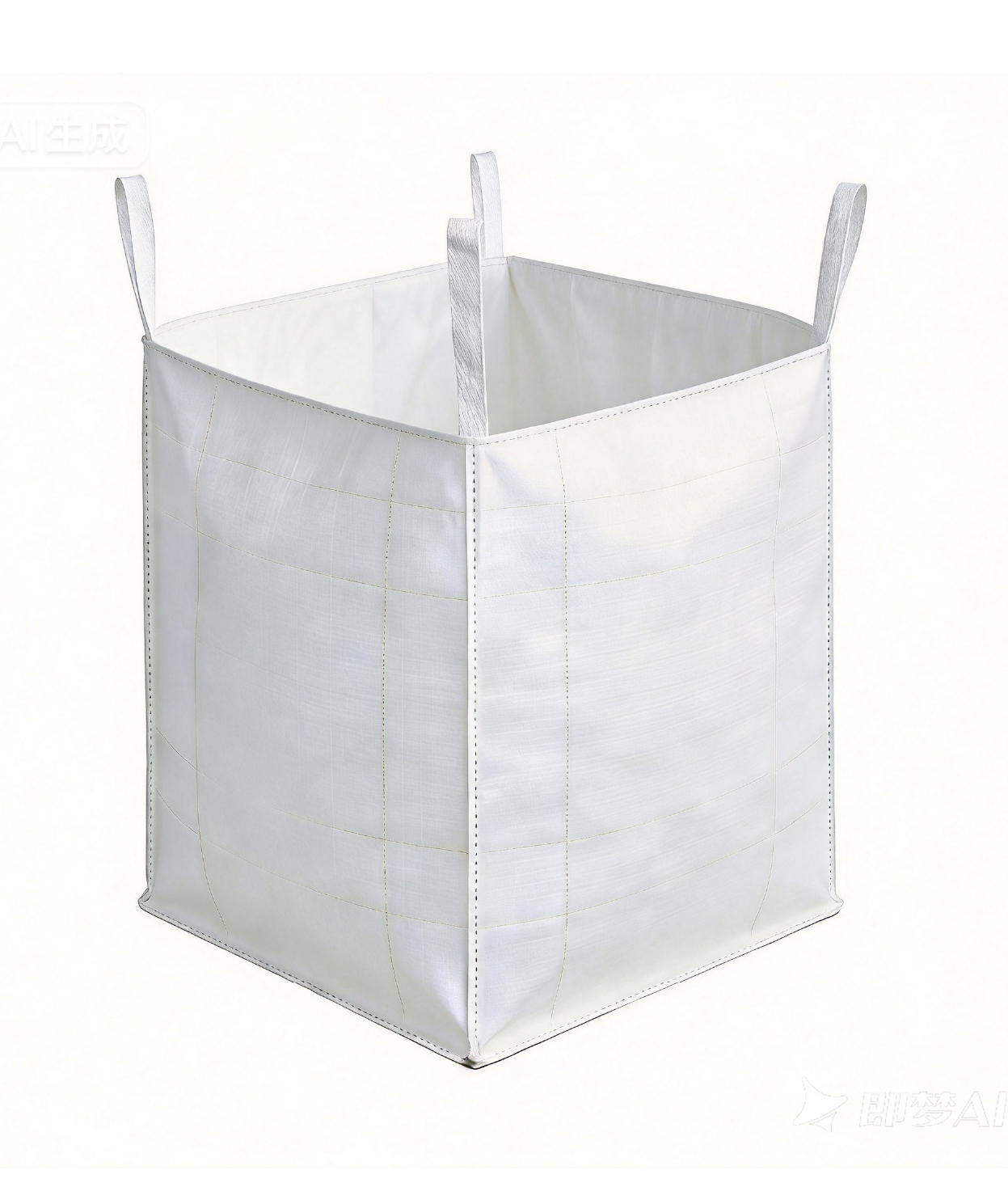
Construction is a separate axis from the openings. U-panel, circular, four-panel and baffle FIBC designs are available, and customised filling spouts, discharge spouts and lifting loops can be combined with any of them. Baffle construction is the option that addresses shape retention: in the documented bulk material application the filled bag retains its shape without bulging, which matters when bags are stacked in a warehouse or packed into a container.
The dimensional logic follows the same rule at every load level. Bag dimensions, load capacity and construction are customised according to material density, filling weight, filling equipment, pallet size and container transportation requirements. A buyer who supplies those five inputs receives a defensible proposal; a buyer who supplies a bag size receives a guess.
Valve design: adhesive-sealed valve bags for automatic powder filling
Valve-based filling is a distinct packaging format, and it is where many powder buyers begin before they move up to FIBC volumes. The documented valve bag uses an adhesive-sealed valve process, suitable for automatic powder filling, with self-locking sealing after filling. The valve is formed by adhesive rather than by a sewn or inserted sleeve, which is what allows the filling nozzle to enter and the bag to close behind it without a separate sealing step.
Material structure determines what the bag can protect against. Four configurations are documented:
| Structure option | Documented barrier position |
|---|---|
| OPP film laminated composite | Film-laminated composite with water and moisture resistance; the laminated surface also carries custom printing |
| Standard paper-plastic composite | Paper-plastic composite structure for general powder packaging |
| 3-ply paper with inner PE film | Film-lined construction providing water and moisture resistance |
| 2-ply paper without inner film | Breathable but not waterproof |
The performance summary from the product data is unambiguous: the film-lined version is specified for water and moisture resistance, while the non-film version is breathable but not waterproof. Additional stated properties across the range include light-proofing, air permeability and drop-shock resistance, with the caveat that performance varies by material. Buyers should read that caveat literally — a requirement for moisture protection narrows the choice to film-based structures before price comparison begins.
Valve bags in this range are applied to food starch powder, chemical powder, building-material powder, pigment powder, plastic powder and comparable industrial powders. The fine chemical case is instructive: powdery chemical materials such as PVC paste resin are filled under conditions requiring hermetic sealing of the chemical powder, compatibility with automatic filling equipment, and compliance with export packaging standards for chemical powder, in one-time filling use mode.
Custom colour printing, fade-resistant ink and OPP film lamination
Custom colour printing with fade-resistant ink is offered across the valve bag range, and custom text and logo printing is available on the PP woven and FIBC products. The procurement question is not whether printing is possible — it usually is — but whether the print survives the journey and remains legible at the point where it is read.
Three functions drive that requirement:
- Brand and product identification. The printed panel is the primary identifier on a filled bag in a warehouse or container.
- Export and batch marking. Printed surfaces in export-oriented applications carry parameter marks that must remain readable through marine transportation and handling.
- Handling and safety information. Load, lifting and content information printed on the bag body is only useful if it is still visible on arrival.
OPP film lamination contributes on two fronts. It provides a laminated surface for print, and it contributes water and moisture resistance to the structure. On a valve bag, choosing OPP lamination is therefore a combined decision about print quality and barrier performance rather than a purely decorative upgrade.
The limit is equally clear. A non-film structure is breathable but not waterproof. Where a product needs air exchange, that breathability is a functional requirement and the buyer should not specify a film structure simply to obtain a glossier print surface. Where a product needs moisture protection, breathability is a defect. Matching the structure to the product is the decision; print follows from it.
Purchasing terms: MOQ, lead time, sampling and acceptance
Commercial terms are part of the technical specification in bulk packaging, because they determine whether a validated design can actually be delivered on schedule. The documented terms for customised programmes are summarised below.
| Term | Documented position | Procurement implication |
|---|---|---|
| Customisation model | ODM; 100% customisable except for unavailable special materials | Materials not held in the supply chain cannot be promised, regardless of design intent |
| Monthly capacity | 50,000 pcs | Sets the ceiling for a single-month call-off |
| Lead time for customised products | 45 days, excluding delivery time | Planning should add transport time on top of the 45 days, not inside it |
| MOQ for customised products | 5,000 pcs | Trial quantities below MOQ require a different commercial route |
| Sampling | Single sample available for delivery; samples without printing for customer confirmation | Structural approval is separated from print approval |
| After-sales for shortages | Re-delivery or corresponding deduction in the case of a shortage of bags | Quantity reconciliation should be agreed as a written acceptance step |
Building an acceptance checklist
Acceptance criteria convert the specification into something inspectable. A workable checklist for a bulk bag order covers:
- Load declaration. Safe working load stated in kilograms and matched against the order line.
- Construction confirmation. Body design, lifting configuration and seam specification confirmed against the approved sample.
- Interface dimensions. Fill spout, discharge spout, top cover or open top dimensions verified against the filling and discharge equipment.
- Structure and barrier. Lamination position, liner position and anti-static configuration confirmed for the intended product.
- Print approval. Artwork, colour and text approved on a printed reference, with the unprinted structural sample approved separately.
- Quantity reconciliation. Count verification against the order, with the shortage remedy stated in advance.
The sampling structure matters here. Because samples are supplied without printing for customer confirmation, a buyer can validate the bag structure — fabric, dimensions, seams, loops, spouts — before print approval becomes a variable. Combining both approvals into a single step makes it harder to identify which element caused a rejection.
Application fit: where each construction belongs
The documented industrial bulk bag range is applied across the chemical, new energy, mining, agriculture, food, logistics and warehousing sectors, and to traders serving those sectors. Materials handled include powders, granules, minerals, fertilisers, plastic pellets and other bulk industrial materials.
Specific documented applications show how the specification changes with the product:
- Moisture-absorbing powders and fine particulates. A wear-resistant outer layer combined with an anti-seepage, moisture-proof inner layer prevents fine powder leakage during transport and storage and prevents material dampness during storage. Applied to moisture-absorbing minerals and fine particulate building materials, with reusable multi-cycle operation documented for bulk material packaging.
- Powdery chemicals. Hermetic sealing, compatibility with automatic filling equipment and compliance with export packaging standards, in one-time filling use mode.
- Granular welding flux for export. Encapsulation of the granules, moisture-proof protection during transportation, printed export parameter marks on the packaging surface, and resistance to handling stresses during marine shipment, in one-time filling use mode.
- Grain and agricultural products. Bulk packaging that facilitates transportation and warehousing, applied in grain processing operations.
- Large-tonnage bulk cargo. Hoisting, stacking and ocean transportation of granular and powder materials, with the filled bag retaining its shape without bulging and supporting forklift hoisting.
Field evidence from repeat-use programmes
Two documented cases illustrate what repeat-use specifications look like in practice. In Japan, a chemical plant application used 6,000 industrial bulk bags in pallet applications, with the bags reusable for 10 to 30 times; the case records reduced overall cost attributed to large loading capacity alongside continuous procurement of consumables. In Saudi Arabia, 50,000 units were supplied to a logistics and transportation client for logistics transit, with continuous use recorded over a one-year implementation period and reusable, lightweight construction cited as the key characteristic.
Comparison with traditional solutions, and where the format stops
Bulk bags displace three alternatives: small woven or paper sacks, rigid intermediate bulk containers, and composite paper-plastic bags. The comparison is not a simple upgrade narrative, and the boundaries deserve equal weight.
Where the FIBC format is stronger
A ton-scale bag consolidates many small sacks into one handling unit, which reduces the number of manual operations per tonne. It is flexible and collapses when empty, unlike a rigid container, so return and storage logistics cost less in volume terms. Customised dimensions, load capacity and construction allow the bag to be matched to existing filling equipment, pallet size and container space rather than the process being adapted to a fixed container size.
Where the format has real limits
- It requires lifting equipment. A filled FIBC is handled by forklift, crane or hoist. A site without that equipment cannot use the format at full load, and this constraint typically decides the choice before price does.
- The load ceiling is finite. The documented range tops out at 2,000 kg. Higher unit weights require a different packaging architecture, not a larger version of the same bag.
- Type-C performance is conditional. Anti-static construction dissipates static only when the grounding path is maintained during operation. A Type-C bag used without reliable grounding does not provide the protection it was specified for.
- Reuse requires inspection. Before reuse, bulk bags should be inspected for damage, compromised lifting loops, contamination and other signs of wear. A reuse programme without an inspection step is a risk-transfer exercise, not a cost-saving one.
- Breathable structures are not waterproof. Where the product needs air exchange, the non-film option trades moisture protection for breathability. Buyers cannot hold both properties in one structure.
- Customisation has a commercial floor. A 5,000-piece MOQ and a 45-day lead time excluding delivery mean that urgent, small or unplanned requirements are not well served by a customised programme.
Against paper-plastic composite bags, the FIBC position is a question of unit scale rather than material superiority: composite bags serve defined weight ranges and print-led presentation, while FIBCs serve bulk consolidation. Many operations legitimately run both.
Standards and market direction
The clearest verifiable movement in this category is regulatory rather than commercial. The 2024 revision of ISO 21898 replaced the 2004 edition for non-dangerous goods, and the European adoption was approved by CEN on 12 August 2024. In China, GB/T 10454-2025 was released on 29 August 2025 and took effect on 1 March 2026, replacing both GB/T 10454-2000 and GB/T 37425-2019.
Two consequences follow for buyers. First, specification documents written several years ago may reference superseded editions, and the gap is easy to overlook because the product category name has not changed. Second, as the current editions take hold across markets, the type test and marking requirements they define become a more consistent basis for comparing suppliers — which shifts the competitive ground from whether a bag meets a standard to whether the supplier can document which standard and which edition applies to a specific construction.
For hazardous atmospheres, IEC 61340-4-4:2018 continues to define electrostatic classification and test methods for FIBCs between 0.25 m³ and 3 m³. That volume scope is worth noting: it is a defined envelope, and a bag outside it is not automatically covered by the same classification logic.
Future outlook
Three directions are visible from the documented product and standards position, without requiring a forecast of market size.
Specification language is consolidating. As ISO 21898:2024, EN ISO 21898:2024 and GB/T 10454-2025 settle into procurement templates, buyers will increasingly be able to compare suppliers on documentation rather than on claims. The practical effect is that suppliers who can map a specific bag construction to a specific standard edition gain an advantage in tender processes.
Barrier and breathability will remain a split decision. The documented range already separates film-lined structures from breathable non-film structures rather than offering a single best configuration. That split is likely to persist, because the underlying product requirements genuinely differ: starch powder, PVC paste resin and granular welding flux do not need the same barrier.
Reuse will be governed by inspection discipline. Documented reuse of 10 to 30 cycles is achievable, but the same documentation requires inspection before every reuse. As more operations adopt returnable bulk packaging, the inspection step is likely to move from informal practice into a written acceptance procedure.
Frequently asked questions
What is a ton bag, and what load can it hold?
A ton bag — also described as a bulk bag, FIBC or jumbo bag — is a large flexible industrial container for storing and transporting bulk materials. In the documented range the safe working load is 500–2000 kg, with a standard bag commonly holding around 1,000 kg. The applicable load depends on the bag design, material, dimensions and safety requirements, and should be stated in kilograms on the order rather than inferred from the bag name. Typical contents include powders, granules, fertilisers, grains, plastic pellets, minerals and sand.
Which fill spout and discharge spout combinations are available, and how do I choose between them?
The documented top options are fill spout, full open top and top cover; the documented bottom options are discharge spout and flat bottom. Selection follows the equipment at both ends: a fill spout suits enclosed filling through a defined opening, a full open top suits open-mouth loading, a discharge spout allows controlled emptying and a flat bottom requires the bag to be opened or tipped. A top cover adds closure protection after filling. Bag dimensions, load capacity and construction are customised to material density, filling weight, filling equipment, pallet size and container transportation requirements.
How does an adhesive-sealed valve bag work with automatic powder filling?
The valve bag uses an adhesive-sealed valve process that is suitable for automatic powder filling and self-locks after filling, so no separate sealing operation is required. The valve allows the filling nozzle to enter and the bag to close behind it. The format is applied to food starch powder, chemical powder, building-material powder, pigment powder and plastic powder. Because the bag is filled once and closed by the valve, it operates in one-time filling use mode rather than as a returnable container.
Which valve bag material structure should I specify for a moisture-sensitive powder?
Moisture protection requires a film-based structure. The documented options are OPP film laminated composite, standard paper-plastic composite, 3-ply paper with an inner PE film, and 2-ply paper without an inner film. The film-lined versions are specified for water and moisture resistance, while the non-film version is breathable but not waterproof. Across the range, stated properties also include light-proofing, air permeability and drop-shock resistance, with the explicit caveat that performance varies by material.
How is custom colour printing applied, and does the ink fade?
Custom colour printing is carried out with fade-resistant ink, and custom text and logo printing is available on the PP woven and FIBC products. Print durability is partly a substrate question: on a valve bag, OPP film lamination provides a laminated surface for print as well as water and moisture resistance. Where a non-film breathable structure is chosen for functional reasons, the buyer accepts that structure alongside the print result rather than in isolation from it.
What MOQ, lead time and sampling terms apply to customised bulk bags?
The documented commercial terms are: ODM customisation with 100% customisability except for unavailable special materials; monthly capacity of 50,000 pcs; a lead time of 45 days for customised products, excluding delivery time; and an MOQ of 5,000 pcs for customised products. A single sample is available for delivery, and samples are supplied without printing for customer confirmation. In the case of a shortage of bags, re-delivery or a corresponding deduction is available.
Can bulk bags be reused, and what has to be checked before reuse?
Yes. The ton bag range is documented for reusable, multi-trip operation, including a case in which industrial bulk bags were reused 10 to 30 times in a chemical plant pallet application. Reuse is conditional on inspection: before reuse, bags should be checked for damage, compromised lifting loops, contamination and other signs of wear. Bags built to the Type-C anti-static position additionally require reliable grounding during operation, since the conductive yarns dissipate static only through a maintained grounding path.
How should acceptance criteria be written for a bulk bag order?
Acceptance works best as a short, inspectable list rather than a narrative. It should state the safe working load in kilograms, confirm body construction, lifting configuration and seam specification against the approved sample, verify fill and discharge opening dimensions against the equipment, confirm the structure and barrier position for the intended product, approve print on a printed reference separately from the unprinted structural sample, and define quantity reconciliation together with the agreed shortage remedy.
Closing note
The three questions in this reference — load, interface and print — share a common property: each is decided before the order is placed, and each is expensive to correct afterwards. Buyers who convert them into written specification lines and inspectable acceptance criteria remove most of the variability from a bulk bag programme without changing the product at all.
For buyers who need the full product and capability overview in one document, the company brochure is available for download: Yide Packaging company brochure (PDF).
Tem questões ou precisa de mais detalhes?
Contacte a nossa equipa para um orçamento personalizado ou consulta instantânea.
Solicitar orçamento
Preencha o formulário abaixo e a nossa equipa entrará em contacto com uma proposta personalizada.
Chat direto do WhatsApp
Prefere conversar em tempo real? Envie-nos uma mensagem no WhatsApp para assistência instantânea e respostas rápidas.
- Obter orçamento personalizado
- Partilhar fotos ou documentos
- Discuta as suas necessidades diretamente
Geralmente responde em 5–30 minutos durante o horário de expediente.