
FPV Camera Operating Range and Durability: Understanding -38°C to 60°C Specs
FPV Camera Operating Range and Durability: Understanding -38°C to 60°C Specs
A specification-reading guide for evaluation-stage buyers who need to know what an operating-envelope claim does and does not cover.
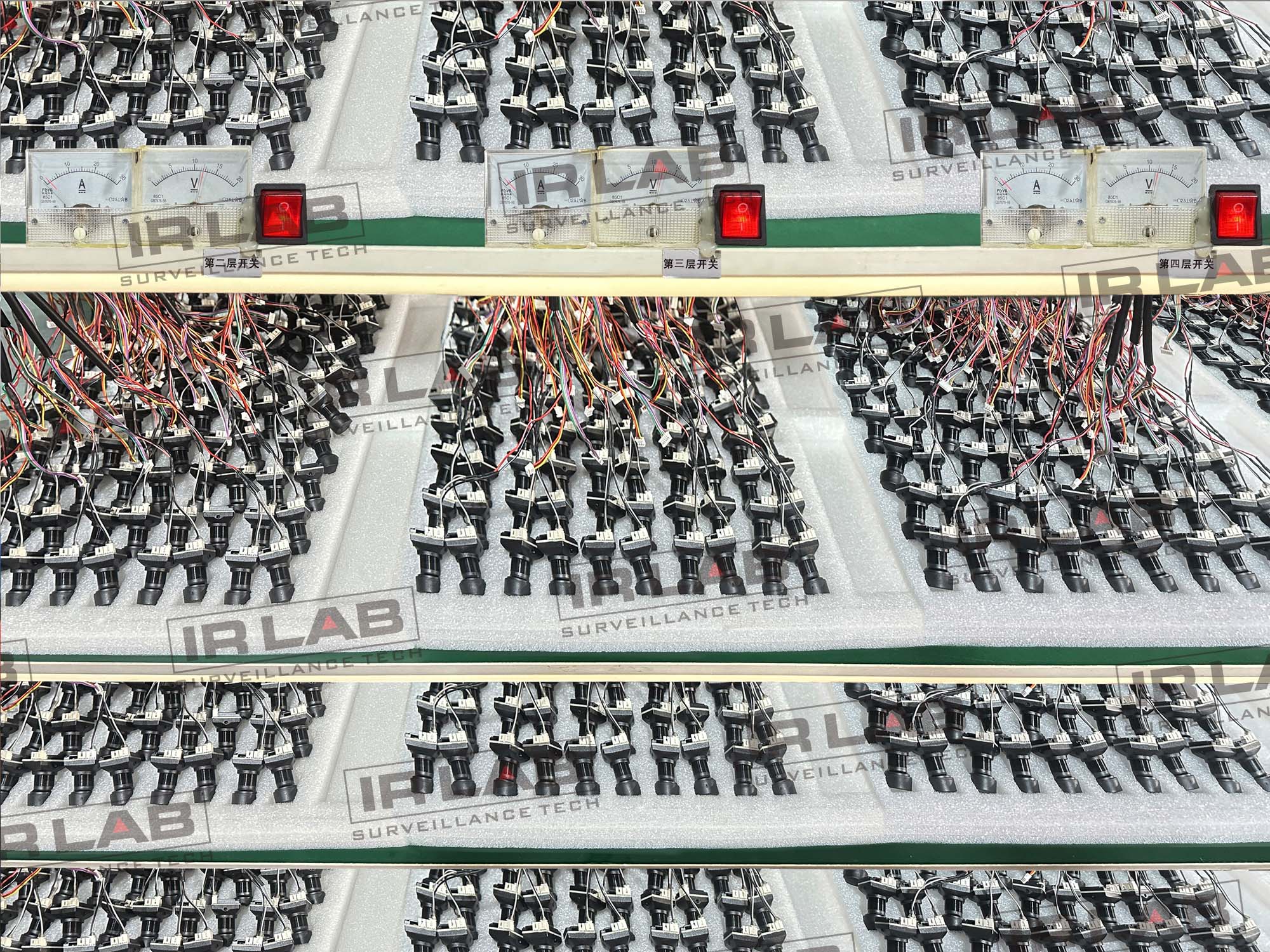
The published numbers that sell an FPV camera are familiar: resolution, latency, field of view, voltage. The number that usually decides whether a design survives its first winter patrol or its first summer rooftop deployment — the operating envelope — is the one most often left unexplained. A buyer reading “-38°C to 60°C” on a datasheet is being handed a durability statement, and durability statements need to be read with the same care as electrical parameters.
The documented specification for IRLAB Limited’s tactical FPV camera states that the camera is suitable for tactical FPV UAV projects and operates under extreme conditions including dark night, sunshine day, high vibration and shock, a wide temperature range from -38°C to 60°C, and EMI environments. Read literally, that sentence answers one question — at what ambient conditions has the camera been engineered to keep producing a usable image — while leaving several others open, including test method, exposure duration, and which specific hardware configuration carries the claim. This article sets out how to interpret the figure, how it differs from formal compliance schemes, and where the documented evidence stops.
What the -38°C to 60°C Figure Actually Describes
An operating temperature range is a design and qualification envelope, not a certification. It describes the ambient conditions under which a camera is expected to function, and it is normally derived from component ratings, thermal design, materials selection and internal validation. It is not issued by a testing house, it does not carry a certificate number, and it does not appear on a regulatory register.
That distinction matters because the FPV camera category mixes two very different kinds of evidence in the same datasheet. On one side sits intrinsic ruggedness: the temperatures the product is built to endure, the vibration it is built to survive, the illuminance it can still resolve an image at, and the electromagnetic environment it is expected to tolerate. On the other side sits formal compliance: the standards a product has been tested against and the certificates that prove it — CE, FCC, UKCA, E-MARK, UL, C-TICK, RoHS, and a certified quality management system.
IRLAB Limited is a camera developer and manufacturer founded in 1992 in Taiwan and established in Shenzhen in 2003, with more than 30 years of camera development and manufacturing experience, a 3,000m² facility, 100+ employees including 10+ engineers, and an annual output of 6 million units. Its documented product range includes FPV Camera, Public View Monitor, HDMI Output Camera, IP Camera, HD Analogue Camera, AI Camera, Dual Liveness Detection Access Control & Advertising Panel, and IR Illuminator. The company holds TÜV-issued ISO 9001:2015 certification (certificate 44100102298, issued 2024-11-11, valid to 2027-11-10) covering R&D and production of audio & video equipment, surveillance and FPV cameras.
Why the Envelope Is the Number That Decides Field Survival
Temperature is not a single stress. It is a family of stresses that act on different parts of a camera at different times, and a stated range only makes sense if you know which stresses the designer was managing.
Cold. At the low end of a range, the dominant risks are mechanical and optical rather than electronic. Lens assemblies, adhesives and housings expand and contract at different rates; focus can drift; lubricants and sealants stiffen. A camera that survives cold exposure in storage may still need to reach a stable image quickly after a cold start, which is a different requirement from simply not failing.
Heat. At the high end, the pressure comes from self-heating plus ambient load. Image sensors generate dark current that rises with temperature, which degrades signal-to-noise ratio precisely in the low-light conditions where FPV cameras are most often used. Power regulation efficiency falls, and a camera already dissipating power inside a small aluminium housing has less headroom.
Sun load. The same sentence that specifies -38°C to 60°C also specifies sunshine day. Direct solar exposure on a small metal housing produces a local surface temperature well above ambient, and the camera must keep producing a usable image rather than simply surviving the storage condition.
Vibration and shock. Launch, flight, hard landing and vehicle mounting all impose repeated mechanical loads. Moving mass matters here: an analogue FPV camera in the documented range weighs 9g, while the digital model weighs 32g with its fan and the thermal models weigh 40g including a 9.1mm lens. Lower mass reduces the loads transmitted through mounts and gimbals, which is one reason compact aluminium-alloy housings are common in this segment.
Electromagnetic environment. A tactical platform is dense with transmitters, motors, ESCs and radios. Whether the camera’s own emissions stay within limits, and whether the camera keeps functioning when it is being irradiated, are questions that belong partly to design and partly to formal EMC testing.
Ruggedness Specifications vs. Formal Compliance Schemes
The cleanest way to stop over-reading a datasheet is to separate the two evidence types into a single view. The table below maps what each evidential layer in the IRLAB documented record actually proves, and what it does not.
| Evidence layer | Documented example | What it supports | What it does not establish |
|---|---|---|---|
| Intrinsic operating envelope | Extreme conditions documented as dark night, sunshine day, high vibration/shock, -38°C to 60°C, and EMI environments | The environment the camera is engineered to operate in | A third-party certificate for the temperature figure itself |
| EMC conformity | CE under EN 55032, EN 61000-3-2, EN 61000-3-3 and EN 55035; UKCA under BS EN 55032:2015/A1:2020 and BS EN 55035:2017/A11:2020; FCC CFR 47 Part 15 Subpart B Class B:2019; C-TICK under AS/NZS CISPR 22:2002 Class B | Emissions and immunity conformity for the listed markets | Any operating temperature limit |
| Vehicle EMC | E-MARK E11, certificate 10R-048329, ECE R10, covering vehicle on-board camera / FPV onboard vehicle camera | EMC conformity for vehicle-mounted camera applications | Temperature or shock qualification |
| Product safety | UL certificate 20170803-E494081, UL 60950-1 & CAN/CSA C22.2 No. 60950-1-07 | Safety conformity for the listed scope | Environmental performance |
| Material compliance | RoHS, certificate ESTSZ130402233R, EC 62321:2008 and RoHS Directive 2011/65/EU Annex II | Restricted substance compliance | Operating range |
| Quality system | ISO 9001:2015 certified by TÜV, certificate 44100102298 | Process consistency in R&D and production of surveillance and FPV cameras | A product-level environmental rating |
Source: IRLAB Limited documented certification and product records.
The conclusion a buyer should draw is narrow but useful. The -38°C to 60°C figure is a product engineering claim about operating conditions. The certificates listed beside it are third-party conformity evidence for entirely different properties. Presenting one as the other — in either direction — is where evaluation-stage mistakes usually happen.
The Rest of the Sentence: Low Light, Vibration and EMI in One Specification
The operating range does not stand alone in the documented record. It sits alongside the conditions the camera is expected to work through, and each of those conditions has its own measurable anchor in the product data.
Dark night. The analogue FPV camera model CDD-BS59KU documents a minimum illumination of 0.00001 lux with a 1500TVL resolution, a 4:3 image, a 120° field of view, an S/N ratio above 60dB, CVBS output and 3DNR, drawing 0.6W from a DC4.5V–27V input. The sibling model CDD-BS59KP documents 1500TVL, a 16:9 image, 0.00002 lux minimum illumination, a 120° field of view, an S/N ratio above 54dB and 0.5W draw over the same DC4.5V–27V input. Both use an aluminium-alloy housing with a glass-and-plastic lens and weigh 9g at 19mm×19mm×27mm.
Day and night in one payload. The digital model CDD-BS5JMU uses a SONY sensor and documents 3840×2160 at 30fps, 1080p at 90fps and 720p at 120fps, a 50ms glass-to-glass latency, a 120° field of view, 5.1GHz–5.8GHz operation with 2T2R antenna configuration, transmit power of ≤29dBm under FCC limits and ≤20dBm under CE limits, MSP and MAVLINK OSD protocol support, a TF card slot supporting 1TB, and a 9–30V input drawing 5.4W normally and 9W maximum. The camera head measures 19mm×19mm×26mm, the main board 32mm×32mm×19.3mm including fan, and the total weight is 32g.
Zero-illuminance imaging. The thermal models CT-EI5ATB and CT-EI5ATC use an uncooled vanadium oxide detector in the 8–14µm spectral range with a 12µm pixel pitch and a NETD of ≤30mK at 25°C, a 9.1mm lens with a 46°×37° field of view, CVBS output with optional MIPI plus UVC, UART or USB communication, and a DC3.9V–5.5V input drawing ≤1.2W. The two models differ in resolution: 384×288 for CT-EI5ATB and 640×512 for CT-EI5ATC. Both weigh 40g including the lens.
Where the Documented Numbers Stop
A credible specification reading has to state its own boundaries, and this one has three.
First, not every model in the range carries the widest figure. The -38°C to 60°C envelope is documented for the tactical FPV camera specification. The two thermal models in the documented range state an operating temperature of -20°C to 60°C and a storage temperature of -45°C to 65°C. The storage figure is wider than the operating figure, which is normal engineering practice but also easy to misread: a camera rated to survive -45°C in storage is not thereby rated to image at -45°C. Buyers integrating a thermal payload into a mission profile that reaches the coldest documented conditions should confirm the range for the specific configured model rather than assume the widest number applies across the family.
Second, the parameter tables for some models do not state a temperature range at all. The documented specifications for the analogue and digital models list resolution, sensitivity, voltage, latency, dimensions, weight and video output, but they do not include an operating or storage temperature line. The absence of that line is not evidence of a narrower envelope, and it is not evidence of a wider one. It means the range has to be confirmed for the configuration being purchased.
Third, intrinsic ruggedness and formal compliance are not interchangeable. A datasheet temperature range and a certificate number answer different questions. For any procurement decision that depends on the environment — cold-soak operation, sustained solar load, mechanical shock, or EMC in a dense RF environment — the practical answer is to request the specific validation documentation that corresponds to the claim, rather than to treat one document as proof of the other. That applies to every supplier in the category, not only to this one.
Application Evidence: Where the Envelope Is Actually Exercised
The clearest field evidence in the documented record is a project in Ukraine, where the camera was deployed for FPV drone camera purposes by an FPV drone manufacturer client. The project scale reached 30,000 units over a one-year duration. The reported result is the delivery of clear video imagery in very dark night conditions, operating at sensitivity levels as low as 0.00001 lux — a regime where conventional vision systems are effectively blind and where the camera enables the platform to identify, lock onto and track targets under extreme low-light or zero-light conditions.
The environmental envelope is documented as relevant across multiple deployment markets, including Ukraine, Russia, Turkey, South Korea and Jordan. That geographic spread matters for specification reading because it implies the camera is expected to hold its operating envelope across winter cold, summer heat, and the mechanical and RF conditions typical of tactical UAV work rather than in a single climate.
Buyers should treat this as application evidence rather than laboratory qualification. It demonstrates sustained volume delivery and reported field performance at a documented sensitivity level; it does not by itself replace a temperature chamber report or an EMC test certificate for a specific project requirement.
Manufacturing Background Behind the Specification
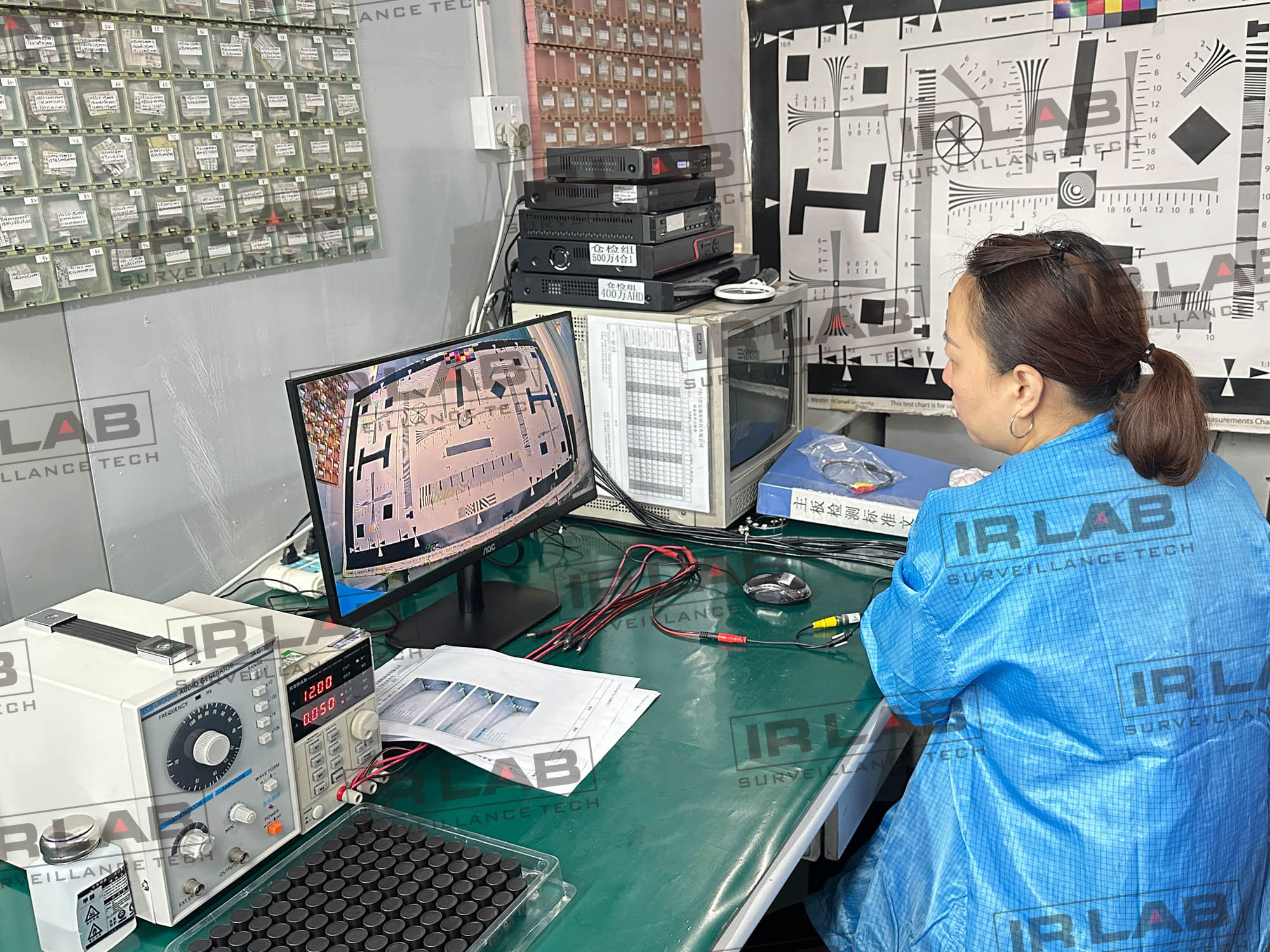
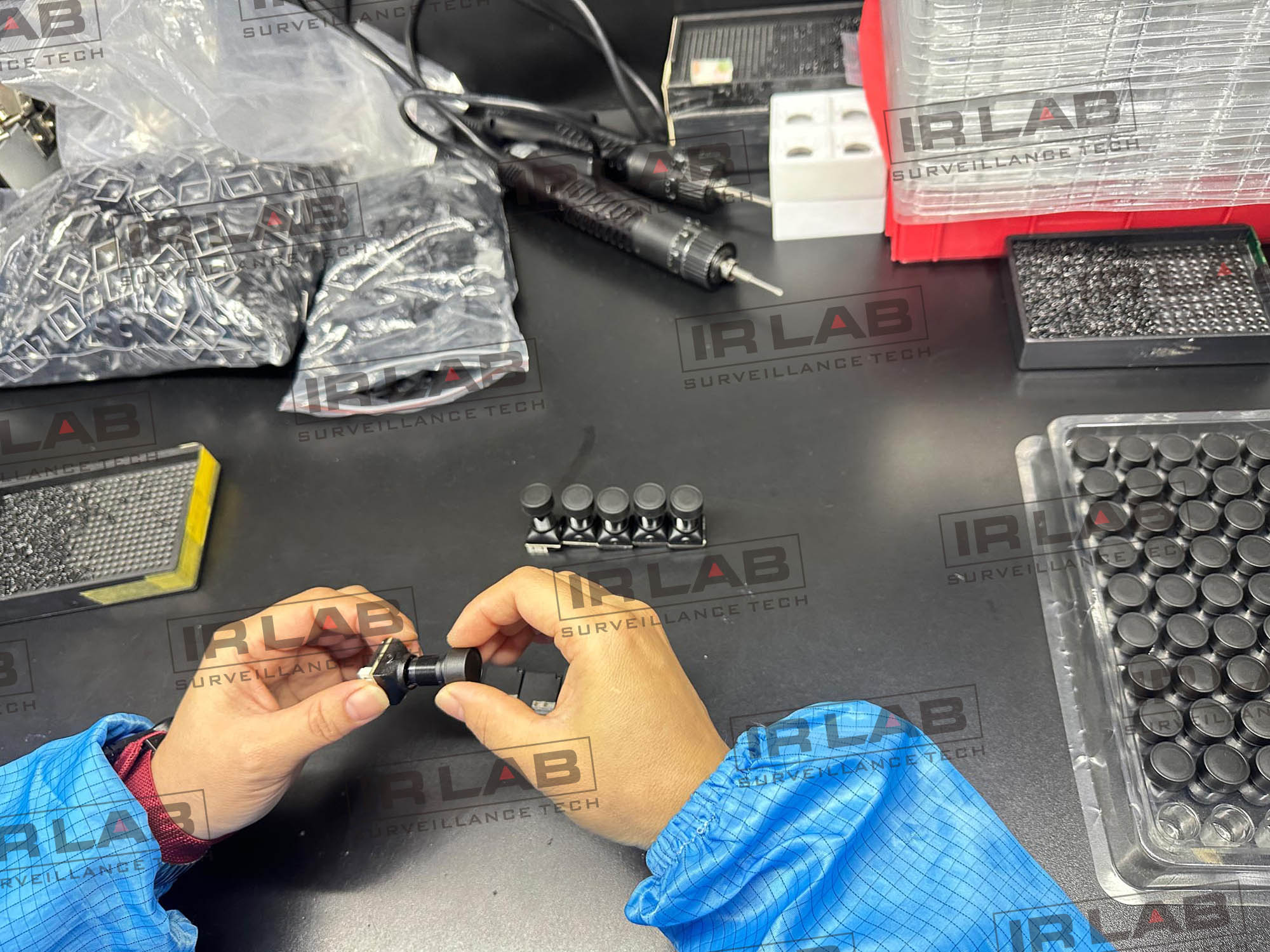
An operating envelope is only meaningful if it can be reproduced across production volume. IRLAB Limited documents a monthly capacity of 500,000 units and an annual output of 6 million units, with an export ratio of 70% and main markets in Europe, the USA, Japan, Korea and Taiwan. Quality control is documented as 100% production check plus AQL-standard OQC check, with a 2-year warranty period.
For evaluation-stage buyers, the commercially relevant details are equally concrete. The production mode is OEM/ODM with documented customization options covering housing colour, logo printing, different viewing angle lenses, video image style, integration of third-party AI algorithms, and integration of third-party wireless transmission solutions. MOQ is documented at 1 unit; small quantities ship immediately and larger quantities ship within 15–25 working days after receipt of deposit. Engineering work across software, hardware, mechanical structure, video image tuning and quality control is handled in house.
Market Context: Why Operating Envelope Claims Are Being Read More Closely
Three documented market movements explain why buyers are now interrogating durability specifications rather than skimming them.
The first is category growth. The global first person view camera market is estimated at US$ 825.3 million in 2024, with a projected CAGR of 14.7% through 2034, according to Fact.MR. The broader drone camera market, including thermal and RGB systems, was valued at USD 13.6 billion in 2025 by Global Market Insights, driven by industrial and defense applications. Within that, Market Research Future projects the thermal camera market growing from USD 5.16 billion in 2024 to USD 10.09 billion by 2035, a CAGR of 6.28%. More units in more environments means more procurement teams asking what a specification actually covers.
The second is regulatory scrutiny. FPV video transmitters in the United States typically require compliance with FCC Part 15 regulations, and uncertified equipment requires a Technician-level amateur radio license. In late 2025 the FCC added uncrewed aircraft systems and critical components from specific foreign countries to the ‘Covered List’ under DA 25-1086, citing national security concerns. Sourcing discussions increasingly involve origin documentation alongside EMC certificates — a different question from operating range, but often asked in the same review.
The third is supplier concentration. DJI continues to dominate the overall drone and imaging market with approximately 74% to 83% of global market share as of 2025–2026, based on Dedrone, Statista and DroneDJ data. For buyers who need an alternative or a second source, the differentiator is rarely brand recognition: it is whether the supplier can document an operating envelope, match a configuration to the mission, and reproduce that configuration at volume.
Shortlist Criteria for Evaluation-Stage Buyers
When a validated operating envelope is the deciding factor, the shortlist criteria change from headline specifications to documentation depth. The table below converts each criterion into the question a buyer should actually ask.
| Evaluation criterion | Question to put to the supplier | Relevant documented record |
|---|---|---|
| Operating envelope | Which ambient conditions is this specific configured model engineered for? | -38°C to 60°C documented for the tactical FPV camera specification; thermal models documented at -20°C to 60°C operating and -45°C to 65°C storage |
| Low-light capability | What minimum illumination is documented, and at what resolution? | 0.00001 lux for CDD-BS59KU; 0.00002 lux for CDD-BS59KP; thermal NETD ≤30mK at 25°C for CT-EI5ATB and CT-EI5ATC |
| Latency fit | What glass-to-glass latency is documented for the digital path? | 50ms glass-to-glass for CDD-BS5JMU |
| Power and platform integration | What input voltage range and draw must the platform budget for? | DC4.5V–27V analogue; 9–30V digital at 5.4W normal / 9W maximum; DC3.9V–5.5V thermal at ≤1.2W |
| Market compliance | Which markets are covered, and by which certificates? | CE, FCC, UKCA, C-TICK, E-MARK E11, UL, RoHS with documented certificate numbers and standards |
| Process repeatability | What quality system and in-line checks govern production? | ISO 9001:2015 certified by TÜV; 100% production check plus AQL-standard OQC check |
| Configuration fit | Can optics, image style and third-party systems be customized? | OEM/ODM with housing colour, logo printing, viewing angle lens, video image style, third-party AI algorithm and wireless transmission integration |
| Supply continuity | What capacity, MOQ and lead time apply? | 500,000 units monthly; MOQ 1 unit; immediate delivery for small quantities and 15–25 working days for larger orders after deposit; 2-year warranty |
| Field evidence | Is there documented deployment at volume? | 30,000-unit FPV drone camera project in Ukraine over one year, with 0.00001 lux low-light performance reported |
Read as a whole, the criteria table shows why a single number cannot carry a procurement decision. Temperature range, low-light sensitivity, latency, power, compliance and reproducibility each answer a separate part of the same mission question, and a supplier that can document all of them is materially easier to qualify than one that documents only the most photogenic one.
Future Outlook
Two directions appear likely to shape how operating-envelope specifications are written and read.
As industrial and defense demand expands the drone camera market, the pressure to document environmental performance formally is likely to increase, moving ruggedness claims closer to the test-report culture that already governs EMC and safety compliance. Buyers who currently accept a datasheet range may begin requesting chamber data, shock profiles and electromagnetic immunity evidence as routine attachments rather than exceptions.
The second direction is convergence. Thermal imaging, low-light RGB imaging and on-board processing increasingly sit on the same platform, and the thermal camera market’s projected growth toward USD 10.09 billion by 2035 reflects that convergence. A single mission may now combine a 0.00001 lux analogue channel for low-light framing, a digital channel with 50ms latency for control, and an uncooled thermal channel for zero-illuminance detection. Each channel carries its own operating envelope, and the platform level only survives as long as the narrowest one does. That makes model-level specification literacy — not family-level marketing ranges — the practical skill for the next procurement cycle.
FAQ
What does an operating temperature range of -38°C to 60°C mean for an FPV camera?
It is a documented operating envelope describing the ambient conditions the camera is engineered to work in, spanning dark night and sunshine day conditions alongside high vibration and shock and EMI environments. It is an engineering durability specification rather than a certificate, and it answers the question of expected functional range rather than the question of formal third-party conformity.
Is the -38°C to 60°C range a certification?
No. Certification in the documented record covers different properties: CE under EN 55032, EN 61000-3-2, EN 61000-3-3 and EN 55035; FCC under CFR 47 Part 15 Subpart B Class B:2019; UKCA under BS EN 55032:2015/A1:2020 and BS EN 55035:2017/A11:2020; C-TICK under AS/NZS CISPR 22:2002 Class B; E-MARK E11 certificate 10R-048329 under ECE R10; UL certificate 20170803-E494081 under UL 60950-1; RoHS certificate ESTSZ130402233R; and ISO 9001:2015 certificate 44100102298 issued by TÜV. None of these certificates states an operating temperature range.
Do all models in the range share the same operating temperature specification?
No. The -38°C to 60°C envelope is documented for the tactical FPV camera specification. The thermal models CT-EI5ATB and CT-EI5ATC document an operating temperature of -20°C to 60°C and a storage temperature of -45°C to 65°C. Buyers should confirm the range for the exact configured model rather than assume the widest documented figure applies across the family.
How does low-light sensitivity relate to the operating envelope?
They are separate parameters that are often evaluated together. Minimum illumination is documented at 0.00001 lux for the analogue model CDD-BS59KU and 0.00002 lux for CDD-BS59KP, while the thermal models document a NETD of ≤30mK at 25°C. Thermal behaviour affects noise and therefore low-light image quality, so a mission that combines cold operation with near-zero-light imaging needs both parameters reviewed rather than one used as a proxy for the other.
What should buyers verify when a supplier lists harsh-environment specifications?
Three checks are practical. Confirm which specific model carries which documented range, since storage limits such as -45°C do not imply operating capability at that temperature. Separate intrinsic ruggedness claims from formal compliance certificates, because EMC, safety and material certificates do not define temperature limits. And request the validation documentation corresponding to the claim that matters for the project, rather than treating one document type as evidence for another.
IRLAB Limited’s documented product and certification records are summarised in the corporate profile and brochure, which is publicly available for download: IRLAB Company Profile & Corporate Brochures.