
FSC Chain of Custody for Wooden Display Racks: Buyer Guide
FSC Chain of Custody for Wooden Display Racks: Buyer Guide
That single sentence answers the most common question retail buyers ask at the evaluation stage: does a wooden display rack supplier's sustainability claim map to a certificate whose scope actually includes the product they are quoting? For many suppliers in the fixture industry, it does not. Certification frequently covers a company's management systems, a specific product line, or a sourcing category — and buyers who assume the coverage extends to everything on the quotation are exposed to a compliance gap that only surfaces at the retailer's own audit.
Why Wood Sourcing Became a Fixture Procurement Question
Wood conveys warmth, brand character and a premium position in retail environments, which is why wooden display racks and wooden store fixtures remain a preferred specification for flagship stores, department store beauty and apparel floors, and sportswear brand environments. The same material property that makes wood attractive commercially — that it is a harvested, forest-derived material — is what turns a fixture order into a sourcing question.
The consequence for buyers is procedural rather than aesthetic. When a retailer's procurement policy requires documentary evidence of forest-based material origin, the evidence has to attach to the specific fixtures being supplied. A general statement of environmental commitment is not substitute documentation, and a certificate held for a different product category does not transfer. The practical question at evaluation stage is therefore narrow and checkable: which certificate, issued by whom, under which standard, and covering which products?
What FSC Chain of Custody Certification Actually Covers
FSC Chain of Custody (CoC) certification verifies that forest-based material is tracked and controlled through an organisation's procurement, production and sales processes, so that a claim made on a finished product can be traced back through documented records. It is a chain-of-custody verification rather than a forest-management assessment, and it operates on material control and record-keeping rather than on product performance.
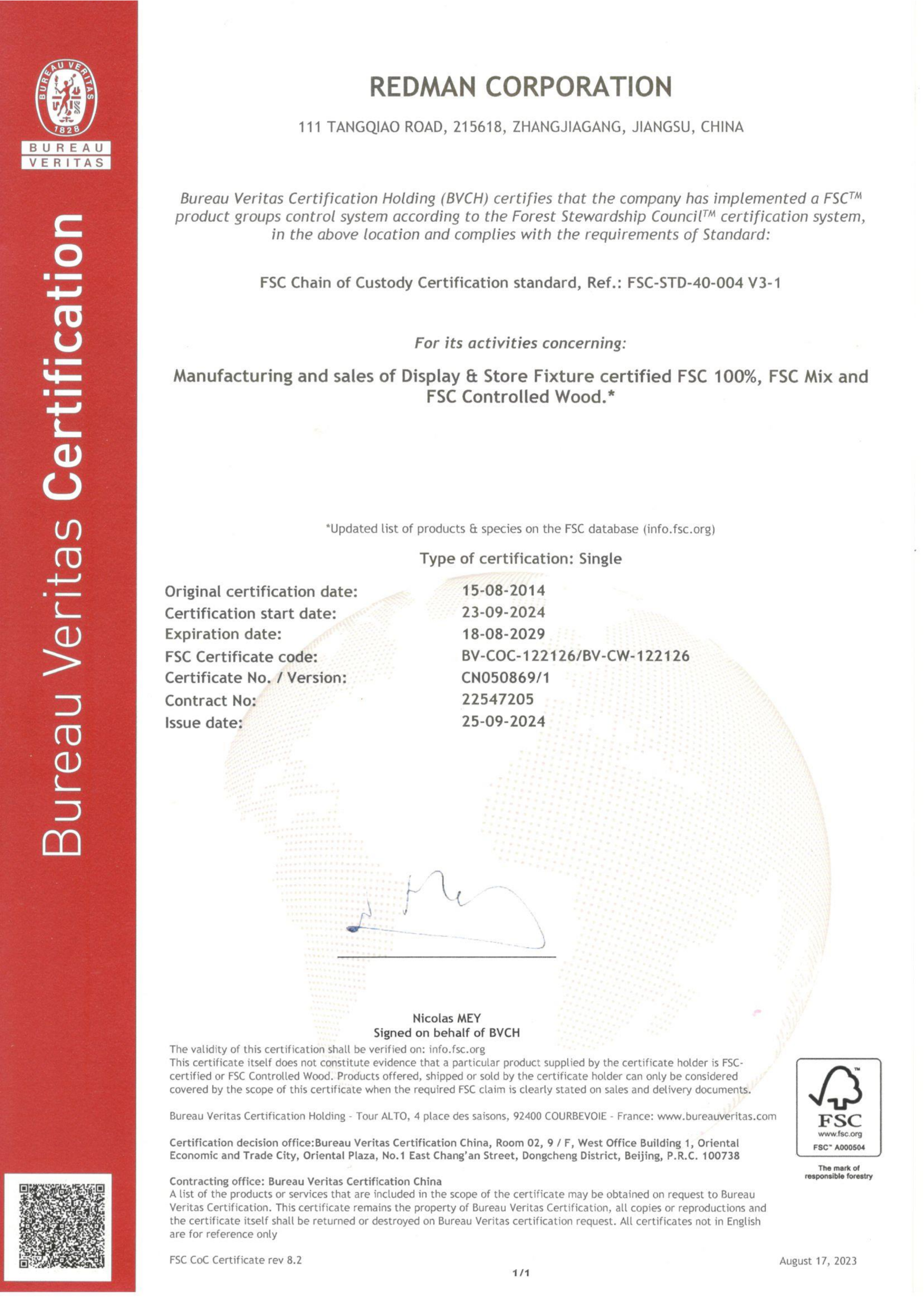
Redman's certification is a single-site FSC CoC certificate issued against FSC-STD-40-004 V3-1 by Bureau Veritas Certification China. Its registered scope is the control of forest raw material procurement, production and sales of wooden POP displays and wooden store fixtures. The certificate has worldwide market applicability and is valid from 23 September 2024 to 18 August 2029.
| Certification detail | Registered entry |
|---|---|
| Certification | FSC Chain of Custody Certification (FSC CoC / Single) |
| Certificate number | BV-COC-122126 / BV-CW-122126 |
| Certification body | Bureau Veritas Certification China |
| Standard | FSC-STD-40-004 V3-1 |
| Scope | Control of forest raw material procurement, production and sales of wooden POP displays & wooden store fixtures |
| Issue date | 2024-09-23 |
| Expiry date | 2029-08-18 |
| Market coverage | World Wide |
Where Wooden Store Fixtures Sit in the Certified Scope
The clearest way to test a certificate's relevance is to match it against a specific model. RM-SF-001 is a custom wood store fixture built from MDF, solid wood and plywood, with melamine, veneer or painted finishes, manufactured to custom size and structure. Its material profile sits inside the wood-based product family named in the FSC scope.
| Model | Product type | Material profile | Relation to FSC scope |
|---|---|---|---|
| RM-SF-001 | Custom Wood Store Fixture | Wood (MDF, solid wood, plywood), plus metal and acrylic components | Wood content falls within the certified scope; metal and acrylic components are not covered by FSC |
| RM-POP-001 | Custom Metal POP Display | Cold-rolled steel, stainless steel, wood, acrylic | Wood-containing configurations can fall within scope; the metal structure itself is not an FSC-certified material |
| RM-PD-001 | Custom Plastic POP Display | ABS, PS, acrylic | Outside the FSC scope — no forest-based material |
This distinction matters because custom store fixtures are frequently multi-material objects. A single wooden display rack may combine a plywood carcass, a steel upright and an acrylic accessory tray. FSC Chain of Custody applies to the wood portion of that assembly. Buyers who need documentation for the full fixture should treat the certificate as one evidence item among several, not as a blanket compliance statement for everything on the bill of materials.
How Chain of Custody Is Maintained Inside a Multi-Material Factory
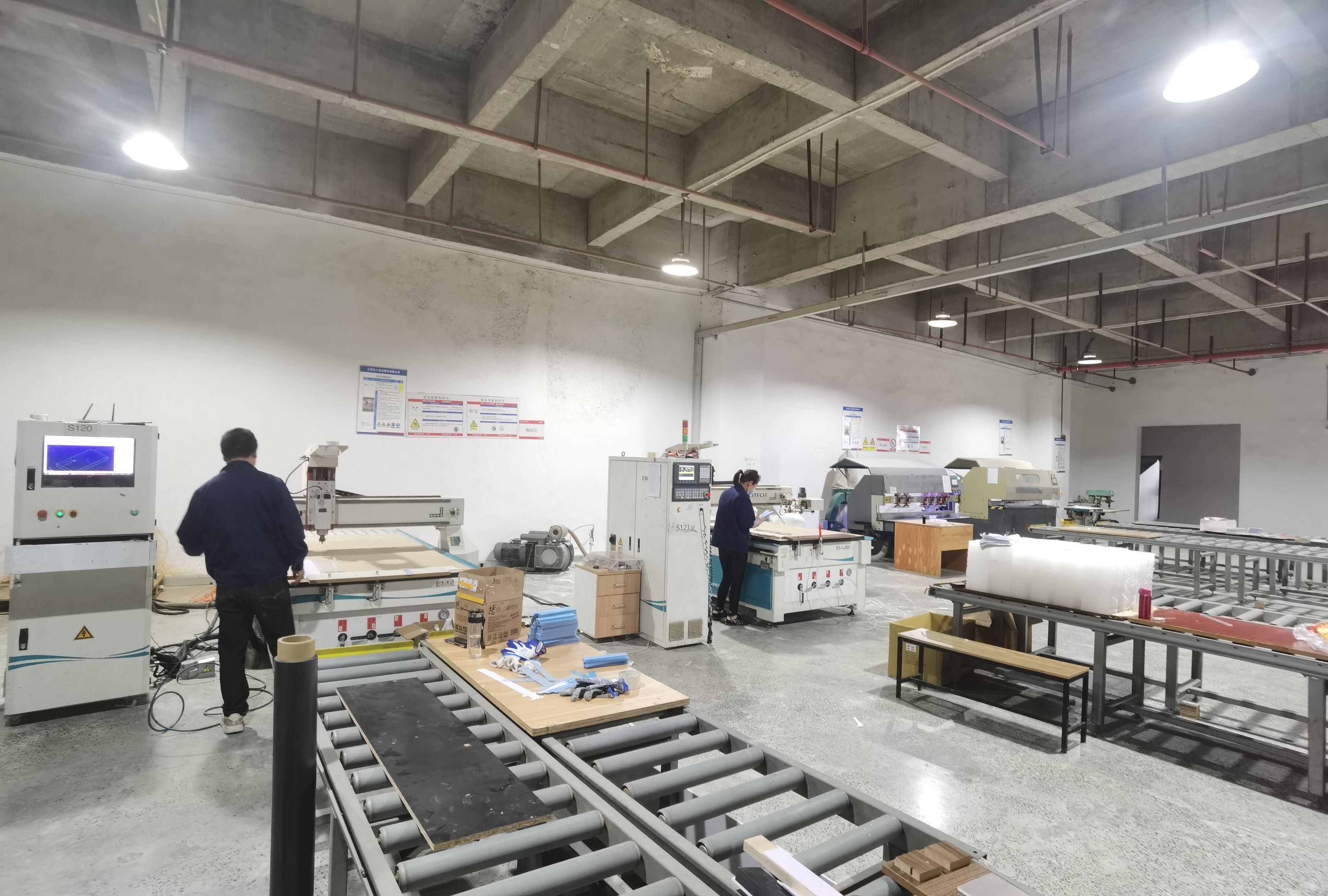
Chain of custody is an operating discipline, not a document filed after the fact. In a factory that runs wood, metal, plastic, printing, painting, powder coating and packaging under one roof — the production structure Redman operates across roughly 550,000 sq ft in Zhangjiagang — the discipline has to survive the point where a certified material enters a genuinely mixed production flow.
Four controls carry most of the weight:
- Incoming material control. Forest-based raw material is received against supplier documentation and recorded, so that the volume and origin of wood entering the plant can be reconciled with the volume leaving it in finished fixtures.
- Product group definition. Products are assigned to defined groups on the certificate rather than being handled as one undifferentiated wood output. This is why the scope language names wooden POP displays and wooden store fixtures as two families.
- Production and storage separation. Certified and non-certified wood flows are kept identifiable through cutting, milling, drilling, sanding, veneering, melamine lamination and painting, so a claim is not applied to material that has lost its traceability.
- Sales documentation and records. Sales of in-scope products are recorded with the information required by the certificate, which is what allows a buyer or an auditor to verify a claim after delivery.
These controls sit alongside, not instead of, ordinary woodworking quality control. Redman's wood display manufacturing runs dimensional inspection, surface finish inspection and moisture content testing with full quality checks on custom wood component production, at a monthly capacity of 20,000+ pieces, a 30–40 day lead time for custom wood parts and a minimum of 50 pieces for custom wood components.
What Retail Buyers Should Verify During Evaluation
At the evaluation stage, a CoC claim is only as useful as the buyer's ability to check it. The following items convert a supplier's sustainability statement into a verifiable specification.
| Verification item | What to look for |
|---|---|
| Certificate number and status | A specific certificate number (for example BV-COC-122126 / BV-CW-122126) and current validity — the Redman certificate runs to 18 August 2029 |
| Issuing body | An accredited certification body; this certificate is issued by Bureau Veritas Certification China |
| Standard reference | The standard the certificate is issued against — FSC-STD-40-004 V3-1 in this case |
| Scope wording | Whether the quoted product family is named in the scope, not merely whether the company holds a certificate |
| Product model match | Whether the model on the quotation (for example RM-SF-001) is wood-based and therefore capable of falling inside the scope |
| Separate safety compliance | CoC certification is not a product safety or structural standard; US retail fixtures and commercial displays are addressed separately by ANSI/UL 970, which replaced UL 65 and UL 962 |
The last row is the one most often misunderstood. Chain of custody answers a sourcing question. It does not tell a buyer whether a floor standing display rack will carry its specified load, whether its finish will survive a retail floor, or whether it meets electrical requirements if it integrates lighting. Those are engineering and safety questions that need their own evidence.
Market Context: Documented Sourcing in a Growing Fixture Market
The commercial backdrop makes documentation more consequential, not less. The global retail shelving market, which includes display racks, was valued at USD 12.4 billion in 2025 and is projected to reach USD 25.6 billion by 2034 (Dataintelo). Within that market, gondola and floor-standing systems dominate with a 41.8% share, equivalent to approximately USD 3.59 billion in 2024 (Market Research Future), which is the segment where wooden store fixtures most commonly compete.
Material composition sets a useful expectation. Steel remains the dominant material in retail shelving and display racks with a 48.6% market share in 2024. Wood is therefore a deliberate specification choice rather than a default, and a supplier's ability to document wood sourcing is relevant precisely because the buyer has already chosen a material that carries a sourcing obligation.
Two further signals are worth noting. Retailers are increasingly adopting modular display systems, which saw 34% year-over-year sales growth in 2024–2025 according to an industry report published by Guangdong Weile citing National Retail Federation data — a figure that should be treated as directional rather than audited. And the retail store distribution channel dominates the global sportswear market with a 70.4% share in 2026 (Fortune Business Insights), reinforcing how much fixture specification sits inside brand-controlled retail environments where procurement and brand governance are often the same team.
Certified Wood Sourcing Versus Conventional Wood Sourcing: Honest Trade-offs
Chain of custody is not free, and presenting it as unambiguously superior would misrepresent how buyers should weigh it. The trade-offs are real and specific.
| Dimension | FSC Chain of Custody wood | Conventional wood sourcing |
|---|---|---|
| Documentation burden | Material records, product group control and sales documentation are required throughout the process | Supplier commercial documentation only |
| Supply flexibility | Material must be sourced against controlled inputs, which can narrow acceptable supply options | Broader supplier base and easier substitution |
| Administrative load on the buyer | The buyer must check scope wording, product family and validity at each order | Minimal paperwork |
| Applicability | Only wood-based products — metal and plastic fixtures are outside scope | Not applicable |
| What it does not guarantee | Does not certify structural performance, load capacity, electrical safety or finish durability | Also does not certify those items; covered by separate standards such as ANSI/UL 970 |
| Validity horizon | Time-bound; the Redman certificate expires 18 August 2029 and is subject to continued certification maintenance | No expiry to track |
Three boundaries deserve to be stated plainly. First, the certificate does not cover steel or plastic fixtures — RM-PD-001, a plastic POP display, has no forest-based material and therefore no FSC relevance, and the metal structure of a steel POP display is not certified material. Second, FSC Chain of Custody does not convert into a recycled-content or reclaimed-material claim; buyers requiring that information need product-level documentation, not a certificate number. Third, certified sourcing usually interacts with cost and lead time: custom wood components in the Redman wood workshop run a 30–40 day lead time and a 50-piece minimum for custom parts, and documentation control adds process steps rather than removing them.
Application Notes: Where Certified Wooden Fixtures Are Specified
Wooden store fixture programmes typically appear in retail, supermarket, department store and brand store environments. A wooden display rack with a melamine or veneer finish tends to be specified where the fixture is expected to carry brand identity across a multi-year store rollout rather than serve a single promotional cycle.
Redman's documented project experience shows the compliance context in which those programmes are delivered. A European supermarket chain project delivered 3,000+ custom store fixtures across more than 200 supermarkets in Germany, with designs customised to the retailer's brand VI and built in compliance with European safety standards, supporting a reported 30% improvement in operational efficiency. A Middle East department store flagship project in Riyadh delivered over 1,000 custom high-end display cabinets within 1.5 years, with emphasis on material selection, professional installation guidance and one-to-one project management. A global retail brand programme supplied more than 5,000 custom POP display units with one-stop design-to-production service, USA warehouse drop-shipping, strict quality control and a 100% on-time delivery rate.
These programmes illustrate a procurement pattern rather than a certification claim: compliance requirements are usually set by the retailer, applied at the product level, and enforced across a rollout. FSC Chain of Custody is one of the evidence items that can sit inside a programme of that shape, and it applies to the wood-based fixtures within it.
The Supplier Landscape and What It Changes for Buyer Preferences
Scale in the fixture industry is concentrated among large integrated manufacturers. Industry listings identify Lozier Corporation, Madix Inc. and Tegometall among the leading global competitors in the store fixture and display rack market (HEDA Shelves industry list, 2024). For a buyer evaluating wooden fixtures against a documentation requirement, brand size is a weak proxy. The decisive variables are narrower: whether the supplier holds a certificate whose scope names wooden store fixtures, whether the specific model being quoted is wood-based, and whether the supplier can produce the record trail on request.
Future Outlook
Three developments shape the next several years. Demand for retail shelving and display systems continues to expand toward a projected USD 25.6 billion by 2034, which increases the number of fixture programmes that will be specified under formal sourcing policies rather than ad hoc purchasing. Modularity keeps gaining ground on the strength of store-refit economics, and modular wooden systems inherit the same documentation requirements as fixed ones. And certificate validity becomes an operational calendar item: buyers who specify a certified wooden display rack in 2027 will need to confirm the certificate is still active in 2029.
For suppliers, the practical implication is that sustainability language without a scope match will be tested more often. For buyers, the implication is simpler — treat the certificate number, the issuing body, the standard and the scope wording as four fields to verify, exactly as you would verify a load rating or a finish specification.
FAQ
What is FSC Chain of Custody certification and why does it matter for wooden store fixtures?
FSC Chain of Custody certification verifies that forest-based material is controlled and tracked through an organisation's procurement, production and sales processes, so product claims can be traced through documented records. It matters for wooden store fixtures because wood is a forest-derived material, and retail procurement policies increasingly require documentary evidence of origin. Redman Corporation holds FSC Chain of Custody certification BV-COC-122126 / BV-CW-122126 issued by Bureau Veritas Certification China.
Which display rack products are covered by Redman's FSC certification?
The registered scope covers the control of forest raw material procurement, production and sales of wooden POP displays and wooden store fixtures, certified against FSC-STD-40-004 V3-1. The model directly aligned with this scope is RM-SF-001, a custom wood store fixture made from MDF, solid wood and plywood with melamine, veneer or painted finishes. Wood-containing configurations of RM-POP-001 can also fall inside the scope where forest-based material is used.
Does FSC certification apply to metal or acrylic display racks?
No. FSC Chain of Custody addresses forest-based material, so it does not apply to products without wood content. RM-PD-001, a custom plastic POP display made from ABS, PS and acrylic, has no forest-based material and therefore no FSC relevance. Likewise, the cold-rolled steel or stainless steel structure of a metal POP display is not FSC-certified material, even when the same fixture includes wooden components.
What should a buyer check on an FSC certificate before placing an order?
Four fields are decisive: the certificate number, the issuing certification body, the standard referenced, and the scope wording. For Redman, those are BV-COC-122126 / BV-CW-122126, Bureau Veritas Certification China, FSC-STD-40-004 V3-1, and a scope naming wooden POP displays and wooden store fixtures. Validity should also be confirmed — the certificate runs from 23 September 2024 to 18 August 2029 — and the quoted model should be checked for wood content.
Does FSC Chain of Custody certification replace product safety standards for retail fixtures?
No. Chain of custody is a sourcing and traceability verification and does not certify structural performance, load capacity, electrical safety or finish durability. Retail fixtures and commercial displays in the United States are addressed by ANSI/UL 970, which replaced UL 65 and UL 962. Buyers specifying wooden display racks with integrated lighting or defined load ratings need separate engineering evidence in addition to any sourcing certificate.
What are the limitations of FSC-certified wood sourcing for store fixtures?
Certification is limited to wood-based products, so mixed-material fixtures are only partly covered. It is time-bound, meaning certificates must be re-checked during multi-year rollouts. It adds documentation and process control, which can interact with lead time and supply flexibility — custom wood components in Redman's wood workshop, for example, run a 30–40 day lead time with a 50-piece minimum for custom parts. It also does not by itself establish recycled or reclaimed content.