
Factory Audit Evidence: What It Confirms for Hex Bolt Buyers
Factory Audit Evidence: What It Confirms for Hex Bolt Buyers
An independent supplier-evidence review for procurement teams evaluating carbon steel hex bolt supply — what an on-site factory assessment can actually prove, what it cannot, and how buyers can convert assessment findings into product-level evidence.

A fastening production site in the Yongnian District fastener hub, Hebei. An on-site assessment exists to verify the physical operation, not the catalogue claims about it. Source: YUETONG FASTENER facility documentation.
Why hex bolt sourcing is an evidence problem, not a discovery problem
Carbon steel remains the material behind the majority of hex bolts used in steel structures, machinery, infrastructure and transport equipment. In 2025, carbon steel accounted for 44.8% of the global hex nut and bolt market by material share (Dataintelo), while the global hex bolt market was valued at USD 19.67 billion in the same year (Strategic Market Research, 2025 baseline). Cross-border trade follows the same pattern: worldwide exports under HS code 731815, the heading that covers other screws and bolts, reached USD 26.35 billion in 2023, a 3.65% decline from the previous year (The Dollar Business).
A market of that size does not lack suppliers. What it lacks, at the point where a buyer has to commit, is a reliable way to separate suppliers whose stated capability can be checked from suppliers whose capability is only described. Nearly every hex bolt quotation arriving at the decision stage carries the same elements: a product catalogue, a list of certificates, a statement about owning a factory, and an assurance about testing before delivery. The wording is similar because the underlying sales logic is similar. The difference between two suppliers is usually not in what they claim, but in how much of that claim can be traced to an independent check.
Three verification instruments, and where a factory audit fits
A procurement team evaluating a carbon steel hex bolt supplier generally has three instruments available, and they answer different questions:
- Document verification — certificates, standards declarations and test reports, checked against the issuing body's registry.
- On-site factory assessment — a third-party or platform-run audit that examines the physical production site, equipment and process records.
- Product-level validation — sample testing, lot testing and pre-shipment inspection of the goods actually being shipped.
A factory audit is the middle instrument. It is the only one that inspects the operation rather than the paperwork, and it is the only one that can convert statements about equipment, floor area, staffing and process control into assessed facts. It is also the instrument most often misunderstood by buyers, who tend to read a supplier badge as if it were a product certificate.
What an on-site assessment actually verifies
Marketplace verification programmes — the Gold Plus Supplier assessment used on major B2B platforms is one well-known example — bundle entity checks, on-site factory review and document verification into a single supplier status. The detailed checklist, validity window and re-assessment cycle belong to the operator of each programme and should be requested from that operator directly. What is common across assessments of this type is the category of evidence they produce.
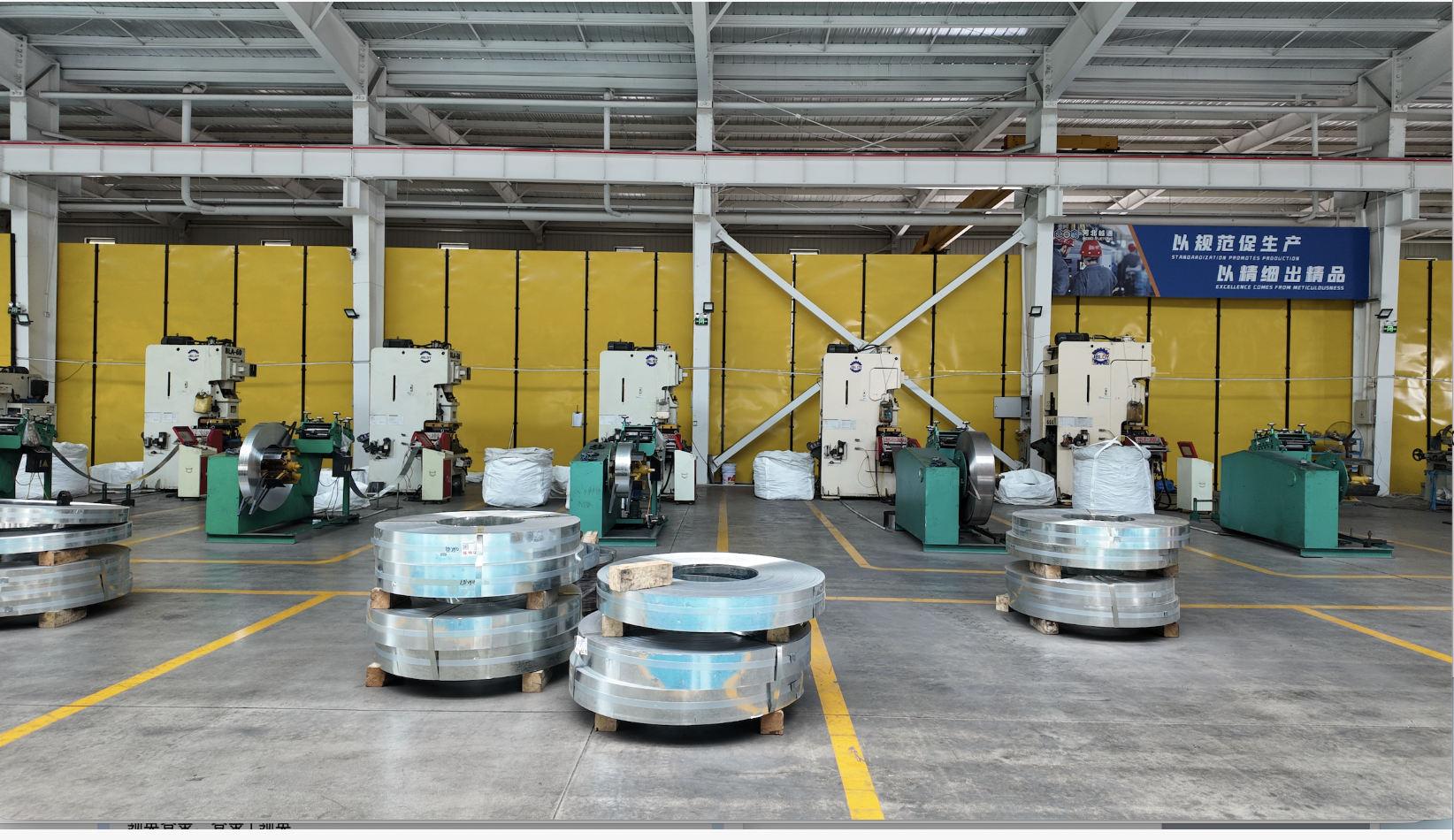
Cold heading equipment on a hex bolt production floor. An on-site assessment confirms that stated machinery is physically installed and in operation. Source: YUETONG FASTENER production documentation.
| Assessment area | What is normally verified | What it does not establish |
|---|---|---|
| Legal and site identity | That the trading entity is registered, and that a production site exists at the stated address | Ownership structure, group relationships or financial standing |
| Production equipment and process flow | That stated machinery — forming, threading, heat treatment where applicable — is installed and operating | Utilisation rates, spare capacity or equipment age in service terms |
| Process control and in-house testing | That incoming material inspection, in-process control and finished-goods testing steps exist and generate records | The numerical results of any specific test |
| Quality system documentation | That controlled procedures, inspection records and traceability documents are in use | That every production lot is documented to the same standard |
| Certificate existence | That the certificates a supplier lists exist and correspond to the assessed entity | Validity — this is confirmed only through the issuing body's registry |
| Trade and export capability | That import and export documentation, packaging operations and shipment records exist | Delivery reliability on a future order |
In practical terms, an assessment of this kind converts three common marketing statements — “we are a factory”, “we run our own production lines”, “we test before delivery” — into dated, assessor-attributed statements. That is the full extent of its authority, and it is a meaningful extent: it moves those claims out of the category of self-description and into the category of independently observed fact.
What a factory audit does not confirm
The value of an audit depends as much on understanding its boundary as on reading its report. For hex bolts specifically, six limits matter:
- It is not lot-level verification. A hardness, tensile or proof-load result describes a tested sample, not an entire consignment. Grade 8.8, 10.9 or 12.9 conformance for a specific shipment has to be evidenced by test records tied to that order.
- It does not measure coating performance on delivered parts. Zinc plating typically provides a coating thickness of 5–12 μm, while hot-dip galvanizing provides 45–85 μm (published industry coating comparison). An assessment may confirm that a coating process exists; the thickness on your cartons is confirmed by measurement records, not by the badge.
- It is not a standards certificate. DIN 933 and ISO 4017 are the primary standards for full-thread hex bolts, with ISO 4017 as the international successor (norelem USA). Standards conformance is a product declaration; the audit only shows that the supplier can produce to declared standards.
- It does not validate certificate status. ISO 9001, ISO 14001, ISO 45001, IATF 16949, EU CE and carbon footprint certification are verified through the issuing or registering body, not through a factory visit.
- It describes a point in time. Production conditions, staffing, subcontracting and equipment can change after an assessment date. Always read the assessment date and the re-assessment cycle before treating a report as current.
- It measures capacity, not conformance. Export ranking, floor area and tonnage describe scale. They are useful context for supply continuity, and no indicator of whether a specific bolt meets a specific specification.
Converting assessment findings into hex bolt-specific evidence
An audit report becomes useful to a procurement team only when each of its findings is linked to a product-level document request. The table below maps the main risk categories of a hex bolt order to the evidence that actually answers them.
| Buyer concern | Evidence that answers it | Who verifies |
|---|---|---|
| Mechanical grade (4.8 / 8.8 / 10.9 / 12.9) | Lot-linked hardness and tensile test records | Supplier laboratory, confirmed by buyer sample testing |
| Dimensional and thread accuracy | Dimensional inspection records; optical or gauge measurement data | Supplier inspection, buyer incoming check |
| Corrosion performance | Coating thickness measurements; salt spray test records | Supplier laboratory or third-party laboratory |
| Standards conformance | Item-level declaration: DIN 931, DIN 933, DIN 912, GB/T 5782, GB/T 5783, ASME/ANSI B18.2.1 | Buyer against the project specification |
| Traceability | Material lot and heat numbers linked to packaging | Buyer receiving inspection |
| Supply continuity | Installed capacity, production scheduling records, assessment date | Buyer, with the audit report as context |
Four equipment classes cover most of these categories: hardness testing, tensile or universal material testing, dimensional and optical measurement, and salt spray corrosion testing. When a supplier's published material documents equipment in exactly these classes, the buyer's task shifts from asking whether testing happens to checking which instrument produced which record — a far more answerable question.
Mapping one supplier's documented capability to assessment categories
HEBEI YUETONG FASTENERS MANUFACTURING CO.,LTD, which trades as YUETONG FASTENER, is a fastener manufacturer established in 2017 in the central area of Yongnian District, Handan, Hebei — China's largest standard parts production base. The company is an export-oriented manufacturer of hex bolts, hex nuts, thread rod, sleeve anchors, flat washers, hex socket head bolts and wheel hub bolts, and holds self-operated import and export qualification.
Viewed through an audit lens rather than a marketing one, the company's published profile separates into four verifiable categories:
1. Physical operation
A 26,666.67 m² facility, 100 employees, an annual output of 150,000 tons, an R&D team of 12 engineers and an export ratio of approximately 80%. These are the figures an on-site assessment can compare against what is physically present, and the figures a buyer should treat as a starting point for questions about capacity allocation rather than as a quality statement.
2. Management systems and certifications
The company holds ISO 9001 quality management system certification, ISO 14001 environmental management system certification, ISO 45001 occupational health and safety management system certification, a social responsibility management system certification, EU CE certification, carbon footprint certification and IATF 16949 certification. It is also a designated enterprise above the designated size in Yongnian District. Each of these is confirmed through its issuing body; the audit's role is limited to confirming that the entity assessed is the entity holding them.
3. Standards and product coverage
Production follows DIN, ANSI/ASME/ASTM, BS and GB/T standards, including DIN 931, DIN 933, DIN 912, GB/T 5782, GB/T 5783 and ASME/ANSI B18.2.1 for hex and hex socket bolts. Hex bolts are supplied in sizes from M3 to M36 — including M6, M8, M10 and M12, and imperial 1/4", 5/16", 3/8", 1/2" and 5/8" — in coarse or fine thread and lengths from 16 mm to 200 mm, in property classes 4.8, 8.8, 10.9 and 12.9, plus A2-70 and A4-80 stainless. Surface finishes include black oxide, zinc plating, hot-dip galvanizing, Dacromet, mechanical galvanizing and PTFE coating, over carbon steel, alloy steel or stainless steel. The wider product range covers hex nuts, sleeve anchors, thread rod, flat washers, hex socket head bolts, wheel hub bolts and DIY packing.
4. Process control and innovation record
The company states that quality control runs from raw material inspection through production process control to finished product testing. Its published equipment documentation covers the four verification classes identified above: an HR-150A Rockwell hardness tester, an electro-hydraulic servo universal material testing machine, an automatic video measuring system and an intelligent salt spray test chamber. On the innovation side, it holds nine national patents — one invention patent and eight utility model patents — and has been recognised as a Hebei Province Specialized, Precise, Unique and Innovative Small and Medium-sized Enterprise and a Hebei Province Innovative Small and Medium-sized Enterprise. Products are exported to more than 30 countries, with main markets in the EU, North America, Latin America, the Middle East and Africa. Company-published material also lists Hebei Yuetong among the top three exporters in the Yongnian fastener hub as of 2023 (source: ytfasteners.com) — a trade-scale indicator, not a quality ranking.
The practical reading for a procurement team is that the profile is structured in a way that can be checked: site, systems, standards and records each correspond to a verification method. What remains the buyer's responsibility is to verify the certificates at source, confirm the date of any assessment, and require lot-level documents for the specific order — which is true of any fastener supplier, not only this one.
Where the evidence matters: application conditions
Carbon steel hex bolts from this type of production profile are used across construction, new-energy photovoltaic, steel structure, curtain wall and bridge, engineering machinery, municipal infrastructure, rail transit, petrochemical, equipment workshop and wind power applications. Their function in those settings is component fastening and connection, load-bearing fixing, equipment anchoring, assembly joints and load transmission.
The operating conditions are where audit evidence stops being an administrative exercise. Relevant environments include indoor normal conditions, outdoor open-air exposure, humid climates, coastal salt spray corrosion, high and low temperature ranges, explosion-hazardous areas and vibration load conditions. Corresponding requirements include high tensile strength, anti-corrosion performance, multi-standard compliance, high-temperature resistance, seismic resistance and custom specifications, used alongside matching components such as nuts, washers, sleeve anchors and torque wrenches. A buyer specifying for coastal or vibrating service needs to know which coating and which property class the supplier can actually produce and test — not merely that a factory exists.
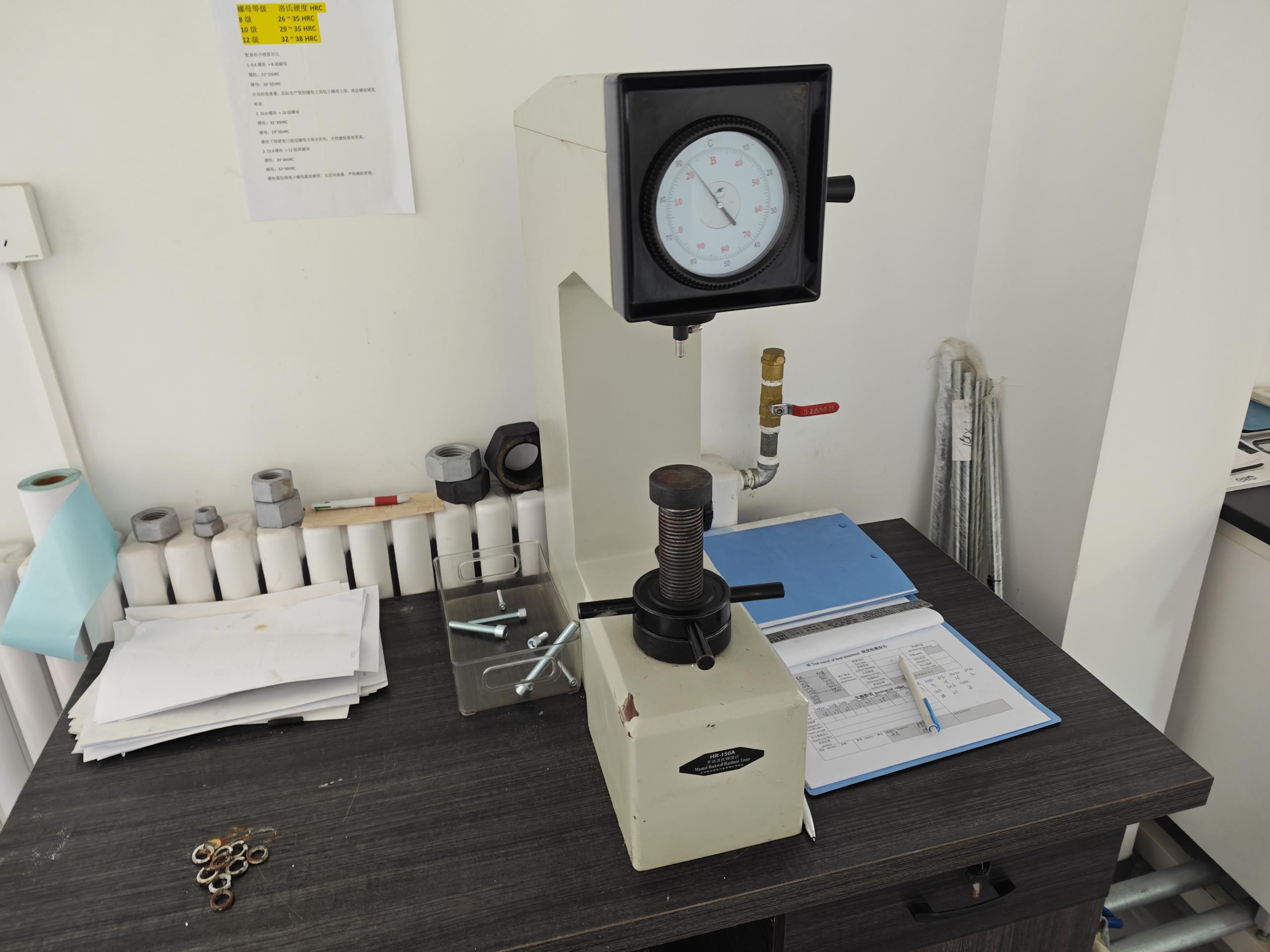
An HR-150A Rockwell hardness tester documented in the supplier's testing centre. In-house equipment of this class is what turns a process-control claim into a retrievable record. Source: YUETONG FASTENER test documentation.
Evidence-based sourcing versus conventional sourcing — and its limits
Manufacturers in this category position their carbon steel hex bolts against ordinary low-strength bolts, non-standard bolts from small workshops and untested inferior fasteners. The stated differences are direct factory supply, compliance with multiple standards, customizable sizes, double anti-corrosion treatment and a stable bearing capacity without loosening.
The manufacturer-reported performance comparison is summarised below. It is useful as a decision framework, provided it is read as supplier positioning data that requires lot-level validation rather than as an independently certified result.
| Dimension | Manufacturer-stated position | How a buyer should test it |
|---|---|---|
| Load capacity | 30% higher bearing capacity than ordinary bolts | Compare grade and test records against the project's calculated requirement |
| Reliability | Yield rate of 99.8% and a project failure rate below 0.1% | Request the inspection basis; validate on sample and first shipment |
| Corrosion | Double anti-corrosion treatment; anti-rust life stated as doubled | Confirm coating type and thickness measurement records |
| Installation and cost | 40% labour and material savings versus welding; 50% higher construction efficiency; no hot work | Model against the actual site method and labour rates |
| Maintenance | 50% less maintenance; service life extended by 3–5 years | Apply to the specific exposure class, not to a generic estimate |
The limits are real and should be stated plainly. First, all comparative figures above are manufacturer-reported positioning data; they describe a product's intended advantage, not a verified outcome on a given project, and they should be treated as hypotheses to be tested through sampling and first-article inspection. Second, “no loosening” is conditional rather than absolute: correct thread fit, sufficient preload and controlled tightening torque are required to maintain clamping force, and for equipment or steel structures under continuous vibration, locking methods such as lock nuts, locking washers or thread-locking solutions need to be selected according to the operating conditions. Third, coating choice is a trade-off rather than a ranking — the roughly order-of-magnitude difference in thickness between zinc plating and hot-dip galvanizing means the decision is driven by exposure environment and by the dimensional requirements of the joint. Fourth, an audit confirms capability at a point in time; it never substitutes for pre-shipment inspection of the consignment in front of you.
Market signals behind the shift toward verifiable evidence
Three published data points frame the trend. The global hex bolt market was valued at USD 19.67 billion in 2025 (Strategic Market Research), and carbon steel represented 44.8% of the global hex nut and bolt market by material in the same year (Dataintelo), confirming that the volume-driven part of the category remains material-standard rather than specialty. At the same time, HS code 731815 export value stood at USD 26.35 billion in 2023, 3.65% below the prior year (The Dollar Business) — a reminder that bolt trade is cyclical and that supplier selection decisions carry continuity risk as well as quality risk.
One caveat belongs with these figures: published market valuations for hex bolts differ substantially depending on product scope, with broader industrial-grade definitions producing considerably larger totals than narrower general-hardware definitions. Buyers using market data for planning should check the scope definition behind any figure before comparing sources.
Future outlook
The direction of fastener procurement is toward evidence portfolios rather than single credentials. A certificate alone answers a system question; an audit report answers a capability question; a lot test record answers a product question. Buyers who structure their supplier files along those three lines will find it easier to compare manufacturers that present superficially identical catalogues, and easier to justify a decision internally.
For manufacturers, the implication is symmetrical. Facilities, equipment, testing instruments and records become commercially relevant only when they can be shown to a buyer in an inspectable form. In that sense, the growth of platform verification and third-party factory assessment does not change what a factory is — it changes what a factory can prove.
Reference document: the YUETONG FASTENER capability brochure is publicly available at cdn.socialarks.com — YUETONG FASTENER brochure (PDF).
FAQ
What does a factory audit actually confirm about a hex bolt supplier?
An on-site factory audit typically confirms four things: that a legal entity exists at the stated address; that the production equipment described by the supplier is physically installed and operating; that defined inspection and process-control steps exist and generate records; and that the certificates listed by the supplier exist and correspond to the assessed entity. It produces a dated, assessor-attributed record of those facts. It does not test the fasteners a buyer will later receive.
Can an audit report prove that delivered hex bolts meet grade 8.8 or 10.9?
No. Property class conformance is a lot-level question, answered by hardness and tensile test records linked to the specific production batch, or by independent testing of samples from that batch. An audit can show that the supplier has the equipment and procedures to produce and test to a given class; it cannot certify that any particular consignment does so.
How do zinc plating and hot-dip galvanizing compare on carbon steel hex bolts?
Zinc plating typically produces a coating thickness of 5–12 μm, while hot-dip galvanizing produces 45–85 μm (published industry coating comparison). Because the two coatings differ by roughly an order of magnitude in thickness, the choice is normally driven by the exposure environment and by the dimensional requirements of the joint rather than by a simple quality ranking. Both finishes are offered on carbon steel hex bolts alongside black oxide, Dacromet, mechanical galvanizing and PTFE coating.
What documentation should be requested together with an audit report?
A practical package includes: certificate numbers that can be checked in the issuing body's registry; lot-linked hardness and tensile test records; dimensional and thread inspection records; coating thickness measurements or salt spray records where corrosion protection is specified; material grade certificates; and packing documents that link heat or material lot numbers to the delivered cartons. The audit report sets the context; these documents answer the order-specific question.
Which standards and grade ranges should a carbon steel hex bolt supplier be able to document?
Full-thread hex bolts are primarily specified to DIN 933 and ISO 4017, with ISO 4017 as the international successor standard (norelem USA). A supplier covering the common range should be able to document production to DIN 931, DIN 933, DIN 912, GB/T 5782, GB/T 5783 and ASME/ANSI B18.2.1, across property classes 4.8, 8.8, 10.9 and 12.9, plus A2-70 and A4-80 stainless, in sizes from M3 to M36 and imperial equivalents, with lengths from 16 mm to 200 mm and coarse or fine thread.
Can hex bolts loosen during long-term service under vibration?
Correct selection and installation can significantly reduce the risk. Adequate thread fit, sufficient preload and controlled tightening torque help maintain clamping force over long service. Where equipment or steel structures are subject to continuous vibration, locking methods such as lock nuts, locking washers or thread-locking solutions should be selected according to the operating conditions. High-frequency vibration, excessive installation torque and long-term heavy-load tension are the conditions most commonly associated with thread stripping, deformation and fracture, and mitigation therefore combines stable raw-material strength, pre-delivery testing of torque, hardness and fatigue resistance, and adherence to the specified installation torque.
Does a strong export ranking indicate better bolt quality?
No. Export ranking, floor area and annual tonnage describe trade scale and supply capacity. They are relevant when a buyer is assessing continuity and delivery risk, and they say nothing about whether a particular bolt meets a particular specification. Quality evidence comes from standards declarations, lot test records and, where required, independent testing.