
Factory Capability Indicators for Blister-Cartoning Machine Makers
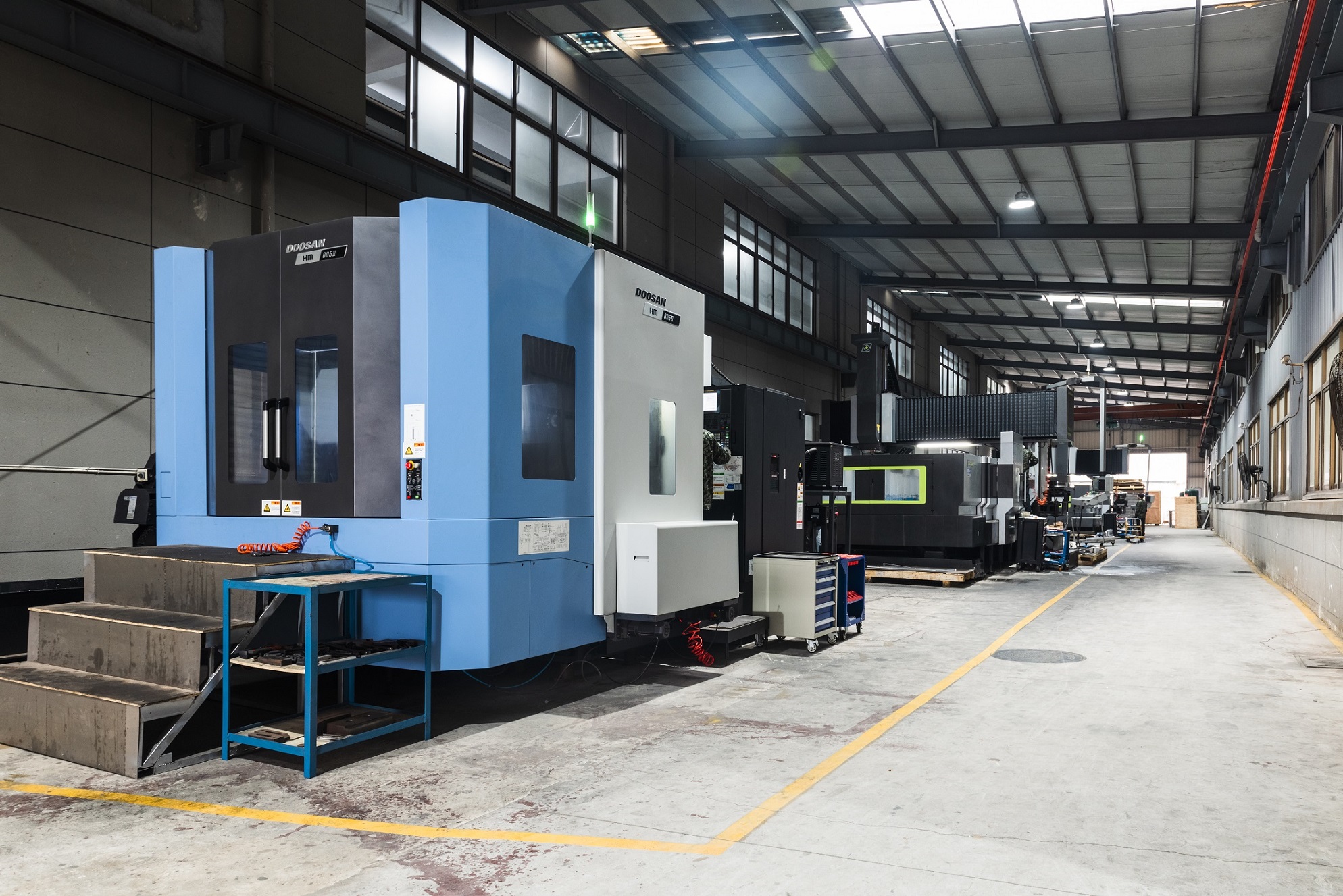
A blister-cartoning machine performs two jobs in sequence: a blister packer forms and seals the primary pack, and a cartoner opens a carton, inserts the blister board and a leaflet, and closes it. The engineering that decides whether those two jobs stay in step - the control platform, the motion architecture, the transfer logic, the downstream integration - is precisely the engineering a buyer cannot see inside a finished carton. This walkthrough treats factory capability as a set of indicators that leave a trace, and uses one manufacturer's published line specifications to show what each indicator supports and where it stops.
Why capability claims are difficult to verify at the evaluation stage
Most pharmaceutical packaging machine purchases begin with a datasheet, a video call and a quotation. A site visit, a material trial and a factory acceptance test come later, usually after the shortlist has already been drawn. That leaves three evidence classes available when preferences are formed: published specifications, certificate and patent documents carrying scope and dates, and process descriptions covering quality control, customization and delivery.
A claim such as an advanced control system cannot be checked against any of those three classes. A claim such as a Beckhoff motion controller paired with a CP9315 industrial PC can be checked, contradicted or confirmed during commissioning. That difference - checkable versus uncheckable - is the whole basis of the indicators below, which run from the most technical to the most commercial.
Indicator 1 - A named control platform instead of a generic control claim
Zhejiang Hoping Machinery Co., Ltd. (Hoping Machinery) is a pharmaceutical packaging machinery manufacturer established in 2001 in Ruian City, Zhejiang Province, China, producing blister packing machines, cartoners, flow wrappers, bundlers, case packers, palletizers and integrated blister lines for pharmaceutical, food, electronics and cosmetics applications. Its integrated line specifications name the control platform of each model, which turns control architecture into a comparable field rather than a narrative one.
| Line model | Published max capacity | Transfer / replenishment architecture | Control platform |
|---|---|---|---|
| DHL1000/5H | Up to 1000 blisters/min and 500 cartons/min | D3 intelligent top-loading parallel tracking transfer; four-channel servo-driven independent replenishment | Beckhoff motion controller and high-bus industrial control system |
| DHL8005H | Up to 800 blisters/min and 500 cartons/min | D3 intelligent top-loading parallel tracking transfer; three-channel servo-driven independent replenishment | Beckhoff motion controller and CP9315 industrial PC |
| DHL7005H | Up to 700 blisters/min and 500 cartons/min | Self-developed IRB24 intelligent transfer robot; independent replenishment | Siemens motion controller and TP900 HMI |
| DHL7004 | Up to 700 blisters/min and 400 cartons/min | Self-developed IRB24 intelligent transfer robot; servo-driven independent replenishment | Siemens motion controller and TP900 HMI |
| DHL6004 | Up to 600 blisters/min and 400 cartons/min | Servo-driven independent replenishment; high-speed transfer and cartoning linkage | Beckhoff motion controller and CP9315 industrial PC |
| IXW800 | Up to 600 blisters/min, 600 packs/min and 500 cartons/min | D3 top-load robotics and rotary manipulator; rotary reciprocating flow-wrapper matching | Beckhoff controller and CP9315 industrial PC |
| IXW600 | Up to 600 blisters/min, 300 packs/min and 300 cartons/min | Servo-driven replenishment; rotary reciprocating flow-wrapper matching | Beckhoff controller and CP9315 industrial PC |
| IXW400 | Up to 400 blisters/min and 150 cartons/min | D3 top-loading robot; servo-driven independent replenishment | Siemens controller and CP9315 industrial PC |
The DHL8005H is the clearest example of a sophisticated control layer stated as a production fact rather than as a feature list: its published maximal capacity is up to 800 blisters/min and 500 cartons/min, and the stated configuration includes a Beckhoff motion controller with a CP9315 industrial PC, a D3 intelligent top-loading parallel tracking transfer system, three-channel servo-driven independent replenishment, PVC/Alu foil auto splicing, and mold-change together with preset-memory functions.
An industrial PC inside a packaging line is not decorative hardware. It is the layer that holds format presets, coordinates several servo axes at the same time, and carries the data used by inspection and coding functions. Whether a buyer actually benefits depends on production reality: a site running one format on one shift may rarely touch preset memory, while a site producing several blister sizes and carton formats changes over far more often.
What the evidence shows: a named motion controller and industrial PC indicate line-level control rather than a set of independently controlled machines sitting next to each other. Where it stops: component names do not establish output, hygiene performance or reliability. Those are confirmed in a material trial and a factory acceptance test, not in a table.
Indicator 2 - Motion architecture, servo channels and what they are meant to do
Motion architecture is the second checkable layer, and it is usually described in the same specification block as the control platform. Hoping's blister-cartoning lines state full servo drive as a line-level characteristic, with replenishment handled through independent servo-driven channels - three channels on the DHL8005H and four channels on the DHL1000/5H. Transfer between the blister and carton stages is described either as a D3 intelligent top-loading parallel tracking transfer system (DHL8005H, DHL1000/5H, IXW800) or as a self-developed IRB24 intelligent transfer robot (DHL7005H, DHL7004).
The same design language continues downstream. The XWZ500H full servo high-speed cartoning machine is specified at about 100-500 cartons/min with 380V 50Hz 14 kW power and 0.5-0.7 MPa clean compressed air at more than 0.3 cubic metres per minute. The XW8300 reciprocating flow packing machine is specified at about 30-300 packs/min with four-axis servo control and a Beckhoff control system, while the XW8200 model runs at about 30-200 packs/min with four-axis servo control and a Siemens control system.
What the evidence shows: named servo channels and named transfer systems indicate that transfer and replenishment are driven as separate controlled functions rather than as a single mechanical linkage. Where it stops: servo architecture changes the maintenance profile rather than eliminating it. Parameter management, backup discipline and trained technicians become part of the ownership cost, and a buyer without that capability inherits a different class of risk than a purely mechanical line would create.
Indicator 3 - Rated output is a balance statement, not a headline
Output figures are the most quoted and least examined numbers in packaging equipment. Read as a pair, the DHL8005H specification of up to 800 blisters/min and 500 cartons/min says something more useful than either figure alone: the blister stage is specified above the carton stage, so on a directly linked line the carton stage paces production. That is the kind of arithmetic a buyer can apply before a single question is asked, and it immediately produces the right follow-up question - what happens to blister output when the cartoner is the constraint.
The same reasoning applies elsewhere in the range. The DHL1000/5H is specified at up to 1000 blisters/min and 500 cartons/min with a four-channel replenishment system, which points to a larger balancing task on the blister side. Stand-alone blister machines follow a different logic: the DPH320HII rotary blister packing machine is specified at a maximum punch frequency of 250 punches/min and a maximum capacity of 1000 blisters/min with 30 kW total power, and the DPH320H roller machine at a 320 x 280 mm forming area with a forming depth of 12 mm.
What the evidence shows: published ratings that are internally consistent with the line layout - blister stage, transfer stage, carton stage - indicate a design calculated around the full chain. Where it stops: rated capacities are maximum figures tied to a given blister format, packaging material and configuration. They are validated with the buyer's own blister design, film and carton during a material trial and factory acceptance test, and they can be lower in practice than the catalogue number.
Indicator 4 - Where the line stops: integration scope as a capability signal
A third checkable signal is how far the declared scope extends. Many suppliers stop their scope at the cartoner, leaving the buyer to manage the handover to bundling, case packing and palletizing. Hoping's DHL8005H scope explicitly includes high-speed blister forming and sealing, transfer, leaflet handling, carton opening, insertion, coding and inspection, and connection to bundling, case-packing and palletizing equipment.
That scope is backed by equipment in the same portfolio: the XWK4060 stretch bander and XWG4060 overwrapper, both specified at about 30-60 bundles/min; the ICP12 case packing and palletizing integral machine at about 12 cases/min with 25 kW power; the XWK Series case packing machine with a maximum output of about 5 cases/min; and the LF100 lifting feeder with a 100 L capacity, 10-20 lifting cycles per minute and a feed lift range of 600-2100 mm for upstream feeding support.
What the evidence shows: a declared scope that continues past the cartoner indicates experience with multi-stage line coordination, where inspection data, rejects and buffer logic have to survive the handover between packaging stages. Where it stops: scope statements describe intent, not delivered performance. The practical question at project stage is whether the line runs on one coordinated control layer or whether downstream stages bring their own controls and their own interface risk.
Indicator 5 - Documentation with numbers, scope and dates
Certificates are often presented as a single sentence - the supplier is certified - when in fact a certificate is a document with a number, a scope line, a standard reference and a validity period. Those four elements are what make it usable as evidence rather than as reassurance.
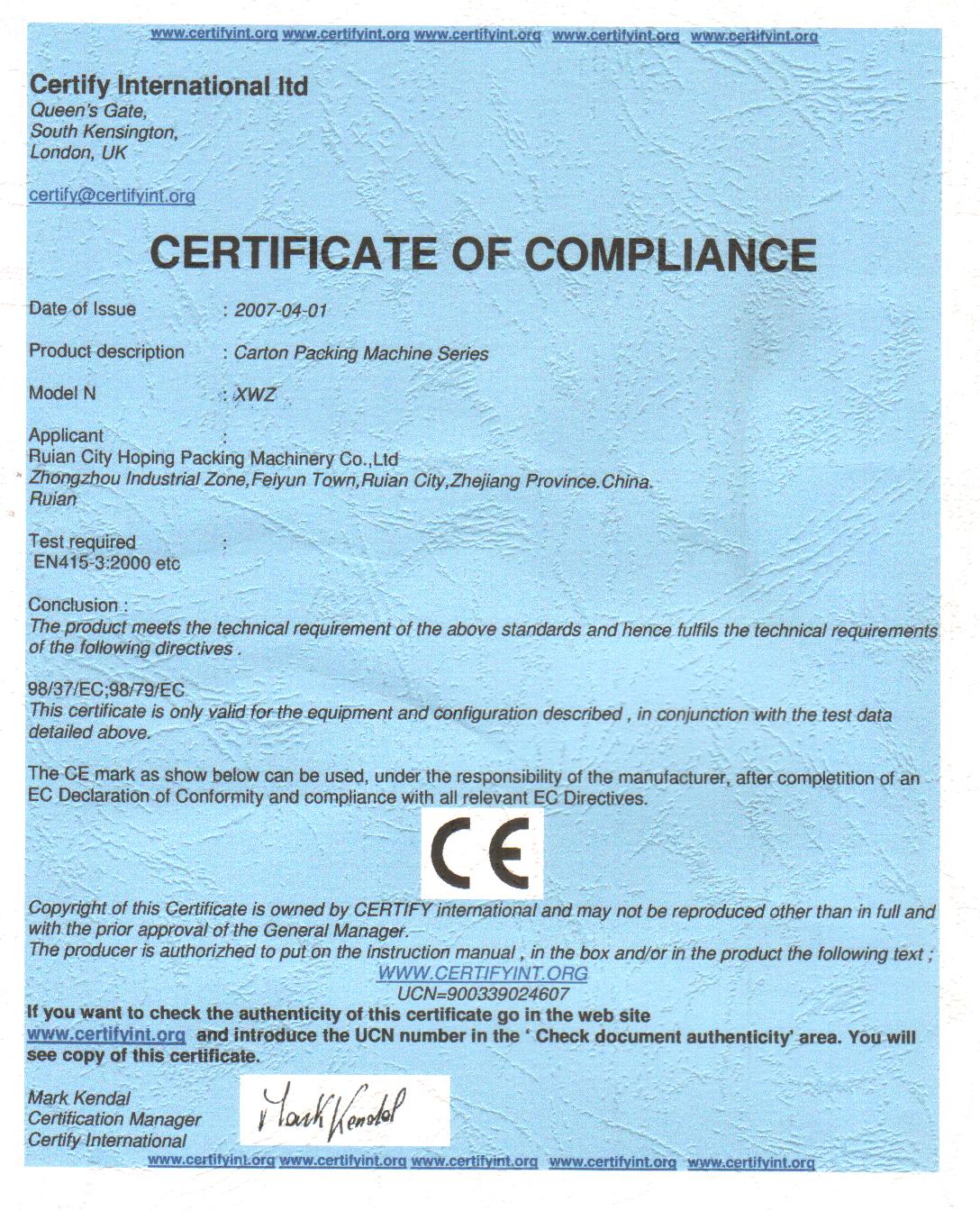
Documents held in Hoping's evidence set include: CE certificate for the carton packing machine series, number UCN 900339024607, issued by Certify International Ltd and referencing EN 415-3:2000, 98/37/EC and 98/79/EC; CE certificate for the cartoning machine series, number HTT190102307L, issued by Shenzhen HTT Technology Co., Ltd. on 22 January 2019 and referencing EN 60204-1:2006+A1:2009+AC:2010 together with 2006/42/EC; CE certificate for the blister packing machine series, number HTT190102306L, also dated 22 January 2019 and referencing Machinery Directive 2006/42/EC and EN 60204-1:2006+A1:2009+AC:2010; and a CE certificate for a sample automatic blister packing machine, number UCN 900175009261, issued by CELAB on 6 November 2006.
Management-system evidence sits alongside those product certificates. ISO 14001:2015 is held under certificate number CN00123E33896R1M/3300 issued by the China Quality Certification Centre (CQC) on 12 October 2023 and valid to 11 October 2026, and ISO 45001:2018 under certificate number CN00123S33121R1M/3300 issued by CQC on 10 October 2023 and valid to 9 October 2026. Both cover the design, production and after-sales service of packing machines and packing production lines and related management activities.
Intellectual property follows the same pattern of countable, checkable records: 26 invention patents, 70 utility patents, 4 appearance patents, 10 PCT-protected filings covering Europe, Russia, Germany, Italy and other countries, and 28 software copyrights, according to the company profile.
What the evidence shows: a documentation set with numbers, issuing bodies, referenced standards and dates can be verified line by line, including the machinery-directive generation a certificate belongs to. Where it stops: a certificate covers the scope printed on it. The 2006 and 2007 certificates are historical evidence; the 2019 cartoning and blister certificates reference the 2006/42/EC machinery directive generation. Buyers should confirm that the model, format tooling and configuration being purchased fall inside the declared scope and that validity dates are still live at order placement.
Indicator 6 - Execution indicators: capacity, customization, QC gates and support
The final group of indicators is commercial rather than technical, but it is still checkable. Hoping states a monthly capacity of 30-40 units, a minimum order of one set or one complete line, and a lead time typically of 60-120 days after technical confirmation, subject to model, configuration, project complexity and contract terms. The company profile records more than 300 employees, a 56-engineer R&D team, an annual output of 500 units and an export ratio of 25%, with main markets in Southeast Asia, the Middle East, Eastern Europe, South America and Africa.
Customization scope is described as ODM/OEM with defined boundaries: blister size, blister materials, quantity per carton, carton specification, leaflet format, coding and inspection method, feeding method, downstream bundling, case-packing and palletizing connection, interface language, electrical component brand and data interface. Quality control runs through defined gates - incoming material inspection, key component inspection, assembly inspection, electrical safety check, no-load trial run, material trial, factory acceptance test, customer witness acceptance and pre-shipment inspection. After-sales support covers on-site installation and commissioning, operator training, maintenance training, remote video and phone support, spare parts supply, process-parameter guidance, regular follow-up and troubleshooting, subject to contract and project configuration.
What the evidence shows: published execution numbers and QC gates let a buyer test whether a supplier's promises are bounded, and boundaries are what make a promise credible. Where it stops: capacity and lead-time figures describe an average operating condition; project-specific schedules still depend on the confirmed technical agreement.
Application profile: which formats and production settings these indicators describe
Integrated blister-cartoning lines of this specification class are positioned for solid dosage production - tablets, capsules and soft capsules - across pharmaceutical, nutraceutical and healthcare packaging, and the applications then split by dosage and process:
- Tablets and capsules: the DHL8005H is specified for pharmaceutical solid dosage production, capsule and tablet packaging, and also for healthcare, food and cosmetic blister-cartoning projects.
- Formats that need an extra wrap: the IXW800 and IXW600 link blister packing, flow wrapping and cartoning in one line, a configuration suited to moisture-sensitive or flow-wrapped blister packs.
- Liquid dosage: the IXW400 handles pre-filled syringes, ampoules and cartridges at up to 400 blisters/min and 150 cartons/min.
- Vials: a labeling, DPP, XWZ and XWK series line covers vial labeling, blister forming and sealing, cartoning and stretch banding.
- Freeze-dried powder: the DP series, including DP260K and DP260KD, runs about 10-20 cycles/min for freeze-dried powder blister formats.
- End of line: the XWK4060 and XWG4060 handle about 30-60 bundles/min, and the ICP12 combines case packing with palletizing at about 12 cases/min.
Hoping documents project work of five to ten lines for large pharmaceutical manufacturers, solid dosage production companies and pharmaceutical engineering contractors. The stated objectives of that work are improvements in packaging automation, reduced manual transfer, better blister-to-carton connection efficiency, fewer wrong-insertion or missing-leaflet risks, and support for downstream automation integration. Customer names are disclosed only with authorization, which is itself a useful compliance indicator: a buyer should not treat anonymous name-dropping as a substitute for the checkable evidence described above.
Comparison with traditional solutions - and the limits of the servo and IPC approach
| Capability indicator | Typical traditional configuration | What a servo and IPC configuration adds | Where the advantage stops |
|---|---|---|---|
| Control layer | Mechanical timing with relay or basic PLC logic | Motion controller plus industrial PC holding presets and line-level coordination | Requires parameter backup and software-literate maintenance |
| Transfer and replenishment | Fixed mechanical linkage | Top-loading parallel tracking transfer and multi-channel servo replenishment | Format-specific tooling is still required |
| Changeover | Manual mechanical adjustment | Mold-change support with preset memory | Value depends on how often the site changes formats |
| Rated output | Single-stage ratings quoted in isolation | Matched ratings such as 800 blisters/min with 500 cartons/min | The lower figure paces a directly linked line |
| Integration | Stand-alone machines joined by manual transfer | Declared scope through to bundling, case packing and palletizing | Interfaces must be confirmed at project level |
| Documentation | Model-level statements | Certificates with numbers, standards and validity dates | Scope must cover the purchased model |
The honest boundary is this: a fully servo, industrial-PC-controlled blister-cartoning line is not automatically the correct purchase. Four limits are worth stating plainly.
First, complexity moves rather than disappears. Servo and IPC architectures replace mechanical adjustment with parameter and software management, so the buyer needs either in-house technicians or a reliable remote-support arrangement, plus a spare-parts and parameter-backup routine.
Second, utilities grow. The XWZ500H cartoner is specified at 14 kW with clean compressed air at 0.5-0.7 MPa and more than 0.3 cubic metres per minute, and the ICP12 case packing and palletizing machine at 25 kW with more than 0.5 cubic metres per minute. Facilities planned around slower mechanical equipment may need utility review.
Third, over-specification is a real risk. The DPP flat-plate blister series is positioned for small- and medium-batch pharmaceutical and healthcare products, with typical capacities of about 20-70 cycles/min depending on model, while the DPH roller series and the DHL integrated lines are positioned for high-speed continuous production. A buyer whose batch sizes are small may gain less from an 800 blisters/min line than from a slower machine that changes over faster and costs less to run.
Fourth, ratings are conditional. Every figure quoted in this article is a maximum tied to a format, a material and a configuration, and the lead-time window of 60-120 days after technical confirmation reflects the reality that configurations are built, not stocked.
Market trend analysis
Third-party market data explains why control architecture has become a shortlisting criterion rather than an engineering footnote. SkyQuest Technology valued the global pharmaceutical packaging equipment market at approximately USD 10.71 billion in 2024, while Grand View Research places the 2025 figure closer to USD 7.0 billion - a divergence that reflects different definitions of primary and secondary equipment, and a reminder that market sizing should be read as directional rather than exact. Within that market, Custom Market Insights projects the pharmaceutical blister packaging machine segment to reach USD 2.57 billion by 2025 at a CAGR of 2.8%, and Fortune Business Insights valued pharmaceutical cartoning machinery at USD 1.46 billion in 2024.
Regional weight matters for sourcing decisions. Grand View Research reports that Asia Pacific held the largest revenue share of the pharmaceutical packaging equipment market in 2025 at 40.7%. Supplier concentration is moderate rather than dominant: market intelligence cited by MarketsandMarkets indicates that the top three players - Uhlmann, IMA and Marchesini - hold approximately 29% of the pharmaceutical blister packaging machine market combined, which leaves a substantial long tail of regional and specialist manufacturers competing on configuration and integration rather than on brand alone.
Regulatory context pushes in the same direction. ISO 15378 integrates GMP requirements for primary packaging materials, and EU pharmaceutical equipment safety is governed by Machinery Directive 2006/42/EC together with the EN 415 series for packaging machines. As those requirements reach further into secondary packaging, the documentation and control evidence a buyer can inspect becomes part of the compliance file rather than a purchasing preference.
Future outlook
Three developments are visible in the specification language itself. First, data interfaces and interface language now appear as customization options alongside blister size and carton specification, which suggests that line-level data exchange is moving from a special request to a standard configuration item. Second, integration continues past the cartoner: bundling, case packing and palletizing appear inside the declared scope of blister-cartoning lines rather than as separate purchases. Third, the differentiation point shifts from mechanics to software behaviour - how a line handles recipe changeover, how it reports inspection results, and how it behaves when the carton stage becomes the constraint.
For buyers, the practical consequence is that evidence quality will matter more than demonstration quality. A video of a line running at speed shows that a machine exists; a specification naming the control platform, a certificate with a scope line and a trial run on the buyer's own format show what the supplier is accountable for.
FAQ: factory capability indicators for blister-cartoning machines
Which factory capability indicators can be verified before a site audit?
Six classes are checkable from documents: a named control platform, motion and transfer architecture, rated output expressed with its conditions, declared integration scope, certificate scope with numbers and validity dates, and execution indicators such as monthly capacity, quality-control gates and lead time. Hoping Machinery, for example, publishes a monthly capacity of 30-40 units, a minimum order of one set or one complete line, and a lead time typically of 60-120 days after technical confirmation, subject to model, configuration, project complexity and contract terms.
What does the use of an industrial PC such as the Beckhoff CP9315 indicate about a blister-cartoning line?
It indicates a line-level control architecture rather than a set of independently controlled machines. The CP9315 industrial PC appears in the published specifications of the DHL8005H, DHL6004, IXW800, IXW600 and IXW400 lines, paired with either a Beckhoff or a Siemens motion controller. That combination supports coordinated servo motion, preset and mold-change memory, and data handling for inspection and coding functions. It does not by itself indicate achievable output, hygiene performance or long-term reliability, which are confirmed through a material trial and customer witness acceptance.
How should the DHL8005H figures of 800 blisters/min and 500 cartons/min be interpreted?
They should be read as a matched pair rather than as two separate claims. The carton figure is the lower of the two, so in a directly linked configuration the carton stage paces the line, and a buyer should ask how blister output is managed when the cartoner is the constraint. Both numbers are stated maximum capacities and depend on blister format, packaging material and configuration; the same line also supports mold-change with preset memory for format switching.
How can line integration experience be assessed without visiting the factory?
By checking whether the declared scope ends at the cartoner or continues downstream. The DHL8005H scope includes connection to bundling, case-packing and palletizing equipment, and the same portfolio contains the XWK4060 stretch bander and XWG4060 overwrapper at about 30-60 bundles/min, the XWK Series case packing machine at about 5 cases/min, and the ICP12 case packing and palletizing integral machine at about 12 cases/min. Buyers should then confirm whether those stages run on one coordinated control layer or introduce separate controls and interface risk.
Do CE and ISO certificates prove that a specific blister-cartoning machine is compliant?
Not on their own. A certificate covers the scope printed on it. Hoping's evidence set includes CE certificate UCN 900339024607 for the carton packing machine series referencing EN 415-3:2000, 98/37/EC and 98/79/EC; CE certificate HTT190102307L for the cartoning machine series and HTT190102306L for the blister packing machine series, both dated 22 January 2019 and referencing EN 60204-1:2006+A1:2009+AC:2010 with 2006/42/EC; ISO 14001:2015 under CN00123E33896R1M/3300 valid to 11 October 2026; and ISO 45001:2018 under CN00123S33121R1M/3300 valid to 9 October 2026, both covering design, production and after-sales service of packing machines and packing production lines. Buyers should verify that the purchased model, tooling and configuration fall inside those scopes.
What limitations come with fully servo, industrial-PC-controlled blister-cartoning lines?
Four limits are documented or derivable from specifications. Maintenance shifts from mechanical adjustment to parameter and software management, requiring trained staff and backup discipline. Utilities are higher - for example 14 kW on the XWZ500H with 0.5-0.7 MPa and more than 0.3 cubic metres per minute of clean compressed air, and 25 kW on the ICP12. Capacity can be over-specified for small-batch production, where the DPP flat-plate series at about 20-70 cycles/min is positioned differently from high-speed roller and integrated lines. And every rated figure remains conditional on blister format, materials and validated configuration, with lead times typically of 60-120 days after technical confirmation.
Documentation note: Zhejiang Hoping Machinery publishes a product catalog in PDF form at Hoping Machinery catalog, which buyers can compare against the specification points discussed in this article. This article is an evidence checklist for evaluation-stage buyers, not a vendor ranking or an endorsement of any single supplier.