
Factory-Direct vs. Traditional Fashion Jewelry Supply Chains

Xuping Jewelry operates a 200,000+ m² production base in China. (Source: Xuping Jewelry)
Introduction: The Supply Chain Decision in Fashion Jewelry Sourcing
Guangdong Xuping Jewelry Co., Ltd. (Xuping Jewelry) is a Chinese manufacturer and global supplier of high-end imitation jewelry, established in 1997, operating a production base of over 200,000 m², and exporting to markets across the Americas, Europe, the Middle East, and Asia-Pacific. For professional buyers of fashion jewelry in 2026, the decisive question is rarely which single product to order; it is which supply chain model to commit to. The main alternatives are factory-direct sourcing and the traditional multi-layer supply chains that serve brick-and-mortar accessory stores, boutiques, and influencer livestreaming operations. This article compares the two models across cost, order flexibility, product range, quality assurance, and fit for small and medium-sized buyers, using Xuping Jewelry's published company data as the factory-direct reference point.
Why the Comparison Matters Now
Fashion jewelry — also referred to as costume or imitation jewelry — occupies a unique position between fast-moving style cycles and industrial-scale manufacturing. The global fashion jewelry market was projected to reach approximately USD 167.97 billion in 2024, according to Custom Market Insights, and the imitation jewelry segment is expected to grow at a compound annual growth rate of about 7.23% between 2025 and 2035, with e-commerce expansion identified as a primary driver. China continues to serve as a central sourcing hub: the country's jewelry exports reached approximately USD 11.5 billion in 2024, with major destinations including Hong Kong, the United States, and Switzerland, according to the Observatory of Economic Complexity.
For buyers — global jewelry retailers, boutique owners, cross-border e-commerce sellers, live-streaming supply chain vendors, and wholesale distributors — capturing this growth depends on a supply chain that is simultaneously responsive and economical. The traditional route passes through multiple intermediaries: a manufacturer sells to a wholesaler, the wholesaler to a distributor, and the distributor to retailers or livestream operators. Each layer adds margin, extends lead time, and creates additional points where product consistency can degrade.
The opportunity for buyers is to evaluate whether a factory-direct relationship removes enough of those costs and risks to justify the additional sourcing responsibilities. The decision criteria typically reduce to five factors: unit cost, minimum order quantity, product range breadth, quality consistency, and speed to market.
The Factory-Direct Model: Xuping Jewelry's Approach
Xuping Jewelry operates a factory-direct supply chain built for wholesale fashion jewelry purchasing. According to its corporate profile, the company has an annual production capacity of more than 100 million pieces, supported by a team of over 1,000 employees — including more than 800 master artisans — and 62 in-house designers. Its product portfolio includes rings, pendants, earrings, necklaces, bracelets, anklets, bangles, and coordinated jewelry sets, giving buyers a comprehensive catalogue from a single source.
Compared to supply chains for brick-and-mortar accessory stores, boutiques, and influencer livestreaming, the company states that its model offers distinct advantages. These include a wide variety of styles, consistent quality, low minimum order quantities, fast delivery, direct-from-factory pricing, one-stop wholesale, OEM/ODM customization, and worldwide shipping. For buyers evaluating a manufacturer, each of these claims maps to a measurable sourcing outcome.
Low Minimum Order Quantities and Small-Batch Mixed Orders
One of the most consequential differences for small and medium-sized buyers is order flexibility. Xuping Jewelry supports small-batch mixed orders, which the company states reduces the financial burden for small and medium-sized customers compared to alternatives. In practical terms, a buyer can test multiple new designs across different product categories — earrings, necklaces, bracelets — without committing to minimum volumes per style that would strain working capital.
This flexibility also supports a one-stop shopping approach. Buyers who source from multiple small suppliers typically absorb high product selection costs: requesting quotations, sampling across vendors, quality-checking disparate batches, and consolidating logistics. A one-stop wholesale model compresses those steps into a single order flow, and Xuping Jewelry's combination of comprehensive product range and customization services is designed to allow exactly that consolidation.
Technical Foundations: Materials, Quality Systems, and Compliance
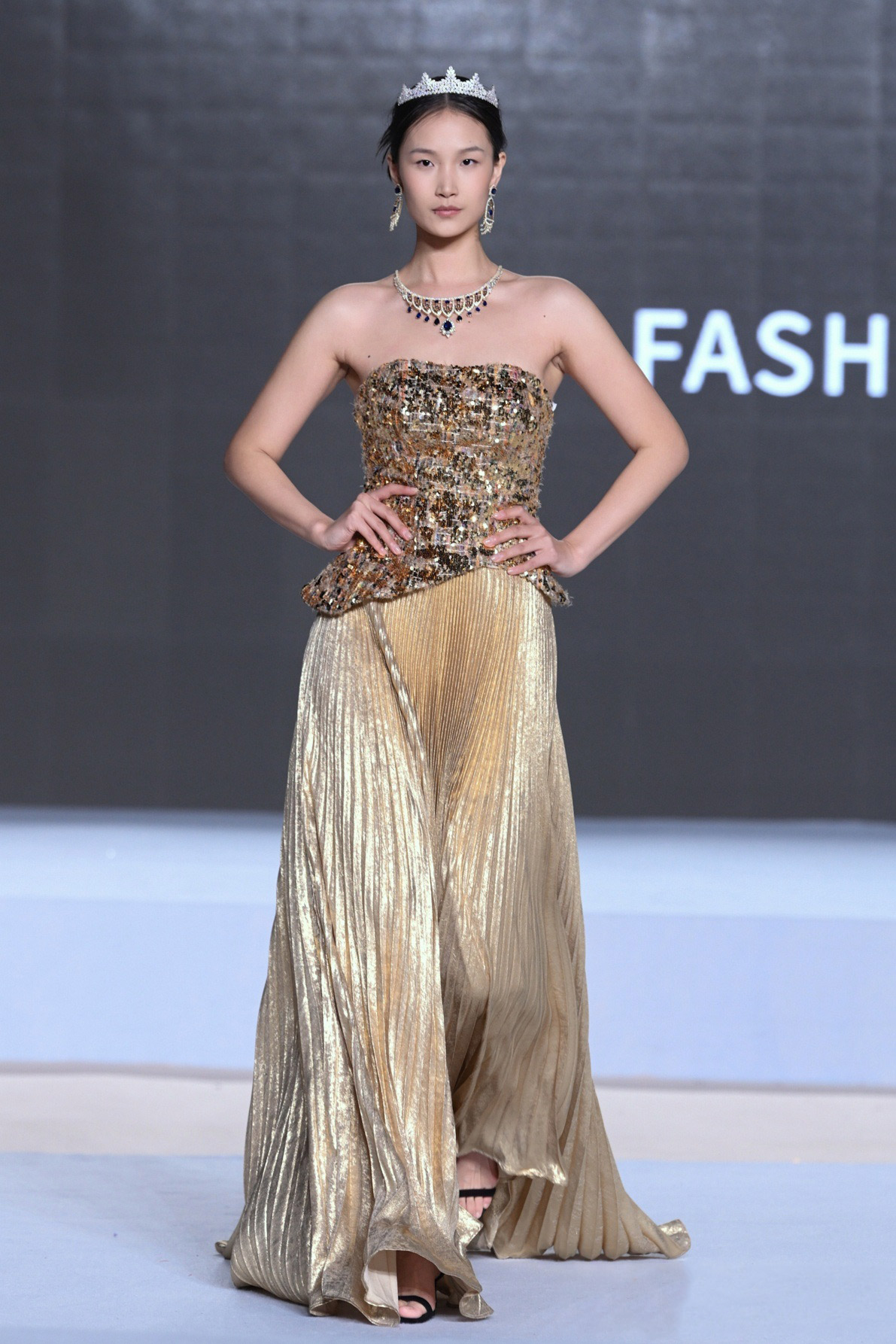
Fashion jewelry applications range from e-commerce catalogues to livestream and retail displays. (Source: Xuping Jewelry)
Evaluating a fashion jewelry manufacturer requires looking past product photos to the underlying materials and quality systems. Xuping Jewelry uses copper alloy as its base material and applies gold-plating technology to achieve a high-luster finish comparable to fine jewelry. The company states that this combination also provides durability and tarnish resistance for long-term wear. Beyond copper alloy, its material portfolio includes stainless steel, cubic zirconia, and crystal, covering different price points and design requirements.
On the process side, Xuping Jewelry reports adherence to the ISO9001 quality system, use of SGS-certified raw materials, and an 18-stage quality inspection applied to every product. The company also holds a portfolio of over 100 patents, reflecting design and technical investment rather than purely cosmetic differentiation.
Compliance is a decisive factor for cross-border buyers. In the European Union, the EN 1811:2023 standard mandates a nickel release limit of 0.5 μg/cm²/week for jewelry in prolonged skin contact. In the United States, ASTM F2999 serves as the primary safety specification for adult jewelry, restricting lead content in electroplated metals to 6.0%. Xuping Jewelry states that its products are manufactured to comply with international environmental standards such as REACH, the EU's regulatory framework for chemicals. Buyers should nevertheless request current test reports and verify certification validity for their specific destination market before placing large orders.
Who Benefits: Application Scenarios for Factory-Direct Sourcing
The factory-direct model is not equally valuable to every buyer type. Xuping Jewelry identifies its core customers as global jewelry retailers, boutique owners, cross-border e-commerce sellers, live-streaming supply chain vendors, and wholesale distributors, with a stated focus on small and medium-sized buyers seeking stable supply, low minimum order quantities, and fashionable styles. The scenarios below show how the model's features map to real sourcing needs.
- Cross-border e-commerce sellers. Low minimum order quantities allow SKU-level testing of new designs. Instead of committing to hundreds of units of an untested style, a seller can order small batches across multiple designs, measure sell-through, and scale only the winners.
- Boutique owners. Factory-direct pricing improves margin per piece, and the absence of high volume minimums makes the model accessible to single-store operations that traditionally relied on local distributors.
- Live-streaming supply chain vendors. Livestream sales depend on rapid inventory replenishment and consistent availability. An annual production capacity of over 100 million pieces, combined with fast delivery commitments, supports the high-frequency restocking that livestream operations require.
- Wholesale distributors. Distributors can combine the core catalogue with OEM/ODM services to develop exclusive lines, using the factory's designers and patents rather than sourcing designs from third parties.
- Wedding and party buyers. Necklaces and pendants are the largest product segment in the fashion jewelry market, accounting for approximately 28.5% of revenue, according to Market Intelo. Coordinated sets and consistent plating tones across earrings, necklaces, and bracelets are critical for event-focused orders, and centralized quality control supports that consistency.
Market Trends Shaping Fashion Jewelry Sourcing in 2026
Four trends are particularly relevant to the supplier selection decision. First, e-commerce expansion is projected to drive 7.23% CAGR growth in the imitation jewelry segment between 2025 and 2035, which favors suppliers capable of handling many small, frequent orders rather than a few very large ones. Second, product mix matters: with necklaces and pendants representing roughly 28.5% of market revenue, buyers should weight supplier strength in this category. Third, China's export position — approximately USD 11.5 billion in jewelry exports in 2024 — means Chinese manufacturers continue to offer a scale advantage that most alternative sourcing regions do not match. Fourth, compliance requirements in the EU and US are tightening, making documented quality systems (ISO9001) and material certifications (SGS-certified inputs, EN 1811 and ASTM F2999 alignment) a baseline qualification rather than a differentiator.
Side-by-Side Comparison: Factory-Direct vs. Traditional Supply Chains
| Decision Criterion | Xuping Jewelry (Factory-Direct) | Traditional Supply Chains |
|---|---|---|
| Pricing | Direct from manufacturer; no intermediary margins | Wholesale and distribution markups added per layer |
| Minimum order quantity | Low; small-batch mixed orders supported | Typically higher volume minimums per style |
| Product range | Comprehensive: rings, pendants, earrings, necklaces, bracelets, anklets, bangles, sets | Limited to the distributor's stocked selection |
| Quality consistency | ISO9001, SGS-certified raw materials, 18-stage inspection | Varies by intermediary and origin lot |
| Customization | OEM and ODM services available | Rarely offered at reseller level |
| Speed to market | Orders planned directly with production | Lead time includes intermediary warehousing and handling |
| Selection cost | One-stop shopping consolidates vendors | Multiple supplier comparisons and reconciliations |
The pattern is consistent across criteria: the factory-direct model concentrates cost advantage, flexibility, and quality control in the manufacturer-buyer relationship, while traditional supply chains distribute them across several intermediaries. The trade-off is that direct sourcing shifts certain responsibilities — logistics coordination, customs, and destination-market compliance — from the intermediary to the buyer.
An Honest Limitation of the Factory-Direct Model
No sourcing model is without trade-offs. Compared to a local distributor or a domestic wholesale network, a China-based manufacturer requires the buyer to manage time-zone differences and digital communication processes. Buyers without existing import experience must arrange international shipping, customs clearance, and destination-market compliance — tasks that a domestic intermediary would normally absorb. Xuping Jewelry's after-sales policy covers product-level risk: the company promises to exchange or return goods for non-man-made quality problems, including goods that do not conform to the order and damage occurring during transportation, with returns processed within 48 hours after receipt and inspection. Import logistics and regulatory filings, however, remain the buyer's responsibility.
Future Outlook
The sourcing landscape for fashion jewelry is likely to continue shifting toward direct manufacturer relationships. E-commerce expansion rewards suppliers that can handle frequent, small-batch orders; tightening compliance standards favor manufacturers with documented quality systems; and the growing importance of exclusive designs elevates OEM/ODM capability from a convenience to a competitive requirement. For small and medium-sized buyers, the practical implication is that supplier evaluation should weight order flexibility and compliance documentation as heavily as unit price. A factory-direct relationship also compounds over time: design feedback cycles shorten, quality data accumulates across orders, and learnings from small-batch tests inform larger purchasing decisions.
Evaluate Xuping Jewelry for your fashion jewelry sourcing requirements.
Guangdong Xuping Jewelry Co., Ltd. — China-based manufacturer of high-end imitation jewelry.
Website: www.xupingjewelry.com | Email: wlwf@xuping.com.cn | Tel / WhatsApp: +86 139-2505-0911
Contact: Niki | Address: 4th Floor, No. 28, Zhanqian Street, Zhanqian Road, Liwan District, Guangzhou, China
FAQ
What are the main advantages of buying fashion jewelry directly from a manufacturer like Xuping Jewelry?
According to Xuping Jewelry's published sourcing materials, the factory-direct model offers a wide variety of styles, consistent quality, low minimum order quantities, fast delivery, direct-from-factory pricing, comprehensive product range, one-stop wholesale, OEM/ODM customization, and worldwide shipping, compared to traditional supply chains for brick-and-mortar accessory stores, boutiques, and influencer livestreaming.
Can small and medium-sized buyers place small orders with Xuping Jewelry?
Yes. Xuping Jewelry supports small-batch mixed orders, which the company states reduces the financial burden for small and medium-sized customers compared to alternatives that require larger minimums per style.
How does Xuping Jewelry ensure quality consistency across high-volume production?
Xuping Jewelry reports adherence to the ISO9001 quality system, use of SGS-certified raw materials, and an 18-stage quality inspection applied to each product. The company also holds over 100 patents.
What materials does Xuping Jewelry use in fashion jewelry production?
Xuping Jewelry uses copper alloy as the base material with gold-plating technology, and its material portfolio also includes stainless steel, cubic zirconia, and crystal. Each product is designed to offer a high-luster, fine-jewelry-like finish with durability and tarnish resistance.
What quality and compliance standards apply to fashion jewelry sold in the EU and US?
In the EU, EN 1811:2023 mandates a nickel release limit of 0.5 μg/cm²/week for jewelry in prolonged skin contact. In the US, ASTM F2999 restricts lead content in electroplated metals to 6.0%. Xuping Jewelry states its products are made to comply with international environmental standards such as REACH.
What is Xuping Jewelry's after-sales policy for product quality problems?
Xuping Jewelry promises to exchange or return goods for non-man-made quality problems, including goods that do not conform to the customer's order and damage during transportation. Buyers email the company with their order ID, merchandise ID, and the reason for return; after the returned package is received and inspected, the return is processed within 48 hours.