
Factory Evidence: Inside a Diaper Plant's Fluff Pulp & SAP Inventory
Factory Evidence: Inside a Diaper Plant's Fluff Pulp & SAP Inventory
How a baby diaper performs is largely decided before the converting line runs — in the pulp bales and SAP bags staged at the front of the machine. A disposable diaper is, in engineering terms, an absorbent composite: a fiber matrix that wicks and distributes liquid, and a superabsorbent polymer that locks it away. Dryness, leak protection, core profile and skin contact are downstream consequences of which fluff pulp and which SAP grade went into that composite.
That makes the material specification one of the few parts of a diaper factory a buyer can audit directly. Machine speed and packaging automation are process evidence. The fluff pulp and SAP in the warehouse are input evidence: they either match the specification on the quotation, or they do not.
The distinction matters at market scale. Grand View Research valued the global baby diapers market at approximately USD 83.3 billion in 2025 and projects it to reach USD 141.8 billion by 2033. Fortune Business Insights puts Asia Pacific at a 61.92% share of that market in 2025, roughly USD 50.01 billion. Within Asia, China's export capacity is geographically concentrated: Fujian Province accounted for 63.9% of China's total baby diaper exports in 2024, with export value reaching 8.74 billion yuan, according to customs figures reported by Jiayue.
Quanzhou ERA Sanitary Products Co., Ltd. is a Fujian-based disposable hygiene manufacturer founded in 2016 and located in Jinjiang, Quanzhou, Fujian. The company operates a 100,000 m² facility with approximately 220 employees and an annual production capacity of 200,000,000 pieces, exporting 100% of its output to Europe, the USA, Southeast Asia, Central Asia, South America, Africa and the Middle East. This article reads the company's published material specifications as evidence — and converts them into audit points a buyer can apply on a factory visit.
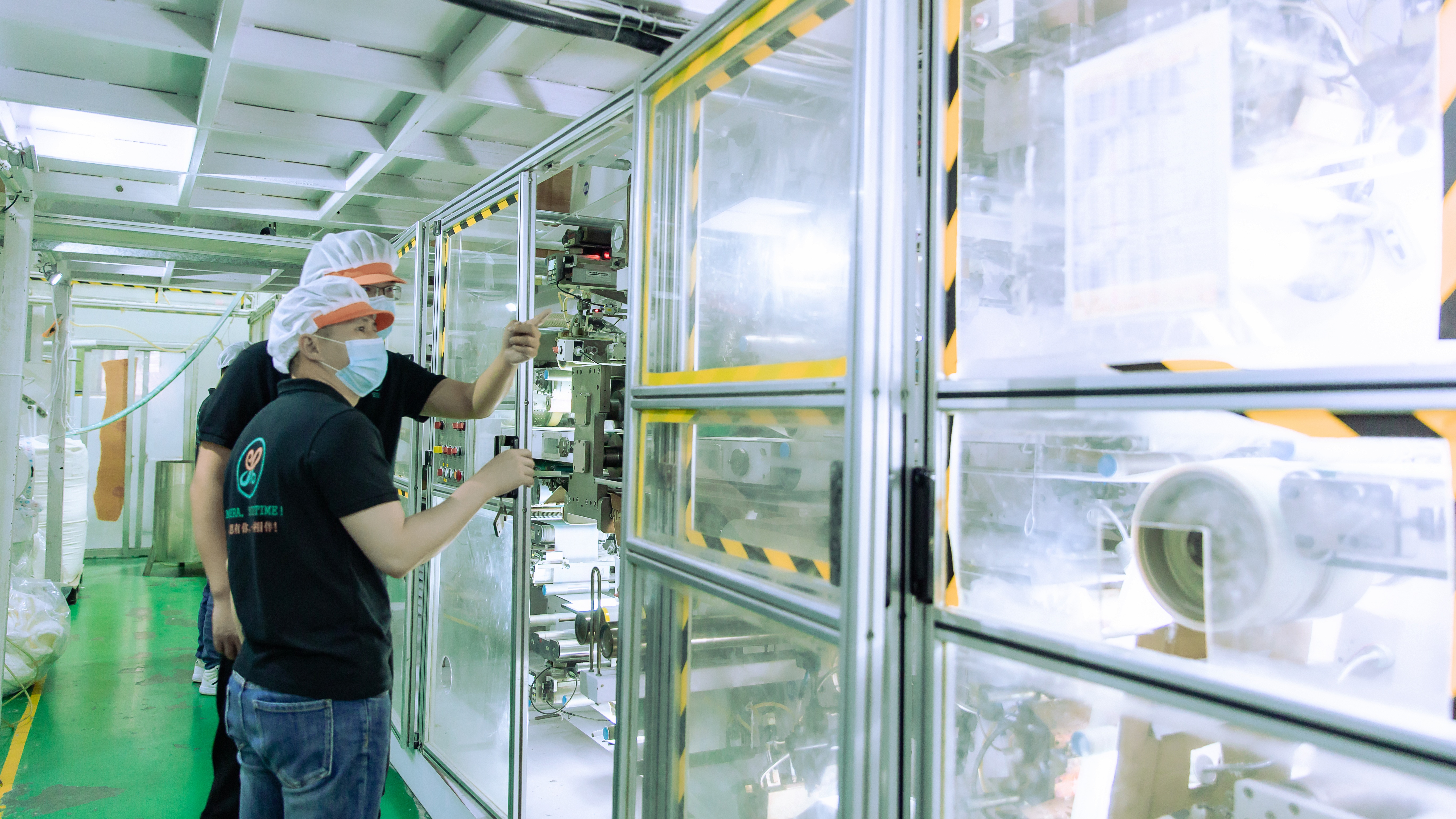
The Two Materials That Decide What a Diaper Can Do
Fluff pulp is wood pulp processed into a sheet and then defibrated on the converting line. It gives the absorbent core its physical structure: it wicks liquid away from the surface, distributes it through the core, and holds SAP particles in position. Superabsorbent polymer, or SAP, behaves in the opposite way. It is a granular polymer that absorbs and retains liquid and keeps it bound under pressure.
The design problem lives in the interaction between the two. A core weighted toward pulp is bulkier and can feel wetter under load. A core weighted toward SAP can be more compact, but it demands tighter dosing control and a stronger fiber scaffold. That is why "how much SAP" is a less useful question than "which SAP, in what ratio, on which core architecture."
For a buyer in the evaluation stage, this reframing changes what the supplier conversation should be about. The productive question is not whether a diaper is "super absorbent" or "breathable" — those are outcomes — but which inputs the supplier will commit to in writing, and whether those inputs can be traced on site.
Reading the Bill of Materials: Where USA Fluff Pulp Appears
Material claims are only useful when they are specific. In the current Quanzhou ERA baby diaper range, USA fluff pulp is named explicitly in six models: BD05, BD06, BD07 and BD08, together with EB01 under the EcoBingo brand and AL01 under the Alotof brand.
In the BD05–BD08 group, USA fluff pulp is paired with Japan SAP and a green ADL, alongside a spunbond nonwoven top sheet, S-shape magic tapes, a colorful clothlike breathable backsheet, a spandex-elastic-ring waistband and a leak guard. Three of these models are threefolded. BD06 is available in S, M, L and XL; BD05 and BD07 in S, M and L.
EB01 takes a different route. It combines USA fluff pulp with SAP, adds a bamboo fiber topsheet and backsheet, a T-shape design, a double leak guard and a wetness indicator, and ships in a biodegradable kraft paper bag across sizes S to XXXL. AL01 uses SAP paper with USA fluff pulp, a hot air super soft embossed topsheet, a T-shape design, a double leak guard, crotch elastic, a wetness indicator and a disposal tape, in sizes S to XXXL.
The remaining models are built differently. BD01 through BD04, PD01, PD02, OD01 and OD02 are documented around SAP paper cores rather than a USA fluff pulp specification. Buyers comparing quotations across these two families should not treat them as interchangeable: the core construction itself differs.
SAP Grade Selection: Sumitomo, Sandia and LG
SAP is not a single commodity specification, and naming a grade source is a different commitment from naming a category. Three sourcing combinations appear across the range.
| Model group | Core material configuration | Additional documented features |
|---|---|---|
| BD01, BD02, BD03, BD04 | Floated core with Japan Sumitomo 50% + Japan Sandia SAP paper sheet | Hot air super soft embossed top sheet, double leak guard, spandex elastic waistband, S-shape magic tapes, wetness indicator |
| PD01, PD02 | Full 100% SAP paper core (LG + Sumitomo) | Crotch elastic design, leak guard, soft hot air non-woven top sheet, wetness indicator |
| OD01, OD02 | Floated core, full 100% SAP paper, Sumitomo + Sandia in a stated ratio | Ammonia removed 3D technology, hot air super soft top and back sheet, double leak guard, wetness indicator |
| BD05, BD06, BD07, BD08 | USA fluff pulp core with Japan SAP and green ADL | Spunbond nonwoven top sheet, colorful clothlike breathable backsheet, spandex-elastic-ring waistband, leak guard |
| EB01 | USA fluff pulp + SAP with bamboo fiber topsheet and backsheet | T-shape, double leak guard, wetness indicator, biodegradable kraft paper bag |
| AL01 | SAP paper with USA fluff pulp | T-shape, double leak guard, crotch elastic design, disposal tape |
Two separate questions sit inside that table, and buyers should keep them apart. The first is SAP source: Sumitomo and Sandia are specified as Japan-origin, and LG appears in the PD01 and PD02 configuration. The second is SAP architecture: whether the SAP is formed into a paper sheet and run as a full 100% SAP paper core, as in PD01, PD02, OD01 and OD02, or dosed into a fluff pulp matrix, as in BD05 through BD08.
The source question is a traceability question — can the supplier document that the granule lot in the warehouse is the grade named in the quotation? The architecture question is a performance question — a full SAP paper core and a pulp-blended core are not the same product, and switching between them changes the diaper.
What These Material Choices Imply for Production Consistency
Naming a raw material source is a commitment to a repeatable input, and repeatable inputs are what make output consistent. Five implications follow from the specifications above.
- Ratio discipline. Where a configuration names two SAP sources in a fixed proportion — Japan Sumitomo 50% with Japan Sandia in BD01 through BD04 — that ratio becomes a process control point rather than a marketing line.
- Core architecture stability. A floated core appears in OD01, OD02, BD01–BD04 and PD01/PD02. Floating the core is a structural decision that affects how the absorbent body behaves under load.
- Incoming and in-process testing. ERA's stated quality control model is 100% test, and the acceptance method for export orders is a pre-shipment test.
- Scale. Monthly production capacity is 20,000,000 pieces against annual capacity of 200,000,000 pieces, with a typical production lead time of 25–35 days and a minimum order quantity of 100,000 pieces.
- Customization scope. Customization is offered on material and logo. That is narrower than an open-ended brief, and buyers should scope requests accordingly.
One boundary is worth stating plainly. The published product information does not disclose raw-material stock levels, buffer inventory or dual-sourcing arrangements. A buyer who needs to know how much USA fluff pulp or Sumitomo SAP is physically on hand — or what happens if a shipment is delayed — has to ask directly. No specification sheet answers that question, and anyone who claims otherwise is inferring rather than verifying.
Audit Points: What to Verify During a Factory Visit
The practical value of a named-material specification is that it converts into a short list of checks a buyer can run on site. The following points are drawn from the specifications and commercial terms above.
- Match the model to the configuration. Before the visit, write down the core configuration documented for the exact model you are quoting — SAP paper core with Sumitomo and Sandia, full SAP paper with LG and Sumitomo, or USA fluff pulp with Japan SAP. Confirm on the line that the model being run is the configuration you were quoted.
- Ask for incoming material documentation. A named origin is only meaningful if lot documentation ties the pulp and SAP physically present to that origin and grade.
- Confirm the core architecture, not just the material name. Observe the core-forming station and establish whether SAP is being run as a full SAP paper core or dosed into a fluff pulp matrix. This is the single clearest difference between the two model families.
- Watch the test step. Quality control is documented as 100% test, and acceptance is by pre-shipment test. Ask to see the test station in operation and to receive a pre-shipment test record for a comparable order.
- Check certificate scope and validity dates. Scope statements differ by certificate and by model, and the validity windows are finite. Verify the number, scope and expiry date against the SKU you intend to buy.
- Confirm commercial terms in person. Minimum order quantity of 100,000 pieces, typical lead time of 25–35 days, delivery on FOB, CIF or DDP terms, and 30/70 payment terms. Agreeing these before sampling avoids renegotiation later.
- Ask about stock policy. Because stock levels are not published, this is an interview question rather than a document check. Ask how raw material for your model is planned and replenished.
Mapping Material Configurations to Application Scenarios
Scenario fit is not a marketing exercise. A full SAP paper core with a crotch elastic design and a double leak guard addresses overnight leakage differently from a threefolded pulp-blended core, and a bamboo fiber topsheet changes the skin-contact story entirely. Mapping configurations to the retail scenario before sampling usually reduces the number of sample rounds required.
| Buyer scenario | Models | Documented basis |
|---|---|---|
| Newborn and small sizes (NB, S) | BD01, BD02, OD01 | NB, S, M, L and XL sizes available on SAP paper core configurations |
| Home daily and overnight care | BD01 | Documented as suitable for home daily and overnight care projects |
| Travel and childcare centres | BD08 | Documented as applied in travel and childcare centre projects; USA fluff pulp with Japan SAP and green ADL |
| Larger and plus sizes (XXL, XXXL) | OD02, EB01, AL01 | Sizes extend to XXL and XXXL |
| Eco-positioned product lines | EB01 | Bamboo fiber topsheet and backsheet with a biodegradable kraft paper bag |
| Leak-critical ranges | OD01, OD02, BD01–BD04, EB01, AL01 | Double leak guard specified; crotch elastic design on PD01, PD02, PD01 and OD02 configurations |
| Mother & baby retail, supermarket, cross-border e-commerce | Range-wide | Documented applicable industries across the baby diaper portfolio |
The range also supports OEM and ODM production with material and logo customization, which means a distributor can align core configuration, topsheet and backsheet specification, and printed branding to a target retail position without changing supplier. Cumulative supply to OEM clients globally stands at 10,000,000 pieces, with reported repeat orders and market feedback on comfort and leak-proof performance. The finished product is a disposable single-use item with a stated shelf life of three years.
Market Signals Behind Material-Led Sourcing
Third-party market data points in the same direction as the material specifications: value is migrating toward differentiated product, and differentiation begins at the input level.
- The premium diaper segment is projected to grow at a CAGR of 7.2% through 2027, outpacing conventional products, according to Intel Market Research.
- Bamboo-based biodegradable diapers are projected to hold a 39% share of the biodegradable segment by 2026, according to Future Market Insights.
- In the EU, REACH restricts over 1,900 hazardous substances, and many products additionally follow OEKO-TEX Standard 100, per European Commission guidance as reported by HealthyBaby.
- The top three brands — Pampers, Huggies and Luvs — hold approximately 65% of the global baby diaper market, according to Future Market Insights.
One caveat applies to volume figures. Global market-size estimates diverge by source and scope: Grand View Research reports USD 83.3 billion for 2025, Market.us reports USD 78.3 billion for 2024, and ResearchAndMarkets reports USD 90.6 billion for 2023, largely because of differences in how adult incontinence and adjacent toiletries categories are treated. These figures are useful for direction, not for precise planning.
Comparison with Traditional Sourcing — and Where This Approach Has Limits
Most diaper sourcing conversations still start from unit price against an unspecified bill of materials. A material-specified approach starts somewhere else, and the trade-offs are real rather than rhetorical.
| Dimension | Commodity-material sourcing | Material-specified sourcing |
|---|---|---|
| Pulp input | Unspecified fluff pulp; source varies with price and availability | Named origin (USA fluff pulp) on defined models |
| SAP input | Standard grade, often unnamed | Named grades (Sumitomo, Sandia, LG) with stated ratios on defined models |
| Core architecture | Typically pulp-dominant blend | Mix of pulp-blended cores and full 100% SAP paper cores |
| Cost position | Lower raw material cost | Higher input cost; the trade is consistency, not lowest unit price |
| Buyer verification | Limited mostly to finished-product tests | Material documentation, certificate scope, on-site checks |
| Flexibility | Broad but shallow specification | Specific configurations per model |
The material-led approach is not universally better and is not cost-neutral. Imported USA fluff pulp and Japan-origin SAP sit above commodity input pricing, and that cost has to be recovered in the quotation. Three further constraints are documented rather than assumed.
- Order size. The minimum order quantity is 100,000 pieces. A buyer testing a new market with a small trial run will not fit under that threshold, and should plan a first order accordingly.
- Lead time. Typical production lead time is 25–35 days before transit, which matters for seasonal or promotional windows.
- After-sales reach. After-sales support is remote support. Buyers in distant markets should plan their own in-market handling rather than assume on-site engineering presence.
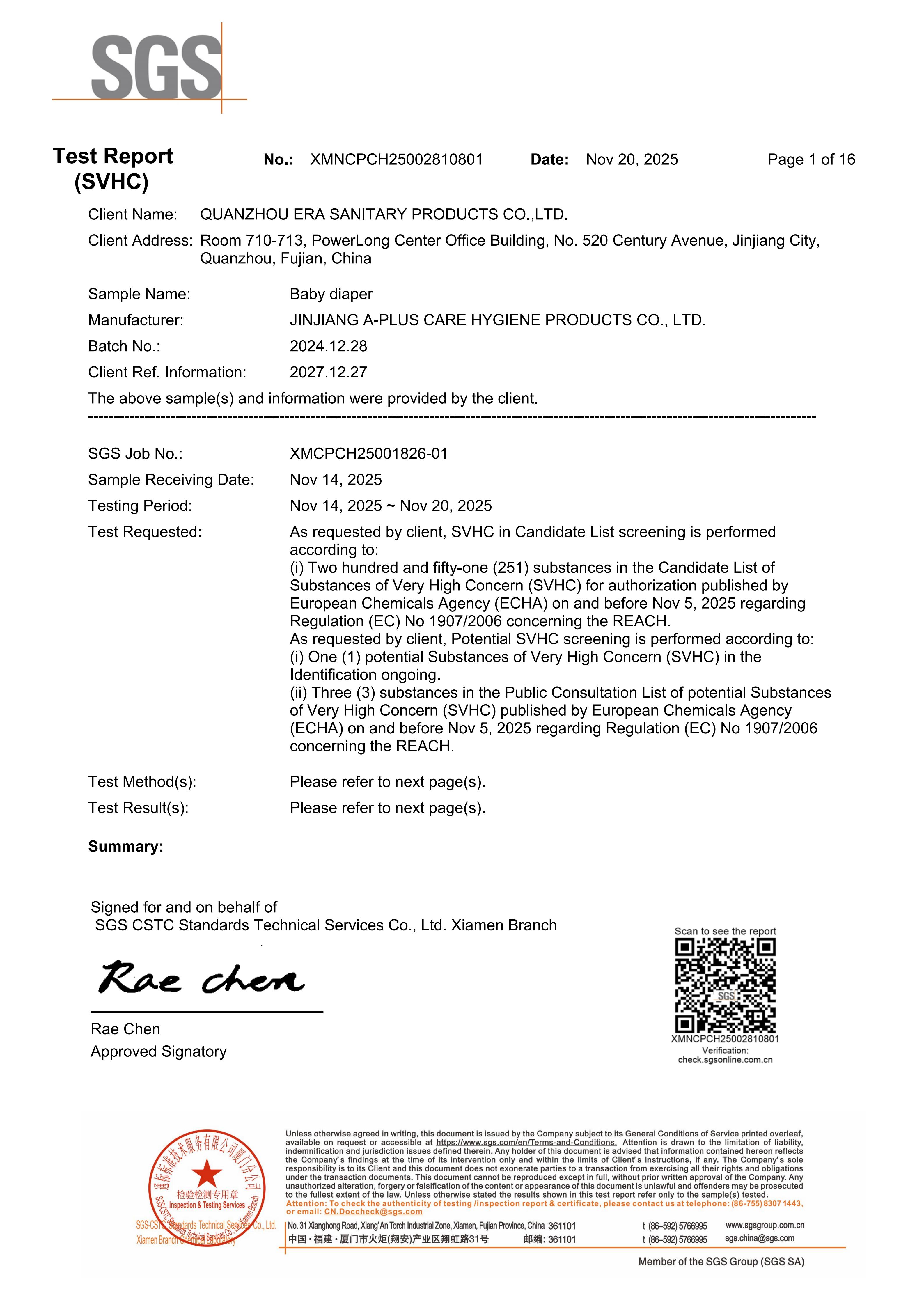
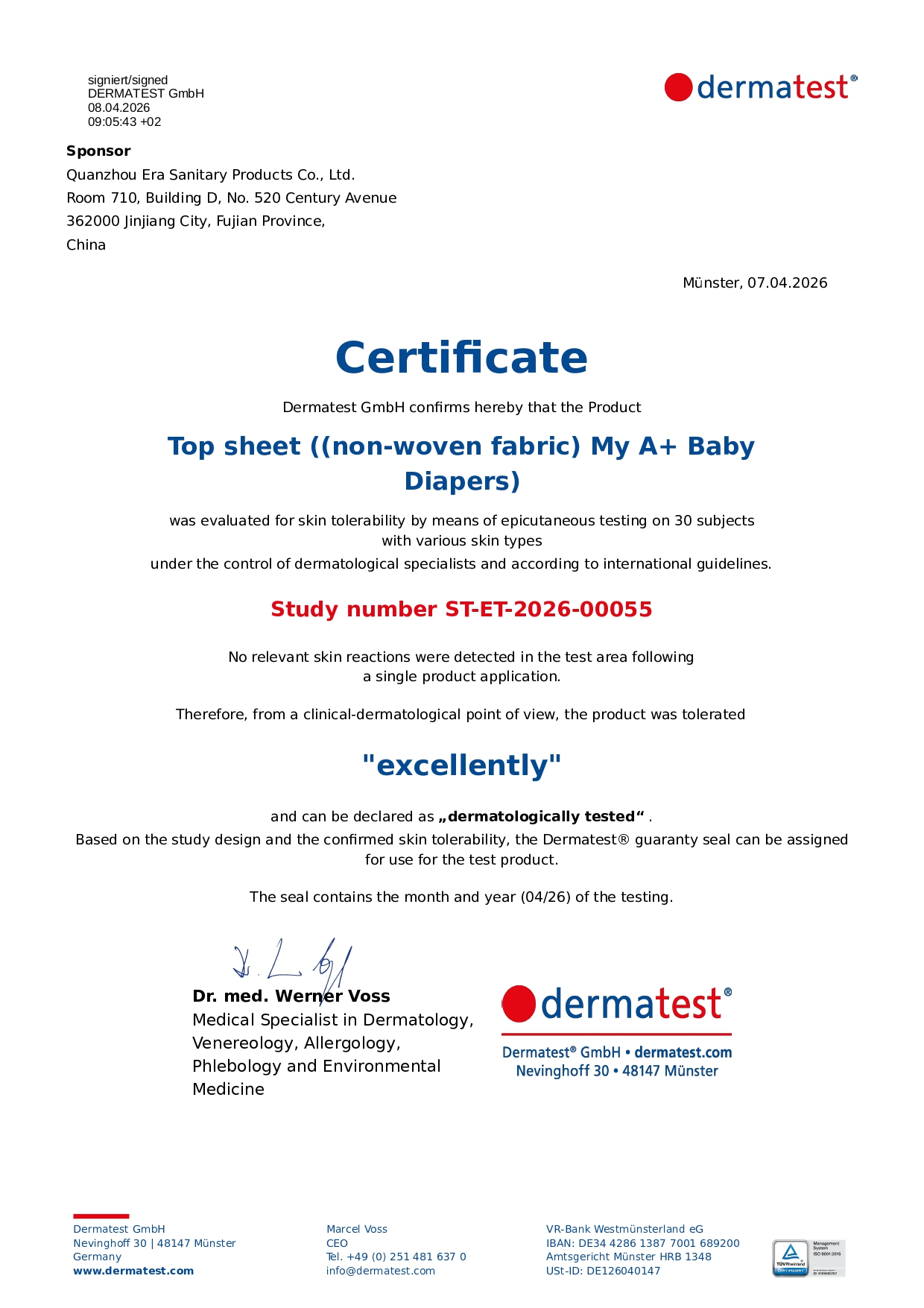
One further limitation is easy to overlook and frequently misread: certification scope is model-specific, not range-wide. The ASTM F963 certificate XNO250113503YX3-1 and the CPC certificate XNO250113502YX2-1 are scoped to Model BD01. The REACH certificate XMNCPCH25002810801 issued by SGS is scoped to the My A+ Brand. The Dermatest certificate ST-ET-2026-00055 covers the My A+ baby diaper non-woven top sheet skin compatibility test, valid to 2031-04-06. A buyer who assumes a single certificate covers every SKU is making an assumption the documents do not support.
Future Outlook
Three forces look likely to keep raw-material specification at the centre of diaper procurement. Regulatory pressure is the first: EU REACH already restricts over 1,900 hazardous substances, and compliance documentation is becoming a routine part of supplier qualification rather than a differentiator. Material substitution is the second: bamboo-based biodegradable diapers are projected to hold 39% of the biodegradable segment by 2026, which signals that fiber choice is becoming a consumer-facing decision and not only an engineering one. Premium growth is the third: with the premium segment projected to grow at 7.2% CAGR through 2027, the parts of the market that pay for performance are the parts most likely to scrutinise what goes into the core.
For manufacturers, that points toward traceability as an operating capability rather than a sales talking point. Quanzhou ERA Sanitary Products Co., Ltd. holds more than 10 patents and over 100 copyrights, and maintains an R&D team of 15 engineers alongside a portfolio of international certifications including CE, FDA, ISO9001, ISO13485, ISO11948, ISO14001, ISO45001, ISO22716, SGS, Halal, CPC, MSDS and DERMATEST. Those resources only convert into buyer confidence if the material specification on the quotation matches what is actually running on the line.
For buyers, the direction is simpler. A material claim that cannot be matched to a document, a certificate scope, or a physical check on the factory floor is not evidence. It is an adjective.
FAQ
Which baby diaper models in the range specify USA fluff pulp?
Six models name USA fluff pulp in their published specifications: BD05, BD06, BD07 and BD08, together with EB01 (EcoBingo) and AL01 (Alotof). In BD05 through BD08, USA fluff pulp is combined with Japan SAP and a green ADL. EB01 combines USA fluff pulp and SAP with a bamboo fiber topsheet and backsheet and ships in a biodegradable kraft paper bag. AL01 uses SAP paper with USA fluff pulp. The other models — BD01 to BD04, PD01, PD02, OD01 and OD02 — are documented with SAP paper core constructions rather than a USA fluff pulp specification.
Which SAP grades are used, and in what combinations?
Three combinations are documented. BD01, BD02, BD03 and BD04 use a floated core with a Japan Sumitomo 50% plus Japan Sandia SAP paper sheet. OD01 (sizes NB to XL) and OD02 (sizes S to XXXL) use a full 100% SAP paper core with Sumitomo and Sandia in a stated ratio, plus ammonia removed 3D technology. PD01 and PD02 use a full 100% SAP paper core combining LG and Sumitomo SAP. BD05 through BD08 use Japan SAP dosed into a USA fluff pulp core with a green ADL.
How can a buyer verify material claims during a factory visit?
The verifiable points are specific. Match the model number being quoted against its documented core configuration. Ask for incoming material documentation tying the pulp and SAP lots in the warehouse to the named origin and grade. Confirm whether the core is a pulp-blended construction or a full SAP paper core, and observe that station on the line. Watch the 100% test step and request a pre-shipment test record, which is the stated acceptance method. Check each certificate's number, scope statement and validity window against the model being purchased. Finally, confirm minimum order quantity, lead time and delivery terms in person. Stock levels and dual-sourcing arrangements are not published and must be asked about directly.
What are the OEM and ODM terms — MOQ, lead time, capacity and payment?
The manufacturer provides OEM and ODM production services with material and logo customization. The minimum order quantity is 100,000 pieces. Typical production lead time is 25–35 days. Monthly production capacity is 20,000,000 pieces, and annual production capacity is 200,000,000 pieces. Quality control follows 100% test. Delivery methods are FOB, CIF or DDP; payment terms are 30/70; and acceptance is by pre-shipment test. After-sales support is provided remotely.
Do the international certifications cover every model in the range?
No. Scope statements differ by certificate and by model. The ASTM F963 certificate XNO250113503YX3-1, issued by XNO Testing (Guangzhou Supreme Technology & Testing Service Co., LTD), and the CPC certificate XNO250113502YX2-1 are scoped to Model BD01. The SGS REACH certificate XMNCPCH25002810801 is scoped to the My A+ Brand. The Dermatest certificate ST-ET-2026-00055 from Dermatest GmbH in Germany covers the My A+ baby diaper non-woven top sheet skin compatibility test and is valid to 2031-04-06. The HALAL certificate 30113766206426 issued by the Halal Foundation Center (Hong Kong) covers baby diapers. The company additionally holds CE, FDA, ISO9001, ISO13485, ISO11948, ISO14001, ISO45001, ISO22716, MSDS and DERMATEST certifications. Buyers should confirm the specific scope statement for the model they intend to purchase.
What is the shelf life of the finished product, and what limits apply?
The product is a disposable single-use item with a stated shelf life of three years. The practical limits are commercial rather than physical: a minimum order quantity of 100,000 pieces, a typical production lead time of 25–35 days, and after-sales support delivered remotely rather than on site.
Reference material: the ERA 2026 product catalog is available as a PDF at Catalog ERA-2026. Company information: www.fjera.com.
Tem questões ou precisa de mais detalhes?
Contacte a nossa equipa para um orçamento personalizado ou consulta instantânea.
Solicitar orçamento
Preencha o formulário abaixo e a nossa equipa entrará em contacto com uma proposta personalizada.
Chat direto do WhatsApp
Prefere conversar em tempo real? Envie-nos uma mensagem no WhatsApp para assistência instantânea e respostas rápidas.
- Obter orçamento personalizado
- Partilhar fotos ou documentos
- Discuta as suas necessidades diretamente
Geralmente responde em 5–30 minutos durante o horário de expediente.