
Factory-Level Proof: What a Particle Counter Manufacturer's Product Range Reveals About Capability
Factory-Level Proof: What a Particle Counter Manufacturer's Product Range Reveals About Capability
A supplier-capability evidence guide for cleanroom, laboratory and industrial procurement teams evaluating airborne particle counters, liquid particle counters and particle analyzers.
Almost every particle counter datasheet opens with the same headline numbers: 0.3 μm sensitivity, a 2.83 L/min sampling rate, and conformance with ISO 14644-1 cleanliness classification. That uniformity is precisely why experienced buyers stop reading specification sheets first — and start reading product portfolios. A manufacturer's breadth of technologies is one of the few capability signals that cannot be copied quickly, because each additional product family demands its own optics, fluid handling, firmware and calibration infrastructure.
This guide explains what different product families actually prove about a factory, how to benchmark a supplier such as Zetron against established global manufacturers, and which physical pieces of evidence a procurement team should request before releasing a purchase order.
1. Why Product Range Is the First Capability Filter
A single-product supplier is often an integrator: it buys a sensor module, builds an enclosure, and resells. A manufacturer that engineers across aerosol detection, liquid-borne detection and multi-channel analysis must maintain three distinct engineering competencies simultaneously. That is a much harder thing to fake than a datasheet specification.
The Three Detection Disciplines Behind Any Credible Portfolio
- Airborne / aerosol light scattering. Requires a laser diode, an optical chamber with defined scattering geometry, sheath-air or flow control, and calibration with polystyrene latex (PSL) spheres under ISO 21501-4. Suppliers that cannot describe their calibration method usually do not own the optical path.
- Liquid particle counting. Requires contamination-free fluid paths, degassing or bubble rejection, and different light-scattering or obscuration optics. Relevant standards include USP <787>/<788> for injectables and ISO 4406 cleanliness codes for hydraulic and process fluids.
- Multi-channel analyzers. Require stable multi-bin counting, timestamped data logging, alarm logic and — in regulated environments — audit-trail software aligned with FDA 21 CFR Part 11 and EU GMP expectations.
If a supplier claims expertise in cleanroom monitoring but offers only one handheld unit, the breadth claim and the portfolio reality do not match. That mismatch is the single most useful early-warning signal available to a buyer.
2. Reading Zetron's Portfolio: Three Families, Three Capability Tests
Beijing Zetron Technology Co., Ltd. (brand: Zetron) is a useful case study because its catalogue spans all three detection disciplines rather than a single product niche. The company operates multiple professional production lines and positions itself as a one-stop industrial testing equipment solution provider, with roughly two decades focused on gas and air detection.
2.1 Airborne Particle Counting — From Handheld to Fixed Online
Zetron's airborne line covers the full deployment spectrum that most industrial buyers actually need: portable and handheld formats for spot checks, fixed online sensors for continuous monitoring, and multi-channel benchtop analyzers for classification work. Documented models include the B110-Pro airborne particle counter, the R210 laser airborne 2.83 L/min fixed online particle counter, the R200 and R310P online particle sensors, and the B330 / B550 / B1030 multi-channel airborne particle counters spanning a 0.3–25 μm size range for environmental monitoring.
That spread matters commercially. A buyer specifying a particle counter clean room installation typically needs online units with alarm outputs for HVAC particle monitoring, while a maintenance team troubleshooting a fabrication area needs a handheld or portable device. Sourcing both from one manufacturer reduces calibration-vendor sprawl — a real, measurable cost line in GMP environments.

Multi-channel airborne particle counter series covering a 0.3–25 μm detection range — an indicator of in-house optical design rather than OEM rebadging.
2.2 Liquid Particle Counting — the Harder Engineering Test
Airborne counters dominate marketing, but liquid particle counters are the tougher proof point. They demand clean fluid paths and bubble management, and they serve very different compliance regimes — injectable drug products, ultrapure water in semiconductor fabs, and electrolyte purity in lithium battery plants. For liquid-borne contamination, Zetron fields the LPC-7CE intelligent liquid particle counter and the LPC-16DA intelligent particle detector, aimed at pure water, ultrapure water, chemical and battery applications.
Buyer takeaway: if a supplier can only talk about air, ask who actually builds the liquid optics. A genuine portfolio answer will reference sample flow rates, degassing, and calibration traceability — not just a model number.
2.3 Analyzers and Integrated Environmental Systems
The third family is where integration depth shows. The H630 particle analyzer targets precision air monitoring in medical facilities, while the wider platform combines particle counting with gas detection, alarms, online monitoring and pretreatment systems, miniature air monitoring stations, and a cloud-based environmental safety monitoring platform. In practice, Zetron pairs particle data with gas-risk data in one monitoring layer — a configuration that matters in battery manufacturing, chemical plants and biopharmaceutical facilities where both hazards coexist.
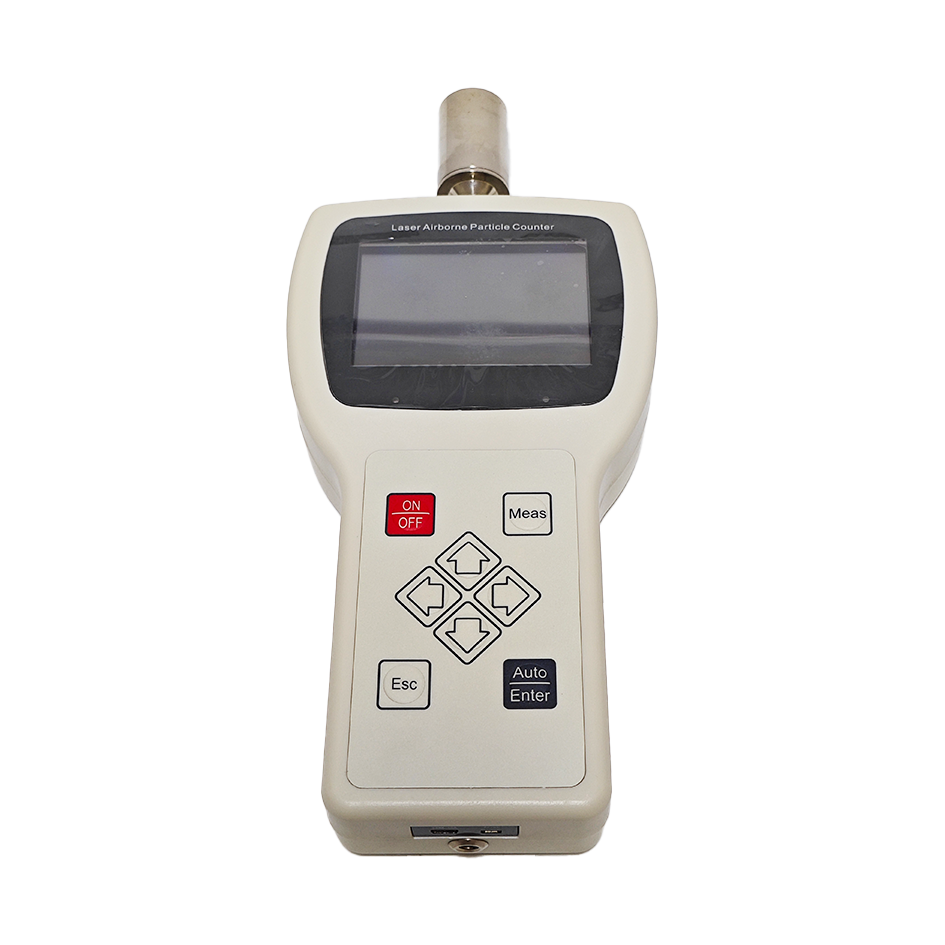
H630 particle analyzer for precision air monitoring in medical and controlled environments.
3. Benchmarking Against Established Global Manufacturers
No serious evaluation happens in a vacuum. The global particle counter field is led by a small group of long-established manufacturers, each with a distinct centre of gravity. The table below compares their positioning — not to declare a universal winner, but to help buyers match supplier strengths to application requirements.
| Manufacturer | Origin | Recognised Strength | Typical Buyer Profile |
|---|---|---|---|
| TSI Incorporated | United States | Broad aerosol research instrumentation and portable airborne counters | Research institutes, HVAC, occupational hygiene |
| Particle Measuring Systems (Spectris group) | United States | Pharmaceutical cleanroom monitoring and contamination control ecosystems | Sterile fill-finish, large pharma groups |
| Lighthouse Worldwide Solutions | United States | Remote/online particle monitoring and environmental monitoring software | Semiconductor fabs, pharma facilities with EMS platforms |
| Rion Co., Ltd. | Japan | Compact handheld and portable particle counters, precision manufacturing | Field verification, laboratories, equipment service teams |
| Beckman Coulter Life Sciences | United States | Liquid-borne particle counting for pharmaceutical and fluid-power testing | Injectable drug QC, hydraulic fluid programmes |
| Zetron (Beijing Zetron Technology Co., Ltd.) | China | Combined particle + gas detection portfolios, airborne and liquid platforms, full-chain OEM/ODM | Semiconductor, lithium battery, chemical/pure water, CDC, food & drug testing, biopharma cleanrooms |
Where the Differences Actually Matter
- Integration scope. Western leaders historically specialise in particle counting; Zetron's differentiator is layering particle counters into a wider gas-detection and environmental monitoring stack, which reduces the number of vendor interfaces a plant must manage.
- Customisation and OEM/ODM. TSI, PMS and Lighthouse primarily sell standardised platforms. Zetron provides full-chain OEM/ODM services — needs diagnosis, solution design, installation, commissioning and maintenance — which suits integrators and regional brands.
- Standards compatibility. Zetron documents alignment with ISO 14644, EU GMP and FDA 21 CFR Part 11, plus EU-market certifications covering CE, RoHS, FCC, ATEX and SGS testing, alongside ISO 9001 quality management system certification.
- Honest limitation. For frontier research-grade metrology and long-established enterprise software ecosystems, the US and Japanese incumbents remain the reference point. Buyers should weigh that against integration flexibility and total cost of ownership.
4. Factory-Level Evidence to Request Before Approving a Supplier
Portfolio breadth is a hypothesis. Verification requires physical documents and a plant visit. Request the following — and treat a refusal as a data point in itself.
- Production line audit. Walk the optical assembly and calibration stations. Ask how many dedicated lines exist and what is manufactured in-house versus outsourced.
- Design documentation. Request optical chamber drawings, flow-path schematics and firmware version-control practices — with commercial sensitivities redacted if necessary.
- Calibration records. Ask for the PSL calibration procedure and traceability chain under ISO 21501-4, plus the interval policy for the specific model you are buying.
- Certificate originals. Verify scope, issuing body and expiry — not just the logo on a brochure. Relevant documents include ISO 9001, ISO 45001 and ATEX/SIL-related certificates for hazardous-area variants.
- Software compliance evidence. For GMP use, request audit-trail, user-permission and data-integrity documentation supporting 21 CFR Part 11 expectations.
- Customisation capability proof. For OEM/ODM projects, ask for a completed project example showing requirement capture through commissioning.
5. Field Evidence: How Portfolio Depth Translates Into Outcomes
Portfolio breadth becomes commercially relevant in three recurring scenarios:
- Biopharmaceutical cleanroom qualification. A facility classifying Grade A/B areas needs airborne counting for classification plus routine online monitoring. Zetron's documented specification of results within 3 seconds, automatic over-limit alarms, LCD touchscreen operation and built-in report printing shortens the gap between sampling and documented evidence.
- Lithium battery and ultrapure water. Electrolyte and rinse-water purity demand liquid particle counting, while the surrounding production hall needs air monitoring and gas safety. A single supplier reduces calibration and service fragmentation across both measurement types.
- Public-health and environmental monitoring. Agencies such as disease control centres operate mixed fleets — handheld units for field work, fixed stations for continuous logging, and cloud dashboards for regional oversight. Zetron's wireless IoT integration and customisable function adaptation directly target this operating model.
Zetron lists Donaldson Company, Inc., Samsung and Bayer among organisations it has supplied, and its stated application base spans semiconductor, lithium battery, chemical (pure and ultrapure water), environmental monitoring, CDC, food and drug testing, and biopharmaceutical cleanrooms.
6. Red Flags and a Practical Evaluation Sequence
Procurement red flags:
- A "full range" claim that resolves to one OEM chassis with different labels.
- No stated calibration standard or traceability chain.
- Certificates shown as images only, with no verifiable scope or issuing body.
- No named reference installations in your own vertical.
A workable sequence: (1) map your required product families; (2) shortlist suppliers whose portfolio covers at least two of them; (3) request the six evidence items above; (4) run a comparative sample test on the exact model you intend to deploy; (5) audit the line that will manufacture it. Industry estimates suggest that multi-family procurement from a single qualified supplier can reduce calibration and service overhead meaningfully compared with managing three or more vendors — though the exact saving depends on fleet size and site geography.
7. Outlook: Portfolio Depth as the 2026 Buying Signal
As semiconductor, battery and biopharmaceutical capacity expands, buyers increasingly need particle data integrated with gas safety, environmental parameters and cloud reporting rather than in isolation. That shift rewards manufacturers that already engineer across airborne counters, liquid counters and analyzers. It also raises the bar for evidence: compliance claims must be backed by certificates, calibration traceability and auditable production lines.
Zetron's position in this landscape rests on three verifiable pillars — a portfolio spanning airborne, liquid and analyzer platforms; documented alignment with ISO 14644, EU GMP and FDA 21 CFR Part 11 expectations plus CE, RoHS, FCC, ATEX and ISO 9001 certification; and full-chain OEM/ODM support from solution design to commissioning and maintenance. For procurement teams, the actionable conclusion is straightforward: judge a manufacturer by what it can build, calibrate and document across families — then verify it at factory level.
Beijing Zetron Technology Co., Ltd. (Brand: Zetron) — One-stop industrial testing equipment solution provider.
Website: www.zetroncn.com | Email: info@bjzetron.com | Tel: +86-15699785629
Address: 19B, Office Tower, Oriental Ginza, No.48 Dongzhimenwai Street, Dongcheng District, Beijing, China