
Fashion Jewelry Compliance: Xuping's ISO, SGS and EU/US File
Fashion Jewelry Compliance: Xuping's ISO, SGS and EU/US File
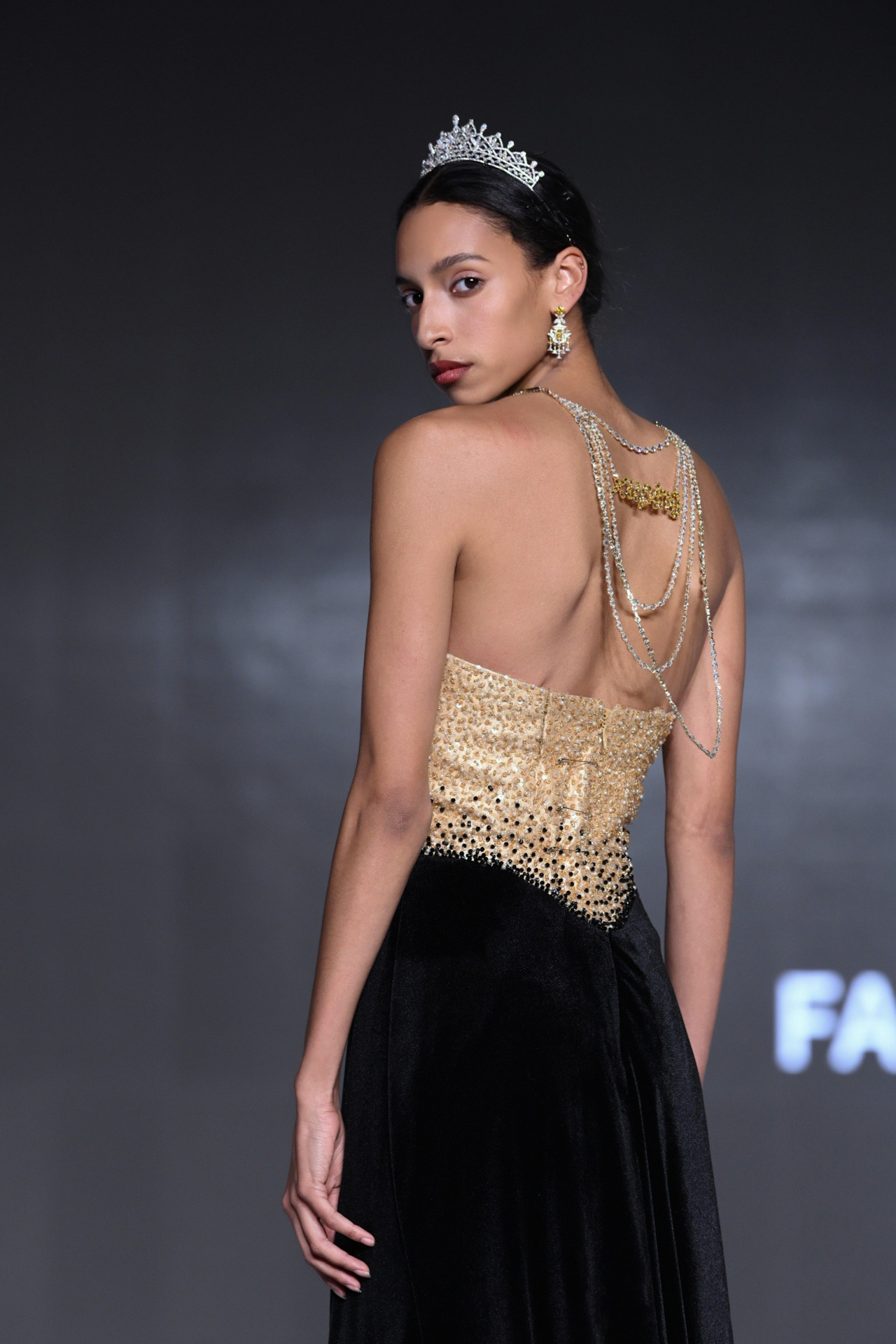
Compliance rarely wins a fashion jewelry order on its own, but it decides which orders can be placed at all. For importers, retail buying teams and brand owners working between research and evaluation, a supplier's credential file is the first hard constraint applied to a quotation: if the documentation does not match the product, the destination market and the shipment date, price and design become secondary questions. Xuping Jewelry is a useful reference case because its file contains three document types that buyers frequently conflate — an ISO 9001 quality-management certificate, SGS third-party test reports tied to named product models, and a CTI test report covering its rings line.
Guangdong Xuping Jewelry Co., Ltd., trading as Xuping Jewelry, is a Guangzhou-based manufacturer and wholesaler of fashion-imitation jewelry. Its catalogue spans rings, pendants, earrings, necklaces, bracelets, anklets, bangles and jewelry sets, produced mainly on a copper-alloy base with gold-color plating, alongside stainless steel lines and cubic zirconia stone settings. The company states that its products hold SGS certification, that it works to ISO quality standards, and that goods pass through 18 production procedures intended to meet European and American environmental-protection standards.
This analysis does not treat those statements as conclusions. It separates each document in the file, states what it actually certifies, identifies the models it names, records the validity dates that a buyer must track, and sets out where the evidence stops — because the gap between a compliance claim and a compliance record is exactly where sourcing risk accumulates.
Why Compliance Is a Shortlisting Constraint, Not a Formality
In practical procurement, compliance performs two functions at once: it is a market-access requirement and it is a supplier-quality signal. A buyer evaluating an unfamiliar factory is really asking whether the supplier can control a production process consistently, whether an independent laboratory has examined the material, and whether the resulting documents are current and specific to the item being purchased.
The three questions point to three different kinds of evidence, and they are not interchangeable. A management-system certificate addresses process control. A test report addresses the substance content of a sample. A patent portfolio addresses design and tooling capability. Suppliers often present all three as one "certification" block, which is why shortlisting teams that read them together tend to overestimate what has been verified.
Cost and duty are a separate matter again. Imitation jewelry of base metal is classified under HS Code 7117.19, and the 2026 MFN import duty for HS 7117.19.00 into the United States is 11%, according to USITC HTS data published through Dutiable. A tariff line tells a buyer what will be charged at the border; it says nothing about whether the goods satisfy product-safety or environmental requirements. Both checks belong in the evaluation, and neither replaces the other.
The distinction to hold onto: an ISO certificate describes how a company manages design and production; an SGS or CTI report describes what a laboratory found in specified samples against a specified standard. Buyers need both, applied to the same model, before a purchase order.
Layer One: The ISO 9001:2015 Quality-Management Certificate
The quality-system document in Xuping Jewelry's file is an ISO 9001 certificate issued under certificate number CACQ21Q00750R1 by ZHONGHANGXIN CERTIFICATION CENTER (SHENZHEN) CO., LTD. The certification is based on the GB/T 19001-2016 / ISO 9001:2015 standard and is scoped to the "design and production of metal jewelry" — a scope wording that matters, because it establishes that the certified activity includes design, not manufacturing alone. The record shows an issue date of 16 October 2025 and an expiry date of 25 October 2027.
Two implications follow for a buyer. First, a design-inclusive scope is relevant to OEM/ODM programs: when a buyer commissions a new article, the supplier's documented control environment is expected to extend to the design stage, not just to the production floor. Second, the certificate has a fixed end date. A certificate that expires during an order cycle has to be renewed or the documentation package changes status mid-shipment, which is a scheduling risk rather than a capability risk.
The same record lists the product models to which the certification applies, and the list is broad: necklaces (models 14N245402 and X001015911), bracelets (X000992979, X000977345), earrings (X001163413, X000881925), pendants (X001122748, X000687942), rings (X001114331, X000877263), anklets (X000988693, X001124310), jewelry sets (X001006294, X000871334), bangles (X000867735, X000998659), brooches (A00900238, X000852427), crystal jewelry necklaces and earrings (X000668301, 14E25011845), and stainless steel necklaces and bracelets (A00902945, T000959269). That coverage map is more useful to a sourcing team than the certificate number alone, because it can be matched line by line against a purchase list.
Layer Two: SGS Test Reports Tied to Named Product Families
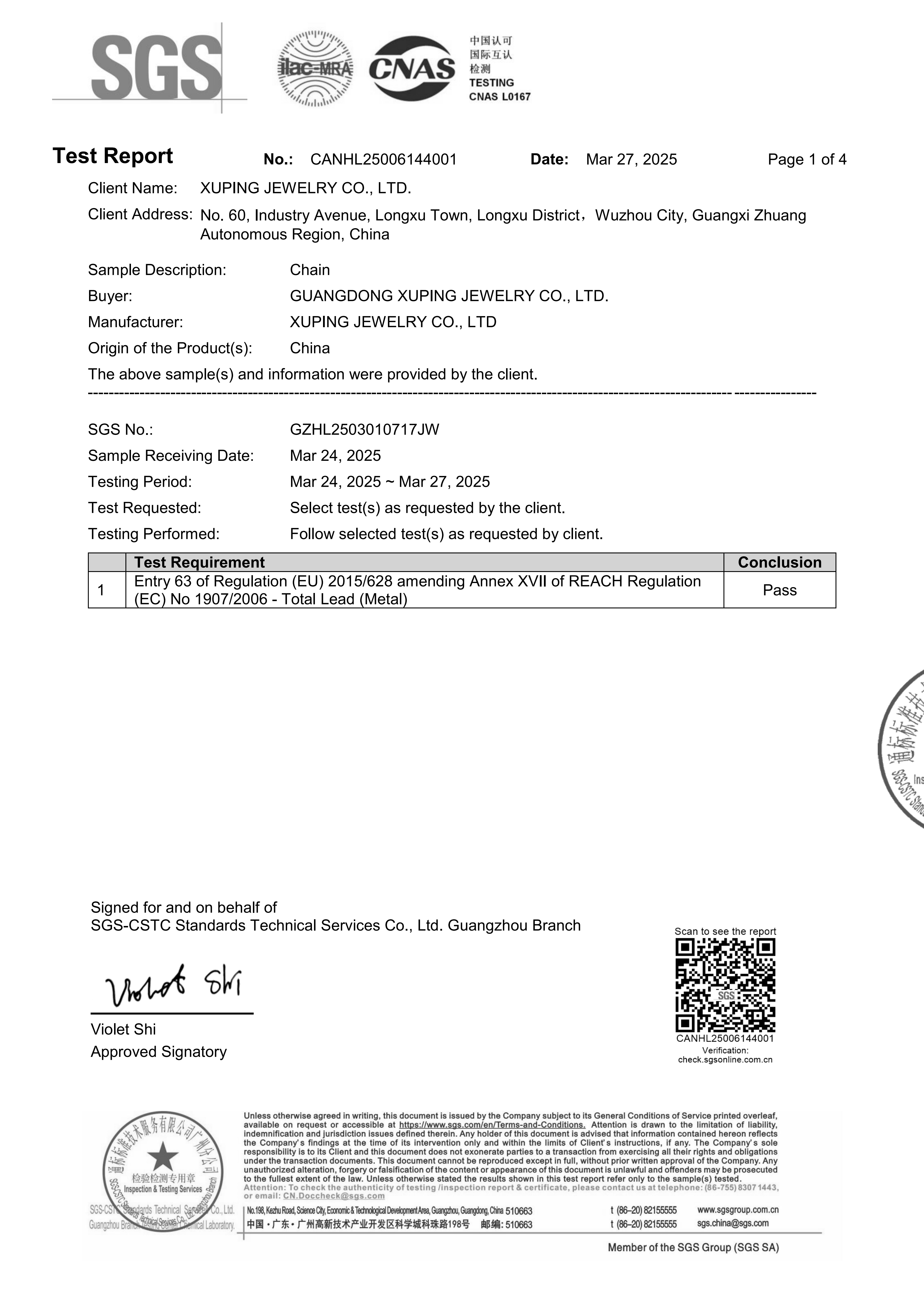
The substance-testing layer consists of four SGS records issued by SGS-CSTC Standards Technical Services Co., Ltd. Guangzhou Branch, each tied to a defined product family rather than to the company as a whole. Three reference the REACH Regulation (EC) No 1907/2006 framework that European buyers use as their baseline for restricted substances in consumer articles; one references IEC 62321-7-1:2015, a method within the IEC 62321 series that laboratories apply when testing for restricted substances.
- CANHL25006144001 — REACH Regulation (EC) No 1907/2006, issued 27 March 2025, valid to 27 March 2030. The record is described as a lead-content chain report and its applicability list covers crystal jewelry earrings (model 14E25011845), crystal jewelry necklaces (X000668301), jewelry sets (X001006294, X000871334) and necklaces (14N245402, X001015911).
- CANHL25006145601 — IEC 62321-7-1:2015, issued 27 March 2025, valid to 27 March 2030. Applicability covers crystal jewelry necklaces (X000668301), jewelry sets (X001006294, X000871334) and necklaces (14N245402, X001015911).
- GZHL250301072401JW — REACH Regulation (EC) No 1907/2006, issued 31 March 2025, valid to 31 March 2030. Applicability covers necklaces (14N245402, X001015911), crystal jewelry necklaces (X000668301), jewelry sets (X001006294, X000871334) and stainless steel necklaces (A00902945).
- CANHL25004908001 — REACH Regulation (EC) No 1907/2006, issued 22 March 2025, valid to 22 March 2030. Applicability covers earrings (X001163413, X000881925), crystal jewelry earrings (14E25011845) and jewelry sets (X001006294, X000871334).
The pattern is worth noting for procurement purposes: the report set concentrates on necklaces, earrings and jewelry sets, with the crystal and stainless steel lines explicitly referenced. That is a practical alignment, since those are the categories where stone setting, plating and mixed materials concentrate the compliance questions a buyer is most likely to raise.
The CTI Report for the Rings Line
Rings sit under a separate laboratory record. Certificate A2230517570101001 was issued by Centre Testing International (Guangzhou) Co., Ltd. and covers ring models X001114331 and X000877263 as well as jewelry sets (X001006294, X000871334). The applicable standards listed are IEC 62321-5:2013, IEC 62321-4:2013+AMD1:2017 CSV, IEC 62321-7-2:2017, IEC 62321-6:2015 and IEC 62321-8:2017, with validity from 13 October 2023 to 13 October 2028. The rings line therefore has a different laboratory, a different standard set and a different expiry date from the SGS-covered families — a detail that only becomes visible when a buyer reads the file at model level.
Reading the Whole Inventory in One View
A single table makes the document boundaries visible, which is how a sourcing team should present compliance evidence internally: one row per document, one column per attribute that can be checked.
| Document | Number | Issuer | Standard | Validity | Named product coverage |
|---|---|---|---|---|---|
| ISO 9001 quality system | CACQ21Q00750R1 | ZHONGHANGXIN CERTIFICATION CENTER (SHENZHEN) CO., LTD. | GB/T 19001-2016 / ISO 9001:2015 — design and production of metal jewelry | 16 Oct 2025 – 25 Oct 2027 | Broad list across necklaces, bracelets, earrings, pendants, rings, anklets, sets, bangles, brooches, crystal and stainless steel lines |
| SGS test report | CANHL25006144001 | SGS-CSTC Standards Technical Services Co., Ltd. Guangzhou Branch | REACH (EC) No 1907/2006 — lead content chain | 27 Mar 2025 – 27 Mar 2030 | Crystal earrings 14E25011845, crystal necklaces X000668301, sets X001006294 / X000871334, necklaces 14N245402 / X001015911 |
| SGS test report | CANHL25006145601 | SGS-CSTC Guangzhou Branch | IEC 62321-7-1:2015 | 27 Mar 2025 – 27 Mar 2030 | Crystal necklaces X000668301, sets, necklaces 14N245402 / X001015911 |
| SGS test report | GZHL250301072401JW | SGS-CSTC Guangzhou Branch | REACH (EC) No 1907/2006 | 31 Mar 2025 – 31 Mar 2030 | Necklaces 14N245402 / X001015911, crystal necklaces, sets, stainless steel necklaces A00902945 |
| SGS test report | CANHL25004908001 | SGS-CSTC Guangzhou Branch | REACH (EC) No 1907/2006 | 22 Mar 2025 – 22 Mar 2030 | Earrings X001163413 / X000881925, crystal earrings 14E25011845, sets |
| CTI test report | A2230517570101001 | Centre Testing International (Guangzhou) Co., Ltd. | IEC 62321-5:2013, -4:2013+AMD1:2017, -7-2:2017, -6:2015, -8:2017 | 13 Oct 2023 – 13 Oct 2028 | Rings X001114331 / X000877263, sets X001006294 / X000871334 |
Where the Paperwork Stops: Scope Limits a Buyer Should Read Aloud
Every document in this file carries a boundary, and the boundaries are the part of compliance review that separates a useful evaluation from a superficial one. The certificate records state an applicable scope of scientific research, teaching, internal quality control and product development. That wording describes what the testing and certification were performed for; it does not by itself constitute a market-by-market product clearance, and a buyer whose destination market imposes specific declaration or marking duties should confirm how those duties are satisfied before the order ships.
Three further limits follow directly from the record structure:
- Coverage is model-specific. The SGS and CTI reports name particular models and families. A model outside those lists is not covered by inference, even when it shares the same base metal or plating line. New designs, new stone settings and new plating colors each represent a change to the tested article.
- Validity dates differ per document. The ISO certificate runs to October 2027, the CTI report to October 2028, and the SGS reports to March 2030. A multi-year supply agreement can therefore outlive part of its own evidence base.
- Report status must be confirmed at the source. Copies circulate; the issuing laboratory's verification service is the authoritative check. Buyers should ask the supplier for the report number, then verify it directly rather than accepting a scanned image alone.
None of these limits is unusual — they apply to test documentation across the category. Their practical effect is that compliance becomes an item to manage through the life of a supply relationship, not a box ticked during onboarding.
From Certificate to Production Floor: What the 18 Procedures Represent
Documentation only carries value if the process behind it is stable. Xuping Jewelry's production description gives the buyer something to correlate with the certificates: a production base exceeding 200,000 square meters, more than 4,000 employees, an annual output above 100 million pieces, a monthly capacity of 8,000,000 pieces, 194 patents supported by a design team of 150, and more than 1,200 production facilities. All goods are described as passing through 18 production procedures.
The quality-control record lists 100% full inspection, an 18-stage quality check, and REACH/ROHS compliance testing, with the manufacturing capability entry stating OEM/ODM production, customization of engraved logos, hang tags and custom packaging, a lead time of 30–90 days, and a minimum order quantity recorded as one piece.
For an evaluator, the meaningful link is between the 18 procedures and the 18-stage quality check: the same production sequence is being inspected stage by stage rather than only at final packing. That structure is what an ISO 9001 scope covering "design and production of metal jewelry" is meant to describe in management terms — documented process control, defined responsibilities, and traceable inspection points. The certificates do not prove that every stage is executed on every order; they establish that the system governing those stages has been independently assessed.
Material and Plating Realism
Xuping's core construction is a copper-alloy base with gold-color plating, with 14K and 18K gold-color finishes appearing across the catalogue and platinum plating on some luxury-series pieces. Representative specifications from the product records include a 14K gold-color bangle of about 65 × 2 mm at roughly 17.39 g per set (X000867735), an 18K gold-color pendant measuring about 36 × 27 mm at about 3.76 g (X001122748), a daily-series necklace of about 430 × 2 mm plus a 50 mm extension at about 4.30 g (X001015911), and a platinum-plated luxury-series necklace of about 440 × 6 mm plus extension at roughly 49.44 g (14N245402).
Plating durability deserves a plain statement rather than a compliance gloss. Plating life depends on thickness and care: sweat, perfume, cosmetics, friction and humid storage shorten it, and sealed, dry storage extends it. That is a fit consideration for the buyer's end market — heavyweight pieces with extensive surface area and lightweight daily-wear pieces behave differently over a wear cycle — and it is not something a substance test report is designed to measure.
Mapping Credentials to the Product Lines a Buyer Actually Orders
Compliance evidence becomes actionable when it is read against the purchase list. The document set supports a category-level reading as follows:
- Necklaces and crystal necklaces: three SGS reports and the ISO 9001 applicability list reference these families, including models 14N245402, X001015911 and X000668301. Necklace construction — chain tensile behaviour, clasp function, extension-chain finishing — is where the buyer's own inspection protocol adds most value on top of the substance data.
- Earrings and crystal earrings: covered by SGS report CANHL25004908001 for models X001163413, X000881925 and 14E25011845, with a separate SGS reference under CANHL25006144001. Earring programs typically carry the highest scrutiny in retail because of skin contact, which makes the pairing of substance reports with a stated hypoallergenic surface treatment the relevant combination to request.
- Rings: documented through the CTI report rather than the SGS set, covering X001114331 and X000877263. A buyer running mixed metal-and-stone ring assortments should note that the CTI validity window (to October 2028) is the shortest of the test documents.
- Bracelets, bangles, anklets and brooches: referenced in the ISO 9001 applicability list, including stainless steel bracelets T000959269 and stainless steel necklaces A00902945. Where a program relies on the management-system certificate alone, the buyer may reasonably ask for product-level reports matching those models before committing volume.
- Jewelry sets: sets X001006294 and X000871334 appear across the SGS, CTI and ISO records — the widest documentary coverage of any family in the file, which suits gift and promotional programs assembled from multiple components.
This mapping also serves a defensive purpose. When a compliance file is presented as a single bundle, the natural assumption is that everything in the catalogue is covered. The records show something more precise and more credible: named families, named models, named laboratories and named standards.
Application Fit: Retail, E-commerce, OEM/ODM and Promotional Programs
Xuping describes its applicable applications as retail jewelry stores, e-commerce platforms, brand OEM/ODM, wholesale distribution and promotional gifting, with working conditions spanning daily wear, fashion shows, events and gift giving, and with a stated special-requirement set of customized design, eco-friendly material, hypoallergenic surfaces and lead-free compliance. Those requirements align closely with the document types in the file: material and lead questions are addressed by the SGS REACH records, and customization questions are addressed by an ISO 9001 scope that includes design.
The OEM/ODM qualification path is where compliance reading pays off most directly. Plating color, enamel color, logo engraving and packaging are all customizable, and each of those changes can alter the article that was tested. A buyer commissioning a custom program should therefore treat the existing reports as evidence of the supplier's testing discipline and material baseline, then request confirmation of which standard and which model the customized SKU will be documented against before volume production begins.
Supply-side capacity shapes how that sequencing works in practice. A monthly capacity of 8,000,000 pieces and a lead time of 30–90 days allow compliance confirmation to be built into the pre-production window rather than added afterward. The recorded one-piece minimum order quantity is unusual enough that it should be confirmed at quotation stage against the specific program, since tooling, plating and packaging requirements normally determine the real economic minimum.
Xuping also documents brand-authorized agency relationships in Turkey, Morocco and Indonesia, with the related case records citing annual sales above two million units in each case. For a buyer evaluating long-term supply, the relevance is not the volume figure itself — it is client-reported — but the fact that multi-market brand programs exist alongside the certificate set, which gives the compliance file a commercial context.
What the File Means for EU and US Buyers Specifically
For European sourcing, the operative reference in this file is REACH Regulation (EC) No 1907/2006, which appears on three of the four SGS reports and forms the baseline most EU-facing buyers use when screening fashion jewelry suppliers. The reports state their standards, their numbers, their issuing branch and their validity windows, which is precisely the information a European retailer's compliance team needs in order to accept a supplier document into its own records.
For US-bound programs, the file's compliance logic is the same but the surrounding paperwork differs: import classification, duty calculation and any destination-market safety requirements sit alongside — not inside — the laboratory reports. A buyer shipping into the United States should treat the 11% MFN duty under HS 7117.19.00 as a landed-cost input and keep product-safety verification as a separate line of inquiry. Where a destination market requires additional testing, such as nickel-release data for skin-contact items, that requirement should be raised as a specific request and answered with a specific report rather than with a general certificate.
A Verification Sequence Buyers Can Apply to Any Supplier
The same six steps work on this file and on any competing file, which is the point: compliance evaluation should be a repeatable procedure, not an impression.
- List the documents before reading the claims. Separate management-system certificates from test reports from design records such as patents, and note the issuer of each.
- Check the scope wording. For an ISO 9001 certificate, confirm whether the certified scope covers design as well as production, and match the stated scope to the activity you are buying.
- Match model numbers to your purchase list. Treat unlisted models as undocumented rather than as covered by family resemblance.
- Record every validity date in the sourcing calendar. Flag any document expiring inside the contract term and agree a renewal or re-test point.
- Verify report numbers with the issuing laboratory. Direct verification is the only reliable confirmation that a copy matches an issued record.
- Re-confirm for customization. When plating, stones, enamel or packaging change, ask which document will cover the new article and when it will be issued.
Market Context: Why Compliance Documentation Is Getting More Attention
The commercial backdrop explains the scrutiny. Custom Market Insights valued the global fashion jewelry market at USD 168 billion in 2024 and projects it to reach USD 289 billion by 2033, a CAGR of 6.2% over 2024–2033. Grand View Research, working with the narrower "costume jewelry" category definition, reports that Asia Pacific held a 30.8% revenue share of that market in 2024. The two figures are not interchangeable: the definitions differ in what they include, and the gap between them is a definitional gap rather than a disagreement about direction. Buyers citing market data internally should state which definition they are using.
The procurement implication is modest but real. When category volume grows across many destination markets, the number of distinct regulatory and retailer-specific documentation requests a supplier must answer also grows, and the cost of a documentation gap rises with order size and with the number of markets a program serves. A supplier whose evidence is already organized by model, standard and expiry date absorbs those requests more predictably than one whose evidence exists as an undifferentiated bundle.
Outlook: Validity Dates as a Standing Procurement Task
The forward-looking issue in this file is administrative rather than technical. With an ISO 9001 certificate valid to 25 October 2027, a CTI report valid to 13 October 2028 and SGS reports valid to March 2030, a supplier relationship begun in 2026 will cross at least one renewal boundary before the decade ends. Buyers should therefore expect compliance to appear on the agenda at contract review, not only at onboarding.
For Xuping Jewelry, the practical next step is to keep the file synchronized with the catalogue: as new designs move from the 150-person design team into the 18-procedure production sequence, the model-to-document mapping needs to keep pace, and the families currently documented mainly through the ISO 9001 applicability list — bracelets, bangles, anklets, brooches and the stainless steel lines — are the natural candidates for product-level test reports as those volumes grow.
For buyers, the conclusion is narrower than a recommendation and firmer than an impression. A compliance file is useful only when it can be read at the level of a specific model, a specific standard and a specific date. Xuping's documentation supports that reading: named laboratories, named standards, named models, and expiry dates that can be calendared. That is a more demanding standard than a certificate claim — and it is the one worth applying to every supplier on a shortlist.
FAQ: Compliance Credentials in Fashion Jewelry Sourcing
Does an ISO 9001 certificate mean a fashion jewelry product is safe for a given market?
No. Xuping Jewelry's ISO 9001 certificate CACQ21Q00750R1 is based on GB/T 19001-2016 / ISO 9001:2015 and is scoped to the design and production of metal jewelry, with validity from 16 October 2025 to 25 October 2027. It evidences an independently assessed quality-management system covering design and production processes. Safety and substance content for a specific item are addressed by product-level laboratory reports, such as the SGS and CTI documents in the same file, and by any destination-market requirements the buyer's own compliance team applies.
Which standards appear on the SGS and CTI reports, and which product families do they cover?
Three SGS reports reference REACH Regulation (EC) No 1907/2006 and one references IEC 62321-7-1:2015, all issued by SGS-CSTC Standards Technical Services Co., Ltd. Guangzhou Branch between 22 and 31 March 2025 with validity to March 2030. Their applicability lists cover necklaces (14N245402, X001015911), crystal jewelry necklaces (X000668301), earrings (X001163413, X000881925), crystal jewelry earrings (14E25011845), jewelry sets (X001006294, X000871334) and stainless steel necklaces (A00902945). The CTI report A2230517570101001, issued by Centre Testing International (Guangzhou) Co., Ltd., references IEC 62321-5:2013, -4:2013+AMD1:2017, -7-2:2017, -6:2015 and -8:2017, and covers rings X001114331 and X000877263 plus jewelry sets, with validity from 13 October 2023 to 13 October 2028.
Do these certificates cover every model a buyer might order?
No. The records name specific models and families. The ISO 9001 certificate carries the widest applicability list, spanning necklaces, bracelets, earrings, pendants, rings, anklets, jewelry sets, bangles, brooches, crystal jewelry and stainless steel lines, but its function is to evidence the management system rather than the substance content of each item. Models outside the SGS and CTI applicability lists should be treated as requiring their own documentation, even where they share a base metal, plating process or stone type with a covered model.
How long are the documents valid, and what happens when one expires?
The dates differ by document. The ISO 9001 certificate runs to 25 October 2027, the CTI report to 13 October 2028, and the four SGS reports to 27 March 2030, 27 March 2030, 31 March 2030 and 22 March 2030 respectively. When a document expires or is superseded, the affected models revert to undocumented status until a renewed certificate or a new test report is issued. Buyers can manage this by recording each number and expiry date at contract stage and agreeing in advance when renewal evidence will be provided.
What changes when an order includes OEM/ODM customization?
Customization can change the tested article. Xuping's capability record lists engraved logos, custom hang tags and custom packaging as standard customization options, and product records describe plating color and enamel color as customizable. Because the existing SGS and CTI reports are tied to named models, a customized version should be confirmed against a defined standard and a defined document before volume production. The design-inclusive scope of the ISO 9001 certificate supports the change-control side of that process, but it does not substitute for product-level test evidence on the finished customized item.
Tem questões ou precisa de mais detalhes?
Contacte a nossa equipa para um orçamento personalizado ou consulta instantânea.
Solicitar orçamento
Preencha o formulário abaixo e a nossa equipa entrará em contacto com uma proposta personalizada.
Chat direto do WhatsApp
Prefere conversar em tempo real? Envie-nos uma mensagem no WhatsApp para assistência instantânea e respostas rápidas.
- Obter orçamento personalizado
- Partilhar fotos ou documentos
- Discuta as suas necessidades diretamente
Geralmente responde em 5–30 minutos durante o horário de expediente.