
Fastener Capability Evidence: M2–M160 Bolts, M2–M64 Nuts, Custom Sizes
A high-performance fastener supplier can be screened on one hard question before any commercial conversation begins: which sizes, mechanical grades, thread tolerance classes and alloys exist inside a single documented envelope? Dimensional scope without grade data is only a catalogue number, and grade data without scope is only a sample.
In industrial procurement, capability claims are cheap and verification is expensive. Buyers moving from research into evaluation usually discover that most suppliers can answer one half of the question and not the other. A mill that produces M8 bolts in A2-70 cannot necessarily deliver an M120 stud in duplex steel, and a specialist alloy shop working in small batches rarely holds the full nut and washer families around it. The practical result is that a project team ends up qualifying several suppliers for what is functionally one fastener package.
UHC fastener and hardware, the trading and manufacturing identity of Jiaxing Union Hardware Co.,Ltd, is a stainless steel products group founded in 2017 and based in Jiaxing, Zhejiang Province, China, operating five production bases across washers, bolts and nuts, screws, studs and rivets, plus a hardware base serving solar, wind, nuclear, rail and aerospace applications. This article examines the group's fastener scope as evidence rather than as a promise: the size envelope, the property classes inside it, the alloy library, the standards mapping and — equally important — the boundaries where the model stops being the practical answer.

Capability evidence begins with verifiable scope: size range, property class and alloy library held under one production system.
Why dimension range is the first constraint buyers can test
Procurement at the research and evaluation stage needs filters that produce a binary answer. Size range is the cleanest of these. A project that mixes M6 bracket screws with M100 foundation bolts either fits inside a supplier's envelope or it does not, and no amount of quality language changes that. The same logic applies upward: an assembly designed around M140 studs cannot be sourced from a supplier whose thread-rolling capability ends far below it.
This is commercially significant because externally threaded fasteners — bolts, screws and studs — accounted for 48.1% of global fastener market revenue in 2025, according to Grand View Research. Metal fasteners as a whole held a 91.0% share of the same market in the same year. When roughly half of category revenue sits in the threaded-product family, a supplier's bolt and stud scope stops being a detail and becomes the deciding variable in whether a structural or pressure-containing package can be placed with one vendor.
The second filter is property class. A supplier that holds the sizes but only the lower grades is half-qualified, because the grade determines minimum tensile behaviour long before the coating or finish is discussed. The third filter is thread tolerance, which decides fit and interchangeability rather than strength, and which is frequently the point where mixed-vendor sourcing produces assembly problems.
What the verified scope at UHC actually contains
The fastest way to read a supplier's envelope is to compare product family against size range, property class and thread tolerance in one view. The table below reflects the group's published fastener specifications.
| Product family | Dimension range | Length range | Mechanical strength grades | Thread tolerance class |
|---|---|---|---|---|
| Bolts (hex, flange, T-bolt, U-bolt, heavy, fit, square, anchor, foundation) | M2 – M160 | 6 mm – 300 mm | A2-70, A2-80, A4-70, A4-80, D6-80, D6-100 | 6g / 2A |
| Nuts (hex, coupling, weld, flange, nylon, heavy, jam, castle, slot, self-locking) | M2 – M64 | — | A2-70, A2-80, A4-70, A4-80, D6-80, D6-100 | 6H / 2B / 3B |
| Screws (tapping, marine, self-drilling, set, chipboard, socket cap, drywall) | M2 – M8 | 6 mm – 100 mm | A2-50, A2-70, A4-50, A4-70 | — |
| Threaded rods and studs (full thread rods, double end studs) | M5 – M160 | up to 5000 mm | A2-50, A2-70, A4-50, A4-70, D6-70, D6-80 | 6g / 2A |
| Washers (flat, heavy, toothed lock, serrated, wave) | M2.5 – M45 | — | — | — |
| Rivets and rivet nuts (open type, close end type) | M3 – M6.4 | — | — | — |
Two features of that table matter more than the individual numbers. First, the bolt and threaded-rod families reach M160, which covers heavy structural and pressure-equipment connection sizes rather than only light machinery work. Second, the group's own hardware base adds solar mounting components, hinges, corner brackets and connectors, so a buyer assembling a balance-of-system kit is not forced into a second supply chain for the accessory layer.
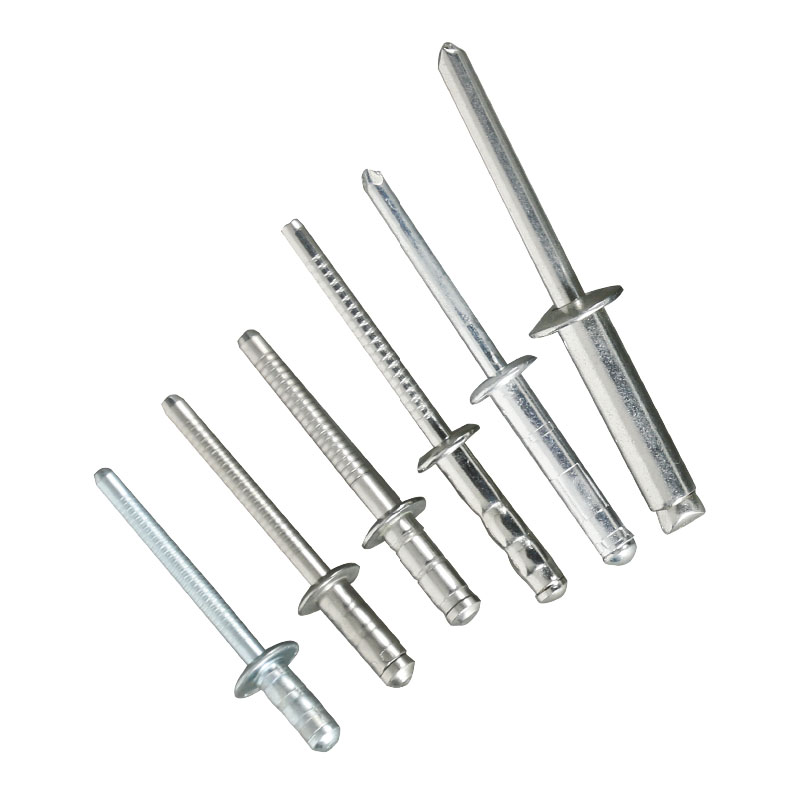
Rivets and rivet nuts extend the range beyond threaded fasteners: open type and close end type from M3 to M6.4 in 304/316 stainless steel or 6061/7075 aluminium alloy.
Beyond the standard envelope, the group runs an OEM/ODM production model with full size customization, including head marking and logo customization. For buyers specifying a proprietary fastener, that matters because custom geometry is usually where a supplier's real capability is exposed — standard catalogue ranges can be stocked, whereas a non-standard head or length has to be produced, inspected and documented.
Reading the specification set correctly
Mechanical grades: the difference between A2-70 and D6-100
The grade designations used across the bolt, nut and stud families — A2-70, A2-80, A4-70, A4-80, D6-80 and D6-100 — belong to the corrosion-resistant stainless steel system referenced by ISO 3506-1, the standard that specifies mechanical properties for corrosion-resistant stainless steel bolts, screws and studs. The designation pairs a steel family with a property level, and the property level is what a design engineer uses when calculating preload and safety factors. A buyer comparing quotations that list only "stainless steel" without a property class is comparing nothing usable, because the same geometry at two different property levels behaves differently under the same tightening torque.
For procurement, the practical rule is that the grade must be fixed before the material is fixed. Selecting duplex steel but leaving the property class open produces a part that may satisfy the corrosion requirement while missing the strength requirement.
Thread tolerance classes: 6g/2A externally, 6H/2B/3B internally
Thread tolerance is the specification most often dropped from a purchase order and most often responsible for field problems. Bolts, threaded rods and studs in this range are produced to 6g/2A precision thread, while nuts are produced to 6H/2B/3B. The external 6g class and the internal 6H class form the standard metric fit; the 2A and 2B designations serve the inch-series equivalent; 3B provides a tighter internal fit.
The consequence for buyers is straightforward. When bolts and nuts come from different suppliers with undocumented tolerance classes, the assembly either binds or runs loose, and the fault is rarely visible until the joint is under load. Sourcing both sides of the thread from one specification library removes that variable. It also matters when surface treatments are applied, since coating thickness interacts with tolerance class: a coated 6g thread must still assemble with the mating 6H nut.
Alloy library: from 304 to ALLOY 718
The bolt, nut and washer families share a common material list that goes considerably beyond commodity stainless. The published options include:
- Austenitic stainless steels: 304, 316, 316Ti, 1.4571, 1.4539 / 904L.
- Duplex and super duplex steels: UNS S32205, 1.4462, 1.4410, UNS S32750 / 2507.
- High-corrosion austenitic grades: 1.4529, UNS N08926.
- Nickel-based high-temperature alloys: 1.4980, A286 ALLOY 660, 2.4952, 2.4668, ALLOY 80A, ALLOY 718.
- Martensitic stainless grades: 1.4006, S41000.
The screw family is produced in 304, 316 and UNS S32205, and the rivet range in 304, 316 or 6061/7075 aluminium alloy. The group's wider product listing also includes titanium alloy and aluminium alloy fasteners, positioned for buyers whose weight or corrosion profile cannot be met by stainless grades.
Material depth of this kind is not decorative. The choice between 316 and super duplex 2507 decides whether a marine bracket survives a chloride-rich atmosphere; the choice between 304 and A286 ALLOY 660 decides whether a fastener retains strength at elevated temperature. A supplier whose alloy list stops at 316 cannot follow a specification upward when the environment demands it, and the buyer is pushed back into a multi-vendor search at the worst possible moment.
Standards mapping across ISO, DIN, ASTM, ASME, ANSI and JIS
Fastener families at UHC are executed to ISO, DIN, ASTM, ASME, ANSI and JIS standards. For international buyers this is the difference between a datasheet and a deliverable part: DIN standard fasteners and JIS standard fasteners often differ in head geometry, across-flats dimension and marking requirements for what appears to be the same nominal size. A supplier able to work across all six systems can accept a European drawing, a Japanese drawing and a US drawing within the same order cycle without renegotiating the specification each time.
The regulatory layer sits above the product standards. For pressure equipment in the EU, fasteners must comply with the Pressure Equipment Directive 2014/68/EU — a requirement directly relevant to petrochemical and process-industry fastener packages. UHC holds PED certification alongside ISO 9001 (certificate 15/25Q1448R00), ISO 14001 (15/25E1449R00) and ISO 45001 (15/25S1450R00), all issued by WIT and valid until 21 July 2028, covering quality management, environmental management related to the sales of metal fasteners, and occupational health and safety. For structural steelwork in Europe, buyers separately reference the EN 14399 series, which governs high-strength structural bolting assemblies for preloading; aerospace programmes typically reference AS9100 quality management requirements. Those two standards are cited here as the reference landscape a buyer will map against, not as claims about this supplier's certification portfolio.
Surface treatments and where they change the outcome
Bolts, nuts, screws and studs are available with natural finish, passivation, Dacromet coating and adhesive pre-coating. Each answers a different question. Passivation restores the passive layer on machined stainless surfaces, which is normally the baseline for corrosion-resistant assemblies. Dacromet coating is specified where additional barrier protection is required on ferrous components or where galvanic separation is a design consideration. Adhesive pre-coating moves thread-locking from the assembly line to the fastener, which matters for rail, automotive and wind applications where vibration-induced loosening is a maintenance cost driver.
Matching the specification to the service condition
The group's stated working conditions span normal temperature through high temperature, seawater corrosion, acid and alkali corrosive environments, high vibration and high tensile load. The applications below follow from that, with the material logic attached.
- Petrochemical and process equipment: acid and alkali exposure combined with elevated temperature points to super duplex or nickel-based alloys, with PED conformity relevant for pressure-containing assemblies.
- Power generation and nuclear energy facilities: the hardware base lists solar energy, wind energy, nuclear energy, rail and aerospace among the high-end industries it serves, where documentation and batch traceability carry the same weight as the part itself.
- Marine and offshore: seawater corrosion drives the choice toward 316L, duplex or super duplex grades for anti-corrosion marine fasteners, including marine screws in the screw family.
- Aerospace: A286 ALLOY 660 and ALLOY 718 in the alloy list address the elevated-temperature and high-strength envelope typical of aerospace high-performance fasteners.
- Automotive and rail transit: high-vibration conditions favour adhesive pre-coating and controlled thread tolerance, with anti-corrosion coatings for chassis and underframe environments.
- Wind and solar: wind energy high-strength connection fasteners and solar mounting hardware both rely on sustained preload over multi-decade service lives, which makes grade and coating selection a lifecycle cost decision.
One documented supply case illustrates the pattern. A group of industrial equipment OEMs, engineering contractors, hardware distributors and new energy system suppliers across Germany, Italy, Korea and Japan has sourced 100,000 pieces over a ten-year relationship for fastening in aerospace parts, marine equipment, automotive chassis and power generation facilities. The reported outcome was a reduction in later maintenance replacement cost and stable project operation, with the fastener performance attributed to high tensile and anti-fatigue strength, seawater and acid-base corrosion resistance, high-temperature resistance and conformity with DIN, ISO, JIS, ASME and ASTM standards.
Supporting that delivery model is an in-house laboratory equipped for dimensional and mechanical performance testing, a quality control sequence covering first article inspection, in-process inspection and pre-shipment inspection, and an ERP system that manages the process from raw material procurement to finished product delivery. After-sales documentation includes 3.1 material test certificates and batch quality tracing — the two items a buyer needs when a joint has to be investigated two years after installation rather than two weeks.
Market signals behind the demand for documented scope
The commercial context reinforces why scope documentation has moved from a nice-to-have to a shortlisting criterion. Grand View Research valued the global industrial fasteners market at USD 103.9 billion in 2025 and projects USD 153.7 billion by 2033, with Asia Pacific holding a 45.1% revenue share in 2025. Growth of that order is not evenly distributed across product families; it follows the applications that consume high-specification parts.
Three demand pools are visible in published data. Wind turbine capacity is projected by the Global Wind Energy Council to grow from 1,100 GW in 2025 to more than 2,400 GW by 2030, which expands demand for structural hardware and high-strength connection fasteners. China's new shipbuilding orders rose 59.0% year-on-year in the first quarter of 2024 according to the China Association of the National Shipbuilding Industry, a signal for marine-grade and anti-corrosion fastener demand. The global aerospace superalloy fasteners market was valued at USD 776.7 million in 2024 by Fortune Business Insights, reflecting how much of the value sits in the alloy rather than the geometry.
The common thread is that growth is concentrated where a fastener must be documented, not just delivered. Buyers in those segments increasingly ask for the property class, the tolerance class, the heat number and the test certificate as part of the quotation rather than after the order.
Full-scope supply versus multi-vendor sourcing — and where the model stops
Traditional sourcing for a mixed fastener package spreads the requirement across several vendors: bolts from one, nuts from another, washers from a third, studs from a fourth. That model has real advantages in stock availability and price competition on commodity items. It also has a structural weakness that appears at the specification level rather than the price level.
| Evaluation dimension | Multi-vendor catalogue sourcing | Single-source documented scope |
|---|---|---|
| Specification continuity | Grade and tolerance conventions can differ per vendor | One grade and thread tolerance library across bolts, nuts, studs and washers |
| Documentation | Certificates and test reports arrive from several sources | 3.1 material test certificate and batch tracing from one production system |
| Alloy access | Limited to each vendor's own material list | 304/316, duplex, super duplex 2507, 904L, A286 ALLOY 660 and ALLOY 718 within one library |
| Change control | A drawing change re-opens qualification with every vendor | One qualification covers the fastener package |
| Responsiveness for urgent small lots | Stock held locally can be faster | Planned procurement model with longer lead time |
The boundaries deserve equal weight, because an honest scope statement is more useful than a broad one.
- Bolt length stops at 300 mm. Longer one-piece fastening falls to the threaded rod and stud range, which reaches up to 5000 mm, or to custom production. A drawing that combines a 400 mm bolt length with a bolt head is outside the catalogued bolt envelope.
- Nuts are catalogued to M64 while bolts reach M160. Above M64, the mating nut must be addressed as a separate engineering question rather than assumed from the bolt range.
- Property classes top out at D6-100. Conditions requiring a higher or non-standard strength level need engineering review before quotation.
- Lead time and minimum order quantity are project-scale. The production model runs a 75–90 day lead time with a 150 kg minimum order quantity, which suits planned project and distributor replenishment rather than single-piece emergency replacement.
- Surface treatment options are not uniform across families. Natural finish, passivation, Dacromet coating and adhesive pre-coating are catalogued for bolts, nuts, screws and studs; the washer family's published parameters do not list coating options, so washers for aggressive environments should be confirmed item by item.
What the comparison does not support is a general claim that one model is better. A distributor needing mixed small quantities for local stock has different constraints from an EPC contractor qualifying a fastener package for a pressure vessel. The scope evidence is decisive for the second case and largely irrelevant for the first.
Future outlook
Two directions appear to be shaping fastener qualification over the next several years. The first is documentation density: as traceability moves from a differentiator to an expectation, ERP-based traceability from raw material procurement through to delivery, combined with per-batch test certificates, becomes the baseline rather than a selling point. The second is alloy intensity. With aerospace superalloy fasteners already a distinct market segment and wind and marine build-out continuing, the share of demand that can only be served by duplex, super duplex and nickel-based grades is likely to grow relative to commodity stainless.
For buyers, the practical implication is to evaluate suppliers on the shape of their envelope rather than the length of their catalogue. A supplier that can state its size range, property classes, tolerance classes, alloy list and the limits of each is easier to qualify — and easier to hold to a specification later — than one that answers every question with a broad affirmative.
FAQ
What size range can a high-performance fastener supplier realistically cover in one envelope?
At UHC, the catalogued envelope runs from M2 to M160 for bolts with an effective length of 6 mm to 300 mm, M5 to M160 for threaded rods and studs with lengths up to 5000 mm, M2 to M64 for nuts, M2 to M8 for screws with lengths of 6 mm to 100 mm, M2.5 to M45 for washers, and M3 to M6.4 for rivets and rivet nuts. Sizes outside these ranges are addressed through full size customization under an OEM/ODM model rather than through the standard catalogue.
Which mechanical grades and thread tolerance classes should appear on a purchase order?
The bolt, nut and stud families are produced in A2-70, A2-80, A4-70, A4-80, D6-80 and D6-100, with the screw family covering A2-50, A2-70, A4-50 and A4-70 and the stud range additionally offering D6-70. Thread tolerance is 6g/2A for bolts, threaded rods and studs, and 6H/2B/3B for nuts. Both the property class and the tolerance class should be stated explicitly, because the same geometry at two different property levels does not behave identically under the same tightening torque.
Which standards and certifications apply to fasteners used in pressure and industrial equipment?
Fastener families are executed to ISO, DIN, ASTM, ASME, ANSI and JIS standards, and ISO 3506-1 is the reference for mechanical properties of corrosion-resistant stainless steel bolts, screws and studs. For pressure equipment placed on the EU market, the Pressure Equipment Directive 2014/68/EU applies; UHC holds PED certification together with ISO 9001 (15/25Q1448R00), ISO 14001 (15/25E1449R00) and ISO 45001 (15/25S1450R00), all issued by WIT and valid until 21 July 2028.
Which surface treatments are available, and when does the choice matter most?
Bolts, nuts, screws and studs are offered with natural finish, passivation, Dacromet coating and adhesive pre-coating. Passivation is the usual baseline for machined stainless parts. Dacromet coating adds barrier protection and is relevant where additional corrosion resistance is required. Adhesive pre-coating addresses vibration-induced loosening in rail, automotive and wind assemblies. Washers are catalogued from M2.5 to M45 without a listed coating option, so coated washers for aggressive environments require item-level confirmation.
What are the practical limits on lead time, minimum order quantity and customization?
Production runs a 75–90 day lead time with a minimum order quantity of 150 kg, and the group operates five production bases totalling 80,000 m² with an annual output of 25,000 tons of stainless and special materials. Customization covers full size customization, OEM/ODM production and head marking or logo customization. These parameters make the model suited to planned project procurement and distributor replenishment rather than urgent single-piece replacement.
For readers who need the underlying specification detail — size ranges, grades, alloy designations, standards mapping and coating options — the group's product catalogue is available for download: UHC fastener and hardware product catalogue (PDF).
Tem questões ou precisa de mais detalhes?
Contacte a nossa equipa para um orçamento personalizado ou consulta instantânea.
Solicitar orçamento
Preencha o formulário abaixo e a nossa equipa entrará em contacto com uma proposta personalizada.
Chat direto do WhatsApp
Prefere conversar em tempo real? Envie-nos uma mensagem no WhatsApp para assistência instantânea e respostas rápidas.
- Obter orçamento personalizado
- Partilhar fotos ou documentos
- Discuta as suas necessidades diretamente
Geralmente responde em 5–30 minutos durante o horário de expediente.