
Fastener Selection for Industrial Projects: A Buyer's Guide
For buyers evaluating industrial fasteners, the starting point should not be a catalog price or a stock availability list. It should be the project condition in which the fastener will be used. Pipeline supports, equipment anchoring, MEP installations and building support systems place different demands on materials, coatings, thread fit and load capacity. Matching the fastener to the application is what turns a mechanical component into a durable installation.
The global industrial fasteners market was valued at USD 93.12 billion in 2025 and is projected to reach USD 153.71 billion by 2033, according to published market research. The scale of the market reflects how widely fasteners are used, but procurement teams rarely need the entire market. They need the right bolt, washer, anchor or channel fitting for a specific project. This is why project-scenario matching is becoming a core part of industrial fastener purchasing.
The Procurement Problem: Generic Fastener Buying Misses Project Requirements
In many projects, bolts, washers, anchors and channel fittings are treated as commodity items. A buyer may select a standard zinc-plated bolt for a structural connection, only to find that the outdoor environment requires a heavier protective coating. A spring nut may be chosen without checking the exact strut channel profile, causing it to slip during assembly. These are not quality defects. They are specification mismatches.
The core problem is not fastener quality alone; it is fastener compatibility. Industrial fasteners operate under general industrial and construction installation conditions. They are used for pipeline support, MEP installation, equipment anchoring, and building and decorative support system projects. Each of these project types creates different forces, exposure levels and installation constraints.
Special Requirements Must Be Defined Before Ordering
For applications with special requirements on corrosion resistance, strength grade or dimensional tolerances, the material grade and finish need to be specified in advance. This is not a minor administrative detail. It determines whether the installation can achieve long-term fixation and whether maintenance intervals can be extended.
Opportunity: Project-Specific Selection Improves Installation Efficiency
When fasteners are selected according to the project type, the installation process becomes more predictable. The product role in these scenarios is to provide connection, fastening and support, combined with channel systems for adjustable installation solutions. A modular approach reduces onsite modification, speeds up assembly, and makes later adjustments easier.
The reported project result is consistent with this view: strong and durable connections for pipeline support and equipment anchoring, improved installation efficiency, and reduced long-term maintenance needs. For engineering contractors, machinery manufacturers and electrical/general industrial customers, that combination is often more valuable than a lower unit price.
Product Range and Supplier Capability: CNS INDUSTRIAL (JIAXING) CO.,LTD
CNS INDUSTRIAL (JIAXING) CO.,LTD is a professional manufacturer located in Jiaxing City, Zhejiang Province, China, with convenient transportation access near Shanghai Port. The company specializes in the manufacturing and export of high-quality fasteners, channel fittings, and metal stamping parts. It operates from a 30,000 m² facility and reports an annual output of 8,000 tons, with an engineering team of 20 people.
From a procurement perspective, the relevant capability is not only product variety but the ability to align specifications with project needs. The company supports made-to-sample production and production to standards. Its portfolio includes bolts and nuts, washers, threaded rods, construction anchors, spring washers, screws, rivets, strut channel fittings, channel nuts, pipe clamps and custom metal stamping parts. The product range is described as manufactured under a strict ISO 9001 quality management system.
For buyers, these details matter because they affect delivery planning. The company reports a monthly capacity of 800 tons, a lead time of 30 to 45 days, and a minimum order quantity of 500 kg per item. Export markets include Europe, North America and South America, with the United States, Canada, Mexico, Germany, Japan, Russia, France and Italy listed among global markets.
Technical Explanation: How Fastener Systems Support a Project
Industrial fasteners in support systems perform more than one function. They connect components, transmit loads and allow adjustment. To evaluate a fastener accurately, the buyer should consider four variables: material, strength grade, surface finish and thread geometry.
| Selection Variable | Why It Matters | Common Options |
|---|---|---|
| Material | Determines corrosion resistance, strength, weight and compatibility with surrounding components. | Carbon steel, alloy steel, stainless steel 304/316/316L, aluminum, copper, brass |
| Strength Grade | Defines load capacity and suitability for structural or high-tensile joints. | 4.8, 8.8, 10.9, 12.9, B7 alloy steel, stainless steel A2-70/A4-80 |
| Surface Finish | Protects against corrosion and affects thread fit in certain applications. | Electro-zinc plated, hot-dip galvanized, Dacromet, Magni, Geomet, pre-galvanized, plain |
| Thread Type | Affects assembly speed, locking behavior and compatibility with mating parts. | Full thread, partial thread, metric and imperial thread sizes |
Production can follow GB, ISO, DIN, ANSI/ASME, UNI, JIS, BS and NFE standards. Size ranges such as M6 to M64 and 1/4" to 2-1/2" cover most industrial and construction needs, while custom sizes are available for made-to-order projects.
Channel Systems and Supporting Equipment
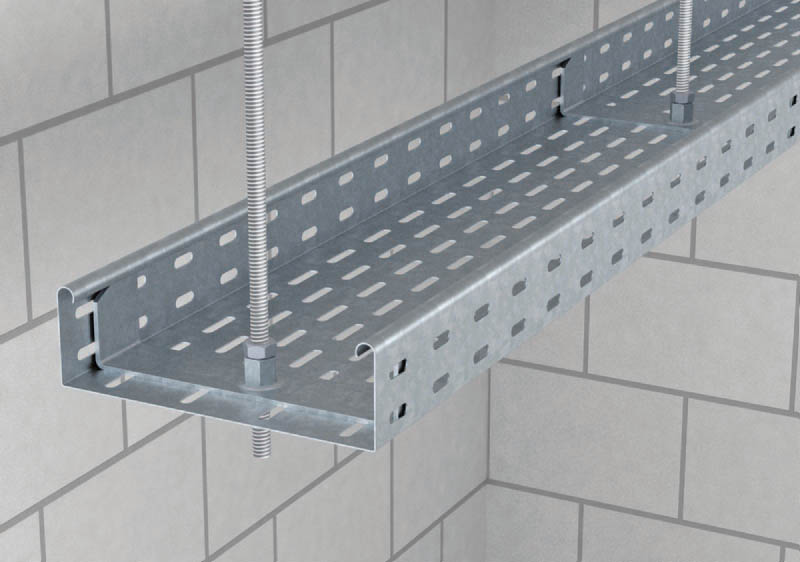
In many installations, the fastener is part of a wider mechanical support system. The product requires supporting equipment such as strut channels, channel nuts, beam clamps, pipe clamps and brackets for integrated installation. For example, a threaded rod hanging from a strut channel may use a channel spring nut and a pipe clamp to support a pipe or cable tray.
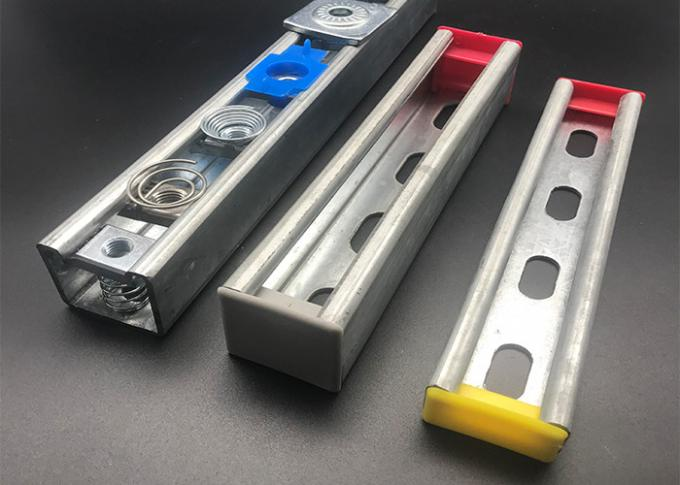
Strut channel systems are available in profiles such as 41×41 mm and 41×21 mm, with thicknesses of 12ga, 14ga and 16ga, and standard lengths of 10ft and 20ft. Materials include carbon steel, stainless steel 304/316 and aluminum. Finishes include pre-galvanized, hot-dip galvanized and powder coated. The accessories—including spring nuts, channel nuts, beam clamps and pipe clamps—make it possible to create adjustable, reusable support points.
Application / Use Cases
The product is used in the construction, MEP/HVAC, solar energy, oil & gas, power generation, and heavy machinery industries. It is suitable for pipeline support, MEP installation, equipment anchoring, and building and decorative support system projects.
Pipeline Support
Pipeline support systems require hangers, clamps, threaded rods and channel assemblies that can hold weight while allowing alignment adjustments. Products such as pipe clamps, U-bolts and strut channel fittings are commonly combined for this purpose. The installation is primarily static, but the fasteners must remain secure under vibration and thermal movement.
Equipment Anchoring
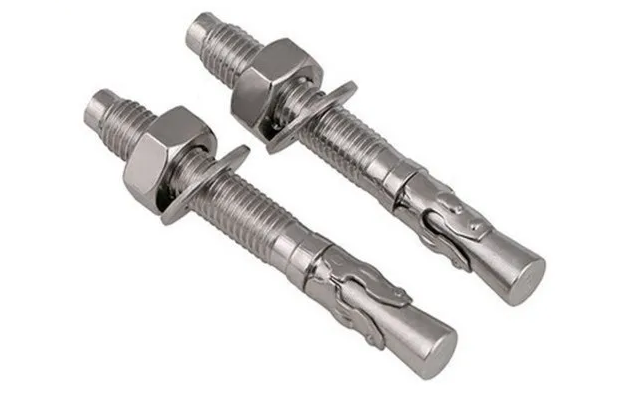
Equipment anchoring connects machinery or structural components to concrete or steel bases. Construction anchors such as wedge anchors and sleeve anchors are typical for this function. Material grade and finish must match the environment, especially in outdoor or corrosive plant conditions.
MEP and Building Support
MEP installations often require adjustable support for pipes, ducts and cable trays. In these projects, the combination of strut channels, channel nuts, spring nuts, beam clamps and threaded rods allows fast positioning and reliable long-term fixation. This application scenario is common in commercial building projects.
Construction Anchors
Construction anchor projects in the construction industry may require anchors for concrete, masonry or steel. The product range includes drywall anchors, self-drive anchors, long lag screw anchors and wedge anchors. For each type, the substrate, load and corrosion environment should be confirmed before selection.
In these scenarios, the product operates primarily in static installations and mechanical fastening mode for long-term fixation or removable connections, depending on the product. Supporting equipment such as strut channels, channel nuts, beam clamps, pipe clamps and brackets is used for integrated installation.
Market Trend Analysis: Project-Based Demand Is Reshaping Fastener Procurement
The industrial fasteners market is growing, and the growth is not limited to a single product family. According to Grand View Research, metal fasteners held the largest market share of 91.0% in 2025, and bolts represented the largest product segment with a 31.3% share. Asia Pacific accounted for 45.1% of the market in 2025, reflecting the region's manufacturing base and export role.
The strut channel market, closely related to MEP support and pipe installation, was valued at USD 4.3 billion in 2024 and is expected to reach USD 7.3 billion by 2033 at a CAGR of 6.1%, according to Dataintelo. This suggests that buyers are moving toward integrated support systems, not just individual fasteners.
There is also strong application-driven demand. The automotive industry accounts for more than 30% of the demand for high-strength industrial fasteners, according to Fortune Business Insights. The same emphasis on performance, traceability and specification is visible in construction, energy and industrial equipment projects.
Comparison with Traditional Solutions
Traditional procurement often treats fasteners as interchangeable commodities and relies on a single coating or material across all applications. Project-scenario-matched selection uses the application to determine material, finish and supporting components.
| Selection Approach | Typical Behavior | Project Outcome |
|---|---|---|
| Traditional bulk buying | One material and finish for many projects; minimal specification review. | Higher risk of corrosion, loosening, or onsite fit problems. |
| Project-scenario matching | Material, grade, finish and supporting equipment selected for the specific installation. | Better compatibility, faster installation, lower maintenance needs. |
One limitation must be stated clearly: project-specific specification requires more upfront work. It requires confirming material grade, finish and dimensional tolerances before ordering. Custom surface treatments or made-to-order parts can extend lead time, and a minimum order quantity may apply. In addition, coatings have trade-offs. Hot-dip galvanized fasteners provide a thick protective zinc layer for outdoor and corrosive environments, while electro-zinc plated fasteners can offer a more precise thread fit for indoor equipment where close tolerances matter.
Future Outlook
As infrastructure and energy projects become more complex, fasteners will increasingly be specified as part of engineered support systems rather than standalone parts. The integration between fasteners and strut channel systems is likely to continue, because it gives installers flexibility and reduces the need for custom fabrication.
Material traceability and finish verification are also becoming more important. Buyers are expected to ask for clearer evidence that a product meets the required standard, coating thickness and strength class. Suppliers that can provide both product-level detail and system-level compatibility may become preferred partners for project-based procurement.
FAQ
How do you choose the right grade of bolts for industrial applications?
Choose the bolt grade based on the required load, tensile strength, yield strength, application conditions, and safety requirements. For common industrial applications, Grade 5 and Grade 8 bolts are widely used, while metric property classes such as 8.8, 10.9, and 12.9 provide different strength levels. The correct grade should match the application, mating components, tightening requirements, and operating environment. A higher-strength bolt is not always the best choice.
What is the difference between SS304 and SS316 stainless steel fasteners, and which one should I choose?
Choose SS304 stainless steel for standard indoor and general outdoor environments where strength and cost performance are needed. Choose SS316 stainless steel for marine, coastal, chemical, or high-chloride environments because it contains added Molybdenum, which provides superior pitting resistance. SS316 is generally recommended for marine hardware, coastal solar installations, food processing equipment, and chemical engineering projects.
How to choose between Hot-Dip Galvanized (HDG) and Cold/Electro-Zinc Plated (EG) fasteners and strut channels for outdoor projects?
Choose Hot-Dip Galvanized (HDG) for outdoor, coastal, and harsh corrosive environments because it provides a heavy protective zinc coating. Choose Electro-Zinc Plated (EG) for indoor, dry environments where cost efficiency and precise thread fit are required. HDG has a thicker zinc coating and offers longer outdoor anti-rust capability, while EG has a thinner coating suited mainly for indoor rust prevention.
How do you choose the right spring nut for strut channel?
The right spring nut should be selected based on the strut channel size, thread size, load requirement, material, and installation environment. First make sure the nut is compatible with the channel profile and slot dimensions. Then select the correct thread size according to the threaded rod or bolt being used. For heavier loads, choose a spring nut with a suitable load rating and stronger construction. Material and surface finish should also match the application.
Why does my spring nut keep slipping inside the strut channel?
A spring nut may slip inside a strut channel because the nut is not correctly matched to the channel profile, the spring is too weak or damaged, the channel or nut dimensions are incorrect, or the nut has not been properly positioned before tightening. Check that the spring nut is designed for the specific strut channel size and profile. Make sure the spring is properly seated against the inside of the channel and that the nut is rotated into the correct locking position. If the spring is damaged, deformed, or has lost its tension, the nut should be replaced.
How do you prevent bolts and nuts from loosening under vibration?
To prevent bolts and nuts from loosening under vibration, use the appropriate locking method and maintain proper bolt preload. Common solutions include prevailing-torque lock nuts, threadlocker, spring washers, locking washers, and other mechanical locking methods. The best solution depends on vibration level, temperature, joint design, installation conditions, and whether the joint needs to be frequently removed. Proper tightening torque is also essential for maintaining joint stability.
Further Reference
For a broader view of the product portfolio and manufacturing capabilities, the company brochure is available for download: CNS Industrial Brochure (PDF). Corporate website: www.cnsindustrial.com.
Tem questões ou precisa de mais detalhes?
Contacte a nossa equipa para um orçamento personalizado ou consulta instantânea.
Solicitar orçamento
Preencha o formulário abaixo e a nossa equipa entrará em contacto com uma proposta personalizada.
Chat direto do WhatsApp
Prefere conversar em tempo real? Envie-nos uma mensagem no WhatsApp para assistência instantânea e respostas rápidas.
- Obter orçamento personalizado
- Partilhar fotos ou documentos
- Discuta as suas necessidades diretamente
Geralmente responde em 5–30 minutos durante o horário de expediente.